220V to 380V VFD Variable Frequency Drive for Motor Speed Control
Official Store Deal
Expert Analysis Overview
Precision Power Conversion: The 220V to 380V VFD
The 220V to 380V VFD Variable Frequency Drive is a critical power conversion unit engineered for industrial applications requiring precise motor speed control from single-phase input. This device addresses a common industrial challenge: operating robust three-phase 380V motors in environments where only single-phase 220V power is readily available. It is a sophisticated solution for optimizing motor performance and energy consumption.
Operational Fundamentals and Power Range
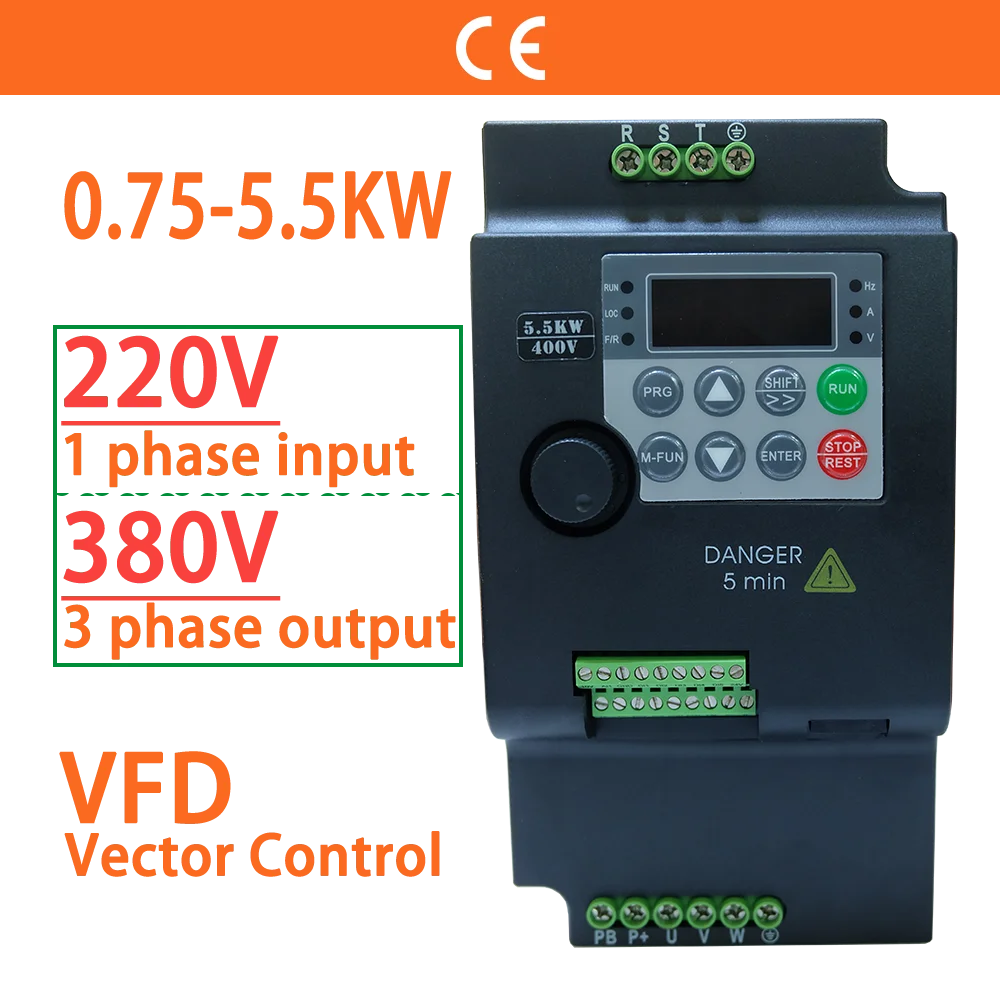
This VFD operates by taking a single-phase 220V input and converting it into a three-phase 380V output. This conversion is essential for driving standard industrial three-phase motors, which are inherently more efficient and durable than their single-phase counterparts. The unit supports a power range from 0.75KW up to 5.5KW, accommodating a wide array of motor sizes commonly found in manufacturing, HVAC, and pumping systems. This flexibility is a significant advantage.
The ability to convert single-phase power to three-phase is not merely about voltage transformation; it is about creating the necessary phase shift to energize a three-phase motor correctly. Without this, a three-phase motor cannot operate. The VFD achieves this through advanced internal circuitry, rectifying the AC input to DC and then inverting it back to AC with the desired frequency and voltage characteristics. This process ensures a stable and reliable power supply to the motor.
Compared to simpler phase converters or static converters, a VFD offers dynamic control. Static converters merely create a third phase, often with unbalanced voltages, which can stress the motor. Rotary phase converters are more effective but are larger, noisier, and less efficient. This VFD provides a compact, efficient, and highly controllable alternative, making it a superior choice for modern industrial setups.
Advanced Control: Vector Control Technology
A standout feature of this VFD is its Vector Control capability. Unlike basic scalar (V/f) control, which only regulates voltage and frequency proportionally, vector control independently manages the motor's magnetic flux and torque-producing current components. This results in superior performance, especially at low speeds.
For applications demanding high starting torque or precise speed regulation across the entire operating range, vector control is indispensable. It allows the motor to maintain consistent torque even at very low RPMs, preventing stalling and ensuring smooth operation. This is crucial for machinery like conveyors, mixers, and machine tools where consistent force is required regardless of speed.
Consider a scenario where a conveyor belt needs to start under a heavy load. A scalar-controlled VFD might struggle, potentially causing jerky movements or even failing to start smoothly. With vector control, the VFD can deliver the necessary torque precisely, ensuring a smooth, controlled start and operation. This capability extends motor life by reducing mechanical stress.
Integrated Braking Unit and Safety Considerations
The VFD includes a built-in brake unit, a critical component for applications requiring rapid deceleration or holding a load. This unit allows for the dissipation of regenerative energy generated by the motor during braking. Without it, this energy could overvoltage the VFD, leading to faults or damage.
For lighter braking requirements, the built-in unit may suffice. However, for applications involving high inertia loads or frequent, rapid stops, the VFD can be connected to an optional external braking resistor. This resistor provides additional capacity for energy dissipation, preventing overheating of the VFD's internal components and ensuring consistent braking performance. Proper sizing of this external resistor is paramount for safety and effectiveness.
Electrical safety is non-negotiable. The visible terminal blocks appear robust, designed for secure wire connections. When installing, verifying wire gauge accuracy is essential to prevent overheating and potential electrical fires. The terminals must accommodate the appropriate wire sizes for the VFD's input and output amperage loads. Insulation ratings (e.g., CE compliance, as indicated by the CE mark) are critical for ensuring the device meets European safety standards, which are generally stringent. Always ensure compliance with local electrical codes.
User Interface and Connectivity
The VFD features a clear digital display and an intuitive control panel. The display provides real-time operational data, such as frequency, current, and voltage. The keypad, with its distinct function, up/down, enter, and stop/reset buttons, allows for straightforward parameter setting and operational control. A rotary knob is also present, likely for fine-tuning frequency or speed adjustments, offering tactile feedback for precise control.
Connectivity is facilitated by clearly labeled terminal blocks for input power (L1, L2), output to the motor (U, V, W), and braking resistor connections (P+, PB). Additional control terminals (24V, AI1, GND, DI1-DI5, TA, TB, TC, AO1) are visible, indicating support for external control signals, analog inputs, and relay outputs. This comprehensive set of terminals allows for integration into complex automation systems, enabling remote control, feedback, and interlocking with other machinery. This is a highly versatile unit.
Proper termination of all wiring is crucial. Loose connections can lead to arcing, overheating, and system failure. Always use appropriate crimp terminals or ferrules where specified, and ensure all screws are tightened to the manufacturer's recommended torque. This attention to detail prevents electrical hazards and ensures reliable operation. The quality of these terminals directly impacts the system's longevity and safety.
Installation and Environmental Considerations
Installation of a VFD requires careful consideration of its operating environment. These devices generate heat, so adequate ventilation and clearance are necessary to prevent thermal derating or premature failure. Mounting in a clean, dry, and vibration-free location is recommended. The enclosure appears to be a standard industrial design, likely offering basic protection against dust and splashes, but specific IP ratings should be confirmed from documentation.
Electromagnetic compatibility (EMC) is another vital aspect. VFDs can generate electromagnetic interference (EMI), which can affect nearby sensitive electronic equipment. Proper grounding, shielded cables for motor connections, and line filters may be required to mitigate EMI, especially in industrial settings with multiple electronic devices. Adherence to installation guidelines minimizes operational issues.
This VFD is designed to integrate into existing electrical infrastructure. Its ability to convert single-phase 220V to three-phase 380V means that facilities with limited three-phase power can still utilize efficient 380V motors. This expands the range of machinery that can be deployed without costly electrical infrastructure upgrades. It is a cost-effective solution.
Value Proposition and Long-Term Benefits
Investing in this VFD offers significant long-term value. The precise motor control afforded by vector control reduces mechanical wear and tear on machinery, extending its operational lifespan. Energy efficiency is also greatly improved, as motors can be run at optimal speeds rather than fixed, often oversized, speeds. This translates directly into lower electricity bills and a reduced carbon footprint.
The ability to fine-tune motor speed allows for process optimization, leading to higher product quality and increased production rates. For instance, in a mixing application, varying the speed precisely can achieve better consistency. In pumping, matching pump speed to demand saves energy and reduces cavitation. This adaptability enhances overall system performance.
This VFD represents an upgrade from traditional motor control methods. Unlike simple contactor-based starters that offer only on/off functionality, or even basic VFDs with limited control algorithms, this unit provides a comprehensive solution for demanding industrial motor control. It is a strategic investment that pays dividends through enhanced efficiency, extended equipment life, and greater operational flexibility. Imagine the seamless operation of your machinery, precisely controlled and optimized for every task, all while reducing energy costs and maintenance overhead. This VFD delivers that capability, transforming your single-phase power into a versatile, efficient industrial workhorse.