AC-DC 5V/12V Isolated Buck Converter Module
Official Store Deal
Expert Analysis Overview
The AC-DC Isolated Switch Power Supply Module is a critical component for hobbyists and repair technicians, offering a compact and cost-effective solution for stepping down high AC voltages to stable DC outputs. This module directly addresses the common frustration of sourcing specific, often expensive, power supplies for custom electronics or repairs. Its design focuses on delivering essential voltage conversion in a minimal footprint, making it ideal for embedded systems and space-constrained applications. Imagine a project stalled because a custom power solution is too costly or takes up too much space. This module provides a compact, dual-voltage output at a fraction of the cost, enabling rapid prototyping and repair. It offers a practical alternative to bulky, integrated power supplies, providing a compact, isolated solution that simplifies power integration.
This module functions as a buck converter, specifically an isolated switch-mode power supply (SMPS). It efficiently transforms a higher AC input voltage, typically 220V, into lower, regulated DC outputs of 5V and 12V. The isolation feature is crucial. It separates the input and output circuits, providing a safety barrier against electrical shock and preventing ground loops that can introduce noise into sensitive electronics. This isolation is achieved through the integrated transformer, visible as the yellow or blue block on the PCB. The transformer physically separates the primary (AC input) and secondary (DC output) sides, ensuring that a fault on one side does not directly impact the other. This significantly enhances safety for the user and the connected load.
The switching frequency of these converters is typically in the kilohertz range. This high-frequency operation allows for the use of smaller transformers and capacitors, contributing to the module's compact size. Traditional linear power supplies, in contrast, rely on larger, heavier transformers operating at line frequency, making them less suitable for modern, miniaturized electronics. The efficiency of a buck converter is also considerably higher than linear regulators, as it dissipates less energy as heat during the voltage conversion process. This translates to cooler operation and less wasted power, a key consideration for continuous use applications.
Compared to standard linear regulators, this switch-mode design offers superior efficiency. Linear regulators simply drop excess voltage as heat, making them inefficient for large voltage differences. A buck converter, however, uses a switching element to rapidly turn the input voltage on and off, then filters the resulting pulses to produce a stable DC output. This method of energy transfer is far more efficient, especially when converting from 220V AC to 5V or 12V DC. For applications where power consumption and heat generation are critical, such as embedded IoT devices or portable equipment, the efficiency of this isolated SMPS module presents a distinct advantage.
Offering both 5V at 700mA and 12V at 300mA, this module provides a versatile power solution for a range of low-power applications. The 5V output is standard for microcontrollers, sensors, and many digital logic circuits. Many common microcontrollers operate at 5V. The 12V output is suitable for driving relays, small motors, or specific analog components that require a higher voltage rail. The combined maximum power output is 3.5W. This power rating indicates its suitability for smaller projects, not high-current demands.
The current limits are important to observe. Exceeding 700mA on the 5V rail or 300mA on the 12V rail can lead to voltage drops, overheating, or even permanent damage to the module. Proper load calculation is essential. For instance, if powering an ESP32 microcontroller (which typically draws around 80-100mA) along with a few sensors, the 5V output is more than adequate. If a small 12V fan (drawing 150mA) is also needed, the 12V output can handle it. This dual output capability simplifies power management in projects that require multiple voltage levels, eliminating the need for separate power supplies or additional DC-DC converters.
In contrast to single-output power bricks, this module's dual-voltage capability enhances its utility for mixed-voltage systems. Many embedded projects require both 5V for logic and 12V for actuators. This integrated solution streamlines the power architecture. It reduces component count. The ability to source both common voltages from a single, compact unit saves valuable PCB space and simplifies wiring, which is a significant benefit for compact designs. This makes it an attractive option for prototyping and small-scale production where efficiency and space are paramount.
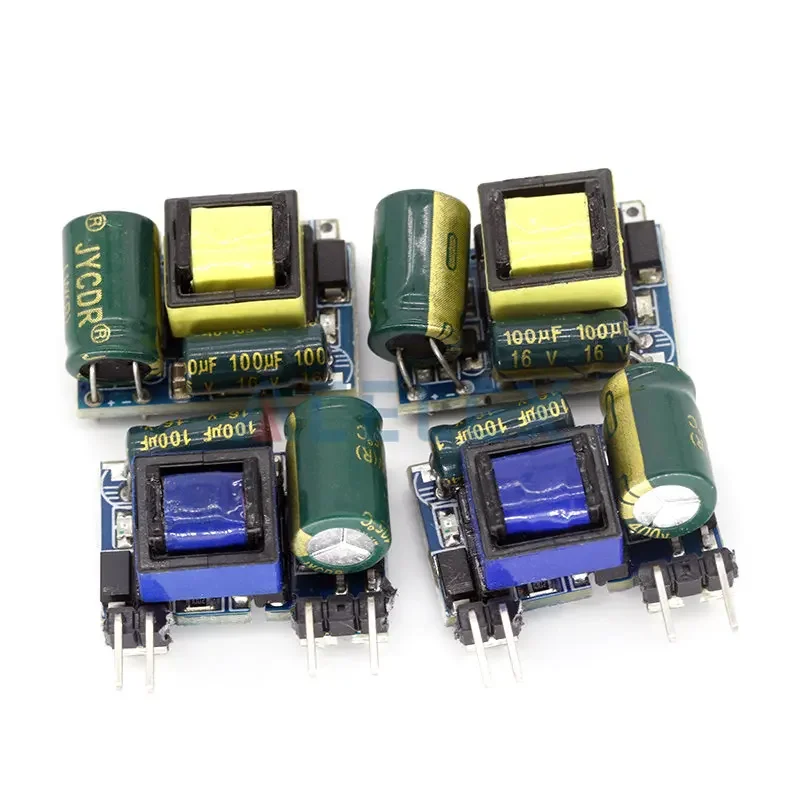
Visual inspection of the modules reveals a compact PCB layout with clearly identifiable components. The electrolytic capacitors (green or gold cylinders) are crucial for filtering and smoothing the DC output. Their visible ratings, such as '100uF 16V', indicate their capacity and voltage tolerance. The transformers, as mentioned, are the prominent yellow or blue blocks. The soldering points appear generally clean and well-defined, suggesting a reasonable level of manufacturing quality for a low-cost module. Component placement is dense, as expected for a compact design.
The PCB material itself appears to be standard FR-4, a common and reliable substrate for electronics. The traces are visible. The connections for input and output are typically through-hole pins, which offer robust mechanical connections once soldered into a larger circuit. The proximity of some components, while necessary for miniaturization, necessitates careful consideration of heat dissipation. Overlapping component footprints are avoided, ensuring adequate clearance for assembly and basic thermal management. The overall construction is typical for an un-enclosed power module.
Compared to hand-assembled prototypes, these modules offer a consistent, machine-assembled quality. The visible components are standard off-the-shelf parts. This ensures a predictable performance baseline. While not industrial-grade, the build quality is sufficient for hobbyist projects, educational purposes, and non-critical embedded applications. The compact size and integrated nature mean fewer external wires and connections, reducing potential points of failure in a final assembly. This streamlined design contributes to overall system reliability, especially in tight enclosures.
Operating at 3.5W, this module generates a modest amount of heat. However, proper thermal management is still important, especially in enclosed spaces or applications with continuous operation. The efficiency of switch-mode power supplies means less heat compared to linear regulators, but some heat is inevitable. The capacitors, in particular, are sensitive to elevated temperatures, which can shorten their lifespan. Ensuring adequate airflow around the module is a simple yet effective way to mitigate heat buildup.
For continuous operation near its maximum load, it is advisable to consider mounting the module in a location with good ventilation. If integrated into a sealed enclosure, passive cooling solutions like heat sinks on the main switching components or even small ventilation holes can significantly extend the module's operational life. The visible components, particularly the electrolytic capacitors, are rated for specific temperatures. Operating within these temperature limits is crucial for long-term reliability. Overheating is a primary cause of component failure.
Unlike modules designed for higher power outputs that often include dedicated heat sinks, this 3.5W unit relies on convection cooling. This design choice keeps costs and size down. For most intermittent or low-duty cycle applications, this is perfectly acceptable. However, for applications requiring continuous, full-load operation, proactive thermal management will prevent premature component degradation. This ensures the module maintains its specified output stability and longevity over time, delivering consistent performance for years.
This module is designed for direct integration into custom PCBs or breadboard setups. The through-hole pins allow for easy soldering. Its small form factor makes it suitable for embedding into compact devices where space is at a premium. Consider its use in smart home devices, small automation projects, or DIY electronics. The isolated output is a significant advantage for sensitive circuits, preventing noise from the AC mains from affecting digital or analog signals. This ensures clean signal transmission.
For electronics repair, this module can serve as a replacement power supply for small appliances, LED drivers, or other devices where the original power supply has failed. Its low cost makes it an attractive option for fixing expensive equipment with affordable components, extending the life of otherwise functional devices. The ability to provide both 5V and 12V outputs means it can replace a wider range of single-output power supplies, offering greater flexibility in repair scenarios. This versatility reduces the need to stock multiple specialized power modules.
Compared to external wall adapters, this integrated module offers a cleaner, more professional solution for internal power. It eliminates external cables and bulky plugs. This results in a more compact and aesthetically pleasing final product. For hobbyists building custom enclosures, integrating this module directly into the circuit board simplifies the overall design and reduces the external footprint. This capability allows for more streamlined and compact product designs, enhancing the user experience.
At its price point, this module offers significant savings compared to replacing entire power bricks or custom-building complex power regulation circuits from discrete components. The value lies in its ready-to-use nature and compact design. For hobbyists and small-scale manufacturers, the time saved in designing and assembling a power supply circuit is substantial. This allows them to focus on the core functionality of their projects, accelerating development cycles. It's an investment in efficiency.
The long-term value of this module is realized through its ability to extend the life of existing equipment. Instead of discarding a device due to a failed internal power supply, this module provides a cost-effective repair solution. This reduces electronic waste and saves money. Its reliability, when properly integrated and thermally managed, ensures consistent performance over time, minimizing the need for future repairs or replacements of the power section. This contributes to a lower total cost of ownership for any project it powers.
Unlike generic, non-isolated power modules, the isolated design of this unit adds a layer of safety and signal integrity often found in more expensive solutions. This critical feature, combined with its dual-voltage output and compact size, positions it as a highly valuable component for a wide array of electronic applications. It represents a smart choice for those seeking reliable, efficient, and safe power conversion without incurring the costs associated with larger, more complex, or pre-packaged power supplies. This module empowers users to bring their electronic projects to life with confidence and precision.
Imagine the satisfaction of powering your next custom gadget or breathing new life into a cherished electronic device, all thanks to a compact, reliable, and precisely engineered power solution. This module provides the stable energy foundation your projects demand, allowing your creations to function flawlessly and reliably for years to come.
Core Voltage Conversion Mechanics
This module functions as a buck converter, specifically an isolated switch-mode power supply (SMPS). It efficiently transforms a higher AC input voltage, typically 220V, into lower, regulated DC outputs of 5V and 12V. The isolation feature is crucial. It separates the input and output circuits, providing a safety barrier against electrical shock and preventing ground loops that can introduce noise into sensitive electronics. This isolation is achieved through the integrated transformer, visible as the yellow or blue block on the PCB. The transformer physically separates the primary (AC input) and secondary (DC output) sides, ensuring that a fault on one side does not directly impact the other. This significantly enhances safety for the user and the connected load.
The switching frequency of these converters is typically in the kilohertz range. This high-frequency operation allows for the use of smaller transformers and capacitors, contributing to the module's compact size. Traditional linear power supplies, in contrast, rely on larger, heavier transformers operating at line frequency, making them less suitable for modern, miniaturized electronics. The efficiency of a buck converter is also considerably higher than linear regulators, as it dissipates less energy as heat during the voltage conversion process. This translates to cooler operation and less wasted power, a key consideration for continuous use applications.
Compared to standard linear regulators, this switch-mode design offers superior efficiency. Linear regulators simply drop excess voltage as heat, making them inefficient for large voltage differences. A buck converter, however, uses a switching element to rapidly turn the input voltage on and off, then filters the resulting pulses to produce a stable DC output. This method of energy transfer is far more efficient, especially when converting from 220V AC to 5V or 12V DC. For applications where power consumption and heat generation are critical, such as embedded IoT devices or portable equipment, the efficiency of this isolated SMPS module presents a distinct advantage.
Output Versatility and Current Delivery
Offering both 5V at 700mA and 12V at 300mA, this module provides a versatile power solution for a range of low-power applications. The 5V output is standard for microcontrollers, sensors, and many digital logic circuits. Many common microcontrollers operate at 5V. The 12V output is suitable for driving relays, small motors, or specific analog components that require a higher voltage rail. The combined maximum power output is 3.5W. This power rating indicates its suitability for smaller projects, not high-current demands.
The current limits are important to observe. Exceeding 700mA on the 5V rail or 300mA on the 12V rail can lead to voltage drops, overheating, or even permanent damage to the module. Proper load calculation is essential. For instance, if powering an ESP32 microcontroller (which typically draws around 80-100mA) along with a few sensors, the 5V output is more than adequate. If a small 12V fan (drawing 150mA) is also needed, the 12V output can handle it. This dual output capability simplifies power management in projects that require multiple voltage levels, eliminating the need for separate power supplies or additional DC-DC converters.
In contrast to single-output power bricks, this module's dual-voltage capability enhances its utility for mixed-voltage systems. Many embedded projects require both 5V for logic and 12V for actuators. This integrated solution streamlines the power architecture. It reduces component count. The ability to source both common voltages from a single, compact unit saves valuable PCB space and simplifies wiring, which is a significant benefit for compact designs. This makes it an attractive option for prototyping and small-scale production where efficiency and space are paramount.
Component Integrity and Build Quality
Visual inspection of the modules reveals a compact PCB layout with clearly identifiable components. The electrolytic capacitors (green or gold cylinders) are crucial for filtering and smoothing the DC output. Their visible ratings, such as '100uF 16V', indicate their capacity and voltage tolerance. The transformers, as mentioned, are the prominent yellow or blue blocks. The soldering points appear generally clean and well-defined, suggesting a reasonable level of manufacturing quality for a low-cost module. Component placement is dense, as expected for a compact design.
The PCB material itself appears to be standard FR-4, a common and reliable substrate for electronics. The traces are visible. The connections for input and output are typically through-hole pins, which offer robust mechanical connections once soldered into a larger circuit. The proximity of some components, while necessary for miniaturization, necessitates careful consideration of heat dissipation. Overlapping component footprints are avoided, ensuring adequate clearance for assembly and basic thermal management. The overall construction is typical for an un-enclosed power module.
Compared to hand-assembled prototypes, these modules offer a consistent, machine-assembled quality. The visible components are standard off-the-shelf parts. This ensures a predictable performance baseline. While not industrial-grade, the build quality is sufficient for hobbyist projects, educational purposes, and non-critical embedded applications. The compact size and integrated nature mean fewer external wires and connections, reducing potential points of failure in a final assembly. This streamlined design contributes to overall system reliability, especially in tight enclosures.
Thermal Considerations and Longevity
Operating at 3.5W, this module generates a modest amount of heat. However, proper thermal management is still important, especially in enclosed spaces or applications with continuous operation. The efficiency of switch-mode power supplies means less heat compared to linear regulators, but some heat is inevitable. The capacitors, in particular, are sensitive to elevated temperatures, which can shorten their lifespan. Ensuring adequate airflow around the module is a simple yet effective way to mitigate heat buildup.
For continuous operation near its maximum load, it is advisable to consider mounting the module in a location with good ventilation. If integrated into a sealed enclosure, passive cooling solutions like heat sinks on the main switching components or even small ventilation holes can significantly extend the module's operational life. The visible components, particularly the electrolytic capacitors, are rated for specific temperatures. Operating within these temperature limits is crucial for long-term reliability. Overheating is a primary cause of component failure.
Unlike modules designed for higher power outputs that often include dedicated heat sinks, this 3.5W unit relies on convection cooling. This design choice keeps costs and size down. For most intermittent or low-duty cycle applications, this is perfectly acceptable. However, for applications requiring continuous, full-load operation, proactive thermal management will prevent premature component degradation. This ensures the module maintains its specified output stability and longevity over time, delivering consistent performance for years.
Integration and Application Scenarios
This module is designed for direct integration into custom PCBs or breadboard setups. The through-hole pins allow for easy soldering. Its small form factor makes it suitable for embedding into compact devices where space is at a premium. Consider its use in smart home devices, small automation projects, or DIY electronics. The isolated output is a significant advantage for sensitive circuits, preventing noise from the AC mains from affecting digital or analog signals. This ensures clean signal transmission.
For electronics repair, this module can serve as a replacement power supply for small appliances, LED drivers, or other devices where the original power supply has failed. Its low cost makes it an attractive option for fixing expensive equipment with affordable components, extending the life of otherwise functional devices. The ability to provide both 5V and 12V outputs means it can replace a wider range of single-output power supplies, offering greater flexibility in repair scenarios. This versatility reduces the need to stock multiple specialized power modules.
Compared to external wall adapters, this integrated module offers a cleaner, more professional solution for internal power. It eliminates external cables and bulky plugs. This results in a more compact and aesthetically pleasing final product. For hobbyists building custom enclosures, integrating this module directly into the circuit board simplifies the overall design and reduces the external footprint. This capability allows for more streamlined and compact product designs, enhancing the user experience.
Cost-Effectiveness and Value Proposition
At its price point, this module offers significant savings compared to replacing entire power bricks or custom-building complex power regulation circuits from discrete components. The value lies in its ready-to-use nature and compact design. For hobbyists and small-scale manufacturers, the time saved in designing and assembling a power supply circuit is substantial. This allows them to focus on the core functionality of their projects, accelerating development cycles. It's an investment in efficiency.
The long-term value of this module is realized through its ability to extend the life of existing equipment. Instead of discarding a device due to a failed internal power supply, this module provides a cost-effective repair solution. This reduces electronic waste and saves money. Its reliability, when properly integrated and thermally managed, ensures consistent performance over time, minimizing the need for future repairs or replacements of the power section. This contributes to a lower total cost of ownership for any project it powers.
Unlike generic, non-isolated power modules, the isolated design of this unit adds a layer of safety and signal integrity often found in more expensive solutions. This critical feature, combined with its dual-voltage output and compact size, positions it as a highly valuable component for a wide array of electronic applications. It represents a smart choice for those seeking reliable, efficient, and safe power conversion without incurring the costs associated with larger, more complex, or pre-packaged power supplies. This module empowers users to bring their electronic projects to life with confidence and precision.
Imagine the satisfaction of powering your next custom gadget or breathing new life into a cherished electronic device, all thanks to a compact, reliable, and precisely engineered power solution. This module provides the stable energy foundation your projects demand, allowing your creations to function flawlessly and reliably for years to come.