AKDZ 2GT Closed-Loop Synchronous Timing Belt (6mm Width)
Official Store Deal
Expert Analysis Overview
The Core of Mechanical Accuracy
The AKDZ 2GT Synchronous Timing Belt is a precision-engineered closed-loop transmission component designed for high-accuracy linear motion in additive manufacturing and small-scale CNC applications. In the realm of mechanical restoration, the belt is the literal heartbeat of the machine. It translates rotational torque into linear movement with uncompromising fidelity. Unlike generic open-ended belts that rely on messy crimping or mechanical clamps, these closed-loop variants offer a continuous, unbroken circuit of power. This eliminates weak points. Reliability increases. Accuracy remains consistent across thousands of cycles.
Restoring an aging 3D printer or a custom CNC rig requires components that respect the original engineering intent while offering modern material advantages. This belt accomplishes that by utilizing a specific curvilinear tooth profile. The GT2 standard was developed specifically for linear motion. Older trapezoidal tooth profiles, such as the MXL or T2.5, suffer from backlash. Backlash occurs when the belt tooth doesn't perfectly seat in the pulley groove. This results in 'play'. It ruins tight tolerances. The GT2 profile solves this. The rounded tooth shape ensures that the entire load is distributed evenly across the tooth surface. Precision is the result.
Fiberglass Reinforcement: The Unseen Spine
Peel back the outer rubber layer and the true strength reveals itself. These belts utilize a fiberglass tensile cord. This is the skeleton. Rubber alone is elastic. Elasticity is the enemy of precision. Under the high-tension requirements of a Voron or a high-speed Ender modification, an unreinforced belt would stretch like a rubber band. This leads to layer shifts. It causes dimensional inaccuracy. The fiberglass core provides near-zero stretch. It maintains its length even under significant load.
Strength matters. Stability is key. This reinforcement allows for higher acceleration settings in firmware. When the stepper motor snaps into a high-speed travel move, the belt doesn't deflect. It transfers that energy instantly to the carriage. The tactile feel of the belt is firm. It resists twisting. This rigidity is essential for maintaining the squareness of the gantry during rapid movements.
The Geometry of the GT2 Tooth Profile
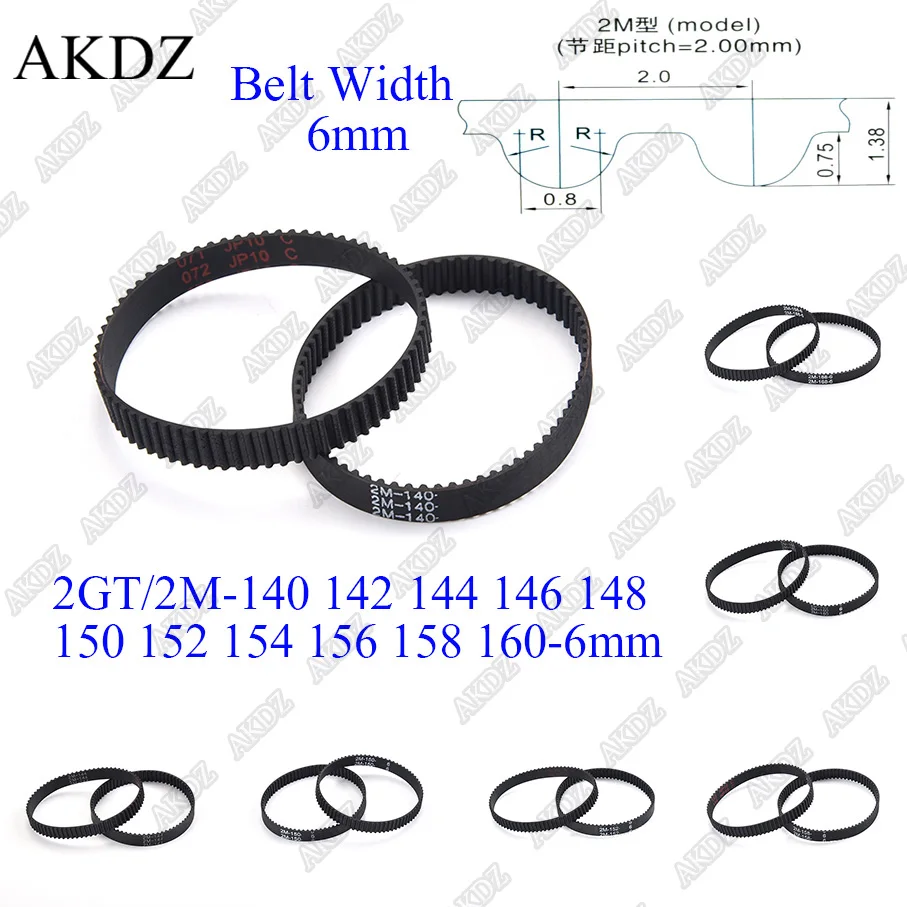
The pitch of these belts is exactly 2.0mm. This measurement is critical. Every tooth is a data point for the motor controller. A deviation of even 0.01mm across the length of the belt would result in a scaled print that doesn't fit its intended housing. AKDZ maintains tight manufacturing tolerances to ensure the pitch is consistent throughout the entire loop. This consistency is what separates a professional restoration from a hobbyist repair.
Tooth height sits at 0.75mm. This allows for a deep engagement with the pulley. High-torque maneuvers won't cause the belt to 'jump' teeth. This 'jumping' or 'skipping' is often the death knell for a long 3D print. It happens when the belt is too loose or the tooth profile is shallow. The 1.38mm total thickness of the belt provides enough mass to dampen vibrations without being so bulky that it increases rotational inertia.
Sizing the Loop: Measuring for Success
Selection is a matter of mathematics. Because these are closed loops, there is no room for error in sizing. The availability of lengths ranging from 140mm to 160mm in 2mm increments caters to the most demanding custom builds. When restoring a Z-axis lead screw synchronization kit, the belt length must be exact. A loop that is too large cannot be tensioned. One that is too small puts excessive radial load on the motor bearings.
Heat is a factor. Friction creates warmth. The neoprene rubber compound used here is rated for environmental stability. It won't become brittle in the warm chamber of a 3D printer. It won't soften under the friction of a high-speed idler. This thermal resistance ensures the belt maintains its grip profile throughout its lifespan.
Eliminating Post-Print Ringing
Ghosting and ringing are the visual scars of a poor motion system. These artifacts appear near sharp corners on a printed part. They are caused by the belt vibrating like a guitar string after a sudden stop. A high-quality belt like the AKDZ 2GT helps mitigate this. The nylon tooth covering reduces the coefficient of friction as the tooth enters and exits the pulley. This makes for a smoother transition.
Vibration is reduced. Noise levels drop. The machine feels 'tighter'. When the belt is properly tensioned—typically to a frequency of 60-90Hz depending on the span—the machine responds with a crispness that is immediately visible in the surface finish of the output.
Friction, Heat, and Longevity
Long-term maintenance is simplified by the material choice. Neoprene is naturally resistant to oils and greases. If a lead screw is over-lubricated and some grease drips onto the belt, it won't disintegrate. Many cheaper belts use inferior rubber that swells and loses its grip when exposed to petroleum-based lubricants. This belt stays stable.
The black matte finish isn't just for aesthetics. It provides UV protection. Sunlight can degrade synthetic rubbers over time. In a workshop environment with fluctuating light and temperature, this protection is vital. The belt remains supple. It doesn't crack. It doesn't shed black dust—a common sign of 'attrition' in low-grade timing belts.
The Professional Installation Path
Installing these belts requires a methodical approach. First, inspect the pulleys. Ensure they are free of debris. A single grain of plastic in a pulley tooth will cause a rhythmic bump in the motion. Align the pulleys. If the belt is forced to run at an angle, the fiberglass core will eventually fray against the pulley flange. Parallelism is mandatory.
Tension it correctly. Over-tightening is a common mistake. It leads to premature bearing failure. Use a tensioning tool or a mobile app to check the resonance. Once set, these belts rarely require adjustment. They 'set' into their shape and hold it.
Imagine the first movement of a restored machine. The motors hum. The carriage glides with a silent, fluid grace. Every corner is sharp. Every circle is perfectly round. This is the reality of using components that prioritize mechanical integrity over cost-cutting. The investment in a high-grade synchronous belt pays dividends in every finished part. Reliability becomes an afterthought because the foundation is solid.