Compact DC 5V LED Driver Power Supply
Official Store Deal
Expert Analysis Overview
The Compact DC 5V LED Driver Power Supply is a focused power conversion unit engineered for stable low-voltage DC delivery in specific applications. From an electrician's perspective, its primary function is to reliably transform a wide range of alternating current (AC) input voltages into a consistent 5-volt direct current (DC) output, crucial for the safe and efficient operation of sensitive electronic components. This unit is not merely a power adapter; it is a dedicated driver designed to maintain output integrity under varying load conditions, a critical factor for the longevity and performance of connected devices. Its compact form factor and specified output ratings position it as a practical solution for integrated systems where space and consistent power are paramount.
This power supply operates with an input voltage range of AC 90-265V at 50/60Hz, delivering a precise DC 5V output. The available models offer output currents of 1A (5W) or 2A (10W), providing specific power capacities. This wide input range is a significant advantage, allowing the unit to function reliably across diverse global electrical grids without requiring external voltage converters. It handles fluctuations in mains power with inherent stability.
Unlike many unregulated wall adapters that exhibit significant voltage ripple and noise, this unit is designed to provide a clean, stable 5V DC output. This stability is vital for sensitive electronics such as CCTV cameras, microcontrollers, and LED lighting, where voltage inconsistencies can lead to flickering, erratic operation, or even permanent damage. Imagine a security camera system powered by an unstable supply; the resulting video feed would be compromised, defeating the purpose of surveillance. This driver prevents such issues.
Compared to older, linear power supplies, this switching mode power supply (SMPS) design offers superior efficiency and a much smaller footprint. Linear power supplies dissipate excess voltage as heat, making them bulky and less energy-efficient. The SMPS, conversely, rapidly switches power on and off, regulating the output voltage with minimal energy loss. This technological advancement allows for the compact dimensions observed, making it an upgrade in both performance and physical integration over conventional transformer-based solutions.
At its heart, the driver employs a sophisticated AC-to-DC conversion mechanism. The incoming alternating current is first rectified into pulsating DC, then smoothed by capacitors. This raw DC is then fed into a high-frequency switching circuit, which rapidly turns a transistor on and off. The duty cycle of this switching action is precisely controlled to regulate the output voltage, ensuring it remains at a constant 5V. This process is highly efficient.
This method of power conversion minimizes energy waste, translating directly into lower operating temperatures and reduced electricity consumption. For installations where multiple drivers are deployed, such as extensive LED lighting arrays, the cumulative energy savings can be substantial over time. Furthermore, the reduced heat generation contributes to the overall reliability of the unit, as excessive heat is a primary cause of component degradation in electronic devices. It runs cooler, lasts longer.
Traditional power conversion methods often involve large, heavy transformers. This driver's lightweight and compact nature is a direct benefit of its switching power supply architecture. This design choice not only simplifies installation but also reduces the material cost and environmental impact associated with manufacturing and shipping. It represents a modern approach to power management, optimized for contemporary electronic demands.
Maintaining a consistent 5V output under varying load conditions is a hallmark of a well-engineered power supply. As the connected load draws more current, a lesser quality driver might experience a voltage drop, known as 'sag'. This driver is engineered to resist such sag, delivering its rated 1A or 2A consistently at 5V. This ensures that devices receive the precise power they need.
For applications like LED strips, consistent voltage translates directly to uniform brightness across the entire length of the strip. In CCTV systems, stable power prevents image distortion or camera resets. The internal feedback loop continuously monitors the output voltage and adjusts the switching frequency to compensate for load changes, ensuring unwavering performance. This active regulation is critical.
Compared to generic, uncertified power supplies, the specified output integrity of this unit provides a significant operational advantage. Many low-cost alternatives often fail to meet their stated specifications under real-world load, leading to premature device failure or suboptimal performance. This driver, with its CE and RoHS markings, indicates a commitment to meeting published performance criteria, offering a more dependable power source for critical applications.
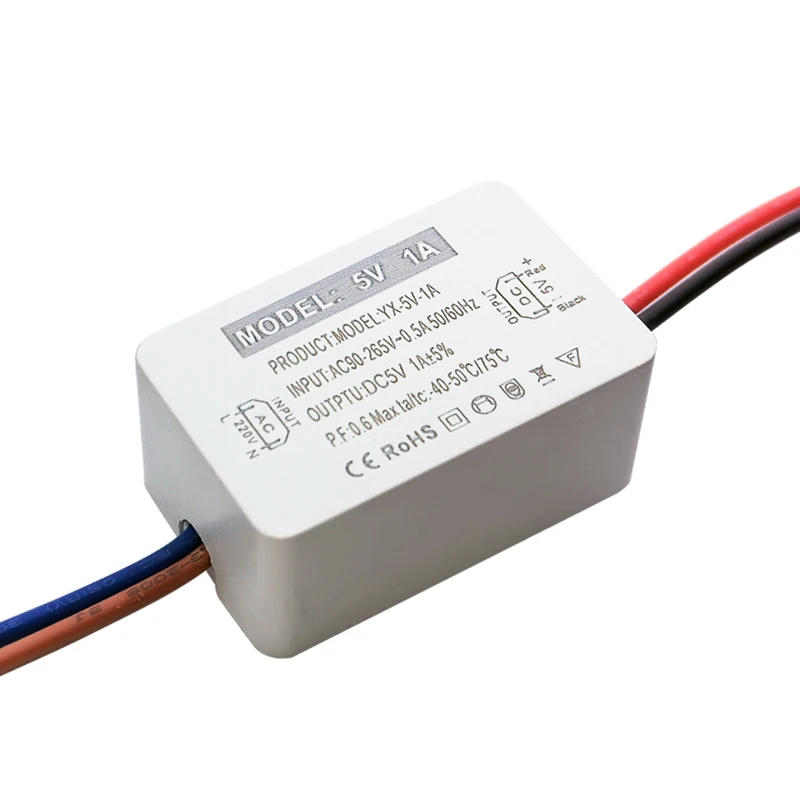
The driver is housed in a white plastic enclosure, presenting a clean and unobtrusive aesthetic. The dimensions are notably compact: 40mm x 25mm x 19mm for the 5W model and 50mm x 28mm x 20mm for the 10W model. These small sizes are a distinct advantage for installations in confined spaces. The enclosure appears to be sealed, offering a degree of protection against environmental ingress.
This compact form factor allows for discreet integration into various setups, such as behind wall panels, inside junction boxes, or within the housing of the powered device itself. The lightweight nature of the unit further simplifies installation, as it places minimal strain on mounting surfaces or cable runs. Its small size is a practical benefit.
Compared to bulkier power bricks or exposed circuit Boards, the enclosed design offers enhanced safety and durability. The plastic housing protects the internal components from physical damage, dust, and accidental contact, which is crucial for preventing electrical hazards. This integrated design streamlines the installation process, reducing the need for additional protective casings in many indoor scenarios.
The choice of a plastic enclosure for this driver is deliberate, balancing cost-effectiveness with functional requirements. The material likely possesses good insulating properties, which is essential for electrical safety, preventing accidental contact with live components. The finish appears smooth, suggesting a degree of mold precision in its manufacturing. This contributes to its overall robustness.
While the plastic enclosure provides basic protection, its sealed nature also implies a degree of ingress protection against dust and minor splashes, though an explicit IP rating is not provided. For installations in environments with higher humidity or dust levels, further external protection, such as an IP-rated junction box, would be a prudent measure. This proactive approach ensures long-term reliability.
In contrast to open-frame power supplies, which require careful handling and custom enclosures, this unit arrives ready for integration. The sealed design also aids in thermal management by creating a contained environment, though adequate ventilation around the unit remains critical to prevent heat buildup, especially when operating at its maximum rated load. Proper airflow is always important.
Input wiring consists of blue and brown insulated wires, while output wiring uses red and black insulated wires. The input wires are typically associated with AC mains, where brown is Live and blue is Neutral in many European and international standards. The output wires follow the conventional DC polarity: red for positive (+) and black for negative (-). Correct connections are vital.
For any electrical installation, accurate identification and connection of these wires are paramount for both safety and proper functionality. While the driver is designed for a wide AC input, ensuring the Live and Neutral connections are consistent with local wiring practices is a fundamental safety measure. Secure terminal connections prevent arcing and ensure efficient power transfer. Loose connections are a fire hazard.
Unlike standardized mains plugs, these bare wire connections offer flexibility for custom installations but demand a higher level of installer competence. The wire gauge appears appropriate for the specified current ratings (1A/2A), preventing excessive voltage drop or overheating under load. Always verify the wire gauge is sufficient for the intended current draw and length of the run, adhering to local electrical codes. This attention to detail prevents future issues.
This driver's AC 90-265V input range makes it exceptionally versatile. It can be powered by standard 110V AC outlets common in North America or 220-240V AC systems prevalent in Europe and other regions. This universal input capability simplifies inventory management for distributors and provides flexibility for end-users. It adapts to various power sources.
This broad compatibility means the driver is resilient to minor grid voltage fluctuations, which can be common in certain areas or during peak demand. The internal circuitry is designed to regulate the output effectively, even when the input voltage varies within its specified range. This robustness ensures continuous operation of connected devices, minimizing downtime and maintenance calls. Stability is a key feature.
Compared to power supplies designed for a single voltage standard (e.g., 120V only), this unit offers superior adaptability. This eliminates the need for region-specific models, reducing complexity and potential for error during procurement and installation. It is a truly global solution for low-voltage DC power, simplifying deployment across different geographical locations.
The ability to accept a wide range of AC input voltages is not merely a convenience; it is a critical engineering feature. This is achieved through a sophisticated input stage that can rectify and filter the incoming AC power effectively, regardless of its nominal voltage. This design choice makes the driver suitable for a multitude of environments, from stable urban grids to more variable industrial settings. It handles diverse power inputs.
Consider an international project where equipment might be deployed in different countries with varying electrical standards. A power supply with a narrow input range would necessitate different models or external transformers, adding cost and complexity. This driver streamlines such deployments, offering a single solution that can be integrated globally. This simplifies logistics considerably.
Furthermore, the driver's tolerance for input voltage variations provides an additional layer of protection for the connected load. In situations where the mains voltage might temporarily dip or surge, the driver's internal regulation ensures that the output 5V DC remains constant, shielding sensitive electronics from potential damage. This protective capability is invaluable for maintaining system integrity.
With 5W (1A) and 10W (2A) output options, this driver is perfectly suited for low-power 5V DC applications. Common uses include powering individual CCTV cameras, short runs of 5V LED strip lighting, small embedded systems, Raspberry Pi projects, or other custom electronics that require a stable 5V source. Its power output is precise.
When selecting the appropriate driver, it is crucial to match the driver's wattage or current capacity to the total power consumption of the connected devices. For instance, a 10W driver can power devices drawing up to 2A at 5V. Exceeding this limit will lead to overheating, reduced lifespan, and potential failure of the driver, or unstable operation of the load. Always calculate the total load.
Unlike general-purpose USB chargers, which may not offer the same level of voltage stability or continuous current delivery, this dedicated LED driver is optimized for sustained operation with specific loads. Its design prioritizes consistent power output, which is essential for applications where performance and reliability are non-negotiable. This makes it a superior choice for permanent installations over makeshift power solutions.
The presence of CE and RoHS certifications on the product label is a strong indicator of its adherence to European safety and environmental standards. CE marking signifies that the product meets essential health and safety requirements, while RoHS (Restriction of Hazardous Substances) ensures that it does not contain certain dangerous materials. These markings provide crucial assurance.
For an electrician, these certifications are not just labels; they represent a commitment to quality control and rigorous testing. Products bearing these marks are less likely to pose risks such as electrical shock, fire, or environmental contamination. Choosing certified components is a fundamental aspect of responsible electrical installation, safeguarding both the equipment and the end-user. Safety is not optional.
Compared to uncertified, generic power supplies, which often cut corners on component quality and safety features, this certified driver offers a significantly reduced risk profile. The investment in a certified product translates into peace of mind, knowing that the unit has undergone scrutiny to meet established benchmarks for electrical safety and environmental responsibility. This is a critical distinction in the market.
Beyond certifications, the design of this driver inherently incorporates features to mitigate common electrical hazards. While not explicitly detailed, switching power supplies typically include protections against overcurrent, short circuits, and sometimes overvoltage. These internal safeguards prevent damage to the driver itself and, more importantly, to the connected load and the surrounding environment. Protection is built-in.
In the event of a short circuit in the connected device or wiring, the driver's overcurrent protection would trip, temporarily shutting down or limiting the output current to prevent overheating and potential fire. This automatic response is a critical safety feature, especially in unattended installations like CCTV systems. It acts as a silent guardian, preventing catastrophic failures.
Without such protective mechanisms, a fault in the load could lead to the driver overheating, melting, or even igniting, posing a severe fire risk. The robust design implied by its certifications suggests that these protective features are implemented effectively, offering a layer of defense against unforeseen electrical anomalies. This proactive safety engineering is invaluable.
The specified maximum case temperature (Max Tc: 75°C) provides a guideline for thermal management. Operating the driver within its thermal limits is crucial for maximizing its lifespan. Excessive heat accelerates the degradation of internal components, particularly electrolytic capacitors, which are often the first to fail in power supplies. Proper ventilation extends life.
For optimal longevity, the driver should be installed in a location with adequate airflow, away from direct heat sources. Avoiding enclosed spaces without ventilation will prevent heat buildup and ensure the unit operates efficiently for years. This attention to installation environment directly impacts the return on investment, as a well-maintained driver will not require frequent replacement. It is a durable component.
Compared to drivers that lack thermal specifications or are designed for minimal lifespan, this unit's explicit temperature rating allows for informed installation decisions. Understanding and respecting these operational parameters ensures that the driver performs reliably over its intended service life, providing consistent power without unexpected failures. This contributes to the overall reliability of the system it powers.
This compact DC 5V LED driver power supply represents a reliable and efficient solution for specific low-voltage applications. Its wide input voltage range, stable output, and safety certifications make it a dependable choice for professionals and enthusiasts alike. Imagine the peace of mind knowing your critical 5V devices, from security cameras to custom LED installations, are powered by a consistent, protected, and certified source. Picture your projects running flawlessly, free from the flickering, instability, and premature failures associated with lesser power solutions. This driver ensures your low-voltage systems operate with the stability and safety they demand, allowing you to focus on the functionality of your devices rather than worrying about their power source. It delivers consistent performance, every time.
Precision Power Delivery
This power supply operates with an input voltage range of AC 90-265V at 50/60Hz, delivering a precise DC 5V output. The available models offer output currents of 1A (5W) or 2A (10W), providing specific power capacities. This wide input range is a significant advantage, allowing the unit to function reliably across diverse global electrical grids without requiring external voltage converters. It handles fluctuations in mains power with inherent stability.
Unlike many unregulated wall adapters that exhibit significant voltage ripple and noise, this unit is designed to provide a clean, stable 5V DC output. This stability is vital for sensitive electronics such as CCTV cameras, microcontrollers, and LED lighting, where voltage inconsistencies can lead to flickering, erratic operation, or even permanent damage. Imagine a security camera system powered by an unstable supply; the resulting video feed would be compromised, defeating the purpose of surveillance. This driver prevents such issues.
Compared to older, linear power supplies, this switching mode power supply (SMPS) design offers superior efficiency and a much smaller footprint. Linear power supplies dissipate excess voltage as heat, making them bulky and less energy-efficient. The SMPS, conversely, rapidly switches power on and off, regulating the output voltage with minimal energy loss. This technological advancement allows for the compact dimensions observed, making it an upgrade in both performance and physical integration over conventional transformer-based solutions.
The Core Conversion Mechanism
At its heart, the driver employs a sophisticated AC-to-DC conversion mechanism. The incoming alternating current is first rectified into pulsating DC, then smoothed by capacitors. This raw DC is then fed into a high-frequency switching circuit, which rapidly turns a transistor on and off. The duty cycle of this switching action is precisely controlled to regulate the output voltage, ensuring it remains at a constant 5V. This process is highly efficient.
This method of power conversion minimizes energy waste, translating directly into lower operating temperatures and reduced electricity consumption. For installations where multiple drivers are deployed, such as extensive LED lighting arrays, the cumulative energy savings can be substantial over time. Furthermore, the reduced heat generation contributes to the overall reliability of the unit, as excessive heat is a primary cause of component degradation in electronic devices. It runs cooler, lasts longer.
Traditional power conversion methods often involve large, heavy transformers. This driver's lightweight and compact nature is a direct benefit of its switching power supply architecture. This design choice not only simplifies installation but also reduces the material cost and environmental impact associated with manufacturing and shipping. It represents a modern approach to power management, optimized for contemporary electronic demands.
Sustained Output Integrity
Maintaining a consistent 5V output under varying load conditions is a hallmark of a well-engineered power supply. As the connected load draws more current, a lesser quality driver might experience a voltage drop, known as 'sag'. This driver is engineered to resist such sag, delivering its rated 1A or 2A consistently at 5V. This ensures that devices receive the precise power they need.
For applications like LED strips, consistent voltage translates directly to uniform brightness across the entire length of the strip. In CCTV systems, stable power prevents image distortion or camera resets. The internal feedback loop continuously monitors the output voltage and adjusts the switching frequency to compensate for load changes, ensuring unwavering performance. This active regulation is critical.
Compared to generic, uncertified power supplies, the specified output integrity of this unit provides a significant operational advantage. Many low-cost alternatives often fail to meet their stated specifications under real-world load, leading to premature device failure or suboptimal performance. This driver, with its CE and RoHS markings, indicates a commitment to meeting published performance criteria, offering a more dependable power source for critical applications.
Structural Integrity and Installation Considerations
The driver is housed in a white plastic enclosure, presenting a clean and unobtrusive aesthetic. The dimensions are notably compact: 40mm x 25mm x 19mm for the 5W model and 50mm x 28mm x 20mm for the 10W model. These small sizes are a distinct advantage for installations in confined spaces. The enclosure appears to be sealed, offering a degree of protection against environmental ingress.
This compact form factor allows for discreet integration into various setups, such as behind wall panels, inside junction boxes, or within the housing of the powered device itself. The lightweight nature of the unit further simplifies installation, as it places minimal strain on mounting surfaces or cable runs. Its small size is a practical benefit.
Compared to bulkier power bricks or exposed circuit Boards, the enclosed design offers enhanced safety and durability. The plastic housing protects the internal components from physical damage, dust, and accidental contact, which is crucial for preventing electrical hazards. This integrated design streamlines the installation process, reducing the need for additional protective casings in many indoor scenarios.
Enclosure and Material Science
The choice of a plastic enclosure for this driver is deliberate, balancing cost-effectiveness with functional requirements. The material likely possesses good insulating properties, which is essential for electrical safety, preventing accidental contact with live components. The finish appears smooth, suggesting a degree of mold precision in its manufacturing. This contributes to its overall robustness.
While the plastic enclosure provides basic protection, its sealed nature also implies a degree of ingress protection against dust and minor splashes, though an explicit IP rating is not provided. For installations in environments with higher humidity or dust levels, further external protection, such as an IP-rated junction box, would be a prudent measure. This proactive approach ensures long-term reliability.
In contrast to open-frame power supplies, which require careful handling and custom enclosures, this unit arrives ready for integration. The sealed design also aids in thermal management by creating a contained environment, though adequate ventilation around the unit remains critical to prevent heat buildup, especially when operating at its maximum rated load. Proper airflow is always important.
Wiring Standards and Connection Protocols
Input wiring consists of blue and brown insulated wires, while output wiring uses red and black insulated wires. The input wires are typically associated with AC mains, where brown is Live and blue is Neutral in many European and international standards. The output wires follow the conventional DC polarity: red for positive (+) and black for negative (-). Correct connections are vital.
For any electrical installation, accurate identification and connection of these wires are paramount for both safety and proper functionality. While the driver is designed for a wide AC input, ensuring the Live and Neutral connections are consistent with local wiring practices is a fundamental safety measure. Secure terminal connections prevent arcing and ensure efficient power transfer. Loose connections are a fire hazard.
Unlike standardized mains plugs, these bare wire connections offer flexibility for custom installations but demand a higher level of installer competence. The wire gauge appears appropriate for the specified current ratings (1A/2A), preventing excessive voltage drop or overheating under load. Always verify the wire gauge is sufficient for the intended current draw and length of the run, adhering to local electrical codes. This attention to detail prevents future issues.
Operational Versatility and Application Suitability
This driver's AC 90-265V input range makes it exceptionally versatile. It can be powered by standard 110V AC outlets common in North America or 220-240V AC systems prevalent in Europe and other regions. This universal input capability simplifies inventory management for distributors and provides flexibility for end-users. It adapts to various power sources.
This broad compatibility means the driver is resilient to minor grid voltage fluctuations, which can be common in certain areas or during peak demand. The internal circuitry is designed to regulate the output effectively, even when the input voltage varies within its specified range. This robustness ensures continuous operation of connected devices, minimizing downtime and maintenance calls. Stability is a key feature.
Compared to power supplies designed for a single voltage standard (e.g., 120V only), this unit offers superior adaptability. This eliminates the need for region-specific models, reducing complexity and potential for error during procurement and installation. It is a truly global solution for low-voltage DC power, simplifying deployment across different geographical locations.
Adapting to Diverse Input Grids
The ability to accept a wide range of AC input voltages is not merely a convenience; it is a critical engineering feature. This is achieved through a sophisticated input stage that can rectify and filter the incoming AC power effectively, regardless of its nominal voltage. This design choice makes the driver suitable for a multitude of environments, from stable urban grids to more variable industrial settings. It handles diverse power inputs.
Consider an international project where equipment might be deployed in different countries with varying electrical standards. A power supply with a narrow input range would necessitate different models or external transformers, adding cost and complexity. This driver streamlines such deployments, offering a single solution that can be integrated globally. This simplifies logistics considerably.
Furthermore, the driver's tolerance for input voltage variations provides an additional layer of protection for the connected load. In situations where the mains voltage might temporarily dip or surge, the driver's internal regulation ensures that the output 5V DC remains constant, shielding sensitive electronics from potential damage. This protective capability is invaluable for maintaining system integrity.
Ideal Deployment Scenarios
With 5W (1A) and 10W (2A) output options, this driver is perfectly suited for low-power 5V DC applications. Common uses include powering individual CCTV cameras, short runs of 5V LED strip lighting, small embedded systems, Raspberry Pi projects, or other custom electronics that require a stable 5V source. Its power output is precise.
When selecting the appropriate driver, it is crucial to match the driver's wattage or current capacity to the total power consumption of the connected devices. For instance, a 10W driver can power devices drawing up to 2A at 5V. Exceeding this limit will lead to overheating, reduced lifespan, and potential failure of the driver, or unstable operation of the load. Always calculate the total load.
Unlike general-purpose USB chargers, which may not offer the same level of voltage stability or continuous current delivery, this dedicated LED driver is optimized for sustained operation with specific loads. Its design prioritizes consistent power output, which is essential for applications where performance and reliability are non-negotiable. This makes it a superior choice for permanent installations over makeshift power solutions.
Safety Compliance and Longevity
The presence of CE and RoHS certifications on the product label is a strong indicator of its adherence to European safety and environmental standards. CE marking signifies that the product meets essential health and safety requirements, while RoHS (Restriction of Hazardous Substances) ensures that it does not contain certain dangerous materials. These markings provide crucial assurance.
For an electrician, these certifications are not just labels; they represent a commitment to quality control and rigorous testing. Products bearing these marks are less likely to pose risks such as electrical shock, fire, or environmental contamination. Choosing certified components is a fundamental aspect of responsible electrical installation, safeguarding both the equipment and the end-user. Safety is not optional.
Compared to uncertified, generic power supplies, which often cut corners on component quality and safety features, this certified driver offers a significantly reduced risk profile. The investment in a certified product translates into peace of mind, knowing that the unit has undergone scrutiny to meet established benchmarks for electrical safety and environmental responsibility. This is a critical distinction in the market.
Mitigating Electrical Hazards
Beyond certifications, the design of this driver inherently incorporates features to mitigate common electrical hazards. While not explicitly detailed, switching power supplies typically include protections against overcurrent, short circuits, and sometimes overvoltage. These internal safeguards prevent damage to the driver itself and, more importantly, to the connected load and the surrounding environment. Protection is built-in.
In the event of a short circuit in the connected device or wiring, the driver's overcurrent protection would trip, temporarily shutting down or limiting the output current to prevent overheating and potential fire. This automatic response is a critical safety feature, especially in unattended installations like CCTV systems. It acts as a silent guardian, preventing catastrophic failures.
Without such protective mechanisms, a fault in the load could lead to the driver overheating, melting, or even igniting, posing a severe fire risk. The robust design implied by its certifications suggests that these protective features are implemented effectively, offering a layer of defense against unforeseen electrical anomalies. This proactive safety engineering is invaluable.
The Long-Term Operational Horizon
The specified maximum case temperature (Max Tc: 75°C) provides a guideline for thermal management. Operating the driver within its thermal limits is crucial for maximizing its lifespan. Excessive heat accelerates the degradation of internal components, particularly electrolytic capacitors, which are often the first to fail in power supplies. Proper ventilation extends life.
For optimal longevity, the driver should be installed in a location with adequate airflow, away from direct heat sources. Avoiding enclosed spaces without ventilation will prevent heat buildup and ensure the unit operates efficiently for years. This attention to installation environment directly impacts the return on investment, as a well-maintained driver will not require frequent replacement. It is a durable component.
Compared to drivers that lack thermal specifications or are designed for minimal lifespan, this unit's explicit temperature rating allows for informed installation decisions. Understanding and respecting these operational parameters ensures that the driver performs reliably over its intended service life, providing consistent power without unexpected failures. This contributes to the overall reliability of the system it powers.
This compact DC 5V LED driver power supply represents a reliable and efficient solution for specific low-voltage applications. Its wide input voltage range, stable output, and safety certifications make it a dependable choice for professionals and enthusiasts alike. Imagine the peace of mind knowing your critical 5V devices, from security cameras to custom LED installations, are powered by a consistent, protected, and certified source. Picture your projects running flawlessly, free from the flickering, instability, and premature failures associated with lesser power solutions. This driver ensures your low-voltage systems operate with the stability and safety they demand, allowing you to focus on the functionality of your devices rather than worrying about their power source. It delivers consistent performance, every time.