Compact Lever-Action Wire Connectors
Official Store Deal
Expert Analysis Overview
Precision Electrical Interconnection
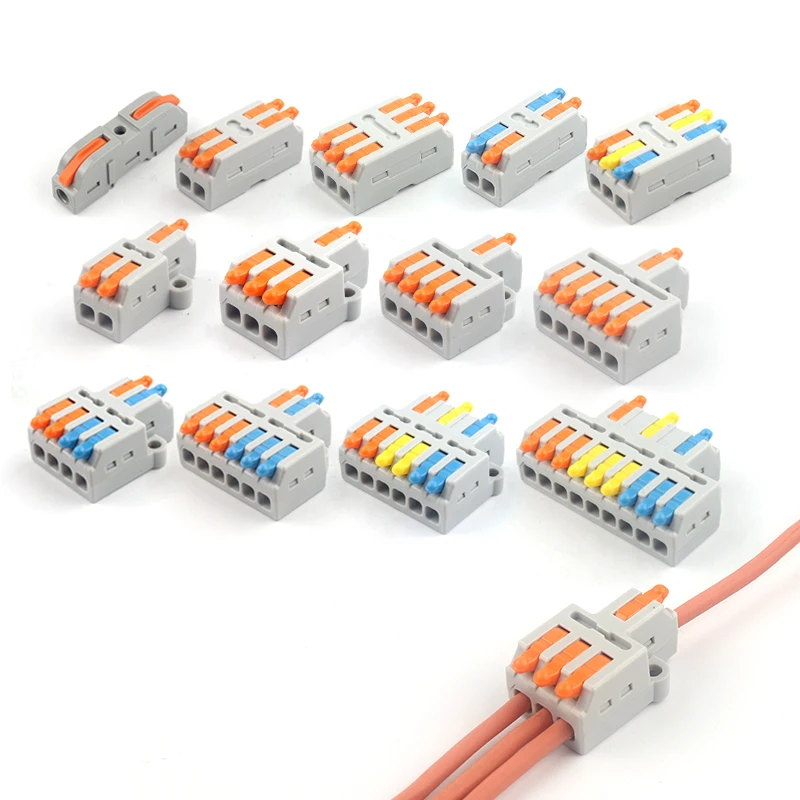
The Compact Lever-Action Wire Connector is a critical electrical component engineered for secure and efficient wire termination in diverse applications. This device offers a significant upgrade over traditional methods, prioritizing both safety and installation speed. Its design directly addresses common frustrations associated with screw terminals and unreliable twist-on connectors, providing a robust and repeatable connection. The visible materials imply a focus on durability and electrical integrity, essential for any professional installation.Core Connection Dynamics
The fundamental operation of these connectors relies on a lever-actuated clamping mechanism. Wires are inserted after stripping, and a simple press of the lever secures the conductor. This push-in terminal block design eliminates the need for specialized tools beyond a wire stripper, streamlining the connection process. It is a quick operation.Traditional screw terminals often require precise torque settings to prevent loose connections or wire damage. This connector's lever mechanism provides a consistent clamping force, reducing the risk of human error. This consistency is vital for long-term electrical stability, preventing intermittent faults that can plague less reliable connections.
Compared to older methods, the lever-action system significantly reduces installation time. Electricians can complete connections faster, increasing overall project efficiency. This efficiency translates directly into cost savings on labor for larger installations.
Electrical Integrity and Safety Compliance
Electrical integrity is paramount for any wiring component. The product specifications clearly state a Rated Voltage of 250V and a Rated Current of 32A. These ratings indicate suitability for standard residential and light commercial circuits. Adherence to these limits is non-negotiable.The use of PC (Polycarbonate) material for the housing is a deliberate choice. Polycarbonate is known for its excellent electrical insulation properties, high impact resistance, and flame retardancy. This material choice directly contributes to preventing electrical fires, a primary concern in any wiring installation. The housing provides robust protection.
Furthermore, the presence of CE and RoHS certifications signifies compliance with European safety, health, and environmental protection standards. These certifications are not merely labels; they represent rigorous testing and adherence to directives that ensure the product meets stringent safety requirements. This provides assurance regarding the product's manufacturing quality and material composition, crucial for installations where safety standards are strictly enforced.
Conductor Compatibility and Preparation
Accurate wire gauge verification is critical for safe electrical connections. These connectors accommodate a Cable Range of 0.08-2.5(4.0)mm², which translates to approximately AWG 28-14 (or 12 for specific applications). This broad range makes them highly versatile for various wiring tasks, from low-voltage signaling to mains power distribution. Proper wire selection is key.The specified Stripping Length of 9.0mm (0.39 inches) is a precise requirement. Adhering to this length ensures the conductor is fully engaged within the terminal without exposing excess bare wire, which could lead to short circuits or accidental contact. An accurate strip prevents hazards.
Unlike generic connectors that might offer vague compatibility, these specifications provide clear guidelines for proper wire preparation. This precision minimizes the chances of improper installation, a common cause of electrical failures. The clear instructions simplify the process for both experienced professionals and competent DIY users, ensuring a secure and compliant connection every time.
Streamlined Installation Protocol
The product wiring instructions are straightforward, emphasizing ease of use. The four steps—stripping, inserting, opening the handle, and pressing the handle—are intuitive. This simplicity is a major advantage.Step 1, Stripping Length, highlights the importance of precise wire preparation. Using a proper wire stripper set to 9.0mm ensures optimal contact. This prevents both insufficient contact and exposed conductors.
Step 2, Strip the wire sheath, is the execution of the previous step. A clean, even strip is essential for reliable electrical contact. The conductor must be free of insulation.
Step 3, Open the handle and insert the wires, demonstrates the lever-action mechanism. The handle provides a clear visual and tactile indication of the terminal's open state, allowing for easy wire insertion. Multiple wires can be inserted simultaneously in multi-port models.
Step 4, Press the handle finish, locks the wire securely in place. The audible click or firm resistance indicates a proper connection. This tactile feedback is invaluable for confirming a secure termination without needing to pull-test every connection, though pull-testing is always recommended for critical circuits.
Design Versatility and Application Scope
The connectors are available in various configurations, including 2-in-2-out (D2-2) and 3-in-9-out (D3-9) models. This modularity allows for flexible wiring solutions, whether for simple splices or more complex distribution points. The compact form factor is a significant benefit.The inclusion of an M3 fixing hole on some models (like the D3-9) provides an option for secure mounting. This feature is particularly useful in control panels, junction boxes, or any application where vibration or movement could compromise unsecured connections. A fixed connection enhances reliability.
Unlike bulky terminal blocks that consume valuable space, these mini compact connectors are designed for tight enclosures. Their small footprint makes them ideal for modern electrical installations where space is often at a premium. This design consideration improves overall system aesthetics and accessibility for future maintenance.
Long-Term Reliability and Value Proposition
These connectors offer a significant long-term value proposition by enhancing reliability and reducing maintenance needs. The secure, consistent connections minimize the risk of loose wires, which are a common cause of electrical faults and potential fire hazards. This reliability saves time and money.The durable PC material and robust lever mechanism are designed for longevity, resisting environmental degradation and mechanical stress. This contrasts sharply with twist-on connectors that can loosen over time due to vibration or thermal cycling. The connectors maintain integrity.
Considering the initial price point, the long-term benefits of enhanced safety, reduced installation time, and improved reliability make these connectors a cost-effective choice. They prevent costly call-backs and ensure the integrity of the electrical system for years to come. Investing in quality connectors is an investment in safety and efficiency.
Imagine completing your wiring projects with confidence, knowing each connection is secure, compliant, and built to last. The ease of use will free up valuable time, allowing focus on other aspects of the installation. These connectors provide peace of mind, ensuring electrical systems operate safely and efficiently for the foreseeable future.