DC Low Voltage Photoelectric Light Sensor Switch
Official Store Deal
Expert Analysis Overview
The Light Sensor Switch (3.7-24V 5A) is a fundamental photoelectric control module engineered for straightforward, low-latency ambient light-activated switching in DC circuits. This device presents itself as a highly specialized, cost-effective solution for automating low-voltage lighting, distinct from more complex smart home integrations. Its design prioritizes direct functionality over networked capabilities, appealing to users who require reliable, localized light management without the overhead of a full smart ecosystem.
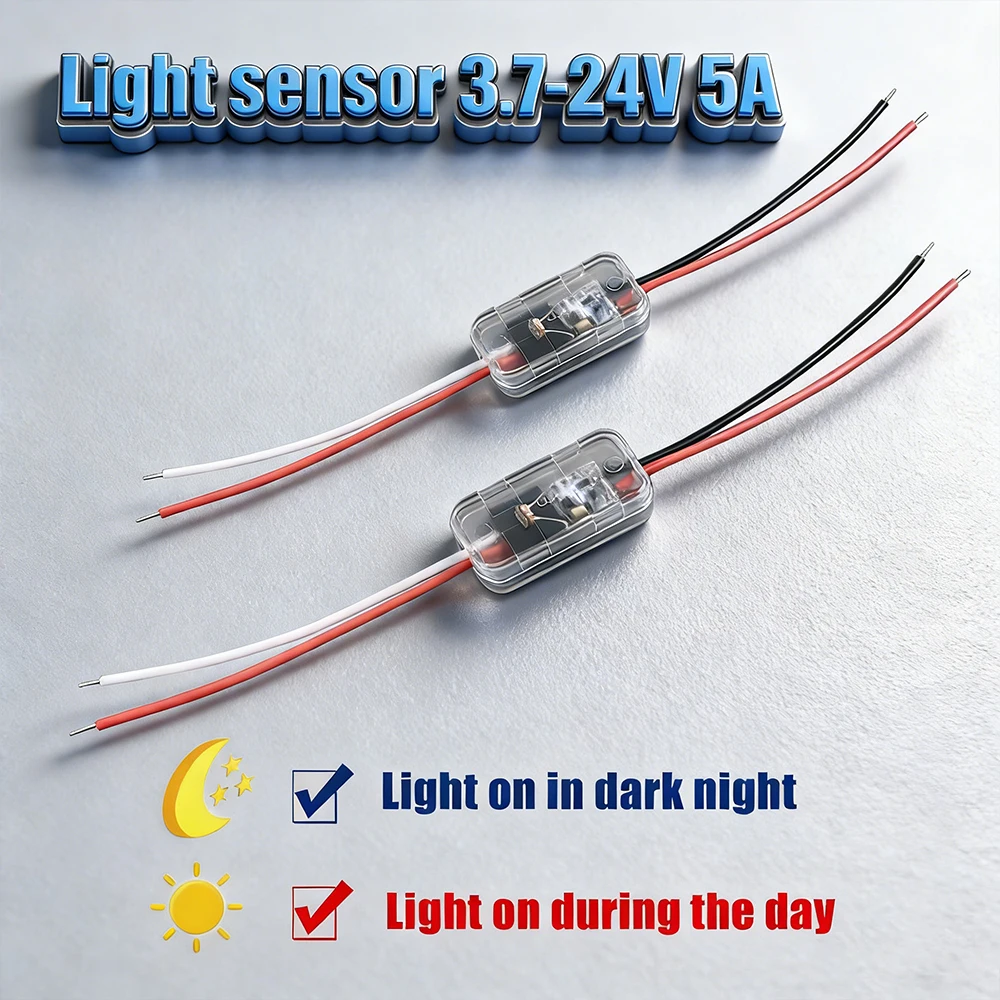
Visually, the product consists of a compact, transparent rectangular module housing the control circuitry and a photoresistor, flanked by pre-wired leads. Two distinct operational models are highlighted: one for "light on in dark night" and another for "light on during the day." This offers immediate utility for diverse automation needs. The transparent casing allows for visual inspection of the internal components, a nod to its simple, purpose-built nature.
This simple design facilitates effortless integration into existing low-voltage DC systems. Users can automate tasks such as turning on cabinet lights at dusk or activating decorative outdoor lighting as ambient light fades. The choice between a night-activated or day-activated model provides flexibility. It is a direct, physical control solution.
Compared to advanced smart home sensors that often rely on Zigbee, Z-Wave, or Wi-Fi protocols, this unit excels in its sheer simplicity. It bypasses network complexity entirely. This sensor is not about feature-richness; it's about reliable, direct action.
Detailed parameters reveal a broad voltage range of 3.7V to 24V DC, coupled with a current capacity of 5A. Its photosensitivity is rated at 10 LUX. The induction mode specifies automatic illumination at night and deactivation during the day, which can be configured for either model. This is a robust power handling capacity.
These specifications translate directly into versatile real-world applications. The 3.7V compatibility makes it ideal for small battery-powered projects, such as portable camping lights or garden accents. Its 12V and 24V support ensures seamless integration with common LED strip lighting, under-cabinet lighting, and various low-voltage fixtures. A 5A current rating means it can handle substantial LED loads, preventing the need for external relays in many scenarios. The 10 LUX photosensitivity ensures the sensor reacts to relatively dim light, suitable for most dusk/dawn applications, but not overly sensitive to minor shadows.
High-end industrial photocells might offer adjustable LUX levels or more rugged, IP67-rated enclosures. This sensor, however, opts for a fixed 10 LUX threshold, a deliberate trade-off for simplified operation and a lower cost. It is a set-and-forget solution. This approach streamlines deployment, removing the need for calibration. This makes it a compelling choice for straightforward automation tasks.
The product's visual presentation confirms it as a simple, wired switch with no visible wireless communication protocols. It operates as a purely electromechanical device. There are no antennas or network indicators.
This device offers immediate, physical control, inherently free from network latency issues. Its operation is entirely local, ensuring reliability even during home network outages. For direct light control, it is exceptionally responsive. This contrasts sharply with cloud-dependent smart devices, which can introduce delays. This unit provides instant feedback.
Integrating such a device into a sophisticated Home Assistant setup requires an understanding of its role as an edge device. While it doesn't directly communicate via Zigbee or Z-Wave, it can effectively trigger smart home routines. This is achieved by wiring the sensor's output to a smart relay, a digital input module (like a Shelly Uni or ESPHome-based board), or even a low-voltage smart switch. This allows the physical state change caused by the light sensor to be translated into a digital signal that Home Assistant can interpret and act upon. This setup maintains the sensor's local control for the light itself, while also offering the flexibility of smart home automation for other devices or notifications. It's an upgrade from a purely manual switch, offering automation without sacrificing local control.
The sensor module is remarkably compact, measuring 43mm in length, 22mm in width, and 11mm in height. It features a clear plastic enclosure and pre-wired leads, each approximately 10cm long. This small footprint is a significant advantage.
Its compact size facilitates discreet installation in tight spaces, such as inside junction boxes, behind cabinet panels, or within fixture housings. The clear casing, while not inherently robust, allows for easy identification of the photoresistor's orientation and basic circuit protection. The short wire leads are practical for close-proximity connections, though extensions may be necessary for longer runs. It fits almost anywhere.
Comparing this to more rugged, weather-sealed outdoor photocells, this unit appears primarily intended for indoor or protected outdoor environments. Its design emphasizes functional simplicity over extreme environmental resilience. For applications under eaves or within enclosed fixtures, it performs admirably. For exposed outdoor use, additional weatherproofing would be a prudent consideration. This is a practical solution.
Wiring is straightforward, requiring connections for V+ (power input positive), V(power input negative), LED+ (load output positive), and LED- (load output negative). The diagram clearly illustrates this configuration. Users simply connect power and load.
Installation is essentially plug-and-play for anyone familiar with basic DC wiring. The primary operational directive is crucial: the photoresistor must not be blocked during normal operation, unless intentionally testing the
Core Functionality and Operational Modes
Visually, the product consists of a compact, transparent rectangular module housing the control circuitry and a photoresistor, flanked by pre-wired leads. Two distinct operational models are highlighted: one for "light on in dark night" and another for "light on during the day." This offers immediate utility for diverse automation needs. The transparent casing allows for visual inspection of the internal components, a nod to its simple, purpose-built nature.
This simple design facilitates effortless integration into existing low-voltage DC systems. Users can automate tasks such as turning on cabinet lights at dusk or activating decorative outdoor lighting as ambient light fades. The choice between a night-activated or day-activated model provides flexibility. It is a direct, physical control solution.
Compared to advanced smart home sensors that often rely on Zigbee, Z-Wave, or Wi-Fi protocols, this unit excels in its sheer simplicity. It bypasses network complexity entirely. This sensor is not about feature-richness; it's about reliable, direct action.
Technical Specifications and Performance Metrics
Detailed parameters reveal a broad voltage range of 3.7V to 24V DC, coupled with a current capacity of 5A. Its photosensitivity is rated at 10 LUX. The induction mode specifies automatic illumination at night and deactivation during the day, which can be configured for either model. This is a robust power handling capacity.
These specifications translate directly into versatile real-world applications. The 3.7V compatibility makes it ideal for small battery-powered projects, such as portable camping lights or garden accents. Its 12V and 24V support ensures seamless integration with common LED strip lighting, under-cabinet lighting, and various low-voltage fixtures. A 5A current rating means it can handle substantial LED loads, preventing the need for external relays in many scenarios. The 10 LUX photosensitivity ensures the sensor reacts to relatively dim light, suitable for most dusk/dawn applications, but not overly sensitive to minor shadows.
High-end industrial photocells might offer adjustable LUX levels or more rugged, IP67-rated enclosures. This sensor, however, opts for a fixed 10 LUX threshold, a deliberate trade-off for simplified operation and a lower cost. It is a set-and-forget solution. This approach streamlines deployment, removing the need for calibration. This makes it a compelling choice for straightforward automation tasks.
Integration into Home Automation Architectures
The product's visual presentation confirms it as a simple, wired switch with no visible wireless communication protocols. It operates as a purely electromechanical device. There are no antennas or network indicators.
This device offers immediate, physical control, inherently free from network latency issues. Its operation is entirely local, ensuring reliability even during home network outages. For direct light control, it is exceptionally responsive. This contrasts sharply with cloud-dependent smart devices, which can introduce delays. This unit provides instant feedback.
Integrating such a device into a sophisticated Home Assistant setup requires an understanding of its role as an edge device. While it doesn't directly communicate via Zigbee or Z-Wave, it can effectively trigger smart home routines. This is achieved by wiring the sensor's output to a smart relay, a digital input module (like a Shelly Uni or ESPHome-based board), or even a low-voltage smart switch. This allows the physical state change caused by the light sensor to be translated into a digital signal that Home Assistant can interpret and act upon. This setup maintains the sensor's local control for the light itself, while also offering the flexibility of smart home automation for other devices or notifications. It's an upgrade from a purely manual switch, offering automation without sacrificing local control.
Design and Physical Durability
The sensor module is remarkably compact, measuring 43mm in length, 22mm in width, and 11mm in height. It features a clear plastic enclosure and pre-wired leads, each approximately 10cm long. This small footprint is a significant advantage.
Its compact size facilitates discreet installation in tight spaces, such as inside junction boxes, behind cabinet panels, or within fixture housings. The clear casing, while not inherently robust, allows for easy identification of the photoresistor's orientation and basic circuit protection. The short wire leads are practical for close-proximity connections, though extensions may be necessary for longer runs. It fits almost anywhere.
Comparing this to more rugged, weather-sealed outdoor photocells, this unit appears primarily intended for indoor or protected outdoor environments. Its design emphasizes functional simplicity over extreme environmental resilience. For applications under eaves or within enclosed fixtures, it performs admirably. For exposed outdoor use, additional weatherproofing would be a prudent consideration. This is a practical solution.
Installation and User Experience
Wiring is straightforward, requiring connections for V+ (power input positive), V
Installation is essentially plug-and-play for anyone familiar with basic DC wiring. The primary operational directive is crucial: the photoresistor must not be blocked during normal operation, unless intentionally testing the