DC Low Voltage PWM Motor Speed Controller
Official Store Deal
Expert Analysis Overview
Precision in Motion Control
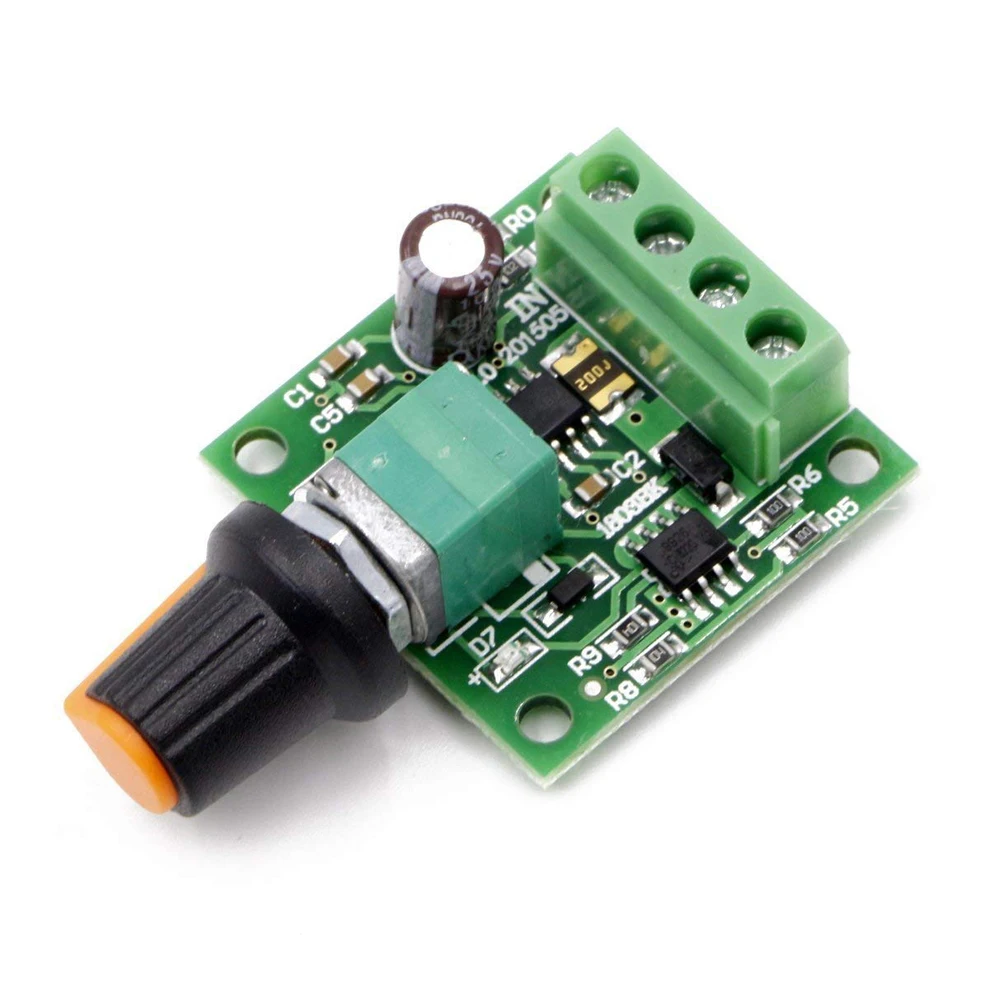
The DC Low Voltage PWM Motor Speed Controller is a compact, highly functional drive module engineered for precise speed regulation of small DC motors in low-power applications. This device offers granular control over motor RPM, critical for delicate operations or specific performance requirements. Its design prioritizes both efficiency and user-friendliness.The module integrates a PWM (Pulse Width Modulation) circuit, visibly featuring a robust potentiometer with an integrated switch. This design allows for a continuous 0-100% speed adjustment. A single electrolytic capacitor and several surface-mount device (SMD) components populate the green PCB, indicating a streamlined and efficient layout. The visible component density suggests a well-engineered layout for its intended function.
This granular control is crucial for applications demanding exact motor speeds, such as miniature robotics, small fans, or model trains. The integrated switch simplifies power management, allowing for a single point of control for both on/off and speed adjustment. Users gain immediate operational control, enhancing project versatility. This is a simple solution.
Unlike basic resistive dimmers that waste energy as heat and offer less stable low-speed performance, this PWM controller efficiently modulates power. It ensures consistent torque even at reduced RPMs, a significant upgrade over simpler, less efficient alternatives. The PWM method is superior for motor control.
The Circuit's Foundation
The printed circuit board (PCB) measures a compact 32mm by 32mm, making it one of the smaller options available for this functionality. It features clearly marked screw terminal blocks for both power input and motor output. The silkscreen labels "Power+" and "Power-" along with "Motor+" and "Motor-" are unambiguous, facilitating straightforward wiring. The board is quite small.Its small footprint allows integration into tight enclosures or existing projects without significant spatial concerns. The screw terminals provide a secure, reliable connection for wiring, essential for maintaining electrical integrity in dynamic environments. This minimizes potential for accidental disconnections, a common failure point in less robust designs.
Many generic modules rely on less secure pin headers or require soldering for permanent connections. The screw terminals here offer a distinct advantage for prototyping or situations requiring frequent wiring changes, providing both flexibility and stability. This enhances user convenience.
Safeguarding the System
A 2A resettable fuse is visibly integrated into the circuit, a critical safety feature. An LED indicator is also present, likely signifying power status or operation. The input voltage range is broad, supporting 1.8V, 3V, 5V, 6V, and 12V DC, accommodating various power sources. Safety is paramount.The resettable fuse offers critical protection against overcurrent conditions, preventing damage to both the module and the connected motor. The LED provides immediate visual feedback on the module's operational state, which is invaluable for troubleshooting and confirming power. This enhances user confidence in the module's reliability.
Cheaper controllers often omit such essential safety features, leaving connected equipment vulnerable to shorts or overloads. The inclusion of a resettable fuse, rather than a single-use fuse, adds convenience and reduces maintenance costs over time. This design choice is a significant advantage.
Component Integrity and Signal Purity
Examination of the PCB reveals a mix of SMD components and through-hole parts, including the potentiometer and the electrolytic capacitor. Solder joints appear consistent and well-formed from the provided images, suggesting a high standard of assembly. The traces are clearly defined, indicating careful board design. Good soldering is visible.High-quality soldering is paramount for long-term reliability in any electronic circuit, especially one subjected to varying loads. Clean signal transmission is maintained through well-designed traces and component placement, which directly impacts the smoothness of motor operation. This construction implies a durable product.
Unlike some mass-produced modules with inconsistent solder quality, the visible construction here suggests attention to manufacturing standards. This directly impacts the module's lifespan and the stability of the PWM signal, crucial for smooth motor operation. The visible quality is reassuring.
The Value Proposition for Hobbyists and Professionals
This module is priced at approximately 2.08 USD, positioning it as an extremely affordable component. Its specifications indicate suitability for low-voltage DC motors up to 2A. The small size and clear labeling are evident, making it accessible for a wide range of users. The price is very low.For those needing to repair or upgrade small electronic devices, this controller offers an extremely cost-effective solution. It can extend the life of equipment that might otherwise be discarded due to a faulty speed control mechanism. The low price point makes it accessible for educational projects or experimentation without significant financial outlay.
Replacing an entire appliance due to a faulty motor controller can be significantly more expensive. This module allows for targeted repair, offering substantial savings and reducing electronic waste. It provides capability at a minimal investment, making it a smart choice for budget-conscious repairs or new builds.
Durability and Connection Reliability
The screw terminals are made of green plastic with metal inserts, designed for robust wire retention. The potentiometer shaft appears to be metal, providing a stable mounting point for the knob and ensuring mechanical integrity during adjustments. The knob itself is plastic with an orange indicator for easy visual reference. Connections are solid.The screw terminals offer a robust mechanical connection for wires, resisting vibration and accidental tugs better than simple push-in connectors or soldered joints in temporary setups. A metal potentiometer shaft ensures durability during repeated adjustments, crucial for applications requiring frequent speed changes. This design choice enhances longevity and operational stability.
Flimsier connectors can lead to intermittent operation or complete failure, especially in applications subject to movement or frequent handling. This module's connection points are designed for sustained use, offering greater peace of mind compared to less substantial alternatives. This is a practical design.
Operational Versatility
The module supports a wide input voltage range from 1.8V to 12V DC. This flexibility is critical for various power sources, from single AA batteries to 12V power supplies commonly found in automotive or hobbyist setups. The 2A current rating is clearly stated, defining its operational limits. Voltage range is broad.This broad voltage compatibility means it can be powered by common battery configurations (e.g., 2xAA, 9V, 12V lead-acid) or low-voltage power supplies. It adapts to many existing setups without requiring additional voltage conversion circuitry. This versatility minimizes the need for additional power conversion components, simplifying project design.
Many motor controllers are limited to a narrow voltage band, forcing users to acquire specific power sources. This module's adaptability makes it a more practical choice for diverse projects, from hobbyist builds to small industrial applications. Its flexibility is a key asset.
Imagine the smooth, precise control over your miniature projects, from robotics to custom cooling fans, operating exactly as intended. Envision the satisfaction of extending the life of a cherished device with a simple, effective repair. This module provides the capability to fine-tune performance, ensuring your creations run with optimal efficiency and reliability.