EARU DZ47 Type C Mini Circuit Breaker
Official Store Deal
Expert Analysis Overview
Guardian of the Grid: Overload & Short-Circuit Defense
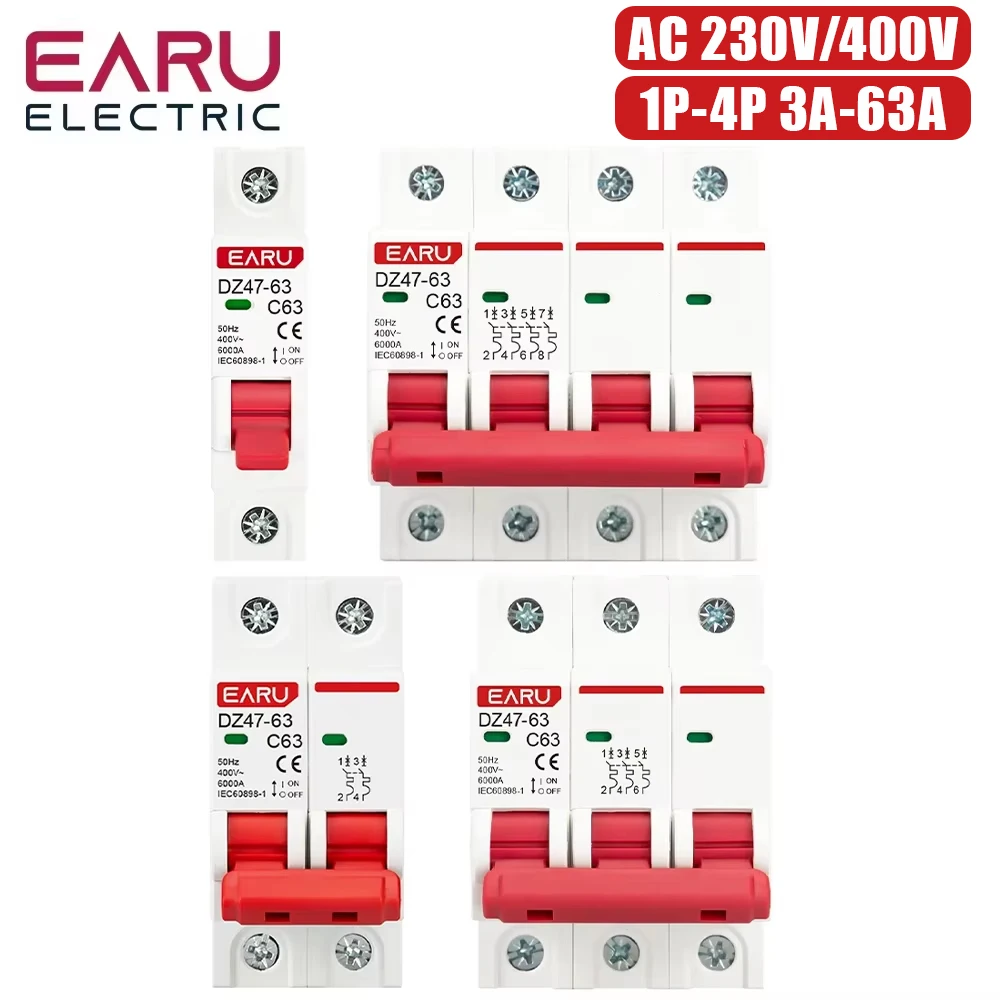
The EARU DZ47 Mini Circuit Breaker is a fundamental protection device designed for robust overload and short-circuit safeguarding in both residential and light industrial electrical systems, particularly valuable for solar energy enthusiasts building resilient off-grid or hybrid setups. This essential component ensures the safety and longevity of electrical installations. The product explicitly states its core function as "Overload/short circuit protection" and is rated for AC 230V/400V applications.This MCB acts as a crucial safeguard, automatically interrupting the circuit when current exceeds safe limits due to overloads or direct shorts. This prevents damage to wiring, appliances, and power sources, mitigating potential fire hazards and equipment failures. Immediate action is taken.
Unlike standard fuses that require replacement after tripping, these miniature circuit breakers offer a resettable solution. This significantly reduces maintenance time and cost, a key advantage in remote solar installations where spare parts might be scarce. Reliability is paramount.
Precision in Protection: Type C Characteristics
The product specifies "Type C" characteristics, a critical detail for understanding its operational behavior. A Type C breaker trips between 5 and 10 times its rated current. This makes it suitable for circuits with moderate inrush currents, common in many household appliances and some solar inverters. It handles initial power surges.For a solar energy system, choosing the correct trip curve is paramount. Type C offers a good balance, preventing nuisance tripping from momentary surges while still providing robust protection against sustained faults, unlike faster B-type or slower D-type breakers. This balance is crucial.
The Heart of Reliability: Mechanical Lifespan
A "Mechanical lifespan: 20000 cycles" is listed in the product parameters, indicating a high degree of durability for the internal switching mechanism. Users can expect reliable operation over many years, even with frequent manual switching or fault-induced trips. Long-term use is assured.In contrast to cheaper, less robust alternatives, a 20,000-cycle lifespan ensures that the breaker remains functional and safe throughout the typical life of an electrical installation. This is critical for systems that might require periodic disconnections for maintenance or expansion. Such longevity is a key value.
Engineering for Integration: Mounting & Dimensions
The images clearly show "Mounting: rail mounted" and provide detailed dimensions: 80mm height, 70mm width (4P), 53mm width (3P), 35mm width (2P), 17mm width (1P), and 75mm depth. This standardized approach simplifies installation.The DIN rail mounting ensures straightforward and standardized installation within electrical distribution boards or custom enclosures. Its compact dimensions allow for efficient use of panel space, making it ideal for various setups. Installation is quick.
This standardized mounting is a significant advantage over older, screw-in fuse blocks, offering modularity and ease of expansion. For a solar enthusiast, this means a clean, organized, and easily maintainable control panel, crucial for troubleshooting and system upgrades. Organization is key.
Compact Form, Mighty Function: Space Efficiency
The various pole configurations (1P, 2P, 3P, 4P) are shown with corresponding widths (17mm for 1P, 70mm for 4P). The narrow profile of each pole allows for high-density installations. This is particularly beneficial in smaller enclosures or when space is at a premium, without compromising on current handling. Efficient space utilization is key.Unlike bulky older circuit protection devices, these miniature breakers minimize the footprint required. This is especially advantageous for compact off-grid solar setups or RV conversions where every cubic inch counts, enabling more components to fit into a confined area. Space is often limited.
Powering the Future: Voltage & Current Versatility
The product is rated for "AC 230V/400V" and available in "3A-63A" current ratings. This broad range of voltage and current options makes the breaker highly adaptable to various single-phase (230V) and three-phase (400V) AC applications. It supports diverse power requirements.For solar installations, this versatility is crucial. Whether protecting an inverter's AC output, a sub-panel in a home, or specific high-draw appliances, the available ratings ensure appropriate protection can be selected, preventing both under-protection and unnecessary oversizing. Proper sizing prevents issues.
AC Compatibility: Bridging Energy Sources
The "Rated Voltage: 230/400V~" clearly indicates AC operation. This breaker is specifically designed for alternating current circuits. It ensures safe integration with grid-tied inverters or the AC output side of off-grid systems. Proper AC protection is vital.While solar panels produce DC power, most household appliances and grid connections operate on AC. This breaker serves as the essential protective interface between the inverter's AC output and the loads, a critical distinction from DC-rated breakers used on the panel side. The distinction matters.
Current Ratings: Tailoring to Your Load
The range of current ratings from 3A to 63A is prominently displayed. A "Circuit breaker selection reference" table provides guidance. This wide selection allows precise matching of the breaker's trip current to the specific circuit's load and wire gauge. Accurate sizing prevents both nuisance trips and inadequate protection. Optimal performance is achieved.In a solar energy system, selecting the correct amperage for each circuit – from lighting (10A) to main power switches (63A) – is fundamental for safety and efficiency. This range ensures that every component, from charge controllers to heavy-duty inverters, receives tailored protection. Safety is paramount.
Operational Clarity & Safety: Visual Indicators
Images show a "Window Indication" (green for open, red for closed) and an "Operating Handle" (red). The clear visual cues immediately convey the breaker's status, allowing for quick assessment of circuit health. The red handle provides an ergonomic and visible means of manual operation. Status is clear.Unlike older, less intuitive fuse boxes, these visual indicators significantly enhance safety and ease of use. In a complex solar setup, quickly identifying a tripped breaker or confirming a circuit is isolated can save valuable troubleshooting time and prevent accidental re-energization. Clarity is a benefit.
Secure Connections: Fastening Screws
"Fastening Screws" are visible at the terminals. These screws ensure a secure and reliable electrical connection, minimizing the risk of loose wires, arcing, or overheating. A tight connection is paramount.Poor connections are a common point of failure and fire hazard in electrical systems, especially those subject to vibration or temperature changes. The robust screw terminals provide confidence in the long-term integrity of the wiring, essential for continuous solar power delivery. Safety is enhanced.
The Solar Enthusiast's Edge: System Integration
The product is a standard MCB, often used in distribution boards. Integrating these breakers into a solar energy system provides essential protection for the AC side, safeguarding inverters, wiring, and connected loads from electrical faults. This is a non-negotiable safety component.For those building a self-sustaining energy system, these MCBs are critical. They protect against catastrophic failures that could damage expensive solar components or endanger occupants, offering peace of mind that generic household breakers might not explicitly guarantee in a renewable energy context. Protection is essential.
Efficiency Through Safety: Minimizing Downtime
The product offers overload and short-circuit protection. By swiftly isolating faulty circuits, these breakers prevent cascading failures and minimize system downtime. This ensures the solar array can continue to generate power to other unaffected circuits. Quick recovery is possible.Unlike a system without proper circuit protection, which could suffer extensive damage from a single fault, these MCBs isolate the problem. This allows for faster diagnosis and repair, maximizing the operational uptime and overall energy harvest from a solar installation. Downtime is reduced.
Scalability for Self-Sufficiency: Future-Proofing
Available in 1P, 2P, 3P, 4P configurations and various current ratings, the modular design and range of options support scalable energy systems. Users can start small and expand their solar setup, adding more circuits or higher-capacity inverters, with compatible protection readily available. Growth is supported.For a solar energy hobbyist, the ability to easily upgrade or modify a system is invaluable. These breakers facilitate that flexibility, ensuring that as energy needs evolve or new components are added, the protective infrastructure can adapt without a complete overhaul. Adaptability is key.