EC11 Rotary Encoder with Push Button Switch
Official Store Deal
Expert Analysis Overview
The EC11 Rotary Encoder with Push Button Switch is a fundamental interface component designed for home automation enthusiasts and custom electronics builders who demand precise input control and tactile feedback for their smart systems. This particular offering, a five-piece lot, provides exceptional value for multiple project deployments, ensuring consistent quality across various control points within a smart home ecosystem. Its robust construction and integrated functionality address common frustrations associated with less reliable or single-function input devices, offering a superior alternative for critical user interactions. This component is not a mere switch.
These EC11 encoders feature 20 distinct detent positions per 360-degree rotation, providing a clear, incremental digital signal. This means for every full turn, the encoder outputs 20 pairs of pulses, allowing a microcontroller to accurately track its position. They are also equipped with a built-in push-button switch, accessible by pressing the shaft directly downwards. The output is typically a quadrature signal, meaning two output pins (Phase A and Phase B) generate pulses slightly out of phase, enabling both direction and step detection.
When adjusting the brightness of smart lights or setting the temperature on a smart thermostat, the tactile feedback from these 20 detents offers a satisfying physical confirmation for each increment. This eliminates the guesswork often associated with touch-sensitive interfaces or less precise analog controls, where a slight slip of the finger can lead to unintended adjustments. Imagine fine-tuning an RGB light strip, smoothly transitioning through colors or dimming levels with absolute confidence in each adjustment. This provides a level of granular control that digital-only interfaces, often lacking physical feedback, frequently struggle to replicate. The precision is palpable.
Unlike generic potentiometers that offer continuous, often imprecise analog input, the EC11 provides 20 distinct detent positions per rotation, ensuring accurate digital incrementation. Potentiometers, while simpler, cannot easily provide discrete steps or direction without complex analog-to-digital conversion and software interpretation. This encoder's digital nature simplifies programming and ensures repeatable, precise adjustments. Standard switches only offer on/off functionality, making them unsuitable for variable control. This is a significant upgrade.
The integration of a push-button switch directly into the rotary encoder shaft simplifies wiring and panel design. This five-pin component (typically two for the encoder phases, two for the switch, and one common ground) combines two essential user inputs into a single physical footprint. The shaft itself is available in common lengths like 15mm and 20mm, catering to various enclosure depths and knob preferences. This saves valuable space.
This dual functionality is invaluable for compact smart home control panels, where real estate is often at a premium. A single knob can control volume with rotation and mute with a press, or cycle through smart scenes with rotation and activate a default scene with a press. This significantly reduces the number of physical components required on a control surface, leading to cleaner aesthetics and more intuitive user interaction. Picture a bedside lamp controller: rotate to dim, press to turn on/off. This makes interaction effortless.
Many basic rotary encoders require a separate push button, increasing component count, wiring complexity, and the overall size of the user interface. This integrated design significantly streamlines the bill of materials and assembly process for DIY projects, making it a more efficient and elegant choice for dedicated control interfaces compared to piecemeal solutions. It simplifies the build.
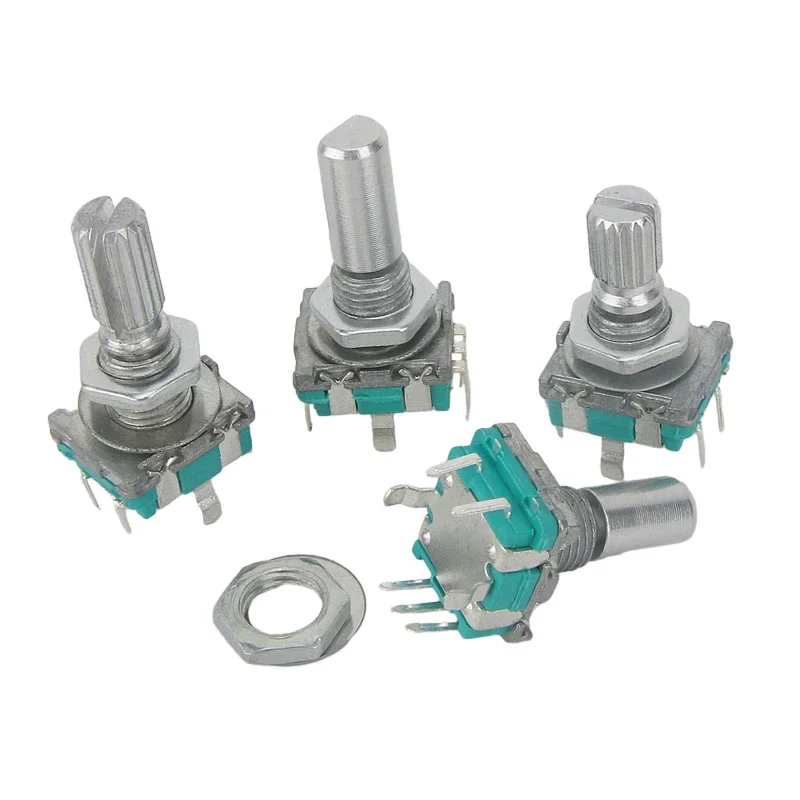
The encoders feature a metallic shaft and a threaded bushing, designed for secure panel mounting. The shaft is typically made of aluminum or a similar durable alloy, providing rigidity. The base appears to be a robust plastic housing with standard PCB-mount pins, often spaced for common prototyping Boards. The visual inspection suggests a sturdy construction capable of withstanding repeated use.
The metal shaft provides a reassuringly solid feel, resisting bending or snapping during enthusiastic or prolonged use, a common failure point for cheaper plastic alternatives found in some budget components. The threaded collar, accompanied by a washer and nut (often included in the package, though not always), allows for easy and stable installation into control panels, preventing wobble and ensuring a professional, flush finish. This stability is paramount for devices that will see daily interaction, such as a main volume knob on an audio system or a primary control for environmental settings. It feels substantial.
Compared to simple through-hole switches or potentiometers that rely solely on solder joints for mechanical stability, the panel-mount design with a threaded nut offers superior mechanical resilience. This robust mounting prevents the component from shifting or becoming loose over time, a critical factor for long-term reliability in custom-built enclosures where consistent user interaction is expected. Many generic encoders lack this crucial, durable mounting feature, leading to premature wear.
These are passive electromechanical components. They do not contain any internal wireless communication capabilities or processing logic. Instead, they generate electrical signals based on physical rotation and button presses. They require an intermediary microcontroller, such as an ESP32 or ESP8266, to read these raw signals, interpret them, and then translate them into commands for a smart home system.
For integration into a Home Assistant setup, the encoder's signals are read by a microcontroller running open-source firmware like ESPHome. This microcontroller then publishes the encoder's state changes (e.g., "rotated clockwise 1 step," "button pressed") via Wi-Fi to the Home Assistant instance using the MQTT protocol. This architecture inherently ensures local control capability, as the processing and initial command generation happen on the device itself, within your local network, before sending commands to the central hub. This means functionality isn't reliant on external cloud servers. The system remains responsive.
Unlike proprietary smart knobs or remote controls that often rely on cloud services, specific manufacturer hubs, or closed ecosystems, these EC11 encoders offer complete flexibility. They provide the raw input, allowing the builder to define the exact logic, functionality, and integration into virtually any open-source or custom home automation system. This open-ended approach is a significant advantage over closed ecosystems, providing unparalleled control, privacy, and customization possibilities. It offers true freedom.
As purely mechanical components, the encoders themselves introduce virtually no inherent latency. The electrical signals are generated instantaneously upon physical movement. The primary sources of potential delay in a smart home integration will be the microcontroller's processing speed, the Wi-Fi network's performance, and the MQTT broker's responsiveness.
When properly implemented with an optimized ESPHome configuration and a stable Wi-Fi network, the response delay from rotating the knob or pressing the button to a corresponding action in Home Assistant is negligible, often imperceptible to the human eye. This ensures a fluid and intuitive user experience, critical for tasks like dimming lights, adjusting speaker volume, or changing climate settings where immediate feedback is expected. Imagine turning a knob and seeing the lights respond instantly, without any frustrating lag or stutter. This is crucial for user satisfaction.
Compared to battery-powered wireless devices that might "sleep" to conserve power and introduce wake-up latency before responding, a wired or constantly-powered ESP-based encoder setup offers superior response times. This makes them ideal for critical control points where instantaneous feedback is preferred over energy efficiency, such as main room lighting controls, media playback navigation, or emergency system overrides. This wired approach provides consistent performance.
The standard EC11 footprint and 5-pin configuration make these encoders highly compatible with a wide range of prototyping boards, breadboards, and custom PCBs. The choice of 15mm or 20mm shaft length further enhances adaptability, allowing for different panel thicknesses and knob styles. The components are small.
Beyond smart home applications, these encoders are perfectly suited for custom audio equipment (e.g., digital volume controls, menu navigation), robotics control panels (e.g., joint angle adjustments, speed control), or even simple menu navigation systems for embedded projects like custom dashboards or instrumentation. Their clear detents and integrated switch offer a versatile and reliable input method for any project requiring precise, multi-function control where a physical interface is desired. A single component offers many uses.
Many specialized input devices are designed for a single, narrow purpose, limiting their utility across different projects. The EC11, however, functions as a highly adaptable general-purpose input, offering far greater utility and long-term value across a developer's toolkit than more restrictive or single-function components. This adaptability allows for creative reinterpretation in various contexts, from consumer electronics to industrial interfaces. It's a true workhorse.
The detent mechanism within the encoder provides a distinct, mechanical click for each of the 20 positions. Similarly, the push button offers a clear, audible click and a definite physical actuation point when pressed.
The crisp, positive clicks from both the rotation and the push button provide excellent haptic feedback. This tactile response confirms user input, which is essential in situations where visual confirmation might be delayed or unavailable, such as adjusting settings in a dark room or without looking directly at a screen. The solid feel of the metal shaft, combined with the precise clicks, adds to a premium user experience, making interactions feel deliberate and controlled. It feels good to use.
Cheaper encoders often have mushy, ill-defined detents or a weak, ambiguous button press, leading to an unsatisfying and potentially frustrating user experience. This EC11 model, with its defined clicks and robust construction, offers a more reliable and enjoyable interaction, making it a preferred choice for interfaces that prioritize user comfort, precision, and long-term durability over minimal cost. This is a noticeable difference.
The EC11 Rotary Encoder with Push Button Switch is not merely a component; it is a gateway to more intuitive and responsive control within your custom home automation projects. Picture a future where every adjustment to your environment feels deliberate and immediate, where the act of interacting with your smart home is as satisfying as the automation itself. Imagine effortlessly dimming lights, adjusting thermostats, or cycling through media playlists with a single, tactile knob that responds without a hint of delay. This five-pack ensures you have the robust, reliable inputs needed to bring multiple control points to life, transforming your smart house into a truly intelligent and interactive living space that anticipates your needs and responds to your touch. This is the next level.
Precise Digital Input for Smart Environments
These EC11 encoders feature 20 distinct detent positions per 360-degree rotation, providing a clear, incremental digital signal. This means for every full turn, the encoder outputs 20 pairs of pulses, allowing a microcontroller to accurately track its position. They are also equipped with a built-in push-button switch, accessible by pressing the shaft directly downwards. The output is typically a quadrature signal, meaning two output pins (Phase A and Phase B) generate pulses slightly out of phase, enabling both direction and step detection.
When adjusting the brightness of smart lights or setting the temperature on a smart thermostat, the tactile feedback from these 20 detents offers a satisfying physical confirmation for each increment. This eliminates the guesswork often associated with touch-sensitive interfaces or less precise analog controls, where a slight slip of the finger can lead to unintended adjustments. Imagine fine-tuning an RGB light strip, smoothly transitioning through colors or dimming levels with absolute confidence in each adjustment. This provides a level of granular control that digital-only interfaces, often lacking physical feedback, frequently struggle to replicate. The precision is palpable.
Unlike generic potentiometers that offer continuous, often imprecise analog input, the EC11 provides 20 distinct detent positions per rotation, ensuring accurate digital incrementation. Potentiometers, while simpler, cannot easily provide discrete steps or direction without complex analog-to-digital conversion and software interpretation. This encoder's digital nature simplifies programming and ensures repeatable, precise adjustments. Standard switches only offer on/off functionality, making them unsuitable for variable control. This is a significant upgrade.
The Integrated Control Advantage: Streamlining Your Interface
The integration of a push-button switch directly into the rotary encoder shaft simplifies wiring and panel design. This five-pin component (typically two for the encoder phases, two for the switch, and one common ground) combines two essential user inputs into a single physical footprint. The shaft itself is available in common lengths like 15mm and 20mm, catering to various enclosure depths and knob preferences. This saves valuable space.
This dual functionality is invaluable for compact smart home control panels, where real estate is often at a premium. A single knob can control volume with rotation and mute with a press, or cycle through smart scenes with rotation and activate a default scene with a press. This significantly reduces the number of physical components required on a control surface, leading to cleaner aesthetics and more intuitive user interaction. Picture a bedside lamp controller: rotate to dim, press to turn on/off. This makes interaction effortless.
Many basic rotary encoders require a separate push button, increasing component count, wiring complexity, and the overall size of the user interface. This integrated design significantly streamlines the bill of materials and assembly process for DIY projects, making it a more efficient and elegant choice for dedicated control interfaces compared to piecemeal solutions. It simplifies the build.
Enduring Construction and Secure Mounting
The encoders feature a metallic shaft and a threaded bushing, designed for secure panel mounting. The shaft is typically made of aluminum or a similar durable alloy, providing rigidity. The base appears to be a robust plastic housing with standard PCB-mount pins, often spaced for common prototyping Boards. The visual inspection suggests a sturdy construction capable of withstanding repeated use.
The metal shaft provides a reassuringly solid feel, resisting bending or snapping during enthusiastic or prolonged use, a common failure point for cheaper plastic alternatives found in some budget components. The threaded collar, accompanied by a washer and nut (often included in the package, though not always), allows for easy and stable installation into control panels, preventing wobble and ensuring a professional, flush finish. This stability is paramount for devices that will see daily interaction, such as a main volume knob on an audio system or a primary control for environmental settings. It feels substantial.
Compared to simple through-hole switches or potentiometers that rely solely on solder joints for mechanical stability, the panel-mount design with a threaded nut offers superior mechanical resilience. This robust mounting prevents the component from shifting or becoming loose over time, a critical factor for long-term reliability in custom-built enclosures where consistent user interaction is expected. Many generic encoders lack this crucial, durable mounting feature, leading to premature wear.
Seamless Integration with Home Automation Platforms
These are passive electromechanical components. They do not contain any internal wireless communication capabilities or processing logic. Instead, they generate electrical signals based on physical rotation and button presses. They require an intermediary microcontroller, such as an ESP32 or ESP8266, to read these raw signals, interpret them, and then translate them into commands for a smart home system.
For integration into a Home Assistant setup, the encoder's signals are read by a microcontroller running open-source firmware like ESPHome. This microcontroller then publishes the encoder's state changes (e.g., "rotated clockwise 1 step," "button pressed") via Wi-Fi to the Home Assistant instance using the MQTT protocol. This architecture inherently ensures local control capability, as the processing and initial command generation happen on the device itself, within your local network, before sending commands to the central hub. This means functionality isn't reliant on external cloud servers. The system remains responsive.
Unlike proprietary smart knobs or remote controls that often rely on cloud services, specific manufacturer hubs, or closed ecosystems, these EC11 encoders offer complete flexibility. They provide the raw input, allowing the builder to define the exact logic, functionality, and integration into virtually any open-source or custom home automation system. This open-ended approach is a significant advantage over closed ecosystems, providing unparalleled control, privacy, and customization possibilities. It offers true freedom.
Minimizing Latency for Instantaneous Feedback
As purely mechanical components, the encoders themselves introduce virtually no inherent latency. The electrical signals are generated instantaneously upon physical movement. The primary sources of potential delay in a smart home integration will be the microcontroller's processing speed, the Wi-Fi network's performance, and the MQTT broker's responsiveness.
When properly implemented with an optimized ESPHome configuration and a stable Wi-Fi network, the response delay from rotating the knob or pressing the button to a corresponding action in Home Assistant is negligible, often imperceptible to the human eye. This ensures a fluid and intuitive user experience, critical for tasks like dimming lights, adjusting speaker volume, or changing climate settings where immediate feedback is expected. Imagine turning a knob and seeing the lights respond instantly, without any frustrating lag or stutter. This is crucial for user satisfaction.
Compared to battery-powered wireless devices that might "sleep" to conserve power and introduce wake-up latency before responding, a wired or constantly-powered ESP-based encoder setup offers superior response times. This makes them ideal for critical control points where instantaneous feedback is preferred over energy efficiency, such as main room lighting controls, media playback navigation, or emergency system overrides. This wired approach provides consistent performance.
Versatility Across Diverse DIY Projects
The standard EC11 footprint and 5-pin configuration make these encoders highly compatible with a wide range of prototyping boards, breadboards, and custom PCBs. The choice of 15mm or 20mm shaft length further enhances adaptability, allowing for different panel thicknesses and knob styles. The components are small.
Beyond smart home applications, these encoders are perfectly suited for custom audio equipment (e.g., digital volume controls, menu navigation), robotics control panels (e.g., joint angle adjustments, speed control), or even simple menu navigation systems for embedded projects like custom dashboards or instrumentation. Their clear detents and integrated switch offer a versatile and reliable input method for any project requiring precise, multi-function control where a physical interface is desired. A single component offers many uses.
Many specialized input devices are designed for a single, narrow purpose, limiting their utility across different projects. The EC11, however, functions as a highly adaptable general-purpose input, offering far greater utility and long-term value across a developer's toolkit than more restrictive or single-function components. This adaptability allows for creative reinterpretation in various contexts, from consumer electronics to industrial interfaces. It's a true workhorse.
The Satisfying Tactile Experience
The detent mechanism within the encoder provides a distinct, mechanical click for each of the 20 positions. Similarly, the push button offers a clear, audible click and a definite physical actuation point when pressed.
The crisp, positive clicks from both the rotation and the push button provide excellent haptic feedback. This tactile response confirms user input, which is essential in situations where visual confirmation might be delayed or unavailable, such as adjusting settings in a dark room or without looking directly at a screen. The solid feel of the metal shaft, combined with the precise clicks, adds to a premium user experience, making interactions feel deliberate and controlled. It feels good to use.
Cheaper encoders often have mushy, ill-defined detents or a weak, ambiguous button press, leading to an unsatisfying and potentially frustrating user experience. This EC11 model, with its defined clicks and robust construction, offers a more reliable and enjoyable interaction, making it a preferred choice for interfaces that prioritize user comfort, precision, and long-term durability over minimal cost. This is a noticeable difference.
Powering Your Automation Vision: The Future of Interaction
The EC11 Rotary Encoder with Push Button Switch is not merely a component; it is a gateway to more intuitive and responsive control within your custom home automation projects. Picture a future where every adjustment to your environment feels deliberate and immediate, where the act of interacting with your smart home is as satisfying as the automation itself. Imagine effortlessly dimming lights, adjusting thermostats, or cycling through media playlists with a single, tactile knob that responds without a hint of delay. This five-pack ensures you have the robust, reliable inputs needed to bring multiple control points to life, transforming your smart house into a truly intelligent and interactive living space that anticipates your needs and responds to your touch. This is the next level.