ECGSOLAX PWM Solar Charge Controller 30A with Dual USB
Official Store Deal
Expert Analysis Overview
The ECGSOLAX PWM Solar Charge Controller 30A is an accessible and practical solution for hobbyists and small-scale off-grid applications requiring reliable battery management. This device serves as a foundational component for those looking to establish or expand a self-sustaining energy system without the complexity or higher cost associated with more advanced technologies. Its design prioritizes ease of use and essential functionality, making solar power more approachable.
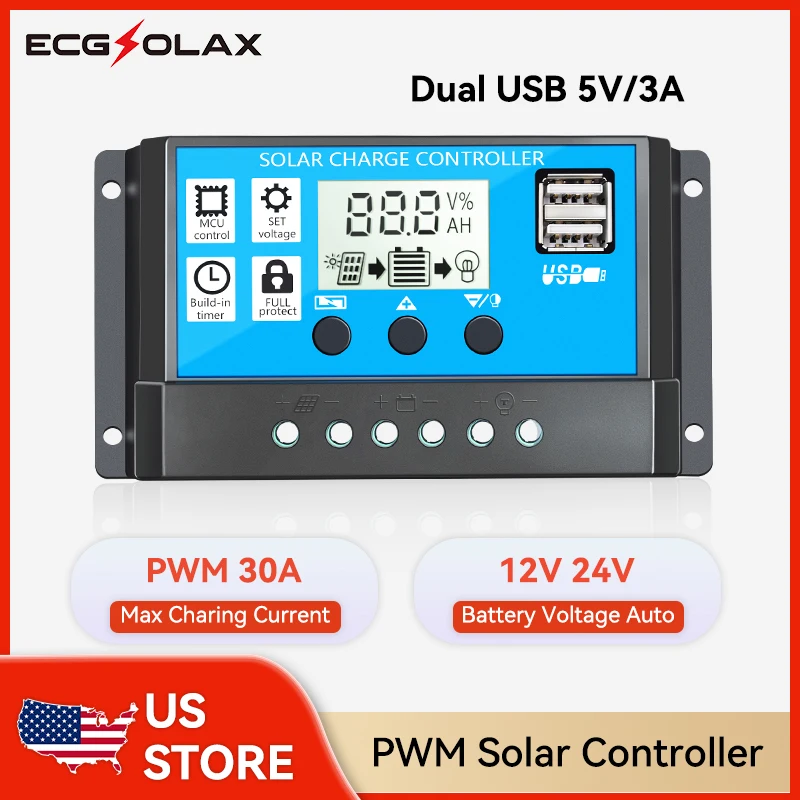
This controller operates on Pulse Width Modulation (PWM) technology, a well-established method for regulating the charge from solar panels to batteries. The unit automatically detects 12V or 24V battery systems, simplifying the setup process considerably. It handles a maximum charging current of 30A.
PWM charging works by rapidly connecting and disconnecting the solar array to the battery, controlling the average voltage and current to prevent overcharging. This method is particularly effective when the solar panel voltage is relatively close to the battery voltage. It ensures a consistent charging profile.
Compared to older, simpler shunt controllers that merely disconnect the panel, PWM offers a more sophisticated, multi-stage charging process. This helps in extending battery life and maintaining optimal charge levels, a significant upgrade for basic solar setups.
The automatic 12V/24V battery voltage detection is a key convenience feature. Users do not need to manually configure the system voltage, which reduces the potential for errors during installation. The controller adapts its charging parameters based on the detected battery voltage.
This auto-detection capability means the controller can be seamlessly integrated into various common off-grid configurations. It supports both smaller, single-battery 12V systems and slightly larger 24V arrays. Its flexibility is a strong point.
Many entry-level controllers require manual voltage selection, which can be a point of confusion for new users. This automatic feature streamlines the initial setup, allowing for quicker deployment of solar power systems.
With a 30A maximum charging current, the controller can manage a substantial amount of solar input. For a 12V system, this translates to approximately 360 watts of solar panels; for a 24V system, it manages around 720 watts. This capacity is ample for many recreational or light utility applications.
Properly sizing the solar array to the controller's current rating is crucial. Overloading the controller can lead to overheating and premature failure. The 30A rating positions it well for moderate power needs.
Lower amperage controllers restrict the size of the solar array, limiting power generation. This 30A capacity offers a good balance between cost and capability for hobbyist projects.
A notable inclusion on this charge controller is the dual USB 5V/3A output. These ports provide a direct, regulated power source for charging small electronic devices. This eliminates the need for an additional inverter for common gadgets.
These USB outputs are incredibly practical for off-grid living or camping scenarios. Users can charge smartphones, tablets, or power small LED lights directly from their solar battery system. Convenience is a major benefit.
Many basic solar controllers lack integrated USB outputs, forcing users to acquire separate DC-DC converters or inverters for device charging. The ECGSOLAX unit offers this utility right out of the box, enhancing its value.
The controller features an integrated LCD display, providing real-time information about the solar system's status. Visible data includes battery voltage, charging current, discharge current, and battery capacity percentage. This display is clear and easy to read.
Monitoring these parameters is essential for understanding system performance and health. Users can quickly assess if panels are generating power, if the battery is charging, or if loads are drawing too much current. Informed decisions are possible.
Simpler controllers often rely on LED indicators, which offer less detailed information. The LCD screen on this unit provides a comprehensive overview, making system management more transparent for the user.
Three physical buttons below the LCD allow for navigation and adjustment of settings. These buttons facilitate setting battery type, load control modes, and other operational parameters. The interface is intuitive.
Configuring the charge controller to match the battery type (e.g., Sealed, Gel, Flooded) is vital for optimal charging and longevity. The button interface makes these adjustments straightforward. Proper battery care is ensured.
Some controllers use complex menu structures or require external programming tools. This direct button interface keeps operation simple, appealing to users who prefer a hands-on, uncomplicated approach.
The visible enclosure appears to be constructed from a durable plastic, providing a lightweight yet protective housing for the internal electronics. The design incorporates mounting holes for secure installation. Its form factor is compact.
This type of enclosure is well-suited for indoor installations, such as inside an RV, shed, or cabin, where it is protected from direct weather exposure. It offers adequate protection against dust and minor impacts. Indoor use is recommended.
Compared to more industrial-grade controllers with metal housings, this plastic design contributes to its affordability and lighter weight. For protected environments, it represents a perfectly functional choice.
The application images demonstrate the controller's versatility across various small-scale solar projects. It is depicted in use with home solar systems, street lights, RVs, boats, and garden sheds. Its adaptability is clear.
This wide range of potential uses highlights its suitability for hobbyists and DIY enthusiasts. Whether powering a remote cabin or providing supplementary power for a vehicle, it fits many scenarios. Practicality defines it.
Many specialized controllers are designed for very specific niches. This general-purpose design, however, makes it a flexible option for diverse off-grid power needs, offering broad appeal to a varied user base.
While PWM technology is cost-effective, it does have limitations regarding efficiency, especially when the solar panel's operating voltage significantly differs from the battery's voltage. This can lead to some energy loss. Efficiency calculations are important.
In scenarios where solar panels are oversized for the battery or operate at much higher voltages, an MPPT (Maximum Power Point Tracking) controller would extract considerably more power. PWM controllers are best when panel and battery voltages are closely matched. Power harvesting is less optimized.
For budget-conscious projects or systems where maximum efficiency isn't the absolute priority, a PWM controller offers a perfectly acceptable performance-to-cost ratio. It remains a reliable option for many users. Value is significant.
Unlike more complex and expensive MPPT controllers, this ECGSOLAX PWM unit offers a straightforward, reliable charging solution at an accessible price point. Its simplicity ensures easy integration into existing solar setups. The cost benefit is clear.
This controller ensures a stable charging environment for lead-acid batteries, preventing common issues like overcharging or deep discharge. It protects battery health, extending their operational lifespan. Longevity is enhanced.
For those new to solar energy or building a basic system, this controller provides all the essential features without unnecessary complexity. It is an ideal starting point for solar exploration. Learning is simplified.
Imagine the satisfaction of powering your remote cabin lights or charging your phone during a camping trip, knowing your solar system is efficiently managed by a dependable controller. This unit provides the foundational capability for energy independence, allowing you to enjoy reliable power wherever the sun shines. It is a tangible step towards self-sufficiency. This controller makes off-grid living more attainable, providing peace of mind and consistent power for your essential needs.
Core Energy Management
This controller operates on Pulse Width Modulation (PWM) technology, a well-established method for regulating the charge from solar panels to batteries. The unit automatically detects 12V or 24V battery systems, simplifying the setup process considerably. It handles a maximum charging current of 30A.
PWM charging works by rapidly connecting and disconnecting the solar array to the battery, controlling the average voltage and current to prevent overcharging. This method is particularly effective when the solar panel voltage is relatively close to the battery voltage. It ensures a consistent charging profile.
Compared to older, simpler shunt controllers that merely disconnect the panel, PWM offers a more sophisticated, multi-stage charging process. This helps in extending battery life and maintaining optimal charge levels, a significant upgrade for basic solar setups.
Voltage Adaptation and Current Handling
The automatic 12V/24V battery voltage detection is a key convenience feature. Users do not need to manually configure the system voltage, which reduces the potential for errors during installation. The controller adapts its charging parameters based on the detected battery voltage.
This auto-detection capability means the controller can be seamlessly integrated into various common off-grid configurations. It supports both smaller, single-battery 12V systems and slightly larger 24V arrays. Its flexibility is a strong point.
Many entry-level controllers require manual voltage selection, which can be a point of confusion for new users. This automatic feature streamlines the initial setup, allowing for quicker deployment of solar power systems.
With a 30A maximum charging current, the controller can manage a substantial amount of solar input. For a 12V system, this translates to approximately 360 watts of solar panels; for a 24V system, it manages around 720 watts. This capacity is ample for many recreational or light utility applications.
Properly sizing the solar array to the controller's current rating is crucial. Overloading the controller can lead to overheating and premature failure. The 30A rating positions it well for moderate power needs.
Lower amperage controllers restrict the size of the solar array, limiting power generation. This 30A capacity offers a good balance between cost and capability for hobbyist projects.
Auxiliary Power Connectivity
A notable inclusion on this charge controller is the dual USB 5V/3A output. These ports provide a direct, regulated power source for charging small electronic devices. This eliminates the need for an additional inverter for common gadgets.
These USB outputs are incredibly practical for off-grid living or camping scenarios. Users can charge smartphones, tablets, or power small LED lights directly from their solar battery system. Convenience is a major benefit.
Many basic solar controllers lack integrated USB outputs, forcing users to acquire separate DC-DC converters or inverters for device charging. The ECGSOLAX unit offers this utility right out of the box, enhancing its value.
System Monitoring and User Interface
The controller features an integrated LCD display, providing real-time information about the solar system's status. Visible data includes battery voltage, charging current, discharge current, and battery capacity percentage. This display is clear and easy to read.
Monitoring these parameters is essential for understanding system performance and health. Users can quickly assess if panels are generating power, if the battery is charging, or if loads are drawing too much current. Informed decisions are possible.
Simpler controllers often rely on LED indicators, which offer less detailed information. The LCD screen on this unit provides a comprehensive overview, making system management more transparent for the user.
Three physical buttons below the LCD allow for navigation and adjustment of settings. These buttons facilitate setting battery type, load control modes, and other operational parameters. The interface is intuitive.
Configuring the charge controller to match the battery type (e.g., Sealed, Gel, Flooded) is vital for optimal charging and longevity. The button interface makes these adjustments straightforward. Proper battery care is ensured.
Some controllers use complex menu structures or require external programming tools. This direct button interface keeps operation simple, appealing to users who prefer a hands-on, uncomplicated approach.
Enclosure Integrity and Application Versatility
The visible enclosure appears to be constructed from a durable plastic, providing a lightweight yet protective housing for the internal electronics. The design incorporates mounting holes for secure installation. Its form factor is compact.
This type of enclosure is well-suited for indoor installations, such as inside an RV, shed, or cabin, where it is protected from direct weather exposure. It offers adequate protection against dust and minor impacts. Indoor use is recommended.
Compared to more industrial-grade controllers with metal housings, this plastic design contributes to its affordability and lighter weight. For protected environments, it represents a perfectly functional choice.
The application images demonstrate the controller's versatility across various small-scale solar projects. It is depicted in use with home solar systems, street lights, RVs, boats, and garden sheds. Its adaptability is clear.
This wide range of potential uses highlights its suitability for hobbyists and DIY enthusiasts. Whether powering a remote cabin or providing supplementary power for a vehicle, it fits many scenarios. Practicality defines it.
Many specialized controllers are designed for very specific niches. This general-purpose design, however, makes it a flexible option for diverse off-grid power needs, offering broad appeal to a varied user base.
Performance Considerations and Efficiency
While PWM technology is cost-effective, it does have limitations regarding efficiency, especially when the solar panel's operating voltage significantly differs from the battery's voltage. This can lead to some energy loss. Efficiency calculations are important.
In scenarios where solar panels are oversized for the battery or operate at much higher voltages, an MPPT (Maximum Power Point Tracking) controller would extract considerably more power. PWM controllers are best when panel and battery voltages are closely matched. Power harvesting is less optimized.
For budget-conscious projects or systems where maximum efficiency isn't the absolute priority, a PWM controller offers a perfectly acceptable performance-to-cost ratio. It remains a reliable option for many users. Value is significant.
The Upgrade Frame: Value for the Hobbyist
Unlike more complex and expensive MPPT controllers, this ECGSOLAX PWM unit offers a straightforward, reliable charging solution at an accessible price point. Its simplicity ensures easy integration into existing solar setups. The cost benefit is clear.
This controller ensures a stable charging environment for lead-acid batteries, preventing common issues like overcharging or deep discharge. It protects battery health, extending their operational lifespan. Longevity is enhanced.
For those new to solar energy or building a basic system, this controller provides all the essential features without unnecessary complexity. It is an ideal starting point for solar exploration. Learning is simplified.
Imagine the satisfaction of powering your remote cabin lights or charging your phone during a camping trip, knowing your solar system is efficiently managed by a dependable controller. This unit provides the foundational capability for energy independence, allowing you to enjoy reliable power wherever the sun shines. It is a tangible step towards self-sufficiency. This controller makes off-grid living more attainable, providing peace of mind and consistent power for your essential needs.