ETEK EKL9-40 Type A RCBO Circuit Breaker
Official Store Deal
Expert Analysis Overview
The ETEK EKL9-40 Type A RCBO is a critical safety device engineered for robust electrical circuit protection in residential and light commercial applications. This combined Residual Current Breaker with Overcurrent protection unit is specifically designed to detect both AC and pulsating DC residual currents, offering a significant upgrade over standard Type AC devices. Its integration of short-circuit, overload, and earth leakage protection into a single compact module simplifies installation and enhances overall electrical safety.
This RCBO unit provides comprehensive protection against common electrical faults. It detects dangerous current imbalances that can lead to electric shock or fire, alongside preventing damage from overcurrents and short circuits. The device is rated for a 6KA breaking capacity, indicating its ability to safely interrupt fault currents up to 6000 Amperes. This is a substantial safety margin.
In practical terms, this means the EKL9-40 can handle significant fault conditions without catastrophic failure. It ensures the circuit remains protected even under severe electrical stress. Unlike basic circuit breakers that only address overcurrents, this RCBO actively monitors for leakage currents, providing a crucial layer of personal protection.
Standard miniature circuit breakers (MCBs) offer only overcurrent and short-circuit protection. The ETEK EKL9-40, as an RCBO, combines this with residual current detection, making it a more complete safety solution. This integrated approach reduces the number of devices required in a consumer unit, streamlining wiring and potentially saving space.
Crucially, the EKL9-40 is a Type A RCBO. This designation signifies its capability to detect not only sinusoidal alternating residual currents but also pulsating direct residual currents. This is a vital distinction in modern electrical installations.
Many contemporary electronic devices, such as those with switched-mode power supplies (e.g., computers, LED lighting, washing machines with speed controls), can generate pulsating DC fault currents. A Type AC RCD or RCBO would not reliably detect these specific fault types. The Type A classification ensures broader compatibility and enhanced safety for a wider range of appliances.
This advanced detection capability provides superior protection for circuits feeding equipment that might introduce DC components into the fault current. It is a necessary consideration for compliance with current electrical safety standards in many regions. Relying solely on Type AC devices in such scenarios could leave occupants vulnerable to undetected electrical hazards.
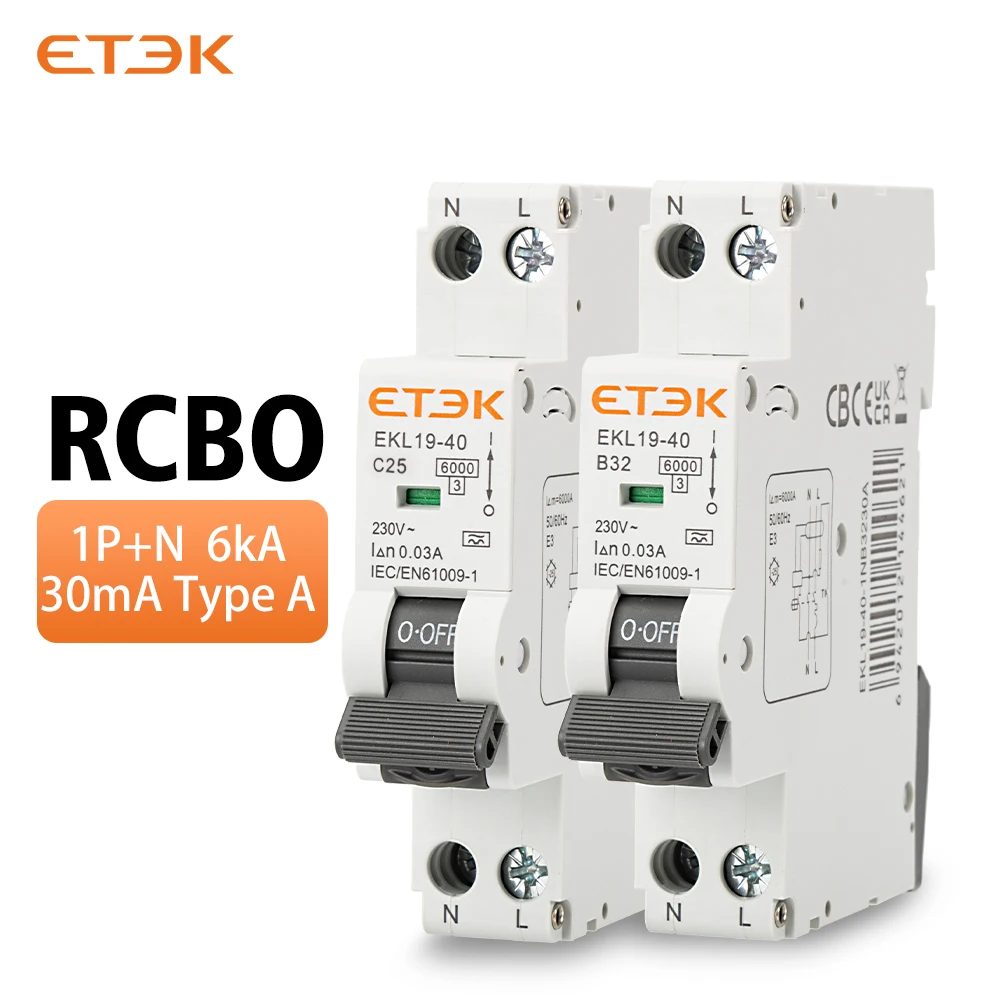
The visible construction of the ETEK EKL9-40 RCBO suggests a robust and functional design. The housing appears to be made from a durable, flame-retardant plastic, typical for electrical safety devices. The terminals are clearly marked for neutral (N) and line (L) connections, facilitating correct wiring.
Proper terminal connections are paramount for safety. The device features an indicator window, visually displaying red for a closed switch (power on) and green for an open circuit (power off). This simple visual cue provides immediate operational status feedback. A wider handle is incorporated for improved operating comfort and ease of switching.
Compared to older or less refined designs, the clear visual indicators and ergonomic handle design contribute to safer and more intuitive operation. The robust terminal screws are essential for securing conductors, preventing loose connections that can lead to overheating and fire hazards. The overall build quality appears consistent with industry expectations for such critical components.
Installation of the EKL9-40 is designed for standard DIN rail mounting, a common practice in modern consumer units and distribution boards. The 1P+N configuration is suitable for single-phase circuits, providing protection for both the live and neutral conductors. The device is rated for 230V~ operation, aligning with typical residential supply voltages in many parts of the world.
Before installation, verifying the circuit's specific requirements for current rating and fault protection is essential. The device's 30mA residual current sensitivity is a standard threshold for personal protection against electric shock. This sensitivity ensures rapid tripping in the event of a dangerous leakage current, minimizing the risk of injury.
Unlike standalone MCBs and RCDs that require separate installation and wiring, the integrated RCBO simplifies the panel layout. This consolidation can save valuable space within the electrical enclosure. Always consult local electrical codes and a qualified electrician for proper installation and commissioning.
The EKL9-40 features a Curve C tripping characteristic. This means the circuit breaker will trip instantaneously at 5 to 10 times its rated current. Curve C is a widely used characteristic for general protection of circuits and resistive or inductive loads.
This tripping curve is suitable for protecting circuits that supply common household appliances, lighting, and small motors. It offers a balance between nuisance tripping and adequate protection against short circuits. For instance, a 25A Curve C RCBO would trip between 125A and 250A instantaneously.
In contrast, Curve B devices trip at lower multiples of rated current (3-5x), suitable for purely resistive loads, while Curve D devices trip at higher multiples (10-20x), designed for highly inductive loads with high inrush currents. The Curve C characteristic of the EKL9-40 makes it a versatile choice for most domestic and light commercial applications, preventing unnecessary interruptions while maintaining safety.
The device prominently displays compliance with IEC/EN61009-1. This international standard specifies requirements for Residual Current Operated Circuit-Breakers with Integral Overcurrent Protection for household and similar uses. Adherence to such standards is non-negotiable for electrical safety devices.
Certification to IEC/EN61009-1 provides assurance that the RCBO has undergone rigorous testing for performance, reliability, and safety. It confirms the device meets specific criteria for breaking capacity, tripping characteristics, and operational integrity. This compliance is a critical factor for electricians and consumers alike.
Products lacking recognized international certifications pose significant safety risks. The ETEK EKL9-40's visible compliance indicates a commitment to manufacturing safe and reliable electrical components. This adherence helps ensure the device will perform as expected when called upon to protect life and property.
The ETEK EKL9-40 Type A RCBO represents a sound investment in electrical safety. Its ability to combine multiple protection functions into a single unit, coupled with its Type A residual current detection, offers superior safeguarding compared to conventional circuit breakers. The visible quality and adherence to international standards underscore its reliability.
Considering the potential costs associated with electrical fires, equipment damage, or personal injury, the price of a high-quality RCBO is a small fraction of the potential losses. This device provides long-term value by preventing costly incidents and ensuring continuous, safe operation of electrical systems. It is an essential component for any modern electrical installation.
Imagine the peace of mind knowing your home or business is protected by a device capable of detecting a wide range of electrical faults, from simple overloads to dangerous leakage currents. Envision an electrical system where safety is not an afterthought but an integrated, proactive measure, ensuring the well-being of occupants and the longevity of appliances. This RCBO delivers that assurance, allowing for uninterrupted and secure power delivery in your daily environment.
Unwavering Electrical Safeguarding
This RCBO unit provides comprehensive protection against common electrical faults. It detects dangerous current imbalances that can lead to electric shock or fire, alongside preventing damage from overcurrents and short circuits. The device is rated for a 6KA breaking capacity, indicating its ability to safely interrupt fault currents up to 6000 Amperes. This is a substantial safety margin.
In practical terms, this means the EKL9-40 can handle significant fault conditions without catastrophic failure. It ensures the circuit remains protected even under severe electrical stress. Unlike basic circuit breakers that only address overcurrents, this RCBO actively monitors for leakage currents, providing a crucial layer of personal protection.
Standard miniature circuit breakers (MCBs) offer only overcurrent and short-circuit protection. The ETEK EKL9-40, as an RCBO, combines this with residual current detection, making it a more complete safety solution. This integrated approach reduces the number of devices required in a consumer unit, streamlining wiring and potentially saving space.
Advanced Leakage Detection: Type A Advantage
Crucially, the EKL9-40 is a Type A RCBO. This designation signifies its capability to detect not only sinusoidal alternating residual currents but also pulsating direct residual currents. This is a vital distinction in modern electrical installations.
Many contemporary electronic devices, such as those with switched-mode power supplies (e.g., computers, LED lighting, washing machines with speed controls), can generate pulsating DC fault currents. A Type AC RCD or RCBO would not reliably detect these specific fault types. The Type A classification ensures broader compatibility and enhanced safety for a wider range of appliances.
This advanced detection capability provides superior protection for circuits feeding equipment that might introduce DC components into the fault current. It is a necessary consideration for compliance with current electrical safety standards in many regions. Relying solely on Type AC devices in such scenarios could leave occupants vulnerable to undetected electrical hazards.
Construction and Operational Integrity
The visible construction of the ETEK EKL9-40 RCBO suggests a robust and functional design. The housing appears to be made from a durable, flame-retardant plastic, typical for electrical safety devices. The terminals are clearly marked for neutral (N) and line (L) connections, facilitating correct wiring.
Proper terminal connections are paramount for safety. The device features an indicator window, visually displaying red for a closed switch (power on) and green for an open circuit (power off). This simple visual cue provides immediate operational status feedback. A wider handle is incorporated for improved operating comfort and ease of switching.
Compared to older or less refined designs, the clear visual indicators and ergonomic handle design contribute to safer and more intuitive operation. The robust terminal screws are essential for securing conductors, preventing loose connections that can lead to overheating and fire hazards. The overall build quality appears consistent with industry expectations for such critical components.
Installation and Compatibility Considerations
Installation of the EKL9-40 is designed for standard DIN rail mounting, a common practice in modern consumer units and distribution boards. The 1P+N configuration is suitable for single-phase circuits, providing protection for both the live and neutral conductors. The device is rated for 230V~ operation, aligning with typical residential supply voltages in many parts of the world.
Before installation, verifying the circuit's specific requirements for current rating and fault protection is essential. The device's 30mA residual current sensitivity is a standard threshold for personal protection against electric shock. This sensitivity ensures rapid tripping in the event of a dangerous leakage current, minimizing the risk of injury.
Unlike standalone MCBs and RCDs that require separate installation and wiring, the integrated RCBO simplifies the panel layout. This consolidation can save valuable space within the electrical enclosure. Always consult local electrical codes and a qualified electrician for proper installation and commissioning.
Performance Under Load: Curve C Characteristics
The EKL9-40 features a Curve C tripping characteristic. This means the circuit breaker will trip instantaneously at 5 to 10 times its rated current. Curve C is a widely used characteristic for general protection of circuits and resistive or inductive loads.
This tripping curve is suitable for protecting circuits that supply common household appliances, lighting, and small motors. It offers a balance between nuisance tripping and adequate protection against short circuits. For instance, a 25A Curve C RCBO would trip between 125A and 250A instantaneously.
In contrast, Curve B devices trip at lower multiples of rated current (3-5x), suitable for purely resistive loads, while Curve D devices trip at higher multiples (10-20x), designed for highly inductive loads with high inrush currents. The Curve C characteristic of the EKL9-40 makes it a versatile choice for most domestic and light commercial applications, preventing unnecessary interruptions while maintaining safety.
Adherence to International Standards
The device prominently displays compliance with IEC/EN61009-1. This international standard specifies requirements for Residual Current Operated Circuit-Breakers with Integral Overcurrent Protection for household and similar uses. Adherence to such standards is non-negotiable for electrical safety devices.
Certification to IEC/EN61009-1 provides assurance that the RCBO has undergone rigorous testing for performance, reliability, and safety. It confirms the device meets specific criteria for breaking capacity, tripping characteristics, and operational integrity. This compliance is a critical factor for electricians and consumers alike.
Products lacking recognized international certifications pose significant safety risks. The ETEK EKL9-40's visible compliance indicates a commitment to manufacturing safe and reliable electrical components. This adherence helps ensure the device will perform as expected when called upon to protect life and property.
Value Proposition and Long-Term Safety
The ETEK EKL9-40 Type A RCBO represents a sound investment in electrical safety. Its ability to combine multiple protection functions into a single unit, coupled with its Type A residual current detection, offers superior safeguarding compared to conventional circuit breakers. The visible quality and adherence to international standards underscore its reliability.
Considering the potential costs associated with electrical fires, equipment damage, or personal injury, the price of a high-quality RCBO is a small fraction of the potential losses. This device provides long-term value by preventing costly incidents and ensuring continuous, safe operation of electrical systems. It is an essential component for any modern electrical installation.
Imagine the peace of mind knowing your home or business is protected by a device capable of detecting a wide range of electrical faults, from simple overloads to dangerous leakage currents. Envision an electrical system where safety is not an afterthought but an integrated, proactive measure, ensuring the well-being of occupants and the longevity of appliances. This RCBO delivers that assurance, allowing for uninterrupted and secure power delivery in your daily environment.