Ewelink Zigbee Wireless Door Window Sensor
Official Store Deal
Expert Analysis Overview
The Ewelink Zigbee Wireless Door Window Sensor is a foundational smart home security component designed for users prioritizing seamless voice control and robust automation within their Zigbee ecosystem. This compact, minimalist sensor integrates directly into existing smart home setups, offering immediate alerts and triggering routines that enhance both security and convenience. Its primary function is to detect the opening and closing of doors, windows, cabinets, or even baby gates, relaying this status instantly to a compatible Zigbee hub.
At its heart, this Ewelink sensor operates on the Zigbee protocol. For those unfamiliar, Zigbee is a wireless technology standard built for low-power, low-data-rate applications. It creates a mesh network, meaning each Zigbee device can communicate with others and relay data, extending the range and reliability of your smart home network. This differs significantly from Wi-Fi devices, which often rely on a single access point and can be more susceptible to network congestion. The requirement for a dedicated Zigbee hub, such as an eWelink Zigbee hub or a Zigbee2MQTT compatible gateway, is a key differentiator. This hub acts as the central brain, translating Zigbee signals into a language your router and smart assistants like Alexa or Google Home can understand. Without it, the sensor cannot communicate or function.
Consider the implications of this architecture: a more stable and less energy-intensive network. Compared to Wi-Fi sensors that can drain batteries quickly and sometimes suffer from connection drops, Zigbee offers an inherently more reliable and power-efficient solution for critical security notifications. The sensor itself is a two-part magnetic contact system. A main unit, which houses the battery and radio, and a smaller magnetic component. When these two parts are separated beyond a specified gap, the circuit breaks, and an 'open' signal is transmitted. When they come back together, a 'closed' signal is sent. This simple mechanism provides accurate and instantaneous status updates, crucial for security applications.
This sensor excels in its compatibility with major voice assistants. It works with Alexa and Google Home, provided it's linked through a compatible Zigbee hub that supports these integrations. Imagine waking up and simply asking, "Alexa, is the front door open?" and receiving an immediate auditory response. This eliminates the need to physically check each entry point, saving time and offering peace of mind. For the voice control fanatic, this level of hands-free interaction is paramount. The integration allows for the creation of sophisticated routines that respond to the sensor's status. For instance, a simple voice command can arm your home security system, which then monitors all connected door and window sensors.
Latency is a critical factor for voice-controlled smart home devices. With Zigbee, the communication speed between the sensor and the hub is generally very low, often milliseconds. This means that when a door opens, the alert is almost instantaneous. When integrated correctly, the delay from the sensor trigger to your voice assistant announcing the event is negligible. This responsiveness is an upgrade from some older Wi-Fi based sensors which could introduce noticeable lag, leading to frustrating delays in alerts or routine activations. The smooth operation makes interacting with your home through voice feel natural and intuitive. No more fumbling with apps. Just speak your command.
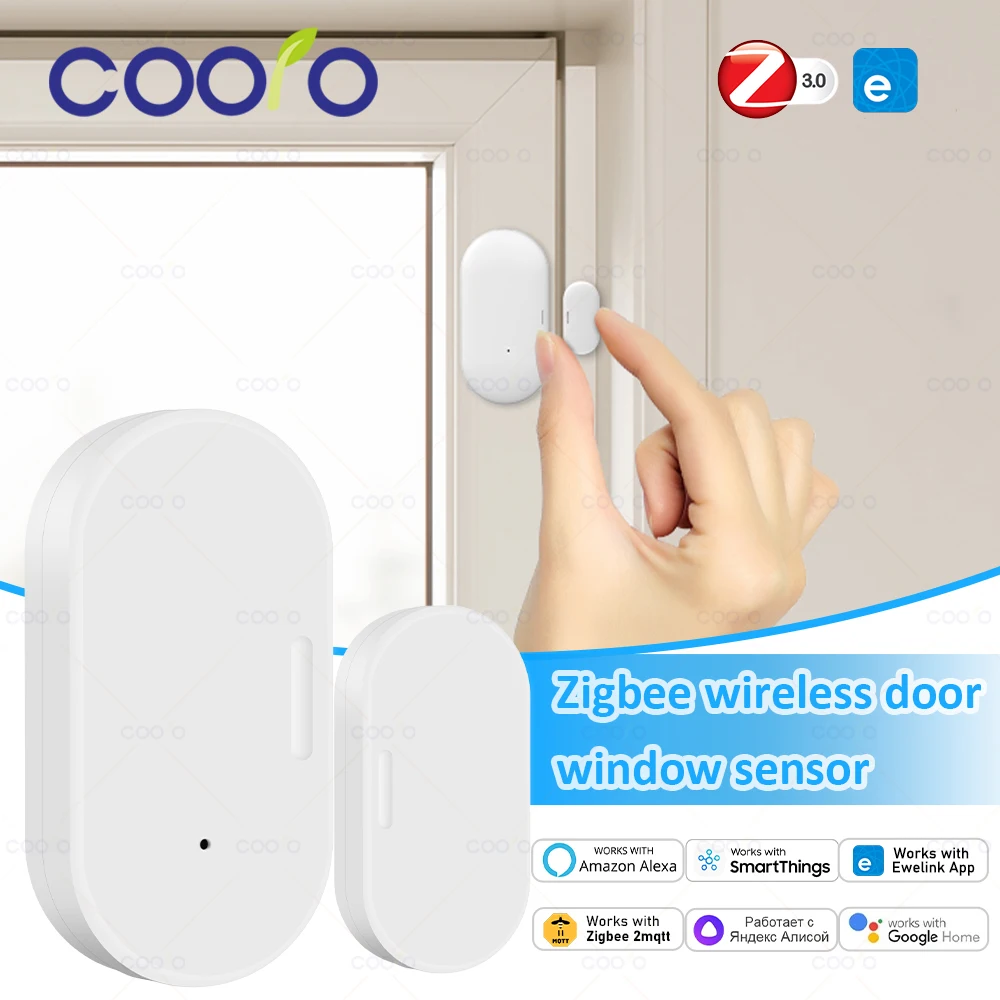
Visually, the sensor presents as a pair of sleek, white, oval-shaped plastic units. The main unit is slightly larger, housing the electronics, while the smaller piece contains the magnet. The finish appears to be a matte, durable ABS plastic, designed to blend discreetly with most door and window frames. The overall aesthetic is clean and unobtrusive, avoiding the bulky appearance of some older security sensors. Its compact size ensures it can be installed without drawing undue attention, maintaining the visual integrity of your living space. The tactile feel is smooth, indicating a good mold precision that prevents sharp edges or awkward protrusions.
Installation is remarkably simple. The sensors come with adhesive backing, allowing for tool-free mounting on any flat surface. The critical aspect is aligning the two components correctly and ensuring the gap between them is less than 5mm when the door or window is closed. This tight tolerance ensures reliable detection. Compared to traditional wired sensors that require drilling and running cables, this wireless design offers unparalleled flexibility. You can place it on a front door, a sliding glass door, a bedroom window, or even a liquor cabinet to monitor access. Its multi-purpose application extends to securing important document cabinets or even a baby's crib gate, providing alerts if it's opened unexpectedly. This ease of installation contributes significantly to its appeal, as users can quickly deploy and reposition sensors as their needs evolve.
The true power of this Zigbee sensor lies in its ability to enable advanced home automation routines. Beyond simple alerts, imagine a scenario where opening the front door after sunset automatically triggers your smart lights to turn on in the entryway. Or, if a window is left open when you leave the house, your thermostat could automatically adjust to an energy-saving mode, preventing wasted heating or cooling. These types of routines eliminate the need for manual intervention, making your home truly intelligent and efficient. They also address common pain points, such as forgetting to turn off lights or adjust climate control, leading to significant energy savings over time.
Setting up these routines is typically done through the eWelink app or your chosen Zigbee hub's interface, which then integrates with Alexa or Google Home. The process is streamlined, allowing users to define conditions (e.g., "sensor status is 'open'") and actions (e.g., "turn on living room lights"). This level of programmable control moves beyond basic security, transforming the sensor into a proactive element of your smart home ecosystem. Compared to standalone alarms that merely make noise, this integrated approach provides actionable intelligence and automated responses, making your home more responsive to your daily life. It’s about not just knowing when something happens, but having your home *react* intelligently.
Ultimately, the Ewelink Zigbee Wireless Door Window Sensor offers more than just security; it delivers unparalleled convenience and control. Imagine a home where your voice effortlessly commands every aspect, from knowing if a window is ajar to automatically illuminating your path. This sensor is a silent sentinel, always vigilant, ready to integrate into your routines and make your daily life smoother, safer, and more energy-efficient. It's the simple upgrade that makes your smart home truly feel smart.
The Core of Connected Security
At its heart, this Ewelink sensor operates on the Zigbee protocol. For those unfamiliar, Zigbee is a wireless technology standard built for low-power, low-data-rate applications. It creates a mesh network, meaning each Zigbee device can communicate with others and relay data, extending the range and reliability of your smart home network. This differs significantly from Wi-Fi devices, which often rely on a single access point and can be more susceptible to network congestion. The requirement for a dedicated Zigbee hub, such as an eWelink Zigbee hub or a Zigbee2MQTT compatible gateway, is a key differentiator. This hub acts as the central brain, translating Zigbee signals into a language your router and smart assistants like Alexa or Google Home can understand. Without it, the sensor cannot communicate or function.
Consider the implications of this architecture: a more stable and less energy-intensive network. Compared to Wi-Fi sensors that can drain batteries quickly and sometimes suffer from connection drops, Zigbee offers an inherently more reliable and power-efficient solution for critical security notifications. The sensor itself is a two-part magnetic contact system. A main unit, which houses the battery and radio, and a smaller magnetic component. When these two parts are separated beyond a specified gap, the circuit breaks, and an 'open' signal is transmitted. When they come back together, a 'closed' signal is sent. This simple mechanism provides accurate and instantaneous status updates, crucial for security applications.
Effortless Integration and Voice Command Mastery
This sensor excels in its compatibility with major voice assistants. It works with Alexa and Google Home, provided it's linked through a compatible Zigbee hub that supports these integrations. Imagine waking up and simply asking, "Alexa, is the front door open?" and receiving an immediate auditory response. This eliminates the need to physically check each entry point, saving time and offering peace of mind. For the voice control fanatic, this level of hands-free interaction is paramount. The integration allows for the creation of sophisticated routines that respond to the sensor's status. For instance, a simple voice command can arm your home security system, which then monitors all connected door and window sensors.
Latency is a critical factor for voice-controlled smart home devices. With Zigbee, the communication speed between the sensor and the hub is generally very low, often milliseconds. This means that when a door opens, the alert is almost instantaneous. When integrated correctly, the delay from the sensor trigger to your voice assistant announcing the event is negligible. This responsiveness is an upgrade from some older Wi-Fi based sensors which could introduce noticeable lag, leading to frustrating delays in alerts or routine activations. The smooth operation makes interacting with your home through voice feel natural and intuitive. No more fumbling with apps. Just speak your command.
Physical Presence and Placement Prowess
Visually, the sensor presents as a pair of sleek, white, oval-shaped plastic units. The main unit is slightly larger, housing the electronics, while the smaller piece contains the magnet. The finish appears to be a matte, durable ABS plastic, designed to blend discreetly with most door and window frames. The overall aesthetic is clean and unobtrusive, avoiding the bulky appearance of some older security sensors. Its compact size ensures it can be installed without drawing undue attention, maintaining the visual integrity of your living space. The tactile feel is smooth, indicating a good mold precision that prevents sharp edges or awkward protrusions.
Installation is remarkably simple. The sensors come with adhesive backing, allowing for tool-free mounting on any flat surface. The critical aspect is aligning the two components correctly and ensuring the gap between them is less than 5mm when the door or window is closed. This tight tolerance ensures reliable detection. Compared to traditional wired sensors that require drilling and running cables, this wireless design offers unparalleled flexibility. You can place it on a front door, a sliding glass door, a bedroom window, or even a liquor cabinet to monitor access. Its multi-purpose application extends to securing important document cabinets or even a baby's crib gate, providing alerts if it's opened unexpectedly. This ease of installation contributes significantly to its appeal, as users can quickly deploy and reposition sensors as their needs evolve.
Automation Potential and Real-World Impact
The true power of this Zigbee sensor lies in its ability to enable advanced home automation routines. Beyond simple alerts, imagine a scenario where opening the front door after sunset automatically triggers your smart lights to turn on in the entryway. Or, if a window is left open when you leave the house, your thermostat could automatically adjust to an energy-saving mode, preventing wasted heating or cooling. These types of routines eliminate the need for manual intervention, making your home truly intelligent and efficient. They also address common pain points, such as forgetting to turn off lights or adjust climate control, leading to significant energy savings over time.
Setting up these routines is typically done through the eWelink app or your chosen Zigbee hub's interface, which then integrates with Alexa or Google Home. The process is streamlined, allowing users to define conditions (e.g., "sensor status is 'open'") and actions (e.g., "turn on living room lights"). This level of programmable control moves beyond basic security, transforming the sensor into a proactive element of your smart home ecosystem. Compared to standalone alarms that merely make noise, this integrated approach provides actionable intelligence and automated responses, making your home more responsive to your daily life. It’s about not just knowing when something happens, but having your home *react* intelligently.
Ultimately, the Ewelink Zigbee Wireless Door Window Sensor offers more than just security; it delivers unparalleled convenience and control. Imagine a home where your voice effortlessly commands every aspect, from knowing if a window is ajar to automatically illuminating your path. This sensor is a silent sentinel, always vigilant, ready to integrate into your routines and make your daily life smoother, safer, and more energy-efficient. It's the simple upgrade that makes your smart home truly feel smart.