GEYA GYHO8 Dual Power Manual Transfer Switch
Official Store Deal
Expert Analysis Overview
The GEYA GYHO8 Dual Power Manual Transfer Switch is a critical component for maintaining power continuity, specifically engineered for scenarios requiring robust, manual isolation and source switching. This device addresses the fundamental need for a secure transition between primary and secondary power supplies, a common requirement in residential, commercial, and industrial settings. Its design prioritizes operational safety and system integrity, providing a dependable solution where automated systems might be overkill or undesirable. The GYHO8 serves as a foundational element in any well-planned backup power infrastructure.
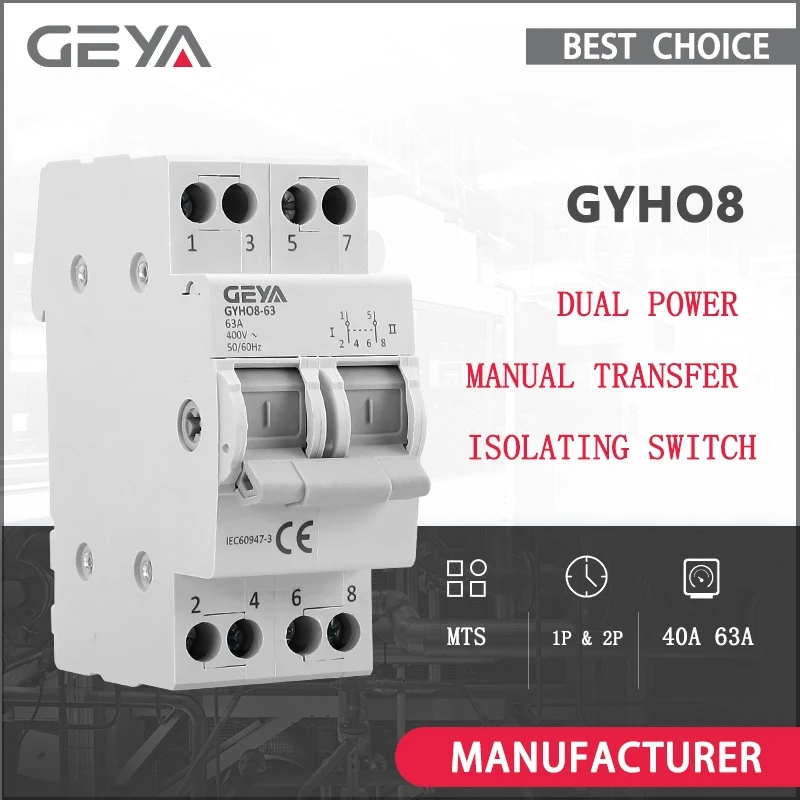
The GYHO8 series units, as depicted across various configurations, feature a modular, DIN rail-mountable white plastic housing. This standardized mounting system allows for quick and secure integration into electrical distribution boards and control panels, a significant advantage for installers. Visible terminals are of the screw-type variety, designed for secure wire connections, ensuring electrical continuity and minimizing potential points of failure. The internal mechanism appears to be a double-throw switch, manually operated by a central lever, providing a clear visual indication of the active power source.
This modular construction simplifies installation within standard electrical panels. Electricians can quickly snap the unit onto a DIN rail, reducing labor time and ensuring a neat, organized panel layout. Screw terminals, particularly those designed for robust clamping, ensure a tight, low-resistance connection, crucial for preventing heat buildup and voltage drops over time. Such connections are vital for the longevity and efficiency of any electrical system. The manual operation provides direct, tactile control, eliminating potential electronic failure points often associated with more complex automated systems. This direct control is often preferred in environments where human oversight is paramount.
Unlike basic single-throw switches, which merely turn a circuit on or off, the GYHO8 integrates an interlock mechanism. This critical safety feature physically prevents simultaneous connection to both power sources. Without such an interlock, an operator could inadvertently connect the backup generator to the utility grid while the grid is still active, leading to a catastrophic short circuit, severe equipment damage, or even back-feeding dangerous voltage into the utility lines. The GYHO8’s design inherently mitigates these risks, offering a safer alternative to makeshift or unapproved transfer methods. It is a fundamental safety device.
The product is explicitly labeled as a "Dual Power Manual Transfer Isolating Switch" with ratings up to 63A (and 125A variants shown in images) and available in 1P, 2P, 3P, and 4P configurations. The switch mechanism clearly indicates two distinct input positions and an off position, providing clear operational states. The "MTS" designation further clarifies its function as a Manual Transfer Switch, emphasizing user control.
These specifications confirm its suitability for a wide range of single-phase and three-phase applications, from small residential backup systems to larger commercial or light industrial setups. The manual conversion capability allows operators to deliberately select the power source, ideal for backup generators or grid-tie systems where a controlled, human-supervised switchover is preferred. For instance, in a small workshop, an operator can safely switch from grid power to a generator during an outage, ensuring critical machinery remains operational. An isolating switch ensures complete disconnection, adding a layer of safety.
Automatic transfer switches (ATS) offer convenience, automatically switching power sources when the primary fails, but they introduce complexity, additional electronic components, and higher costs. For many applications, particularly those with infrequent power outages or where an operator is always present, a manual transfer switch like the GYHO8 provides equivalent core functionality at a significantly lower investment. This reduces the overall cost of integrating a backup power solution. The simplicity of a manual switch also means fewer components to fail.
The housing material appears to be a robust, flame-retardant thermoplastic. This material choice is critical for electrical safety, as it resists ignition and self-extinguishes, minimizing fire propagation in the event of an electrical fault or overload. The internal contacts, though not directly visible, are implied to handle currents up to 63A or 125A, suggesting high-quality copper or silver alloy construction. The CE marking prominently displayed indicates compliance with European safety and health protection standards, specifically IEC/EN60947-3.
Flame-retardant materials are essential for electrical safety, mitigating fire risks in the event of an overload or fault within the electrical panel. A V0 flame rating, common for such components, means the material will stop burning within 10 seconds on a vertical part and will not drip flaming particles. High-quality contact materials, typically silver alloys, minimize arcing and wear during switching operations, extending the device's operational lifespan. This ensures clean signal transmission and minimizes power loss across the switch contacts. Such material choices are non-negotiable for reliable electrical components.
Cheaper alternatives often use lower-grade plastics that can become brittle over time or degrade under sustained heat, compromising both structural integrity and fire safety. The GYHO8's evident adherence to IEC/EN60947-3 standards positions it as a reliable choice for long-term electrical infrastructure. This standard specifically covers low-voltage switchgear and control gear, ensuring the device meets stringent requirements for operational performance and safety. This assesses long-term reliability of connections, a key concern for any permanent electrical installation. Investing in certified components prevents costly future repairs.
The images clearly show various pole configurations (1P, 2P, 3P, 4P) and distinct terminal markings (1, 3, 5, 7 for inputs; 2, 4, 6, 8 for outputs). This clear labeling is a significant aid during the wiring process. The compact form factor is evident, especially for the 1P and 2P models, which occupy minimal space within an electrical enclosure.
The clear numbering simplifies wiring, significantly reducing installation errors and the time required for setup. For electricians, this means less time spent deciphering complex diagrams and more confidence in correct connections. The availability of multiple pole options means a single product line can serve diverse electrical system requirements, from small residential panels needing 1P or 2P for essential loads, to larger industrial setups requiring 3P or 4P for motors and machinery. Its compact size saves valuable panel space, allowing for more components in a given enclosure or enabling smaller, more discreet installations.
Some transfer switches require complex external wiring diagrams or specialized enclosures, adding to installation complexity and cost. The DIN rail compatibility and straightforward terminal layout of the GYHO8 streamline the integration process for qualified electricians. This makes it an accessible and efficient choice for upgrading existing panels or designing new ones. For those looking to implement a backup power solution without overhauling their entire electrical system, this switch provides a focused, affordable component to achieve that goal. This helps fix expensive equipment with affordable components.
The presence of an explicit isolating switch function is a key highlight of the GYHO8. The "MTS" designation (Manual Transfer Switch) reinforces the user's direct involvement in power source selection, demanding conscious action for every transition. This design philosophy prioritizes safety through deliberate control.
An isolating switch provides a visible break in the circuit. This physical separation offers a higher level of safety during maintenance, troubleshooting, or system modifications, as technicians can visually confirm that the circuit is de-energized. The manual nature demands operator awareness, ensuring intentional power transitions rather than unexpected automated shifts that could disrupt sensitive equipment or processes. This prevents accidental power fluctuations. It puts the operator in charge.
Without a dedicated isolating switch, technicians might rely solely on circuit breakers for disconnection. While breakers offer overcurrent protection, they are not always designed for guaranteed isolation or frequent switching under load. The GYHO8's explicit isolation capability adds a crucial layer of safety, ensuring that when the switch is in the "off" or "isolated" position, there is a verifiable physical gap in the circuit. This mitigates risks associated with working on live circuits, enhancing overall workplace safety protocols.
Imagine the peace of mind during a grid outage, knowing a reliable, manually controlled transfer switch stands ready. Visualize the seamless transition to backup power, keeping essential systems operational without complex automation. This device ensures your critical circuits remain powered, providing stability and control when it matters most, allowing you to maintain productivity and comfort even when the unexpected occurs.
Architectural Integrity and Component Selection
The GYHO8 series units, as depicted across various configurations, feature a modular, DIN rail-mountable white plastic housing. This standardized mounting system allows for quick and secure integration into electrical distribution boards and control panels, a significant advantage for installers. Visible terminals are of the screw-type variety, designed for secure wire connections, ensuring electrical continuity and minimizing potential points of failure. The internal mechanism appears to be a double-throw switch, manually operated by a central lever, providing a clear visual indication of the active power source.
This modular construction simplifies installation within standard electrical panels. Electricians can quickly snap the unit onto a DIN rail, reducing labor time and ensuring a neat, organized panel layout. Screw terminals, particularly those designed for robust clamping, ensure a tight, low-resistance connection, crucial for preventing heat buildup and voltage drops over time. Such connections are vital for the longevity and efficiency of any electrical system. The manual operation provides direct, tactile control, eliminating potential electronic failure points often associated with more complex automated systems. This direct control is often preferred in environments where human oversight is paramount.
Unlike basic single-throw switches, which merely turn a circuit on or off, the GYHO8 integrates an interlock mechanism. This critical safety feature physically prevents simultaneous connection to both power sources. Without such an interlock, an operator could inadvertently connect the backup generator to the utility grid while the grid is still active, leading to a catastrophic short circuit, severe equipment damage, or even back-feeding dangerous voltage into the utility lines. The GYHO8’s design inherently mitigates these risks, offering a safer alternative to makeshift or unapproved transfer methods. It is a fundamental safety device.
Orchestrating Power Transitions
The product is explicitly labeled as a "Dual Power Manual Transfer Isolating Switch" with ratings up to 63A (and 125A variants shown in images) and available in 1P, 2P, 3P, and 4P configurations. The switch mechanism clearly indicates two distinct input positions and an off position, providing clear operational states. The "MTS" designation further clarifies its function as a Manual Transfer Switch, emphasizing user control.
These specifications confirm its suitability for a wide range of single-phase and three-phase applications, from small residential backup systems to larger commercial or light industrial setups. The manual conversion capability allows operators to deliberately select the power source, ideal for backup generators or grid-tie systems where a controlled, human-supervised switchover is preferred. For instance, in a small workshop, an operator can safely switch from grid power to a generator during an outage, ensuring critical machinery remains operational. An isolating switch ensures complete disconnection, adding a layer of safety.
Automatic transfer switches (ATS) offer convenience, automatically switching power sources when the primary fails, but they introduce complexity, additional electronic components, and higher costs. For many applications, particularly those with infrequent power outages or where an operator is always present, a manual transfer switch like the GYHO8 provides equivalent core functionality at a significantly lower investment. This reduces the overall cost of integrating a backup power solution. The simplicity of a manual switch also means fewer components to fail.
Engineered for Enduring Performance
The housing material appears to be a robust, flame-retardant thermoplastic. This material choice is critical for electrical safety, as it resists ignition and self-extinguishes, minimizing fire propagation in the event of an electrical fault or overload. The internal contacts, though not directly visible, are implied to handle currents up to 63A or 125A, suggesting high-quality copper or silver alloy construction. The CE marking prominently displayed indicates compliance with European safety and health protection standards, specifically IEC/EN60947-3.
Flame-retardant materials are essential for electrical safety, mitigating fire risks in the event of an overload or fault within the electrical panel. A V0 flame rating, common for such components, means the material will stop burning within 10 seconds on a vertical part and will not drip flaming particles. High-quality contact materials, typically silver alloys, minimize arcing and wear during switching operations, extending the device's operational lifespan. This ensures clean signal transmission and minimizes power loss across the switch contacts. Such material choices are non-negotiable for reliable electrical components.
Cheaper alternatives often use lower-grade plastics that can become brittle over time or degrade under sustained heat, compromising both structural integrity and fire safety. The GYHO8's evident adherence to IEC/EN60947-3 standards positions it as a reliable choice for long-term electrical infrastructure. This standard specifically covers low-voltage switchgear and control gear, ensuring the device meets stringent requirements for operational performance and safety. This assesses long-term reliability of connections, a key concern for any permanent electrical installation. Investing in certified components prevents costly future repairs.
Streamlined Installation and Versatile Integration
The images clearly show various pole configurations (1P, 2P, 3P, 4P) and distinct terminal markings (1, 3, 5, 7 for inputs; 2, 4, 6, 8 for outputs). This clear labeling is a significant aid during the wiring process. The compact form factor is evident, especially for the 1P and 2P models, which occupy minimal space within an electrical enclosure.
The clear numbering simplifies wiring, significantly reducing installation errors and the time required for setup. For electricians, this means less time spent deciphering complex diagrams and more confidence in correct connections. The availability of multiple pole options means a single product line can serve diverse electrical system requirements, from small residential panels needing 1P or 2P for essential loads, to larger industrial setups requiring 3P or 4P for motors and machinery. Its compact size saves valuable panel space, allowing for more components in a given enclosure or enabling smaller, more discreet installations.
Some transfer switches require complex external wiring diagrams or specialized enclosures, adding to installation complexity and cost. The DIN rail compatibility and straightforward terminal layout of the GYHO8 streamline the integration process for qualified electricians. This makes it an accessible and efficient choice for upgrading existing panels or designing new ones. For those looking to implement a backup power solution without overhauling their entire electrical system, this switch provides a focused, affordable component to achieve that goal. This helps fix expensive equipment with affordable components.
Operational Safety and Assured Performance
The presence of an explicit isolating switch function is a key highlight of the GYHO8. The "MTS" designation (Manual Transfer Switch) reinforces the user's direct involvement in power source selection, demanding conscious action for every transition. This design philosophy prioritizes safety through deliberate control.
An isolating switch provides a visible break in the circuit. This physical separation offers a higher level of safety during maintenance, troubleshooting, or system modifications, as technicians can visually confirm that the circuit is de-energized. The manual nature demands operator awareness, ensuring intentional power transitions rather than unexpected automated shifts that could disrupt sensitive equipment or processes. This prevents accidental power fluctuations. It puts the operator in charge.
Without a dedicated isolating switch, technicians might rely solely on circuit breakers for disconnection. While breakers offer overcurrent protection, they are not always designed for guaranteed isolation or frequent switching under load. The GYHO8's explicit isolation capability adds a crucial layer of safety, ensuring that when the switch is in the "off" or "isolated" position, there is a verifiable physical gap in the circuit. This mitigates risks associated with working on live circuits, enhancing overall workplace safety protocols.
Imagine the peace of mind during a grid outage, knowing a reliable, manually controlled transfer switch stands ready. Visualize the seamless transition to backup power, keeping essential systems operational without complex automation. This device ensures your critical circuits remain powered, providing stability and control when it matters most, allowing you to maintain productivity and comfort even when the unexpected occurs.