Infrared Motion Sensing LED Strip Controller
Official Store Deal
Expert Analysis Overview
The Sensing Core: Automated Illumination with Precision
The Infrared Motion Detection LED Strip Light Controller is a versatile, low-voltage smart switch module engineered for responsive, localized automation of lighting in diverse residential and light commercial settings. This device represents a fundamental upgrade from basic manual lighting, providing a hands-free, energy-efficient solution for illuminating areas only when needed. Its core functionality revolves around a Passive Infrared (PIR) sensor. This sensor detects changes in infrared radiation within its field of view, typically emitted by moving human bodies or animals. The module then acts as a switch, activating connected LED strips.
Unlike standard manual switches, this module provides passive infrared sensing, ensuring lights activate only upon presence. This eliminates the need for physical interaction, a significant convenience. The operational principle relies on ambient light detection as well, preventing unnecessary activations during daylight hours. This dual sensing mechanism optimizes energy consumption.
For a home automation engineer, the appeal lies in its simplicity and effectiveness for targeted applications. The device integrates seamlessly into a low-voltage DC lighting circuit. It's a foundational component for creating intelligent lighting zones, particularly in areas like under-bed lighting, cabinet illumination, or stairwell guidance, where constant light is wasteful.
Versatile Power Management: Enabling Diverse Applications
The controller supports a broad input voltage range from 5V to 24V DC. This wide compatibility is a critical specification, allowing the module to power a vast array of LED strip lights. Many LED strips operate at either 12V or 24V, and increasingly, USB-powered (5V) options are prevalent for smaller, accent lighting. This flexibility simplifies power supply selection.
Powering various LED configurations becomes straightforward. A single module can manage different voltage requirements, provided the power supply matches the LED strip's voltage. This adaptability makes it suitable for both DIY enthusiasts and professional installers. It offers significant design freedom.
Compared to single-voltage controllers, this broad input range minimizes inventory and complexity. It means fewer specific power supplies are needed for different projects. The module acts as a universal trigger for low-voltage lighting. Users can confidently select LED strips without worrying about controller compatibility within this voltage envelope.
The Brain of Automation: PIR Sensor Dynamics
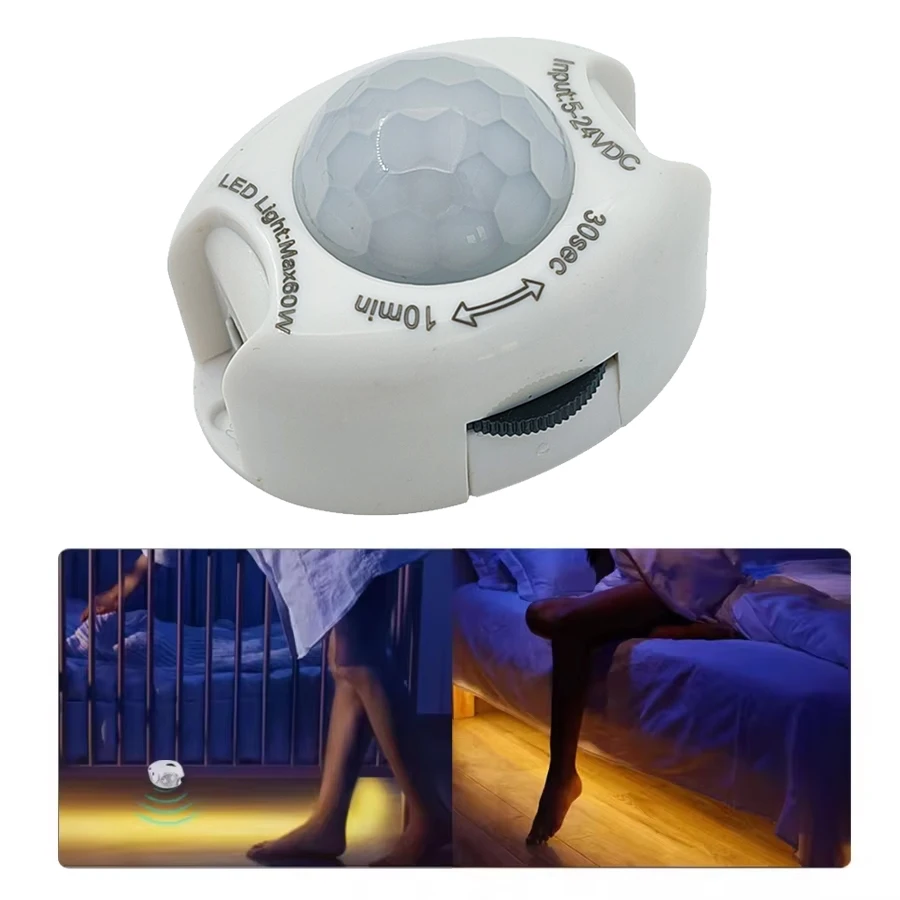
At the heart of this module is its PIR sensor, visible as the domed component on the device's surface. PIR sensors work by detecting infrared energy, which all objects with a temperature above absolute zero emit. When a warm body, such as a person, moves into or out of the sensor's field, it causes a rapid change in the detected infrared energy, triggering the switch. The sensing range is specified at 1-3 meters.
This responsive detection ensures lights turn on promptly as someone enters the detection zone. The minimal response delay is crucial for safety and convenience, especially in dimly lit areas like hallways or closets. It provides immediate illumination, preventing fumbling or accidents.
Many basic motion sensors often suffer from inconsistent detection or significant lag. This module's dedicated PIR design focuses on reliable human body detection. Its effective range, while modest, is optimized for localized applications. This makes it more efficient than broader, less precise detection methods.
Configurable Timing and Ambient Awareness
The module features adjustable timing settings, allowing users to configure the duration the light remains on after motion is no longer detected. Options include 30 seconds and 10 minutes, with a dial for granular adjustment. This customization is vital for different use cases.
For instance, a short 30-second delay is ideal for a closet or pantry, where quick entry and exit are common. A longer 10-minute delay might suit a workshop or under-bed lighting for children, providing sustained illumination. This configurability directly impacts energy efficiency and user satisfaction.
Unlike fixed-delay sensors, this module empowers the user to fine-tune its operation. This prevents lights from turning off too quickly, leading to frustration, or staying on too long, wasting energy. The integrated ambient light sensor also ensures the light only activates in dim conditions or at night, further conserving power. It's a smart feature.
Integration into Modern Smart Homes: A Local Control Approach
While this module is a standalone, direct-wired solution, its simplicity is a strength for specific smart home architectures. It provides local control, meaning its operation does not rely on Wi-Fi, cloud services, or complex network configurations. This ensures extremely low latency and high reliability, as there are no external dependencies.
For advanced users building complex Home Assistant setups, this module can serve as a robust, low-cost trigger for specific lighting zones. Although it doesn't offer direct API access or standard smart home protocols like Zigbee or Z-Wave, its output can be integrated indirectly. For example, the switched output can power a small smart relay or a low-voltage input on a microcontroller like an ESP32, which then communicates with a broader Home Assistant system. This allows for hybrid automation.
This approach minimizes common smart home frustrations. It avoids network dropouts or cloud service interruptions that can plague Wi-Fi-dependent devices. The module acts as a reliable, hard-wired sensor. The low latency of a direct PIR trigger is often superior for immediate light activation compared to a sensor that needs to communicate over a network before triggering a light.
Installation and Placement Considerations
The compact form factor of the module, with its domed sensor, suggests easy installation in discreet locations. Its design is unobtrusive. Optimal placement is key for effective motion detection.
For under-bed lighting, mounting the sensor facing outwards ensures detection upon exiting or entering bed. For stairwells, placing it at the top or bottom, with a clear line of sight, maximizes coverage. Under-cabinet lighting benefits from mounting the sensor near the front edge to detect presence at the countertop. Correct positioning prevents false triggers.
Consider the sensor's field of view and potential obstructions when installing. Avoid placing it directly above heat sources or in areas with constant air currents, which can cause false positives. A clear path to movement is essential. This ensures reliable operation.
Durability and Build
The visible casing appears to be constructed from a durable, white ABS plastic. This material choice is common for indoor electronic components, offering good impact resistance and electrical insulation. The simple, robust design minimizes points of failure.
Its compact size and lack of complex moving parts contribute to its longevity. The absence of external buttons or intricate interfaces reduces wear and tear. This is a device built for function, not excessive aesthetics.
Compared to more fragile, exposed circuit boards, the fully enclosed design protects internal components from dust and minor physical impacts. This enhances its operational lifespan. The build quality suggests a utilitarian, long-lasting device.
Value Proposition: Efficient Automation on a Budget
This motion sensor module offers an exceptionally cost-effective way to introduce automation into specific lighting scenarios. Its low price point makes it accessible for extensive deployment across multiple rooms or areas. The immediate benefit is enhanced convenience and safety.
The energy savings from automatically turning off lights are a significant long-term value. This shifts the focus from the initial purchase price to the ongoing operational savings. It's a smart investment for reducing electricity bills.
Compared to integrating expensive smart bulbs or complex smart switches for every light, this module provides a targeted, efficient solution for dedicated LED strip lighting. It's a pragmatic choice for practical automation. The return on investment is clear.
Imagine stepping out of bed in the middle of the night, and a soft, guiding light immediately illuminates your path, then gently fades as you return. Picture opening a closet door and having the interior instantly lit, revealing your clothes without fumbling for a switch. Envision walking up a darkened staircase, each step anticipated by a welcoming glow. This module delivers seamless, intuitive lighting that anticipates your needs, transforming mundane moments into effortless experiences. It's about enhancing comfort and efficiency in your daily life, creating an environment that responds to your presence with subtle intelligence.