Javino 10x38 Fast Blow Ceramic Fuses
Official Store Deal
Expert Analysis Overview
The Unseen Guardian: Essential Circuit Protection
The Javino 10x38 Fast Blow Ceramic Fuse is a critical protective component for solar energy systems, engineered to safeguard sensitive electronics from sudden current surges. This product offers a robust defense mechanism for direct current (DC) circuits, which are prevalent in renewable energy installations. Its design emphasizes reliability and rapid fault isolation, crucial for maintaining system integrity.
Guarding the Power Flow: Overcurrent Defense
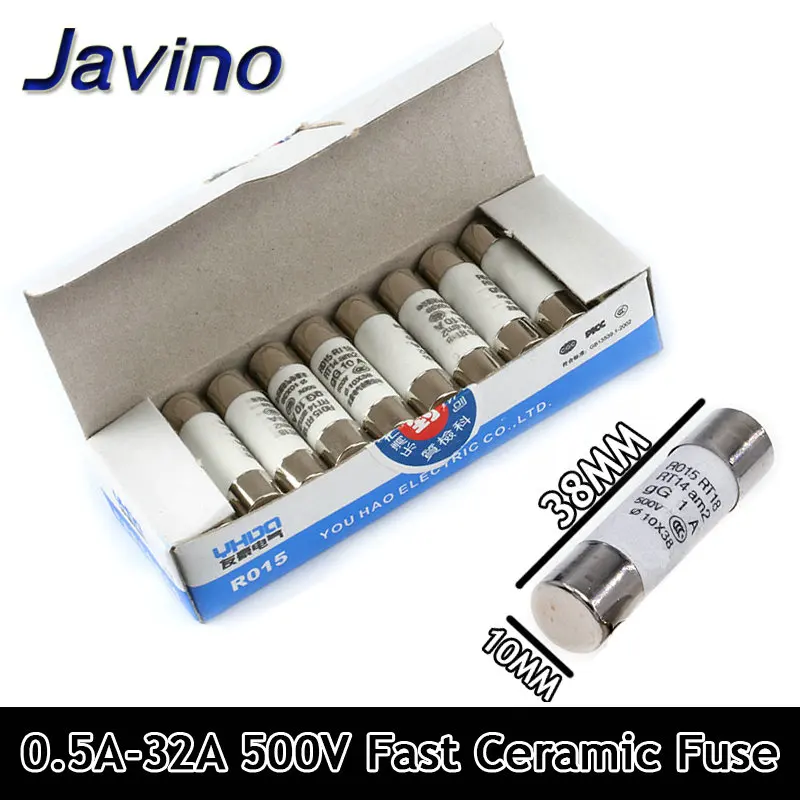
The Javino 10x38 fast-blow ceramic fuses are visibly constructed with a robust ceramic body and metallic end caps, indicating a focus on high-performance electrical protection. These cylindrical components measure 10mm in diameter and 38mm in length, a widely adopted form factor for fuse cartridges. A comprehensive range of current ratings, from 0.5A up to 32A, is readily available.
This deliberate design implies a rapid and decisive response to overcurrent conditions within an electrical circuit. When a fault occurs, such as a short circuit or a significant overload, the internal fuse element is engineered to melt with extreme speed. This immediate interruption prevents excessive current from flowing through and damaging sensitive downstream equipment, like charge controllers, inverters, or battery management systems in a solar setup. Protection is instant.
Unlike standard slow-blow fuses, which are designed to tolerate brief, harmless overcurrents for motor startup or inductive loads, these fast-blow variants are specifically engineered for instantaneous action. Generic fuses might allow a surge to persist for milliseconds longer. This rapid response is absolutely critical in protecting semiconductor devices, which are exceptionally susceptible to even momentary current spikes and can be irrevocably damaged. A quick reaction saves components.
Engineering for High-Voltage DC Environments
The fuses carry a significant 500V voltage rating, a specification prominently displayed and indicative of their intended use in higher voltage applications. The choice of a ceramic body, rather than glass, is a key material decision for these electrical safeguards. Ceramic provides superior mechanical strength and thermal stability under fault conditions.
This 500V rating directly implies suitability for handling the voltages typically generated by solar photovoltaic (PV) arrays, especially in larger string configurations. DC fault interruption is inherently more challenging than AC fault interruption due to the lack of a natural zero-crossing point. The ceramic construction ensures the fuse can safely extinguish the arc formed during a high-current DC interruption, preventing sustained arcing that could damage the fuse holder or surrounding components. It handles the heat.
Compared to fuses designed solely for lower voltage AC applications, these 500V ceramic fuses offer a critical safety margin for solar systems. The ability to reliably interrupt high-voltage DC faults is paramount for preventing fires and catastrophic equipment failures. Generic low-voltage fuses simply cannot withstand such demands. This is a specialized component.
Precision in Protection: Amperage Versatility
The product offers an extensive selection of current ratings, spanning from a delicate 0.5A to a robust 32A. This wide array of options ensures that system designers and solar hobbyists can select a fuse precisely matched to the specific current requirements of each circuit segment within their energy system. Precise matching is possible.
This broad amperage range is particularly beneficial for complex solar installations, allowing for tailored protection of diverse components. A 0.5A fuse might protect a delicate monitoring circuit, while a 32A fuse could safeguard a main power line from a battery bank to an inverter. This granularity ensures that only the affected circuit is isolated during a fault, minimizing downtime for the entire system. Each component gets its guard.
Unlike generic fuse assortments that offer only a few common ratings, this comprehensive selection allows for optimal circuit design, preventing both under-fusing (which leads to nuisance blowing) and over-fusing (which fails to protect adequately). The importance of correctly sized fuses cannot be overstated when calculating efficiency losses and ensuring the longevity of expensive solar equipment. It prevents costly errors.
Standardization and Seamless Integration
The consistent 10x38mm dimensions of these Javino fuses adhere to a widely recognized international standard for cylindrical fuses. Furthermore, their compliance with RO15, RT18, and RT14 standards underscores their adherence to established electrical safety and performance benchmarks. Standard dimensions simplify integration.
This adherence to standardized dimensions and international norms implies broad compatibility with a vast array of fuse holders and blocks commonly available in the electrical market. For a solar energy hobbyist building a self-sustaining energy system, this means easier sourcing of compatible components and straightforward replacement procedures. System expansion becomes simpler.
In contrast to proprietary or less common fuse sizes, standardized components significantly reduce the complexity and cost associated with system maintenance and upgrades. This ensures that the fuses can be seamlessly integrated into existing solar setups, verifying compatibility with minimal effort. It simplifies the build process.
The Ceramic Advantage: Superior Breaking Capacity
The use of ceramic material for the fuse body is a distinct advantage over more common glass fuses, especially in high-energy applications. Ceramic is non-conductive and possesses excellent thermal properties. This material choice is not merely aesthetic.
This material choice directly implies a significantly higher breaking capacity, which is the maximum current a fuse can safely interrupt without rupturing or causing an external arc. In solar systems, particularly with large battery banks or high-power inverters, fault currents can be substantial. The ceramic body effectively contains the arc generated during a fault, suppressing it rapidly and safely. It handles extreme conditions.
Unlike brittle glass fuses, which can shatter under high fault currents, ceramic fuses offer superior mechanical and thermal resilience. This makes them a more reliable and safer choice for critical power protection where high DC currents are present. The