Javino Multi-Channel Optocoupled Relay Modules
Official Store Deal
Expert Analysis Overview
The Javino Multi-Channel Optocoupled Relay Modules are essential interface components designed for hobbyists and engineers building automated solar energy systems, offering robust isolation between control logic and high-power loads. These modules bridge the gap between low-voltage microcontrollers and the higher voltage or current requirements often found in solar installations, such as switching DC loads from batteries or controlling AC inverters. Their modular design, available in 1, 2, 4, and 8 channel configurations, provides significant flexibility for projects ranging from simple lighting automation to complex energy management systems. The inclusion of optocouplers is a critical safety and reliability feature, ensuring galvanic isolation. This protects sensitive microcontroller circuitry from voltage spikes, noise, and potential damage originating from the high-power side of the system, a common concern when integrating diverse electrical components in renewable energy setups. The various channel counts allow for precise control over multiple independent circuits, optimizing resource allocation and system efficiency within a self-sustaining energy framework. These modules are a cornerstone for any solar energy enthusiast aiming for reliable, automated control.
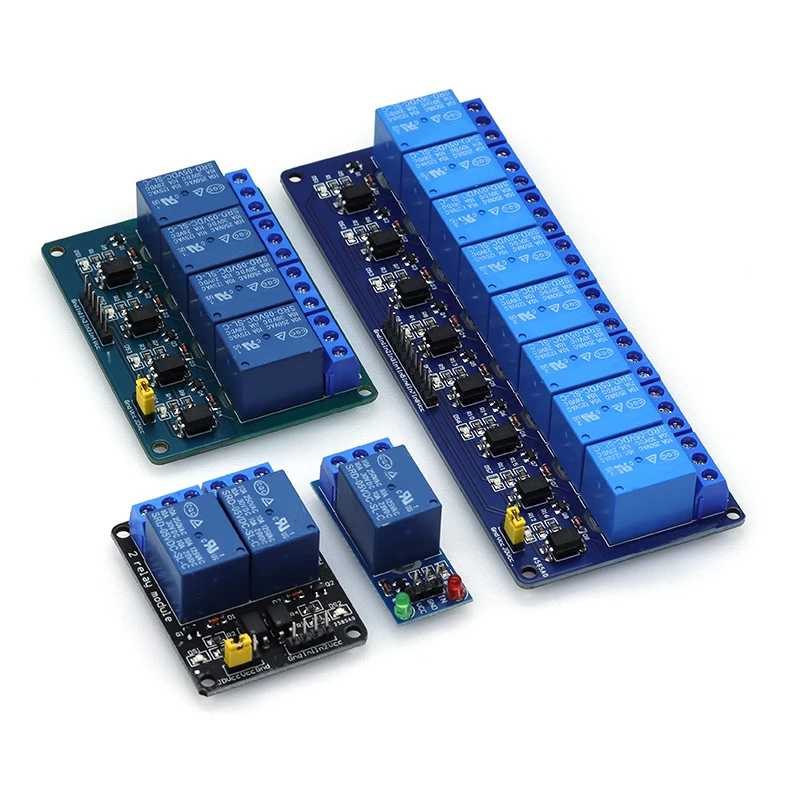
These relay modules feature distinct blue mechanical relays, clearly visible across all channel configurations. Each relay includes screw terminals for secure and robust connections to the load. The visible components indicate a standard electromagnetic relay mechanism, capable of switching both DC and AC loads within their specified current and voltage limits. This capability is paramount for solar applications, where managing power flow from panels to batteries, or from batteries to inverters, often requires switching higher currents than a microcontroller can directly handle. The modules are designed to accept standard control signals, typically 5V or 12V DC, making them compatible with popular development boards like Arduino, ESP32, or Raspberry Pi. This direct compatibility streamlines the integration process, allowing for rapid prototyping and deployment of automated solar solutions. Control is simple.
In a typical solar energy setup, these relays could manage the activation of a charge controller, divert excess solar power to a heating element, or switch between grid power and battery power for specific loads. Unlike attempting to drive high-current loads directly from a microcontroller's GPIO pins—a practice that risks immediate and irreparable damage to the control board—these relay modules provide a safe, isolated intermediary. They act as robust digital switches, translating a low-power digital signal into a high-power switching action. This ensures the longevity of expensive control electronics while enabling the management of significant electrical loads. This isolation is crucial.
Compared to simpler transistor-based switches, which can also handle higher currents but often lack galvanic isolation, these relay modules offer superior protection. The physical separation provided by the relay contacts means there is no electrical connection between the control circuit and the load circuit when the relay is open. This prevents ground loops, voltage spikes, and electromagnetic interference from propagating back to the microcontroller. For critical solar infrastructure, where reliability and protection are non-negotiable, this design choice represents a significant upgrade in system integrity. It's a fundamental safeguard.
A key feature highlighted by the product title is the inclusion of an optocoupler on each channel. These small black integrated circuits are clearly visible on the PCBs, positioned between the input pins and the relay driver circuitry. An optocoupler uses light to transmit a signal across an electrical barrier, effectively creating a complete electrical separation, or galvanic isolation, between the control side and the load side of the module. This isolation is not merely a convenience; it is a fundamental requirement for robust and safe electrical systems, especially those dealing with power generation and distribution.
In a solar energy context, where power fluctuations, inductive kicks from motors, or even lightning strikes can introduce significant noise and voltage transients, an optocoupler acts as an indispensable protective barrier. It prevents these potentially damaging electrical events from reaching and corrupting or destroying the sensitive digital logic of a microcontroller. Imagine a scenario where a large inductive load, like a water pump in an off-grid irrigation system, is switched off. The back-EMF generated could easily fry a microcontroller without proper isolation. The optocoupler ensures the control signal remains pristine. This protects your investment.
Unlike direct wiring or basic transistor switching circuits that share a common ground or have direct electrical pathways, the optocoupled design of these modules offers a distinct advantage. It significantly reduces the risk of electrical noise interfering with digital signals, leading to more stable and predictable system operation. This is particularly important for solar setups where sensors, communication modules, and power electronics all coexist and can generate varying levels of electrical interference. The cleaner control signals lead to more reliable automation, reducing troubleshooting time and increasing system uptime. It's a smart design choice.
The availability of these modules in 1, 2, 4, and 8 channel configurations provides immense design flexibility. The images clearly show the different board sizes accommodating these varying relay counts, from a compact single-channel unit to an extended 8-channel board. This range allows solar energy hobbyists to select the precise number of control points needed for their specific application, avoiding unnecessary bulk or the need to daisy-chain multiple smaller modules.
For a small, focused solar project, such as automating a single garden light or controlling a single DC fan based on temperature, a 1-channel or 2-channel module is perfectly adequate and space-efficient. Conversely, a more ambitious project, like a smart home energy management system that controls multiple lighting zones, a solar water heater pump, and an automatic battery disconnect, would benefit significantly from an 8-channel module. This consolidation simplifies wiring, reduces the number of individual components, and makes the overall system more organized and easier to maintain. Fewer components mean less complexity.
This modularity stands in contrast to fixed-function controllers or custom-built relay boards, which might offer too many or too few channels for a given task. By providing a spectrum of options, Javino allows users to scale their automation solutions precisely. This adaptability is crucial for hobbyists whose projects often evolve or expand over time. It ensures that the control system can grow with the solar installation, from a basic setup to a comprehensive, fully automated energy solution. The right size is available.
The product description specifies both 5V and 12V variants of these relay modules. This dual voltage compatibility is a significant advantage for integration into various solar energy systems. The 5V versions are directly compatible with the standard operating voltage of most popular microcontrollers like Arduino Uno, ESP32, and Raspberry Pi, which typically operate on a 5V logic level or can easily interface with it. This simplifies the power supply requirements for the control side of the relay module.
For larger solar systems, particularly those built around 12V battery banks, the 12V relay modules offer direct compatibility with the system's primary power source. This means the relay coil can be powered directly from the 12V battery, reducing the need for additional voltage converters or separate power supplies. This direct integration streamlines the system architecture, minimizes potential points of failure, and can slightly improve overall system efficiency by reducing conversion losses. Direct power is simpler.
Compared to modules that are strictly 5V or 12V, having both options available ensures broader applicability across different solar project scales and designs. A hobbyist building a small portable solar charger might prefer 5V modules for simplicity, while someone constructing an off-grid cabin power system might opt for 12V modules to align with their battery bank voltage. This choice allows for optimized design and power management, ensuring that the control circuitry operates reliably within the established voltage parameters of the solar installation. It's about seamless integration.
Installation of these relay modules is straightforward, thanks to their standardized design. Each module features standard header pins for connecting to a microcontroller's GPIO (General Purpose Input/Output) pins, typically requiring VCC (power), GND (ground), and one or more IN (input signal) pins. The images show clearly labeled screw terminals for connecting the high-power loads, providing a secure connection for wires. This method of connection is preferred for higher current applications compared to simple pin headers, reducing the risk of loose connections or arcing.
For a solar charging system, wiring might involve connecting a 5V relay module to an Arduino, then using the relay's normally open (NO) and common (COM) terminals to switch a 12V DC pump that circulates water for a solar thermal collector. The clear labeling on the PCB, visible in the images, aids in correct wiring, reducing the chance of errors during setup. The compact form factor, especially for the 1and 2-channel modules, allows for easy placement within project enclosures. Setup is intuitive.
Unlike complex power electronics that might require specialized soldering or intricate circuit design, these modules are essentially plug-and-play components. Their pre-assembled nature means users can focus on the logic and application of their solar project rather than spending time on fundamental circuit construction. This dramatically lowers the barrier to entry for beginners and accelerates development for experienced engineers. The robust screw terminals ensure reliable connections, a critical factor for systems that may experience vibrations or need to operate continuously for extended periods. This simplifies project development.
The visible construction of the PCBs, with well-soldered components and clear traces, implies a design intended for reliable operation. The use of standard blue mechanical relays, while not solid-state, are known for their robustness in switching various loads. The boards appear to be made of FR-4 fiberglass, a common and durable material for circuit boards, providing a stable platform for the electronic components. This level of construction is suitable for the demands of hobbyist and light industrial solar applications, where components might be exposed to varying environmental conditions within an enclosure.
For a solar energy system, where components are often expected to operate for years without intervention, the durability of these relay modules is a key consideration. They are designed to withstand repeated switching cycles, making them suitable for tasks like daily activation of solar-powered irrigation pumps or night-time disconnection of specific loads to conserve battery power. While mechanical relays have a finite number of switching cycles, for most solar automation tasks, their lifespan is more than adequate. Regular operation is expected.
Compared to generic, unbranded modules, the consistent appearance and clear component labeling suggest a level of quality control. While not industrial-grade, these modules offer a cost-effective and sufficiently robust solution for most DIY solar projects. Their design prioritizes functionality and protection, ensuring that the critical control interface remains operational even when managing demanding electrical loads. This provides peace of mind for those investing time and resources into building their own sustainable energy solutions. Reliability is built-in.
Imagine your fully automated solar energy system, seamlessly managing power flow, optimizing battery usage, and activating various loads with precision. These Javino relay modules are the silent workhorses making it all possible, protecting your sensitive electronics while empowering your sustainable vision. Picture your off-grid cabin, where lights, pumps, and appliances respond intelligently to available solar power, all orchestrated by a robust and reliable control system. This is the future these modules help you build, bringing your solar dreams to tangible reality, day after day, year after year.
The Heart of Automation: Switching Power Efficiently
These relay modules feature distinct blue mechanical relays, clearly visible across all channel configurations. Each relay includes screw terminals for secure and robust connections to the load. The visible components indicate a standard electromagnetic relay mechanism, capable of switching both DC and AC loads within their specified current and voltage limits. This capability is paramount for solar applications, where managing power flow from panels to batteries, or from batteries to inverters, often requires switching higher currents than a microcontroller can directly handle. The modules are designed to accept standard control signals, typically 5V or 12V DC, making them compatible with popular development boards like Arduino, ESP32, or Raspberry Pi. This direct compatibility streamlines the integration process, allowing for rapid prototyping and deployment of automated solar solutions. Control is simple.
In a typical solar energy setup, these relays could manage the activation of a charge controller, divert excess solar power to a heating element, or switch between grid power and battery power for specific loads. Unlike attempting to drive high-current loads directly from a microcontroller's GPIO pins—a practice that risks immediate and irreparable damage to the control board—these relay modules provide a safe, isolated intermediary. They act as robust digital switches, translating a low-power digital signal into a high-power switching action. This ensures the longevity of expensive control electronics while enabling the management of significant electrical loads. This isolation is crucial.
Compared to simpler transistor-based switches, which can also handle higher currents but often lack galvanic isolation, these relay modules offer superior protection. The physical separation provided by the relay contacts means there is no electrical connection between the control circuit and the load circuit when the relay is open. This prevents ground loops, voltage spikes, and electromagnetic interference from propagating back to the microcontroller. For critical solar infrastructure, where reliability and protection are non-negotiable, this design choice represents a significant upgrade in system integrity. It's a fundamental safeguard.
Galvanic Isolation: A Shield for Your Microcontroller
A key feature highlighted by the product title is the inclusion of an optocoupler on each channel. These small black integrated circuits are clearly visible on the PCBs, positioned between the input pins and the relay driver circuitry. An optocoupler uses light to transmit a signal across an electrical barrier, effectively creating a complete electrical separation, or galvanic isolation, between the control side and the load side of the module. This isolation is not merely a convenience; it is a fundamental requirement for robust and safe electrical systems, especially those dealing with power generation and distribution.
In a solar energy context, where power fluctuations, inductive kicks from motors, or even lightning strikes can introduce significant noise and voltage transients, an optocoupler acts as an indispensable protective barrier. It prevents these potentially damaging electrical events from reaching and corrupting or destroying the sensitive digital logic of a microcontroller. Imagine a scenario where a large inductive load, like a water pump in an off-grid irrigation system, is switched off. The back-EMF generated could easily fry a microcontroller without proper isolation. The optocoupler ensures the control signal remains pristine. This protects your investment.
Unlike direct wiring or basic transistor switching circuits that share a common ground or have direct electrical pathways, the optocoupled design of these modules offers a distinct advantage. It significantly reduces the risk of electrical noise interfering with digital signals, leading to more stable and predictable system operation. This is particularly important for solar setups where sensors, communication modules, and power electronics all coexist and can generate varying levels of electrical interference. The cleaner control signals lead to more reliable automation, reducing troubleshooting time and increasing system uptime. It's a smart design choice.
Scalability for Diverse Solar Projects
The availability of these modules in 1, 2, 4, and 8 channel configurations provides immense design flexibility. The images clearly show the different board sizes accommodating these varying relay counts, from a compact single-channel unit to an extended 8-channel board. This range allows solar energy hobbyists to select the precise number of control points needed for their specific application, avoiding unnecessary bulk or the need to daisy-chain multiple smaller modules.
For a small, focused solar project, such as automating a single garden light or controlling a single DC fan based on temperature, a 1-channel or 2-channel module is perfectly adequate and space-efficient. Conversely, a more ambitious project, like a smart home energy management system that controls multiple lighting zones, a solar water heater pump, and an automatic battery disconnect, would benefit significantly from an 8-channel module. This consolidation simplifies wiring, reduces the number of individual components, and makes the overall system more organized and easier to maintain. Fewer components mean less complexity.
This modularity stands in contrast to fixed-function controllers or custom-built relay boards, which might offer too many or too few channels for a given task. By providing a spectrum of options, Javino allows users to scale their automation solutions precisely. This adaptability is crucial for hobbyists whose projects often evolve or expand over time. It ensures that the control system can grow with the solar installation, from a basic setup to a comprehensive, fully automated energy solution. The right size is available.
Powering Your Solar Innovations: Voltage Compatibility
The product description specifies both 5V and 12V variants of these relay modules. This dual voltage compatibility is a significant advantage for integration into various solar energy systems. The 5V versions are directly compatible with the standard operating voltage of most popular microcontrollers like Arduino Uno, ESP32, and Raspberry Pi, which typically operate on a 5V logic level or can easily interface with it. This simplifies the power supply requirements for the control side of the relay module.
For larger solar systems, particularly those built around 12V battery banks, the 12V relay modules offer direct compatibility with the system's primary power source. This means the relay coil can be powered directly from the 12V battery, reducing the need for additional voltage converters or separate power supplies. This direct integration streamlines the system architecture, minimizes potential points of failure, and can slightly improve overall system efficiency by reducing conversion losses. Direct power is simpler.
Compared to modules that are strictly 5V or 12V, having both options available ensures broader applicability across different solar project scales and designs. A hobbyist building a small portable solar charger might prefer 5V modules for simplicity, while someone constructing an off-grid cabin power system might opt for 12V modules to align with their battery bank voltage. This choice allows for optimized design and power management, ensuring that the control circuitry operates reliably within the established voltage parameters of the solar installation. It's about seamless integration.
Installation and Integration: A Practical Approach
Installation of these relay modules is straightforward, thanks to their standardized design. Each module features standard header pins for connecting to a microcontroller's GPIO (General Purpose Input/Output) pins, typically requiring VCC (power), GND (ground), and one or more IN (input signal) pins. The images show clearly labeled screw terminals for connecting the high-power loads, providing a secure connection for wires. This method of connection is preferred for higher current applications compared to simple pin headers, reducing the risk of loose connections or arcing.
For a solar charging system, wiring might involve connecting a 5V relay module to an Arduino, then using the relay's normally open (NO) and common (COM) terminals to switch a 12V DC pump that circulates water for a solar thermal collector. The clear labeling on the PCB, visible in the images, aids in correct wiring, reducing the chance of errors during setup. The compact form factor, especially for the 1
Unlike complex power electronics that might require specialized soldering or intricate circuit design, these modules are essentially plug-and-play components. Their pre-assembled nature means users can focus on the logic and application of their solar project rather than spending time on fundamental circuit construction. This dramatically lowers the barrier to entry for beginners and accelerates development for experienced engineers. The robust screw terminals ensure reliable connections, a critical factor for systems that may experience vibrations or need to operate continuously for extended periods. This simplifies project development.
Durability and Longevity in Energy Systems
The visible construction of the PCBs, with well-soldered components and clear traces, implies a design intended for reliable operation. The use of standard blue mechanical relays, while not solid-state, are known for their robustness in switching various loads. The boards appear to be made of FR-4 fiberglass, a common and durable material for circuit boards, providing a stable platform for the electronic components. This level of construction is suitable for the demands of hobbyist and light industrial solar applications, where components might be exposed to varying environmental conditions within an enclosure.
For a solar energy system, where components are often expected to operate for years without intervention, the durability of these relay modules is a key consideration. They are designed to withstand repeated switching cycles, making them suitable for tasks like daily activation of solar-powered irrigation pumps or night-time disconnection of specific loads to conserve battery power. While mechanical relays have a finite number of switching cycles, for most solar automation tasks, their lifespan is more than adequate. Regular operation is expected.
Compared to generic, unbranded modules, the consistent appearance and clear component labeling suggest a level of quality control. While not industrial-grade, these modules offer a cost-effective and sufficiently robust solution for most DIY solar projects. Their design prioritizes functionality and protection, ensuring that the critical control interface remains operational even when managing demanding electrical loads. This provides peace of mind for those investing time and resources into building their own sustainable energy solutions. Reliability is built-in.
Imagine your fully automated solar energy system, seamlessly managing power flow, optimizing battery usage, and activating various loads with precision. These Javino relay modules are the silent workhorses making it all possible, protecting your sensitive electronics while empowering your sustainable vision. Picture your off-grid cabin, where lights, pumps, and appliances respond intelligently to available solar power, all orchestrated by a robust and reliable control system. This is the future these modules help you build, bringing your solar dreams to tangible reality, day after day, year after year.