LCTC Slim Solid State Relays (SSR-41FDA & SSR-41FDD)
Official Store Deal
Expert Analysis Overview
The LCTC Slim Solid State Relays (SSR-41FDA & SSR-41FDD) are precision-engineered switching components designed for reliable, non-contact control in both AC and DC load applications. These devices offer a significant upgrade over traditional mechanical relays, providing silent operation, extended lifespan, and faster switching speeds critical for modern automation and control systems.
Solid State Relays, or SSRs, represent a fundamental shift from electromechanical switching. Unlike their mechanical counterparts, which rely on physical contacts that wear down, arc, and generate noise, SSRs utilize semiconductor devices to perform the switching function. This inherent design eliminates moving parts, leading to a drastically improved operational lifespan and enhanced reliability in demanding environments.
This non-contact methodology ensures that the LCTC SSRs maintain signal integrity over prolonged periods. The absence of arcing contacts also significantly reduces electromagnetic interference (EMI) and radio-frequency interference (RFI), which is a crucial consideration in sensitive electronic systems where clean signal transmission is paramount. Traditional relays often introduce electrical noise, complicating circuit design and potentially affecting other components. These SSRs mitigate such concerns effectively.
Compared to standard mechanical relays that are prone to contact bounce and eventual failure due to mechanical fatigue, these LCTC SSRs offer a robust alternative. Their solid-state nature means they can handle rapid switching cycles without degradation, making them ideal for applications requiring frequent on/off operations. This capability translates directly into reduced maintenance costs and increased system uptime, offering a compelling return on investment for industrial and hobbyist applications alike.
The LCTC series is presented with two distinct models: the SSR-41FDA and the SSR-41FDD. Each model is optimized for specific load types, ensuring precise and efficient power management.
The SSR-41FDA model is engineered for DC to AC control. This means it accepts a low-voltage DC control signal, typically from a microcontroller or PLC, and uses it to switch a higher voltage AC load. The specifications indicate a control voltage range of 3-32VDC, making it highly compatible with common logic-level outputs from devices like Arduino, Raspberry Pi, or industrial control systems. The load voltage capacity spans 24-250VAC.
This configuration is invaluable in scenarios where a low-power control system needs to manage standard household or industrial AC equipment. Imagine a smart home system using a 5V logic signal to turn on a 240V AC light fixture or a heating element. The SSR-41FDA executes this transition silently and efficiently. Its ability to handle up to 6A peak current means it can manage a variety of moderate AC loads, from lighting circuits to small motors or solenoid valves.
Unlike direct mechanical relays that might struggle with inductive AC loads or require additional snubbing circuits to prevent arcing, the SSR-41FDA's solid-state design inherently manages these challenges more gracefully. The specified 24-250VAC load range covers most global AC power standards, offering broad applicability. This versatility makes it a go-to component for automating AC-powered devices with DC control signals, simplifying complex control schemes.
Conversely, the SSR-41FDD model is designed for DC to DC control. It takes a DC control signal (again, 3-32VDC) and switches a separate DC load. The load voltage range for this variant is 5-60VDC, accommodating a wide array of DC-powered devices.
This model finds its niche in applications where DC power needs to be precisely controlled by another DC signal. Consider robotics, automotive electronics, or specialized industrial machinery that operates entirely on DC power. A microcontroller could activate a 12V DC motor, a 24V DC solenoid, or a bank of 48V DC LEDs using the SSR-41FDD. Its 6A peak current rating ensures it can handle substantial DC loads without issue.
The SSR-41FDD offers superior performance compared to using mechanical relays for DC switching, particularly when dealing with inductive DC loads. Mechanical relays switching DC can experience significant arcing, leading to rapid contact degradation. The solid-state nature of the SSR-41FDD eliminates this, providing a much cleaner and more reliable switching action. This ensures the longevity of both the relay and the controlled DC components, which is critical for maintaining system integrity.
Several key specifications define the performance envelope of these LCTC slim relays, highlighting their suitability for various applications.
Both the SSR-41FDA and SSR-41FDD models share a common control voltage range of 3-32VDC. This broad compatibility is a significant advantage. It means these relays can be directly driven by the digital output pins of most microcontrollers (e.g., 3.3V, 5V) without requiring additional driver circuitry. It is very flexible.
This wide range simplifies integration into existing electronic projects and industrial control panels. Engineers and hobbyists can confidently incorporate these SSRs into systems powered by various DC logic levels, reducing complexity and component count. The low control current required (50mA-1A for FDA, <0.8A for FDD) ensures that the control source is not unduly burdened, preserving its stability and performance.
In practical terms, this allows for seamless interfacing with a vast ecosystem of development boards and programmable logic controllers. The robustness of the control input ensures reliable triggering even with slight variations in the control signal voltage, a common occurrence in real-world applications. This makes the LCTC SSRs a dependable choice for diverse control architectures.
A peak current rating of 6A is specified for both models. This indicates their capacity to switch moderate electrical loads. For many common applications, such as controlling small motors, LED strips, or heating elements, 6A provides ample headroom. However, the nature of solid-state devices means that they generate heat when conducting current.
For continuous operation at or near the 6A limit, proper thermal management becomes a critical consideration. While the slim form factor is advantageous for space-saving, it also implies a smaller surface area for passive heat dissipation. In scenarios with sustained high current flow, an external heatsink or adequate airflow within the enclosure may be necessary to prevent the relay from overheating and potentially failing. Overheating can lead to reduced lifespan or premature failure.
Understanding the thermal implications is key to maximizing the lifespan and reliability of these SSRs. Unlike mechanical relays that dissipate heat primarily through their coil, SSRs dissipate heat through their semiconductor junctions. Designing for appropriate cooling ensures that the relay operates within its safe temperature limits, maintaining its specified performance characteristics over time. This careful consideration prevents unexpected system downtime.
Both models boast an off-state time of ≤10ms. This specification highlights the rapid switching capability inherent to solid-state technology. A 10-millisecond response time is significantly faster than many mechanical relays, which can have switching times in the tens or even hundreds of milliseconds due to the physical movement of contacts.
This fast response is crucial for applications requiring precise timing or rapid control cycles, such as pulse-width modulation (PWM) for motor speed control or fast-acting safety interlocks. The quick transition from off to on and vice-versa minimizes latency in control systems, allowing for more responsive and accurate operation. This contributes to the overall efficiency and precision of the controlled system.
The rapid switching capability also reduces the duration of transient states, which can be a source of electrical noise or stress on components. By quickly settling into either an on or off state, these SSRs contribute to a more stable electrical environment. This makes them particularly suitable for high-frequency switching tasks where mechanical relays would quickly degrade or introduce unacceptable delays.
The physical design of these LCTC SSRs emphasizes compact integration and robust connectivity.
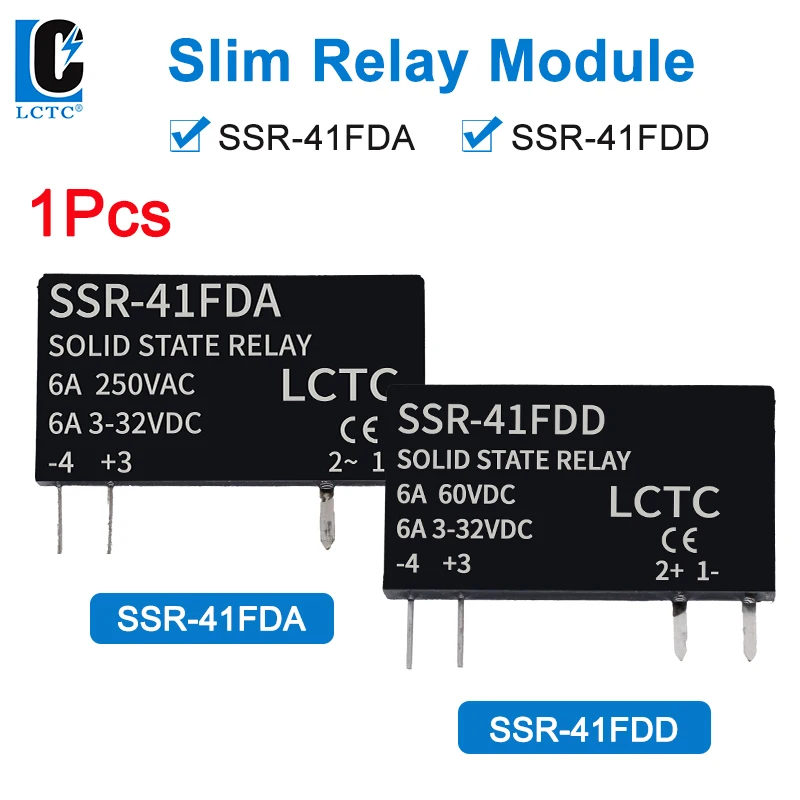
The images clearly depict a slim relay module. This compact design is a significant advantage in modern electronic systems where space is often at a premium. Whether integrating into a crowded PCB, a compact control panel, or a small project enclosure, the minimal footprint of these relays allows for denser component placement. This contributes to smaller overall product sizes and more efficient use of available space.
The slim profile also makes these relays suitable for applications where multiple switching channels are required in a confined area. It simplifies the layout of control boards, reducing the need for larger enclosures or complex wiring harnesses. This space efficiency is a direct benefit for designers looking to optimize their product's physical dimensions without compromising on functionality or performance.
Compared to bulkier mechanical relays or even some larger SSRs, the slim design of these LCTC models offers a distinct advantage in miniaturization efforts. This allows for more streamlined and aesthetically pleasing product designs, which can be a competitive differentiator in various markets. The compact nature does not detract from their electrical capabilities.
The insert installation method is evident from the visible pins designed for through-hole mounting. This method provides a mechanically strong and electrically reliable connection to a printed circuit board (PCB). Soldered connections are known for their durability and resistance to vibration, which is important in many industrial and automotive applications.
The visible pins appear sturdy, suggesting a good mechanical interface with the PCB. Proper soldering ensures low contact resistance, which is vital for efficient power transfer and minimizing heat generation at the connection points. This method contrasts with surface-mount components, which can sometimes be more challenging for hobbyists or small-batch production without specialized equipment. The through-hole design offers ease of assembly.
The robust nature of insert installation contributes to the long-term reliability of the overall system. Once soldered, the relays are securely fixed, reducing the risk of intermittent connections or dislodgement due to environmental factors. This focus on secure physical integration underscores the product's suitability for applications requiring sustained, dependable operation. The connections are built to last.
These LCTC slim solid state relays offer a compelling value proposition for a wide range of users, from industrial automation engineers to electronics hobbyists.
For industrial applications, the reliability and extended lifespan of SSRs translate directly into reduced downtime and lower maintenance costs. Replacing a mechanical relay that fails prematurely can be an expensive endeavor, both in terms of the component cost and the labor involved. These SSRs, with their robust solid-state design, minimize such risks. They ensure continuous operation of critical machinery, which is invaluable in production environments.
In the realm of electronics repair, these affordable components provide an excellent solution for fixing expensive equipment where a faulty relay might be the only issue. Instead of replacing an entire control board, a technician can often desolder a failed mechanical relay and replace it with one of these LCTC SSRs, potentially upgrading the system's reliability in the process. This approach offers a cost-effective repair strategy.
For hobbyists and DIY enthusiasts, the ease of integration with microcontrollers and the clear differentiation between AC and DC load switching models simplify project design. The ability to control higher power loads with low-voltage logic signals opens up possibilities for sophisticated home automation, robotics, and custom control systems. The competitive price point makes advanced control accessible without breaking the bank.
These LCTC slim solid state relays represent a smart investment for anyone seeking to implement reliable, efficient, and long-lasting electrical switching solutions. Their compact size, versatile control options, and inherent durability make them a superior choice over traditional mechanical relays in virtually any application where silent, fast, and frequent switching is required. Imagine the peace of mind knowing your automated systems are running on components designed for longevity and precision, operating silently in the background, reliably executing every command. This is the capability these SSRs bring to your projects and systems, ensuring consistent performance and minimizing the need for future interventions. The upgrade in reliability is tangible.
The Evolution of Switching: Solid-State Superiority
Solid State Relays, or SSRs, represent a fundamental shift from electromechanical switching. Unlike their mechanical counterparts, which rely on physical contacts that wear down, arc, and generate noise, SSRs utilize semiconductor devices to perform the switching function. This inherent design eliminates moving parts, leading to a drastically improved operational lifespan and enhanced reliability in demanding environments.
This non-contact methodology ensures that the LCTC SSRs maintain signal integrity over prolonged periods. The absence of arcing contacts also significantly reduces electromagnetic interference (EMI) and radio-frequency interference (RFI), which is a crucial consideration in sensitive electronic systems where clean signal transmission is paramount. Traditional relays often introduce electrical noise, complicating circuit design and potentially affecting other components. These SSRs mitigate such concerns effectively.
Compared to standard mechanical relays that are prone to contact bounce and eventual failure due to mechanical fatigue, these LCTC SSRs offer a robust alternative. Their solid-state nature means they can handle rapid switching cycles without degradation, making them ideal for applications requiring frequent on/off operations. This capability translates directly into reduced maintenance costs and increased system uptime, offering a compelling return on investment for industrial and hobbyist applications alike.
Tailored Control: DC to AC and DC to DC Variants
The LCTC series is presented with two distinct models: the SSR-41FDA and the SSR-41FDD. Each model is optimized for specific load types, ensuring precise and efficient power management.
SSR-41FDA: Bridging DC Control to AC Loads
The SSR-41FDA model is engineered for DC to AC control. This means it accepts a low-voltage DC control signal, typically from a microcontroller or PLC, and uses it to switch a higher voltage AC load. The specifications indicate a control voltage range of 3-32VDC, making it highly compatible with common logic-level outputs from devices like Arduino, Raspberry Pi, or industrial control systems. The load voltage capacity spans 24-250VAC.
This configuration is invaluable in scenarios where a low-power control system needs to manage standard household or industrial AC equipment. Imagine a smart home system using a 5V logic signal to turn on a 240V AC light fixture or a heating element. The SSR-41FDA executes this transition silently and efficiently. Its ability to handle up to 6A peak current means it can manage a variety of moderate AC loads, from lighting circuits to small motors or solenoid valves.
Unlike direct mechanical relays that might struggle with inductive AC loads or require additional snubbing circuits to prevent arcing, the SSR-41FDA's solid-state design inherently manages these challenges more gracefully. The specified 24-250VAC load range covers most global AC power standards, offering broad applicability. This versatility makes it a go-to component for automating AC-powered devices with DC control signals, simplifying complex control schemes.
SSR-41FDD: Precision DC Switching for DC Systems
Conversely, the SSR-41FDD model is designed for DC to DC control. It takes a DC control signal (again, 3-32VDC) and switches a separate DC load. The load voltage range for this variant is 5-60VDC, accommodating a wide array of DC-powered devices.
This model finds its niche in applications where DC power needs to be precisely controlled by another DC signal. Consider robotics, automotive electronics, or specialized industrial machinery that operates entirely on DC power. A microcontroller could activate a 12V DC motor, a 24V DC solenoid, or a bank of 48V DC LEDs using the SSR-41FDD. Its 6A peak current rating ensures it can handle substantial DC loads without issue.
The SSR-41FDD offers superior performance compared to using mechanical relays for DC switching, particularly when dealing with inductive DC loads. Mechanical relays switching DC can experience significant arcing, leading to rapid contact degradation. The solid-state nature of the SSR-41FDD eliminates this, providing a much cleaner and more reliable switching action. This ensures the longevity of both the relay and the controlled DC components, which is critical for maintaining system integrity.
Performance Under Scrutiny: Key Operational Parameters
Several key specifications define the performance envelope of these LCTC slim relays, highlighting their suitability for various applications.
Control Voltage Compatibility
Both the SSR-41FDA and SSR-41FDD models share a common control voltage range of 3-32VDC. This broad compatibility is a significant advantage. It means these relays can be directly driven by the digital output pins of most microcontrollers (e.g., 3.3V, 5V) without requiring additional driver circuitry. It is very flexible.
This wide range simplifies integration into existing electronic projects and industrial control panels. Engineers and hobbyists can confidently incorporate these SSRs into systems powered by various DC logic levels, reducing complexity and component count. The low control current required (50mA-1A for FDA, <0.8A for FDD) ensures that the control source is not unduly burdened, preserving its stability and performance.
In practical terms, this allows for seamless interfacing with a vast ecosystem of development boards and programmable logic controllers. The robustness of the control input ensures reliable triggering even with slight variations in the control signal voltage, a common occurrence in real-world applications. This makes the LCTC SSRs a dependable choice for diverse control architectures.
Current Handling and Thermal Considerations
A peak current rating of 6A is specified for both models. This indicates their capacity to switch moderate electrical loads. For many common applications, such as controlling small motors, LED strips, or heating elements, 6A provides ample headroom. However, the nature of solid-state devices means that they generate heat when conducting current.
For continuous operation at or near the 6A limit, proper thermal management becomes a critical consideration. While the slim form factor is advantageous for space-saving, it also implies a smaller surface area for passive heat dissipation. In scenarios with sustained high current flow, an external heatsink or adequate airflow within the enclosure may be necessary to prevent the relay from overheating and potentially failing. Overheating can lead to reduced lifespan or premature failure.
Understanding the thermal implications is key to maximizing the lifespan and reliability of these SSRs. Unlike mechanical relays that dissipate heat primarily through their coil, SSRs dissipate heat through their semiconductor junctions. Designing for appropriate cooling ensures that the relay operates within its safe temperature limits, maintaining its specified performance characteristics over time. This careful consideration prevents unexpected system downtime.
Rapid Switching: The Off State Time
Both models boast an off-state time of ≤10ms. This specification highlights the rapid switching capability inherent to solid-state technology. A 10-millisecond response time is significantly faster than many mechanical relays, which can have switching times in the tens or even hundreds of milliseconds due to the physical movement of contacts.
This fast response is crucial for applications requiring precise timing or rapid control cycles, such as pulse-width modulation (PWM) for motor speed control or fast-acting safety interlocks. The quick transition from off to on and vice-versa minimizes latency in control systems, allowing for more responsive and accurate operation. This contributes to the overall efficiency and precision of the controlled system.
The rapid switching capability also reduces the duration of transient states, which can be a source of electrical noise or stress on components. By quickly settling into either an on or off state, these SSRs contribute to a more stable electrical environment. This makes them particularly suitable for high-frequency switching tasks where mechanical relays would quickly degrade or introduce unacceptable delays.
Physical Integration and Durability
The physical design of these LCTC SSRs emphasizes compact integration and robust connectivity.
Slim Form Factor for Space Efficiency
The images clearly depict a slim relay module. This compact design is a significant advantage in modern electronic systems where space is often at a premium. Whether integrating into a crowded PCB, a compact control panel, or a small project enclosure, the minimal footprint of these relays allows for denser component placement. This contributes to smaller overall product sizes and more efficient use of available space.
The slim profile also makes these relays suitable for applications where multiple switching channels are required in a confined area. It simplifies the layout of control boards, reducing the need for larger enclosures or complex wiring harnesses. This space efficiency is a direct benefit for designers looking to optimize their product's physical dimensions without compromising on functionality or performance.
Compared to bulkier mechanical relays or even some larger SSRs, the slim design of these LCTC models offers a distinct advantage in miniaturization efforts. This allows for more streamlined and aesthetically pleasing product designs, which can be a competitive differentiator in various markets. The compact nature does not detract from their electrical capabilities.
Insert Installation for Reliable Connections
The insert installation method is evident from the visible pins designed for through-hole mounting. This method provides a mechanically strong and electrically reliable connection to a printed circuit board (PCB). Soldered connections are known for their durability and resistance to vibration, which is important in many industrial and automotive applications.
The visible pins appear sturdy, suggesting a good mechanical interface with the PCB. Proper soldering ensures low contact resistance, which is vital for efficient power transfer and minimizing heat generation at the connection points. This method contrasts with surface-mount components, which can sometimes be more challenging for hobbyists or small-batch production without specialized equipment. The through-hole design offers ease of assembly.
The robust nature of insert installation contributes to the long-term reliability of the overall system. Once soldered, the relays are securely fixed, reducing the risk of intermittent connections or dislodgement due to environmental factors. This focus on secure physical integration underscores the product's suitability for applications requiring sustained, dependable operation. The connections are built to last.
Value Proposition and Application Context
These LCTC slim solid state relays offer a compelling value proposition for a wide range of users, from industrial automation engineers to electronics hobbyists.
For industrial applications, the reliability and extended lifespan of SSRs translate directly into reduced downtime and lower maintenance costs. Replacing a mechanical relay that fails prematurely can be an expensive endeavor, both in terms of the component cost and the labor involved. These SSRs, with their robust solid-state design, minimize such risks. They ensure continuous operation of critical machinery, which is invaluable in production environments.
In the realm of electronics repair, these affordable components provide an excellent solution for fixing expensive equipment where a faulty relay might be the only issue. Instead of replacing an entire control board, a technician can often desolder a failed mechanical relay and replace it with one of these LCTC SSRs, potentially upgrading the system's reliability in the process. This approach offers a cost-effective repair strategy.
For hobbyists and DIY enthusiasts, the ease of integration with microcontrollers and the clear differentiation between AC and DC load switching models simplify project design. The ability to control higher power loads with low-voltage logic signals opens up possibilities for sophisticated home automation, robotics, and custom control systems. The competitive price point makes advanced control accessible without breaking the bank.
These LCTC slim solid state relays represent a smart investment for anyone seeking to implement reliable, efficient, and long-lasting electrical switching solutions. Their compact size, versatile control options, and inherent durability make them a superior choice over traditional mechanical relays in virtually any application where silent, fast, and frequent switching is required. Imagine the peace of mind knowing your automated systems are running on components designed for longevity and precision, operating silently in the background, reliably executing every command. This is the capability these SSRs bring to your projects and systems, ensuring consistent performance and minimizing the need for future interventions. The upgrade in reliability is tangible.