LD06AJSA Adjustable Constant Current LED Driver Module
Official Store Deal
Expert Analysis Overview
Precision Current Regulation Architecture
The LD06AJSA module is a compact, adjustable constant current LED driver designed for low to medium power applications. This buck power module efficiently regulates current for various LED configurations, making it suitable for portable lighting, custom fixtures, and hobbyist electronics. Its small footprint allows for integration into space-constrained projects.
The primary function of this module is to provide a stable current output to LEDs, which is crucial for their longevity and consistent brightness. Unlike direct voltage application, constant current driving prevents thermal runaway and premature degradation of LED emitters. This ensures a predictable operational lifespan for connected lighting elements.
Compared to basic resistor-based current limiting, a constant current driver like the LD06AJSA offers superior efficiency and stability across varying input voltages. Resistor solutions dissipate significant power as heat, reducing overall system efficiency. This module minimizes such losses.
Output Current Management
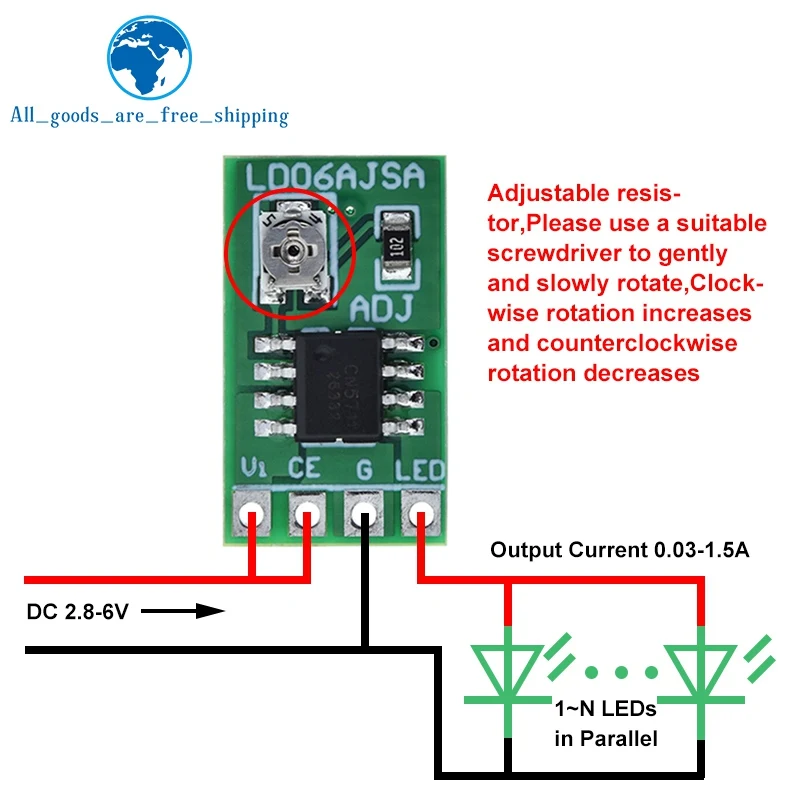
The module features an adjustable output current range from 30mA to 1500mA (1.5A). This wide range accommodates a variety of single or parallel-connected LEDs. Current adjustment is performed via an onboard potentiometer, circled in the instructional image.
Precise current setting is vital for matching the forward current requirements of specific LEDs. Overcurrent can lead to immediate damage, while undercurrent results in dim output. The adjustable resistor allows for fine-tuning.
Standard LED drivers often come with fixed current outputs, limiting their versatility. This adjustable design provides flexibility for prototyping and adapting to different LED specifications without needing multiple driver modules. It is a significant advantage.
Input Voltage Versatility
Operating with a DC input voltage range of 2.8V to 6V, the LD06AJSA is compatible with common power sources. This includes single-cell Li-ion batteries (3.7V nominal), 3V coin cells, or 5V USB power supplies. Its low minimum input voltage is particularly beneficial for battery-powered devices.
Powering LEDs from various battery chemistries or regulated low-voltage supplies becomes straightforward. The buck converter topology efficiently steps down the input voltage to the required forward voltage for the LEDs. This ensures stable operation.
Many LED drivers demand higher input voltages, restricting their use in compact, low-power applications. The LD06AJSA's broad low-voltage input capability expands its utility significantly, especially for portable electronics. It simplifies power integration.
PWM Control Integration
The module incorporates a PWM (Pulse Width Modulation) control input, labeled 'CE'. This feature enables external dimming or on/off control of the connected LEDs. PWM offers a highly efficient method for brightness adjustment without significant power loss.
Connecting a microcontroller or a dedicated PWM generator to the 'CE' pin allows for dynamic lighting effects or precise brightness levels. This is a critical feature for smart lighting applications or user-interface controlled illumination. Dimming is smooth and flicker-free.
Unlike simple voltage dimming, which can alter LED color temperature and efficiency, PWM maintains the LED's optimal operating point. It cycles the LED rapidly between on and off states, controlling perceived brightness. This preserves LED performance.
Thermal Considerations and Component Integrity
The compact size of the LD06AJSA module necessitates careful consideration of thermal management, especially when operating at higher current outputs. The main integrated circuit (IC) and other components are surface-mounted. The PCB itself acts as a heat sink.
Operating at 1.5A, the module will generate heat. Adequate airflow or mounting to a larger metallic surface may be required to prevent overheating and ensure long-term reliability. Over-temperature protection is typically integrated into such ICs, but external measures are prudent. Heat dissipation is crucial.
Compared to larger, heatsink-equipped drivers, this miniature module relies more on its environment for cooling. Users must factor in the ambient temperature and enclosure design when pushing the upper limits of its current capability. Proper installation prevents thermal stress.
Wiring and Connection Standards
The module features clearly labeled solder pads for input (V1, G) and output (LED+, LED-). The input voltage range is explicitly stated as DC 2.8-6V. Output current flows to 1-N LEDs connected in parallel.
Correct polarity is paramount during wiring. Reversing input polarity can damage the module and connected components. The output connections are designed for parallel LED arrays, ensuring each LED receives the regulated current. Clear markings aid installation.
Many generic modules lack explicit wiring diagrams or clear labeling, leading to potential installation errors. The provided visual instructions simplify the setup process, reducing the risk of misconnection. This enhances user confidence.
Durability and Build Quality
The visible PCB appears to be a standard FR-4 substrate, common in consumer electronics. The surface-mount components are neatly soldered, indicating automated assembly processes. The potentiometer for adjustment is a miniature trim pot.
While the module is not encased, its solid-state design offers inherent durability against minor vibrations. Protection against environmental factors like moisture or dust would require an external enclosure. Component quality appears standard for its price point.
Unlike modules with through-hole components that can be more susceptible to physical stress, surface-mount technology (SMT) offers a more compact and often more robust assembly. This contributes to the module's small size and potential for integration. It is a practical design.
Operational Safety and Compliance
As an electrical component, adherence to safe operating parameters is critical. The module's specified input voltage and output current ranges must be respected to prevent component failure or fire hazards. Overloading the module is a significant risk.
Ensuring proper wire gauge for the current drawn is essential to prevent overheating of conductors. For 1.5A, standard small gauge wires are typically sufficient, but verification is always recommended. Compliance with local electrical codes is the installer's responsibility. Safety protocols are non-negotiable.
Many DIY electronics projects overlook the importance of proper electrical safety. This module, while small, still requires careful handling and integration into a safe circuit. Understanding its limitations prevents dangerous situations. User vigilance is key.
The Advantage of Precision
This LD06AJSA module offers a compelling solution for precise LED current control in a compact form factor. Its adjustable output, wide input voltage range, and PWM dimming capability provide significant flexibility for various lighting projects. The clear labeling and instructional diagrams simplify integration, even for those new to constant current drivers. For anyone seeking to power LEDs efficiently and reliably from low-voltage sources, this module presents a highly functional and cost-effective option. Imagine effortlessly integrating custom lighting into portable devices or creating dynamic, dimmable LED displays with consistent brightness and extended LED lifespan, all managed by this miniature yet powerful driver.