Lithium Battery Charger Board with LED Display and Dual USB Output
Official Store Deal
Expert Analysis Overview
The Lithium Battery Charger Board is a highly adaptable power management circuit designed for DIY mobile power bank projects, particularly those utilizing 18650 lithium-ion cells. This module addresses the common frustration of proprietary charging solutions by offering a universal, multi-input charging and dual-output discharge platform. Its compact form factor and integrated LED display provide essential functionality for custom portable power solutions, making it a definitive, problem-solving component for electronics enthusiasts and repair technicians.
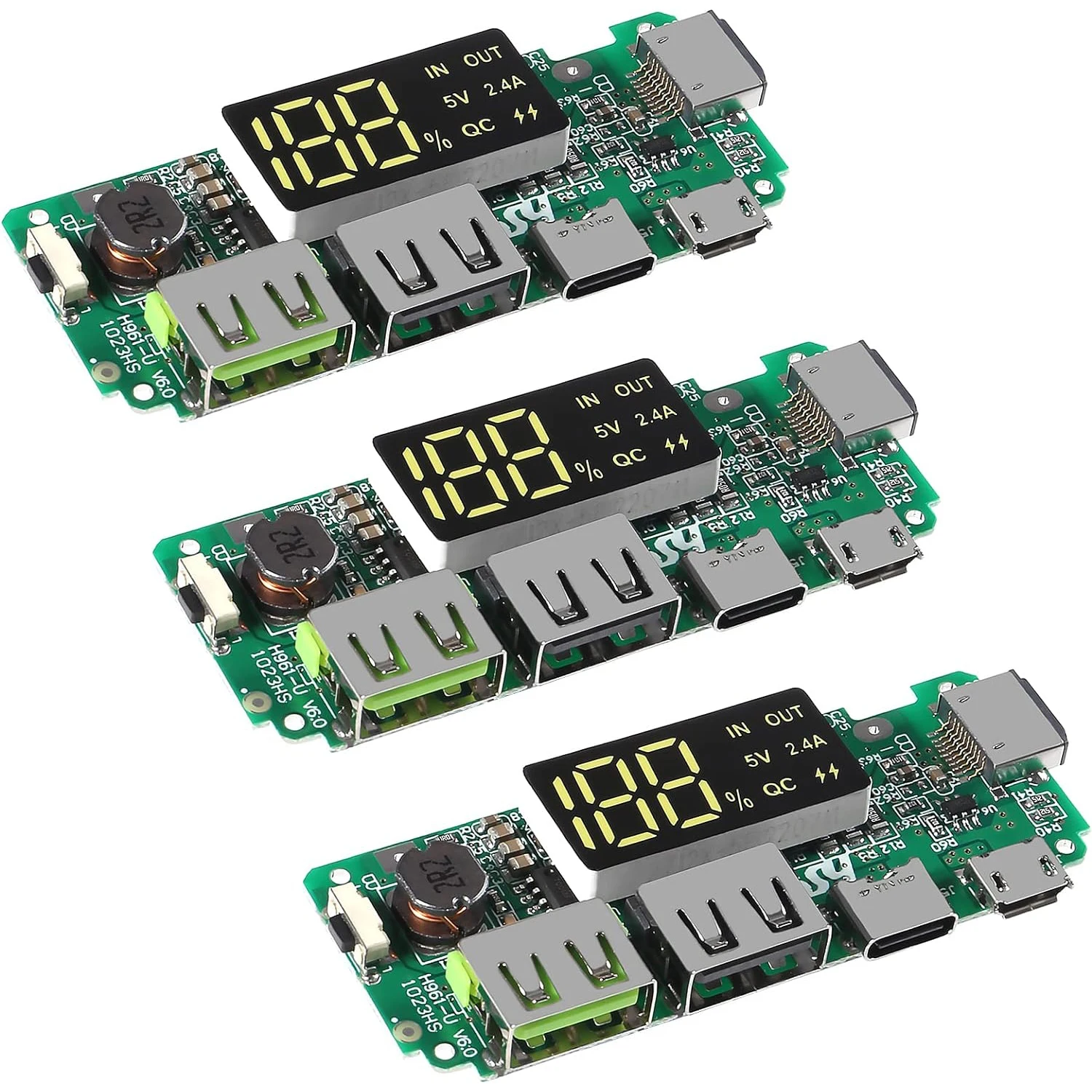
This charging module integrates a comprehensive set of features onto a single printed circuit board (PCB). Visible components include an LED digital display, two USB-A output ports, and three distinct input ports: Micro USB, USB Type-C, and Lightning. The board measures approximately 6.5 x 2.5 x 0.1 cm, a very small footprint. This design choice maximizes versatility for various charging cables and device compatibility.
Such a multi-input design significantly enhances the module's utility. Users are not restricted to a single cable type for charging the power bank itself, a common annoyance with many generic power bank kits. This flexibility means fewer cables to carry and greater convenience in diverse charging environments. It simplifies the user experience considerably.
Compared to simpler charging modules that often feature only a single input type, this board's triple input capability is a clear upgrade. It allows for seamless integration into existing charging ecosystems, whether the user primarily relies on Android-standard Micro USB/Type-C or Apple's Lightning cables. This broad compatibility reduces friction for the end-user, ensuring the power bank is always ready for a charge.
Each of the two USB-A output ports is rated for 5V at 2.4A. This specification indicates a total potential output of 4.8A across both ports, assuming the power source and battery can sustain it. The board's ability to deliver 2.4A per port is crucial for modern devices. Many smartphones and tablets require at least 2A for efficient charging.
This dual 2.4A output ensures that connected devices receive adequate power for quick charging, preventing the slow, trickle-charge scenario often experienced with lower-amperage ports. It allows for simultaneous charging of two power-hungry devices without significant performance degradation. This capability is a significant advantage for users with multiple gadgets.
Standard entry-level power bank modules frequently offer only 1A or 2.1A outputs, often shared across multiple ports. The dedicated 2.4A per port on this module positions it as a more capable alternative, offering faster charging times and better compatibility with a wider range of contemporary electronics. This is a noticeable improvement.
The visible soldering points on the PCB appear clean and well-formed, indicating a reasonable level of manufacturing quality. Surface-mount components are precisely aligned, and the larger through-hole components, such as the USB ports and inductor, show solid connections. Component placement is orderly.
Clean soldering is paramount for long-term reliability in any electronic circuit. Poor solder joints can lead to intermittent connections, increased resistance, and premature component failure, especially under thermal stress or vibration. The visual inspection suggests a robust assembly process, minimizing such risks. This contributes to a stable power delivery.
Unlike hastily assembled generic boards where cold solder joints or misaligned components are common, the visual evidence here points to a more controlled manufacturing environment. This attention to detail in assembly is a critical factor in ensuring the module's operational longevity and consistent performance. It reduces the likelihood of early failure.
The USB-A output ports feature metal shielding, which provides structural integrity and helps prevent electromagnetic interference (EMI). The Micro USB, Type-C, and Lightning input ports also appear to be standard, robust connectors. These connections are frequently used.
Robust connectors are essential for devices that undergo frequent plugging and unplugging cycles. The metal shielding on the USB-A ports, in particular, offers mechanical reinforcement against wear and tear, reducing the chance of the port detaching from the PCB. This design choice enhances the module's overall durability. It withstands repeated use.
Compared to modules with unshielded or flimsy plastic connectors, the use of metal-shielded USB-A ports is an upgrade that directly impacts the product's lifespan. This design choice minimizes the risk of physical damage to the most frequently used interfaces, ensuring a more reliable connection over time. It is a practical engineering decision.
The integrated LED digital display provides real-time feedback on the module's status, showing charge percentage, input/output voltage (5V), and current (2.4A). It also indicates 'IN' or 'OUT' status and 'QC' (Quick Charge) if applicable. This display is highly informative.
Accurate and immediate feedback from the LED display is invaluable for managing power bank usage. Users can quickly ascertain the remaining battery capacity, monitor charging progress, or confirm output delivery to connected devices. This transparency allows for better power management decisions. It removes guesswork from charging.
Many basic charging modules lack any form of visual feedback beyond a simple LED indicator, which provides minimal information. This module's detailed digital display offers a significant advantage, empowering users with precise data for optimal use and troubleshooting. It is a substantial functional enhancement.
The board is designed for 18650 lithium-ion batteries, with clearly marked 'Battery Positive +' and 'Battery Cathode -' soldering pads. The product data indicates an allowed 0V change and an IR of PCM <=65 mΩ. Proper battery connection is vital.
Correct polarity when connecting the 18650 cells is absolutely critical to prevent damage to the module and potential safety hazards. The low internal resistance (IR) of the Power Control Module (PCM) ensures efficient power transfer and minimizes heat generation during charging and discharging. This efficiency is key for battery health. It prolongs battery life.
Unlike modules that might offer less explicit battery connection points or lack specified PCM characteristics, this board provides clear guidance for integration. Users must ensure their 18650 cells have their own protection circuits (PCM) or integrate an external one, as the module itself focuses on charging and discharge regulation rather than comprehensive battery cell protection. This is a design trade-off for simplicity.
At its price point, this 3-piece set offers exceptional value for building multiple custom power banks or for repair projects. The cost-effectiveness of these modules allows for fixing expensive equipment with affordable components, extending the life of devices rather than replacing them entirely. This is a smart economic choice.
For hobbyists or technicians, having multiple modules on hand means greater flexibility for experimentation or for quickly replacing a faulty charging circuit in an existing power bank. The ability to source and integrate these components individually reduces the overall cost of custom solutions. It empowers creative projects.
Generic, pre-built power banks often come with fixed capacities and limited input/output options. This module, however, provides the capability to construct a power bank tailored to specific capacity requirements (by choosing the number of 18650 cells) and desired port configurations. This customization capability is a significant differentiator. It offers unparalleled flexibility.
The Lithium Battery Charger Board with LED Display and Dual USB Output is a highly capable and versatile component for anyone looking to build or repair portable power solutions. Its multi-input flexibility, robust dual 2.4A outputs, and informative LED display make it an excellent foundation for custom power banks. The attention to detail in its assembly and the clear labeling for battery integration underscore its utility for reliable, long-term operation. This module allows users to craft power solutions that perfectly match their needs, ensuring clean signal transmission and reliable connections for all their portable devices. Imagine the satisfaction of powering all your gadgets from a custom-built power bank, perfectly suited to your daily demands, always knowing its exact charge status, and never being caught without the right charging cable. This board makes that vision a practical reality, offering the capability to create truly personalized and efficient mobile power. It is a solid choice for any electronics project requiring flexible power management. This module delivers on its promises.
Core Functionality and Design Precision
This charging module integrates a comprehensive set of features onto a single printed circuit board (PCB). Visible components include an LED digital display, two USB-A output ports, and three distinct input ports: Micro USB, USB Type-C, and Lightning. The board measures approximately 6.5 x 2.5 x 0.1 cm, a very small footprint. This design choice maximizes versatility for various charging cables and device compatibility.
Such a multi-input design significantly enhances the module's utility. Users are not restricted to a single cable type for charging the power bank itself, a common annoyance with many generic power bank kits. This flexibility means fewer cables to carry and greater convenience in diverse charging environments. It simplifies the user experience considerably.
Compared to simpler charging modules that often feature only a single input type, this board's triple input capability is a clear upgrade. It allows for seamless integration into existing charging ecosystems, whether the user primarily relies on Android-standard Micro USB/Type-C or Apple's Lightning cables. This broad compatibility reduces friction for the end-user, ensuring the power bank is always ready for a charge.
Output Capability and Current Delivery
Each of the two USB-A output ports is rated for 5V at 2.4A. This specification indicates a total potential output of 4.8A across both ports, assuming the power source and battery can sustain it. The board's ability to deliver 2.4A per port is crucial for modern devices. Many smartphones and tablets require at least 2A for efficient charging.
This dual 2.4A output ensures that connected devices receive adequate power for quick charging, preventing the slow, trickle-charge scenario often experienced with lower-amperage ports. It allows for simultaneous charging of two power-hungry devices without significant performance degradation. This capability is a significant advantage for users with multiple gadgets.
Standard entry-level power bank modules frequently offer only 1A or 2.1A outputs, often shared across multiple ports. The dedicated 2.4A per port on this module positions it as a more capable alternative, offering faster charging times and better compatibility with a wider range of contemporary electronics. This is a noticeable improvement.
Component Quality and Assembly Integrity
The visible soldering points on the PCB appear clean and well-formed, indicating a reasonable level of manufacturing quality. Surface-mount components are precisely aligned, and the larger through-hole components, such as the USB ports and inductor, show solid connections. Component placement is orderly.
Clean soldering is paramount for long-term reliability in any electronic circuit. Poor solder joints can lead to intermittent connections, increased resistance, and premature component failure, especially under thermal stress or vibration. The visual inspection suggests a robust assembly process, minimizing such risks. This contributes to a stable power delivery.
Unlike hastily assembled generic boards where cold solder joints or misaligned components are common, the visual evidence here points to a more controlled manufacturing environment. This attention to detail in assembly is a critical factor in ensuring the module's operational longevity and consistent performance. It reduces the likelihood of early failure.
Connector Durability and Interface Options
The USB-A output ports feature metal shielding, which provides structural integrity and helps prevent electromagnetic interference (EMI). The Micro USB, Type-C, and Lightning input ports also appear to be standard, robust connectors. These connections are frequently used.
Robust connectors are essential for devices that undergo frequent plugging and unplugging cycles. The metal shielding on the USB-A ports, in particular, offers mechanical reinforcement against wear and tear, reducing the chance of the port detaching from the PCB. This design choice enhances the module's overall durability. It withstands repeated use.
Compared to modules with unshielded or flimsy plastic connectors, the use of metal-shielded USB-A ports is an upgrade that directly impacts the product's lifespan. This design choice minimizes the risk of physical damage to the most frequently used interfaces, ensuring a more reliable connection over time. It is a practical engineering decision.
Power Management and Display Feedback
The integrated LED digital display provides real-time feedback on the module's status, showing charge percentage, input/output voltage (5V), and current (2.4A). It also indicates 'IN' or 'OUT' status and 'QC' (Quick Charge) if applicable. This display is highly informative.
Accurate and immediate feedback from the LED display is invaluable for managing power bank usage. Users can quickly ascertain the remaining battery capacity, monitor charging progress, or confirm output delivery to connected devices. This transparency allows for better power management decisions. It removes guesswork from charging.
Many basic charging modules lack any form of visual feedback beyond a simple LED indicator, which provides minimal information. This module's detailed digital display offers a significant advantage, empowering users with precise data for optimal use and troubleshooting. It is a substantial functional enhancement.
Battery Integration and Safety Considerations
The board is designed for 18650 lithium-ion batteries, with clearly marked 'Battery Positive +' and 'Battery Cathode -' soldering pads. The product data indicates an allowed 0V change and an IR of PCM <=65 mΩ. Proper battery connection is vital.
Correct polarity when connecting the 18650 cells is absolutely critical to prevent damage to the module and potential safety hazards. The low internal resistance (IR) of the Power Control Module (PCM) ensures efficient power transfer and minimizes heat generation during charging and discharging. This efficiency is key for battery health. It prolongs battery life.
Unlike modules that might offer less explicit battery connection points or lack specified PCM characteristics, this board provides clear guidance for integration. Users must ensure their 18650 cells have their own protection circuits (PCM) or integrate an external one, as the module itself focuses on charging and discharge regulation rather than comprehensive battery cell protection. This is a design trade-off for simplicity.
Value Proposition and DIY Potential
At its price point, this 3-piece set offers exceptional value for building multiple custom power banks or for repair projects. The cost-effectiveness of these modules allows for fixing expensive equipment with affordable components, extending the life of devices rather than replacing them entirely. This is a smart economic choice.
For hobbyists or technicians, having multiple modules on hand means greater flexibility for experimentation or for quickly replacing a faulty charging circuit in an existing power bank. The ability to source and integrate these components individually reduces the overall cost of custom solutions. It empowers creative projects.
Generic, pre-built power banks often come with fixed capacities and limited input/output options. This module, however, provides the capability to construct a power bank tailored to specific capacity requirements (by choosing the number of 18650 cells) and desired port configurations. This customization capability is a significant differentiator. It offers unparalleled flexibility.
Conclusion: Empowering Custom Power Solutions
The Lithium Battery Charger Board with LED Display and Dual USB Output is a highly capable and versatile component for anyone looking to build or repair portable power solutions. Its multi-input flexibility, robust dual 2.4A outputs, and informative LED display make it an excellent foundation for custom power banks. The attention to detail in its assembly and the clear labeling for battery integration underscore its utility for reliable, long-term operation. This module allows users to craft power solutions that perfectly match their needs, ensuring clean signal transmission and reliable connections for all their portable devices. Imagine the satisfaction of powering all your gadgets from a custom-built power bank, perfectly suited to your daily demands, always knowing its exact charge status, and never being caught without the right charging cable. This board makes that vision a practical reality, offering the capability to create truly personalized and efficient mobile power. It is a solid choice for any electronics project requiring flexible power management. This module delivers on its promises.