Milfra Smart Wall Light Switch Dual Protocol
Official Store Deal
Expert Analysis Overview
The Milfra Smart Wall Light Switch is a dual-protocol smart switch engineered for broad compatibility and flexible deployment within modern and legacy home electrical systems. This device targets users seeking advanced lighting control without the typical installation hurdles, particularly those integrating into sophisticated Home Assistant environments or requiring robust local control capabilities. Its support for both Wi-Fi and Zigbee protocols positions it as a highly adaptable component in any smart home ecosystem.
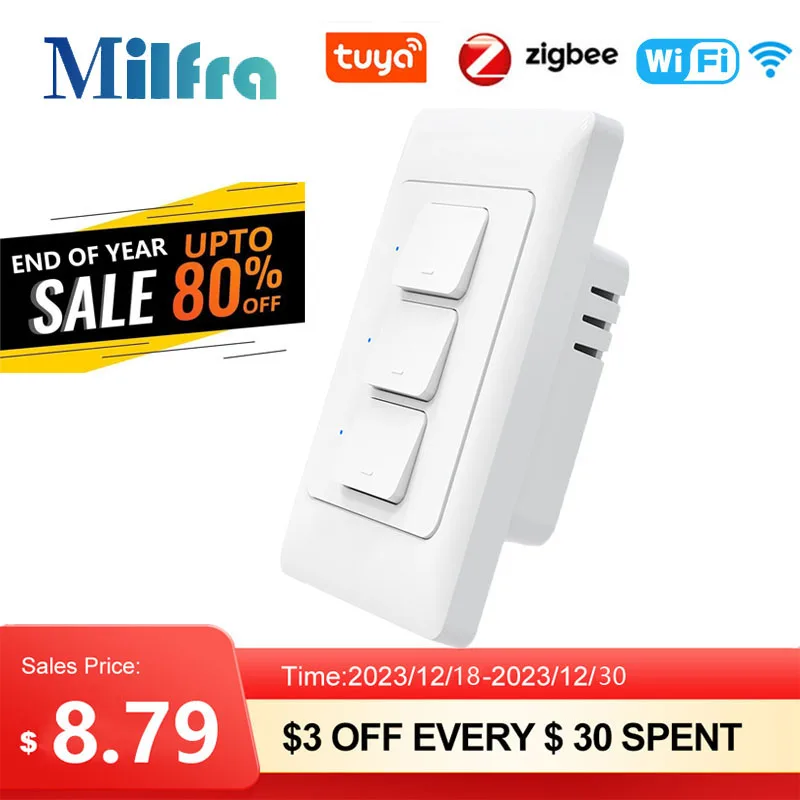
The Milfra Smart Wall Light Switch fundamentally distinguishes itself through its dual wireless protocol support: Wi-Fi and Zigbee. This is not merely a redundancy; it represents a strategic advantage for system architects and home automation enthusiasts. The primary image prominently displays both the 'Wi-Fi' and 'Zigbee' logos, signaling this crucial capability.
Wi-Fi connectivity, operating on the ubiquitous 2.4GHz band (IEEE802.11b/g/n), offers direct integration with existing home networks and cloud services like Tuya. This path provides straightforward setup for many users, leveraging familiar infrastructure without requiring a dedicated hub. The switch communicates directly with the router, making it accessible from anywhere with an internet connection via the associated mobile application.
Zigbee, conversely, introduces a mesh networking topology. This protocol excels in creating a more resilient and responsive local network, independent of internet connectivity for core functions. A Zigbee coordinator or hub is necessary, but once established, devices form a self-healing network, extending range and enhancing reliability. For environments with numerous smart devices, Zigbee's lower power consumption and reduced network congestion are significant benefits. This dual-protocol approach means the switch can operate effectively in diverse network configurations, from simple Wi-Fi setups to complex, hub-centric Zigbee mesh networks.
One of the most significant engineering challenges in smart switch design, particularly for retrofits, is the requirement for a neutral wire. The Milfra Smart Wall Light Switch boldly addresses this with a "No Neutral Wire Required" option, as explicitly stated in the product title and implied by the 'Natural Wire Optional' specification. This feature is a game-changer for older properties or regions where neutral wires are not typically run to light switch boxes.
Traditional smart switches often necessitate a neutral wire to provide a continuous power supply for their internal electronics, even when the light is off. Without it, the switch might "leak" a small current through the light fixture, causing flickering or preventing ultra-low wattage LED bulbs from fully turning off – a phenomenon known as "ghosting." By engineering a solution that operates without a neutral wire, this Milfra switch bypasses the need for costly and disruptive electrical rewiring. This simplifies installation significantly. For many, this removes a major barrier to smart home adoption.
However, it is crucial to understand the implications. No-neutral switches typically require a small capacitor or adapter to be wired in parallel with the light fixture to ensure stable operation and prevent ghosting, especially with low-wattage LED loads. While the product images do not explicitly show such an adapter, its inclusion is common for this technology. The switch's ability to operate across a wide voltage range (AC100-250V, 50/60Hz) further enhances its global applicability, accommodating various electrical standards found in regions like Australia, Korea, and Brazil, as indicated in the product title.
The physical design of the Milfra switch prioritizes user interaction with tangible buttons and indicator lights. Image 2 clearly labels the "Physical Button" and "Indicator Light," emphasizing that while smart features abound, the fundamental act of manually controlling lighting remains intuitive. This tactile feedback is often preferred over purely touch-sensitive interfaces, offering a satisfying click and immediate confirmation of input. The presence of 1, 2, or 3 gangs (buttons) caters to different wiring configurations, allowing control over multiple light circuits from a single wall plate.
The integration with voice control assistants like Amazon Alexa and Google Home is a core capability, as demonstrated in Image 3. This allows for hands-free operation, seamlessly blending into daily routines. A simple command like "Alexa, turn on the living room light" executes the action, enhancing convenience and accessibility. The switch's reliance on the Tuya ecosystem facilitates this integration, as Tuya-compatible devices are widely supported by major voice platforms.
Beyond immediate control, the switch offers advanced automation capabilities. Scheduling functions, depicted in Image 4, enable users to set specific times for lights to turn on or off, aligning with daily routines or simulating occupancy for security. For instance, lights can be programmed to activate at 7:00 PM and deactivate at 11:00 PM, creating a consistent lighting schedule. This level of programmability moves beyond simple on/off, contributing to energy efficiency and enhanced home security.
One-key scene pattern settings represent a powerful feature for dynamic lighting environments, illustrated in Image 5. Instead of individually adjusting multiple lights, a single button press or app command can trigger a predefined lighting scenario. Examples include "Away from home mode" (all lights off), "Sleep patterns" (dimmed or specific lights on), "Home mode" (general illumination), or "Theater mode" (specific lights dimmed for entertainment). This capability significantly enhances the usability of a smart home, allowing complex lighting moods to be invoked instantly.
Operating within the Tuya ecosystem provides access to a vast array of compatible devices and automation rules. This means the Milfra switch can interact with other Tuya-enabled sensors, cameras, and appliances, creating intricate automation flows. For example, a motion sensor could trigger the lights via the Milfra switch, or the switch's status could influence other devices. The Tuya platform, while cloud-centric, offers a robust framework for device management and inter-device communication.
For advanced users, the dual-protocol nature, especially Zigbee, opens doors to local control via Home Assistant. This setup allows the switch to operate without reliance on external cloud servers, enhancing privacy, security, and response times. Integrating the Milfra switch into Home Assistant means it becomes a fully controllable entity within a self-hosted automation hub, enabling highly customized scripts and automations that are not dependent on internet connectivity. This is a critical consideration for users prioritizing system autonomy and minimal latency.
The physical dimensions provided in Image 6 (116mm H x 75mm W x 35mm D, with 23mm in-wall depth) indicate a standard form factor for a wall switch, designed for easy integration into existing wall boxes. The build materials appear to be a durable plastic, offering a clean, white aesthetic that blends with most interior decors. The design is functional and unobtrusive.
Load capacity specifications are vital for compatibility with various lighting types. The switch supports up to 100W for LED lamps and up to 500W for incandescent lamps. This demonstrates adequate power handling for most residential lighting applications. The 10A maximum rated current is standard for light switches, ensuring it can safely manage typical electrical loads. This robust capacity means it can handle multiple LED fixtures on a single gang or even a substantial incandescent load without issue. Users should always verify their total wattage to remain within these limits.
The Milfra Smart Wall Light Switch represents a compelling option for anyone looking to upgrade their home lighting. Its dual-protocol support and no-neutral wire capability solve common installation headaches and offer unparalleled integration flexibility. The device's ability to seamlessly connect with both Wi-Fi and Zigbee networks means it can adapt to almost any smart home strategy, from simple app control to complex, locally managed Home Assistant setups. Its physical buttons, voice control, scheduling, and scene management features provide multiple layers of interaction, catering to diverse user preferences. This switch delivers a capable and adaptable platform for modern lighting control, enhancing convenience, security, and energy management within the home. Imagine effortlessly commanding your lights with your voice, having them automatically adjust to your daily rhythm, or activating a perfect ambiance with a single tap, all while knowing your smart home infrastructure is robust and responsive.
Unpacking the Connectivity Architecture
The Milfra Smart Wall Light Switch fundamentally distinguishes itself through its dual wireless protocol support: Wi-Fi and Zigbee. This is not merely a redundancy; it represents a strategic advantage for system architects and home automation enthusiasts. The primary image prominently displays both the 'Wi-Fi' and 'Zigbee' logos, signaling this crucial capability.
Wi-Fi connectivity, operating on the ubiquitous 2.4GHz band (IEEE802.11b/g/n), offers direct integration with existing home networks and cloud services like Tuya. This path provides straightforward setup for many users, leveraging familiar infrastructure without requiring a dedicated hub. The switch communicates directly with the router, making it accessible from anywhere with an internet connection via the associated mobile application.
Zigbee, conversely, introduces a mesh networking topology. This protocol excels in creating a more resilient and responsive local network, independent of internet connectivity for core functions. A Zigbee coordinator or hub is necessary, but once established, devices form a self-healing network, extending range and enhancing reliability. For environments with numerous smart devices, Zigbee's lower power consumption and reduced network congestion are significant benefits. This dual-protocol approach means the switch can operate effectively in diverse network configurations, from simple Wi-Fi setups to complex, hub-centric Zigbee mesh networks.
Installation Flexibility: The No-Neutral Advantage
One of the most significant engineering challenges in smart switch design, particularly for retrofits, is the requirement for a neutral wire. The Milfra Smart Wall Light Switch boldly addresses this with a "No Neutral Wire Required" option, as explicitly stated in the product title and implied by the 'Natural Wire Optional' specification. This feature is a game-changer for older properties or regions where neutral wires are not typically run to light switch boxes.
Traditional smart switches often necessitate a neutral wire to provide a continuous power supply for their internal electronics, even when the light is off. Without it, the switch might "leak" a small current through the light fixture, causing flickering or preventing ultra-low wattage LED bulbs from fully turning off – a phenomenon known as "ghosting." By engineering a solution that operates without a neutral wire, this Milfra switch bypasses the need for costly and disruptive electrical rewiring. This simplifies installation significantly. For many, this removes a major barrier to smart home adoption.
However, it is crucial to understand the implications. No-neutral switches typically require a small capacitor or adapter to be wired in parallel with the light fixture to ensure stable operation and prevent ghosting, especially with low-wattage LED loads. While the product images do not explicitly show such an adapter, its inclusion is common for this technology. The switch's ability to operate across a wide voltage range (AC100-250V, 50/60Hz) further enhances its global applicability, accommodating various electrical standards found in regions like Australia, Korea, and Brazil, as indicated in the product title.
Tactile Control and Smart Integration
The physical design of the Milfra switch prioritizes user interaction with tangible buttons and indicator lights. Image 2 clearly labels the "Physical Button" and "Indicator Light," emphasizing that while smart features abound, the fundamental act of manually controlling lighting remains intuitive. This tactile feedback is often preferred over purely touch-sensitive interfaces, offering a satisfying click and immediate confirmation of input. The presence of 1, 2, or 3 gangs (buttons) caters to different wiring configurations, allowing control over multiple light circuits from a single wall plate.
The integration with voice control assistants like Amazon Alexa and Google Home is a core capability, as demonstrated in Image 3. This allows for hands-free operation, seamlessly blending into daily routines. A simple command like "Alexa, turn on the living room light" executes the action, enhancing convenience and accessibility. The switch's reliance on the Tuya ecosystem facilitates this integration, as Tuya-compatible devices are widely supported by major voice platforms.
Beyond immediate control, the switch offers advanced automation capabilities. Scheduling functions, depicted in Image 4, enable users to set specific times for lights to turn on or off, aligning with daily routines or simulating occupancy for security. For instance, lights can be programmed to activate at 7:00 PM and deactivate at 11:00 PM, creating a consistent lighting schedule. This level of programmability moves beyond simple on/off, contributing to energy efficiency and enhanced home security.
Scene Management and Ecosystem Depth
One-key scene pattern settings represent a powerful feature for dynamic lighting environments, illustrated in Image 5. Instead of individually adjusting multiple lights, a single button press or app command can trigger a predefined lighting scenario. Examples include "Away from home mode" (all lights off), "Sleep patterns" (dimmed or specific lights on), "Home mode" (general illumination), or "Theater mode" (specific lights dimmed for entertainment). This capability significantly enhances the usability of a smart home, allowing complex lighting moods to be invoked instantly.
Operating within the Tuya ecosystem provides access to a vast array of compatible devices and automation rules. This means the Milfra switch can interact with other Tuya-enabled sensors, cameras, and appliances, creating intricate automation flows. For example, a motion sensor could trigger the lights via the Milfra switch, or the switch's status could influence other devices. The Tuya platform, while cloud-centric, offers a robust framework for device management and inter-device communication.
For advanced users, the dual-protocol nature, especially Zigbee, opens doors to local control via Home Assistant. This setup allows the switch to operate without reliance on external cloud servers, enhancing privacy, security, and response times. Integrating the Milfra switch into Home Assistant means it becomes a fully controllable entity within a self-hosted automation hub, enabling highly customized scripts and automations that are not dependent on internet connectivity. This is a critical consideration for users prioritizing system autonomy and minimal latency.
Durability and Load Capacity
The physical dimensions provided in Image 6 (116mm H x 75mm W x 35mm D, with 23mm in-wall depth) indicate a standard form factor for a wall switch, designed for easy integration into existing wall boxes. The build materials appear to be a durable plastic, offering a clean, white aesthetic that blends with most interior decors. The design is functional and unobtrusive.
Load capacity specifications are vital for compatibility with various lighting types. The switch supports up to 100W for LED lamps and up to 500W for incandescent lamps. This demonstrates adequate power handling for most residential lighting applications. The 10A maximum rated current is standard for light switches, ensuring it can safely manage typical electrical loads. This robust capacity means it can handle multiple LED fixtures on a single gang or even a substantial incandescent load without issue. Users should always verify their total wattage to remain within these limits.
The Value Proposition in an Integrated Ecosystem
The Milfra Smart Wall Light Switch represents a compelling option for anyone looking to upgrade their home lighting. Its dual-protocol support and no-neutral wire capability solve common installation headaches and offer unparalleled integration flexibility. The device's ability to seamlessly connect with both Wi-Fi and Zigbee networks means it can adapt to almost any smart home strategy, from simple app control to complex, locally managed Home Assistant setups. Its physical buttons, voice control, scheduling, and scene management features provide multiple layers of interaction, catering to diverse user preferences. This switch delivers a capable and adaptable platform for modern lighting control, enhancing convenience, security, and energy management within the home. Imagine effortlessly commanding your lights with your voice, having them automatically adjust to your daily rhythm, or activating a perfect ambiance with a single tap, all while knowing your smart home infrastructure is robust and responsive.