Mini Micro Limit Switch Roller Lever Arm (10-Pack)
Official Store Deal
Expert Analysis Overview
Precision Actuation for Smart Systems
The Mini Micro Limit Switch with Roller Lever Arm is a fundamental electromechanical component. Designed for precise detection of physical presence or position, these SPDT (Single Pole Double Throw) snap-action switches are indispensable for builders integrating robust, physical feedback into home automation and custom control systems. This 10-pack offers significant value for multi-project or iterative development needs.
These switches serve as critical input devices, providing binary feedback (on/off) based on mechanical actuation. Their compact footprint makes them suitable for tight enclosures and discreet installations. The tactile feedback during operation is distinct.
Unlike purely optical or proximity sensors that can be affected by dust or light, these mechanical switches offer reliable, hard-wired detection. This ensures consistent performance in environments where other sensor types might falter. The mechanical nature minimizes false positives.
The Engineering of Actuation
The roller lever arm actuator is a key design choice. This mechanism allows for activation by moving objects, providing a smooth interaction that reduces wear on both the switch and the contacting surface. The roller minimizes friction.
This specific roller lever configuration excels in applications requiring detection of linear motion or rotational limits. Consider a 3D printer's end-stops or a smart blind system detecting full extension. The lever arm provides mechanical advantage, requiring minimal force to trigger the internal snap-action mechanism.
Compared to a simple plunger-style micro switch, the roller lever arm offers greater flexibility in mounting and actuation angle. It tolerates slight misalignments in the activating component, making installation simpler and more forgiving. This improves system reliability.
Electrical Interfacing and Longevity
Electrically, these are SPDT switches. This means they feature three terminals: Common (C), Normally Open (NO), and Normally Closed (NC). This versatility allows the switch to either complete a circuit when actuated (C to NO) or break a circuit (C to NC), catering to a wide array of control logic requirements.
The stated electrical rating, typically 8A at 125V AC, indicates a capability for handling moderate loads directly. For low-voltage automation systems, such as those employing ESP32 or Raspberry Pi microcontrollers, the switches operate well within their current limits. They provide clean digital signals.
When contrasted with lower-rated switches, this 8A capacity suggests a more durable contact material and mechanism, translating to a longer operational lifespan. This is crucial for devices intended for continuous use, such as door sensors or automated pet feeders. Reliability is paramount.
Seamless Integration into Smart Environments
For the home automation engineer, integrating these micro switches into platforms like Home Assistant is straightforward. Connecting the switch to a general-purpose input/output (GPIO) pin on an ESPHome-flashed ESP32 board creates a physical input that can trigger automations. The local control is immediate.
Picture a scenario where a smart drawer lock is implemented. A micro switch detects when the drawer is fully closed, providing instant feedback to the automation system without relying on network communication. This minimizes response delay significantly. The physical feedback is undeniable.
Unlike Wi-Fi or Zigbee-based sensors that introduce potential latency and network dependencies, these wired switches offer near-instantaneous state changes. This is critical for time-sensitive automations, such as safety interlocks or precise positioning systems. Response time is almost zero.
Physical Durability and Mounting Considerations
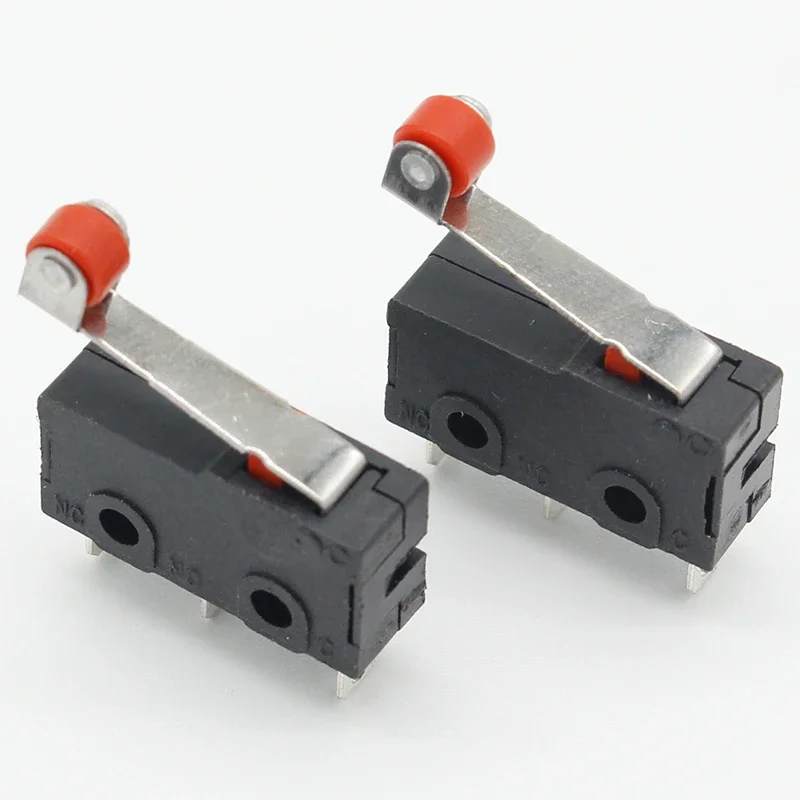
The housing appears to be a durable black plastic, providing adequate protection for the internal mechanism. The metal lever arm exhibits a clean finish, suggesting resistance to corrosion in typical indoor environments. The roller itself is a distinct red, likely a robust plastic or rubber for smooth operation.
Two mounting holes are visible, allowing for secure panel or surface mounting using small screws. The precision of these holes, as detailed in the technical drawing, ensures consistent alignment across multiple installations. This aids in repeatable system builds.
Compared to switches with flimsy plastic levers, the metal roller arm here indicates a higher degree of mechanical resilience. This is vital for applications involving frequent actuation cycles, preventing premature failure due to fatigue. The build quality is solid.
Value Proposition and Scalability
Acquiring these switches in a 10-pack offers substantial cost savings per unit. For hobbyists, students, or professional integrators working on multiple projects, this bulk purchase reduces the overall expenditure on components. It's an economical choice.
Consider the long-term ROI for a complex home automation setup. Instead of purchasing individual, often more expensive, integrated sensors for every door, window, or mechanism, these switches provide a low-cost, high-reliability alternative. This allows for extensive sensor deployment without breaking the budget. Scalability becomes practical.
This bulk offering provides a ready supply for experimentation, prototyping, and even replacement parts. It eliminates the frustration of running out of a critical component mid-project. Having spares is always wise.
Operational Reliability in Diverse Settings
While an IP rating is not explicitly stated, the robust construction implies suitability for typical indoor conditions. The snap-action mechanism ensures a quick, clean break and make of contacts, preventing arcing and prolonging contact life. This is a hallmark of quality micro switches.
Imagine a custom security system where these switches detect the opening of a safe or a cabinet. Their reliable operation ensures that an alert is triggered precisely when the physical state changes. The system remains vigilant.
In contrast to cheaper, less robust switches that might suffer from contact bounce or inconsistent actuation, these units are designed for consistent, repeatable performance. This reliability is foundational for any automation system where accuracy matters. Every trigger counts.
The Unseen Advantage: Offline Control
One of the often-overlooked benefits of physical switches in a smart home is their ability to function independently of network connectivity. When the Wi-Fi goes down or the internet service is interrupted, a wired micro switch still provides its binary input to the local microcontroller. Automation continues locally.
Picture an automated garage door. While a smart opener might rely on cloud services, a safety limit switch ensures the door stops correctly, regardless of network status. This local control enhances safety and system resilience. It keeps critical functions operational.
This contrasts sharply with purely wireless solutions that become inoperable during network outages. For critical automations or basic functionality, the ability of these switches to provide reliable local input is an immense advantage. They are always ready.
These mini micro limit switches are an essential building block for any home automation project demanding precise, reliable, and locally controlled physical state detection. Their robust design, versatile SPDT configuration, and cost-effective bulk packaging make them an intelligent choice for engineers and DIY enthusiasts alike. Imagine the satisfaction of a perfectly synchronized smart home, where every physical interaction is instantly translated into an intelligent action, all thanks to the dependable feedback from these unassuming components. Your custom automations will function with unparalleled precision and responsiveness.