Mini PWM DC Motor Speed Controller
Official Store Deal
Expert Analysis Overview
Precision Power Modulation for Compact Systems
The Mini PWM DC Motor Speed Controller is a compact, cost-effective solution for precise power modulation in low-voltage applications. This device is designed for hobbyists, educators, and technicians requiring granular control over DC motor speed or LED brightness without significant investment. Its small footprint and straightforward interface make it an accessible component for a wide array of projects, from robotics to custom lighting setups.The module's core functionality revolves around Pulse Width Modulation (PWM), a technique that rapidly switches power on and off to control the average voltage supplied to a load. This method is highly efficient, minimizing energy loss as heat compared to traditional resistive dimming or voltage regulation. The efficiency ensures that the connected motor or LED operates optimally, preserving battery life in portable applications and reducing operational costs in fixed installations.
Unlike simpler voltage dividers that dissipate excess energy as heat, this PWM controller actively manages power delivery. The result is a cooler running system and a more stable output, particularly beneficial for sensitive electronics or applications where thermal management is a concern. This inherent efficiency positions the controller as a superior alternative to basic rheostats or linear regulators for dynamic load control.
Component-Level Scrutiny
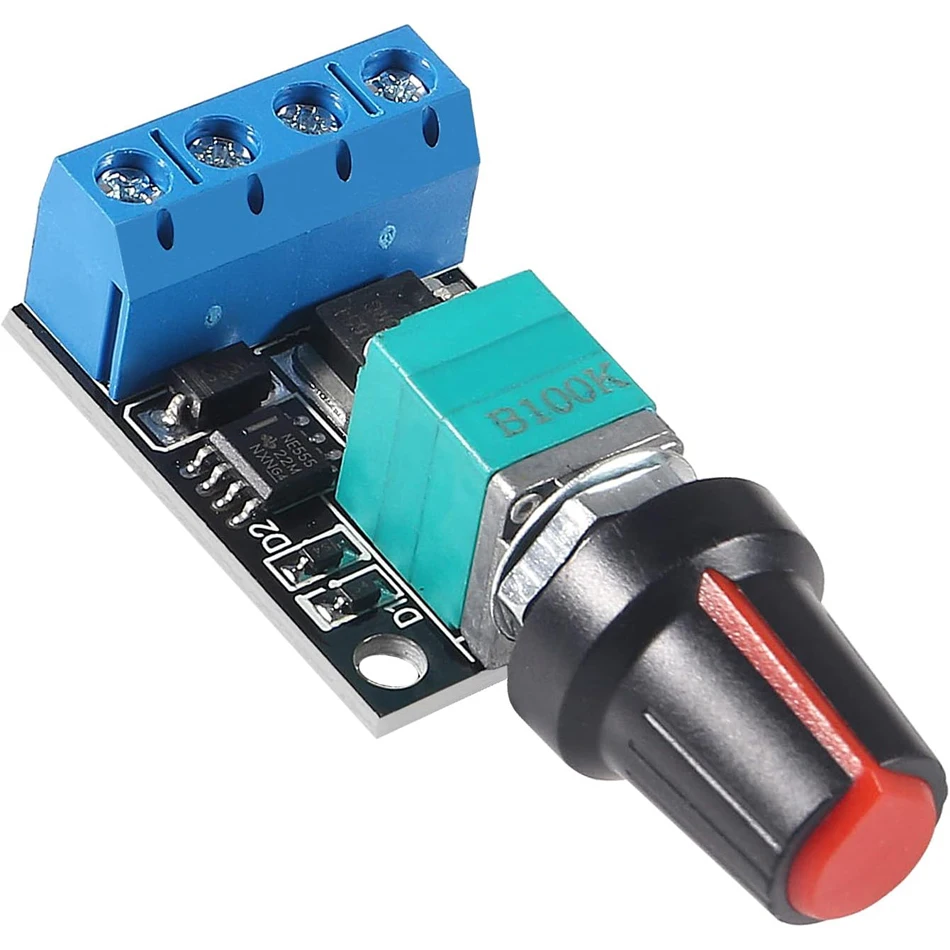
The visible components on the PCB include a standard 2-pin screw terminal block for power input and a similar 2-pin block for motor or LED output. A robust potentiometer, topped with a knurled black and red knob, is centrally mounted for adjustment. The PCB itself is a compact, double-sided design, labeled "Mini PWM Controller HW-070 v1."This configuration simplifies wiring, allowing for quick integration into existing circuits. The screw terminals ensure a secure, albeit temporary, connection for prototyping or light-duty permanent installations. The clear labeling of "Power+", "Power-", "Output+", and "Output-" minimizes connection errors, which is crucial for preventing damage in sensitive circuits.
Compared to soldered connections or proprietary connectors often found in integrated systems, these terminal blocks offer significant flexibility. They permit rapid changes to motor or power sources without specialized tools, a distinct advantage over fixed wiring solutions that demand desoldering for modifications. This modularity enhances the controller's utility in experimental and educational environments.
Signal Integrity and Control Dynamics
Signal integrity in PWM controllers is paramount for smooth operation and longevity of connected devices. The compact layout of the HW-070 v1 minimizes trace lengths, which inherently reduces electromagnetic interference (EMI) and signal degradation. This design choice contributes to a cleaner output signal, ensuring consistent motor speed or flicker-free LED dimming.Effective signal transmission is critical. The board's design appears to prioritize direct signal paths, a common practice in small form-factor electronics to maintain performance. This directness helps in delivering the modulated signal to the load with minimal distortion, which is essential for applications requiring precise control.
Many entry-level controllers often suffer from noisy outputs due to poor layout or insufficient filtering. This module's visible design suggests a focus on fundamental signal cleanliness, offering a more stable control signal than many generic alternatives. The operational stability directly impacts the lifespan and efficiency of the connected DC motors or LEDs.
Durability and Connection Reliability
The blue screw terminal blocks, a common choice in low-voltage electronics, provide a reliable mechanical connection. These terminals are designed to accept various wire gauges, offering versatility in wiring. The screws secure the wires firmly, mitigating the risk of intermittent connections due to vibration or movement.Long-term reliability of electrical connections is a critical factor in any circuit. While screw terminals are generally robust, proper wire stripping and tightening are essential to prevent strand breakage or loosening over time. The visible quality of the plastic housing and metal inserts suggests a standard level of durability for this component class.
Unlike spring-loaded terminals that can degrade with repeated insertions, screw terminals maintain their grip with proper installation. This makes them a more dependable choice for applications where the wiring might be adjusted periodically, providing a consistent contact point over many cycles. The mechanical strength is adequate for its intended use.
Thermal Management and Operational Limits
Given its 10A current rating, the module likely incorporates a power MOSFET or similar switching component capable of handling the specified load. The absence of a large heatsink suggests that for continuous operation at peak current, adequate airflow or a duty cycle below 100% might be necessary to prevent thermal runaway. Small form factors often rely on convection cooling.Operating within the specified voltage (5V-12V) and current limits is crucial for the longevity of the controller. Exceeding these parameters can lead to component overheating and premature failure. The board's design appears to be optimized for typical small motor or LED strip applications, where sustained high current draws are less common.
Many compact controllers struggle with thermal dissipation when pushed to their limits. This module, like others in its class, benefits from careful consideration of its operating environment. Ensuring it is not enclosed in a poorly ventilated space when driving near its maximum current capacity will significantly extend its operational life, outperforming modules prone to rapid thermal degradation under similar stress.
Value Proposition for the Technician
This controller presents an exceptional value proposition for technicians and hobbyists seeking to repair or upgrade existing equipment with affordable components. Its low cost allows for experimentation and quick fixes without significant financial outlay. The ability to replace a faulty speed control mechanism with a readily available, inexpensive module can save considerable time and money compared to sourcing proprietary parts.For those working on projects where budget constraints are a factor, this module allows for the integration of speed control or dimming capabilities at a fraction of the cost of more integrated or specialized solutions. This affordability democratizes access to precise power control, enabling more complex projects for a wider audience.
Compared to purchasing a new appliance or system due to a single failed speed controller, this module offers a pragmatic and economical repair option. It transforms an otherwise costly repair into a simple component swap, extending the life of existing devices and reducing electronic waste. The return on investment is immediate and tangible for repair-focused applications.
Versatile Application Scenarios
This controller's broad voltage range (5V-12V) and 10A current capacity make it suitable for a diverse range of applications. It can regulate the speed of small DC motors in toys, fans, or pumps. It also effectively dims LED strips or individual high-power LEDs, offering adjustable lighting solutions.Consider its utility in a DIY robot project, where precise motor speed control is essential for navigation and manipulation. Or imagine its use in a custom aquarium setup, where dimming LED lights can simulate natural dawn and dusk cycles. Its adaptability is a key strength.
Unlike single-purpose controllers, this module's dual capability as a motor speed governor and an LED dimmer expands its potential uses. This versatility means a single component can serve multiple functions, simplifying inventory for hobbyists and reducing the need for specialized parts for each project.
User Experience and Integration
The intuitive rotary knob provides stepless speed regulation, offering smooth and continuous adjustment. This tactile control allows for fine-tuning of output, which is often preferred over digital button interfaces for certain applications. The physical feedback of the knob enhances the user experience.Integration into existing systems is straightforward due to the clearly marked screw terminals. No complex programming or external drivers are typically required, making it a plug-and-play solution for basic control tasks. Its simplicity is a major asset.
Many advanced controllers require software configuration or specific microcontrollers, adding complexity and cost. This module bypasses those hurdles, offering an immediate and direct control interface. This ease of use makes it ideal for beginners or projects where rapid deployment is a priority, distinguishing it from more intricate control systems.
Optimizing Performance and Longevity
To ensure optimal performance, it is advisable to match the controller's voltage and current ratings closely with the load. Using wires of appropriate gauge for the current draw will prevent voltage drop and overheating in the wiring itself. Proper insulation is also critical.Regular inspection of the screw terminals for tightness can prevent intermittent connections, which can cause erratic behavior or damage to the motor/LED. Keeping the module free from dust and moisture will also contribute to its long-term reliability. A clean environment is always best.
Unlike sealed industrial controllers, this open-board design benefits from a clean, dry operating environment. Protecting it from conductive debris or excessive humidity will prevent short circuits and corrosion, ensuring it continues to operate reliably for years. This simple maintenance extends its useful life significantly.