Modular Lever-Action Quick Wire Connectors
Official Store Deal
Expert Analysis Overview
Precision in Connection: An Expert Review of Modular Lever-Action Quick Wire Connectors
The Modular Lever-Action Quick Wire Connectors are a highly practical and efficient solution for secure, tool-free electrical connections, specifically targeting rapid assembly and maintenance scenarios in both professional and DIY electrical work. This design represents a significant advancement over traditional wire termination methods, offering enhanced reliability and ease of use. The system simplifies the process.Design and Material Integrity
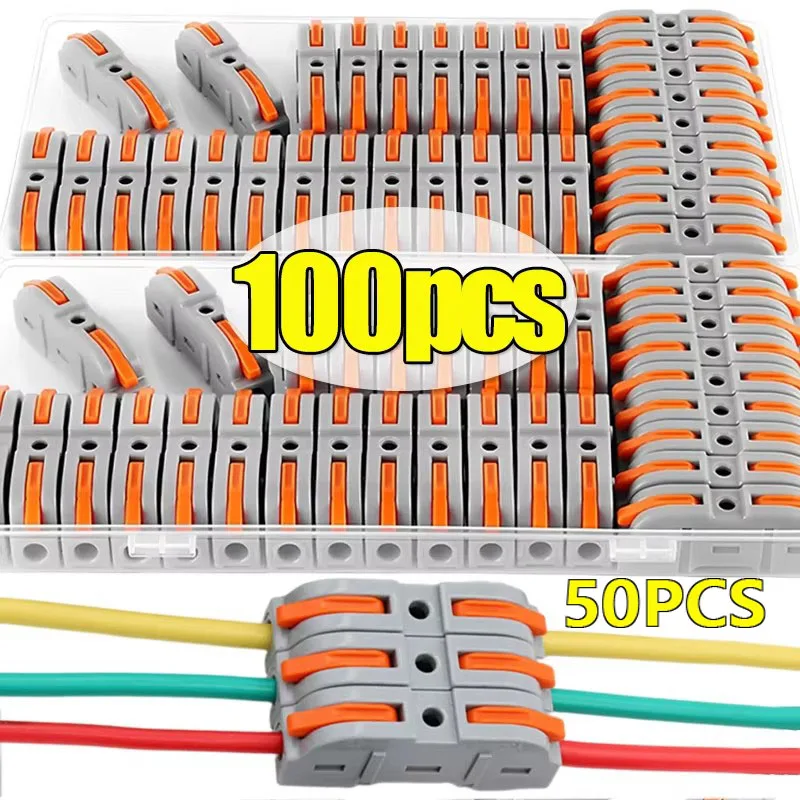
The connectors feature a robust grey thermoplastic housing, complemented by distinct orange lever mechanisms. This visual consistency suggests a standardized manufacturing process. Unit dimensions are precisely 1.57 inches (40mm) in length, 0.59 inches (15mm) in width, and 0.35 inches (9mm) in height for a single module. These are compact units.This material selection, likely a high-grade polycarbonate or polyamide, provides essential dielectric strength and resistance to mechanical stress. Such plastics offer inherent insulation properties, crucial for preventing accidental contact with live conductors. The housing protects internal components. This choice also contributes to the connector's ability to withstand common environmental factors, including moderate temperature fluctuations and incidental moisture exposure, without compromising structural integrity.
Compared to traditional electrical tape or older ceramic connectors, which can degrade or become brittle over time, these modern thermoplastic housings offer superior long-term stability. Tape often fails. The integrated design eliminates the need for external insulating materials, streamlining installations and reducing potential points of failure. This represents a significant upgrade in material science applied to basic electrical components, enhancing both safety and durability.
Connection Mechanics and Wire Versatility
The operational instructions detail a straightforward, three-step connection process: strip the wire insulation to 0.39 inches (9-10mm), push the orange levers to a 90-degree open position, insert the stripped wire lead, and then press the lever down to close the clamp. This is a simple operation. This mechanism ensures a firm, consistent grip on the conductor.This method of termination is compatible with a wide array of wire types, including solid (BV), stranded (BVR), and flexible (RV) wires. The specified wire gauge range is 0.08-4.0mm², which translates to AWG 28-12. This broad compatibility makes these connectors exceptionally versatile for various electrical applications, from low-voltage control circuits to standard residential and commercial wiring. Versatility is key.
Unlike many quick connectors that are often limited to solid core wires or require specific, often expensive, crimping tools for stranded wire termination, these lever connectors offer universal compatibility. This significantly streamlines inventory management for technicians. It also reduces the potential for installation errors. The ability to reliably secure flexible wires is particularly advantageous for appliance repairs, automotive electrical systems, or marine applications where vibration is a constant factor, ensuring a connection that resists loosening over time.
Modularity and Configuration Flexibility
A key feature of these connectors is their assembly-type design, allowing for modular configuration. Individual units can be interlocked to form multi-way connection blocks, supporting 1-way, 2-way, 3-way, or even more complex arrangements by combining multiple single units. This interlocking design creates a neat and organized block. This offers substantial flexibility.This inherent modularity provides significant advantages in complex wiring setups, where precise control over connection points is critical. Technicians can construct custom connection blocks directly on-site, tailoring the configuration to meet specific circuit requirements without needing to stock a wide variety of pre-configured multi-port connectors. Customization saves time. This adaptability minimizes material waste and optimizes space utilization within junction boxes or electrical panels.
Fixed multi-port connectors often lead to unused ports, representing wasted material and space, or necessitate the use of additional single connectors for odd numbers of wires. This assembly-type design optimizes resource utilization. It also simplifies troubleshooting by allowing individual connections within a block to be isolated and tested independently, without disturbing adjacent circuits. This enhances diagnostic efficiency.
Electrical Performance and Reliability
While internal contact mechanisms are not explicitly detailed, the lever-clamp design inherently implies a direct, robust metal-to-metal contact between the conductor and the internal busbar. The specified wire gauge range (AWG 28-12) suggests a design capable of handling typical current loads for its intended applications. Low resistance is critical.A secure and consistent electrical connection is paramount for maintaining signal integrity in sensitive control circuits and preventing voltage drop in power distribution applications. This direct connection minimizes impedance, which is crucial for efficient power transfer and reliable data transmission. The design aims for minimal resistance, which translates directly to reduced heat generation at the connection point.
Poorly executed connections, such as loose screw terminals or improperly twisted and taped wires, can introduce significant resistance, leading to increased heat, intermittent signals, and potential equipment malfunction or even fire hazards. These lever connectors, by providing a strong mechanical and electrical bond, are engineered to mitigate such risks more effectively. They offer a verifiable connection. This contributes to the long-term reliability and safety of the electrical system.
Installation Efficiency and Time Savings
The tool-free, rapid connection process is a primary benefit of these lever-action connectors. The ability to quickly strip, insert, and clamp a wire significantly reduces the time spent on each termination. This accelerates project completion. For large installations with numerous connections, the cumulative time savings can be substantial.This efficiency extends beyond initial installation to maintenance and modification tasks. Wires can be easily disconnected and reconnected without damaging the conductor or the connector itself, facilitating quick circuit changes or component replacements. This reusability adds value. The straightforward nature of the process also reduces the learning curve for new installers, ensuring consistent quality across different skill levels.
Traditional methods like soldering require specialized tools, heat, and a cooling period, while screw terminals demand careful torqueing to avoid over-tightening or under-tightening. These lever connectors bypass these complexities. They offer a simpler, faster, and less error-prone alternative. This translates directly into lower labor costs and improved project timelines, making them an economically sound choice for high-volume work.
Value Proposition and Long-Term Cost-Effectiveness
The product is offered in various pack sizes (20, 30, 50, 100 pieces), indicating a clear focus on bulk purchasing options for both professional electricians and dedicated DIY enthusiasts. The listed price point (5.46 USD for a quantity) suggests an accessible and affordable solution. Bulk buying is economical.For those undertaking frequent electrical projects or managing extensive installations, purchasing these connectors in larger quantities translates directly to a lower cost per unit. This significantly reduces the overall material expense of projects. The time saved during installation, as discussed previously, further contributes to a superior cost-effectiveness when considering total project expenditure.
While individual high-end connectors might offer marginal performance improvements for highly specialized applications, for the vast majority of general electrical work, these lever connectors provide an excellent balance of performance, reliability, and price. They offer a significant upgrade in both reliability and ease of use compared to budget alternatives like generic wire nuts, which often compromise on connection quality and long-term stability. This is a smart investment.
Safety Considerations and Best Practices
As with any electrical component, proper installation and adherence to safety guidelines are paramount when using these connectors. The insulated housing provides protection against accidental contact. However, user vigilance is still required.Incorrect installation, such as insufficient wire stripping or exceeding the specified wire gauge and current ratings, can lead to dangerous conditions. Overheating, short circuits, and potential fire hazards are real risks if these parameters are ignored. Adherence to local electrical codes and standards is non-negotiable. Always consult relevant regulations.
Unlike insulated crimp connectors that require specific tools and a trained technique to ensure a safe connection, these lever connectors offer a visually verifiable clamping action. However, the user must still ensure the wire is stripped correctly and fully inserted. A quick visual check confirms the lever is fully closed. This simple verification step enhances safety by reducing ambiguity in the connection status.
Imagine completing complex wiring projects with unprecedented speed and confidence, knowing each connection is secure and reliable. Envision a workshop where troubleshooting becomes a matter of quick visual checks, not tedious re-terminations. These connectors empower efficient electrical work, transforming frustrating tasks into streamlined operations, ensuring your systems run flawlessly for years.