MPPT Low Voltage Wind Turbine Charge Controller
Official Store Deal
Expert Analysis Overview
The Engineering of Low-Wind Extraction
The HXCONTROLLER MPPT Wind Turbine Regulator is a specialized power management interface designed to bridge the gap between low-RPM turbine outputs and standard deep-cycle battery banks. Unlike generic PWM (Pulse Width Modulation) controllers that require high wind speeds to initiate a charge, this unit utilizes an integrated boost circuit to harvest energy even when the turbine is spinning at speeds normally insufficient to overcome the battery's resting voltage. It's a technical solution for locations where consistent high-velocity gales are rare. Power efficiency depends on extracting every possible watt from the surrounding environment.
Thermal Management and Structural Integrity
Passive cooling is the primary defense against thermal throttling in high-output scenarios. The housing features a cast aluminum alloy heat sink with deep vertical fins. This design maximizes the surface area exposed to ambient air. Feel the weight of the unit; it doesn't feel like a hollow plastic shell. The mass of the aluminum serves as an effective thermal reservoir, absorbing rapid heat spikes during gusty conditions when the turbine output surges. This thermal stability prevents the internal MOSFETs from reaching the junction temperatures that lead to premature failure. Heat kills electronics. This controller prevents that heat from accumulating.
Total Submersion Protection: The IP67 Standard
Marine and coastal environments are notoriously hostile to electrical components. This controller utilizes a full-body potting process, where the internal circuitry is entirely encased in a high-density, thermally conductive epoxy resin. Looking at the bottom of the unit, the solid seal of the resin is visible. This isn't just a gasket; it's a permanent barrier against moisture, salt spray, and corrosive oxygen. IP67 certification means the device survives temporary immersion in water. For a device often mounted in external junction boxes or near turbine masts, this level of sealing is mandatory for long-term survival. Salt air won't penetrate this barrier.
Intelligent Voltage Logic and Braking
The internal logic board automatically detects the connected battery bank voltage, switching between 12V and 24V profiles without manual intervention. This reduces setup errors. The real intelligence lies in the braking system. Wind turbines are mechanical systems with physical limits. If a battery is full or a storm hits, the controller must protect the turbine from over-speeding. The braking voltage is set at 14.5V for 12V systems and 29V for 24V systems. When these thresholds are crossed, the controller applies an electromagnetic load to the turbine phases, slowing the blades to a safe crawl. It protects the bearings. It prevents blade flutter. It keeps the system intact.
Electrical Connection and Wire Gauge Analysis
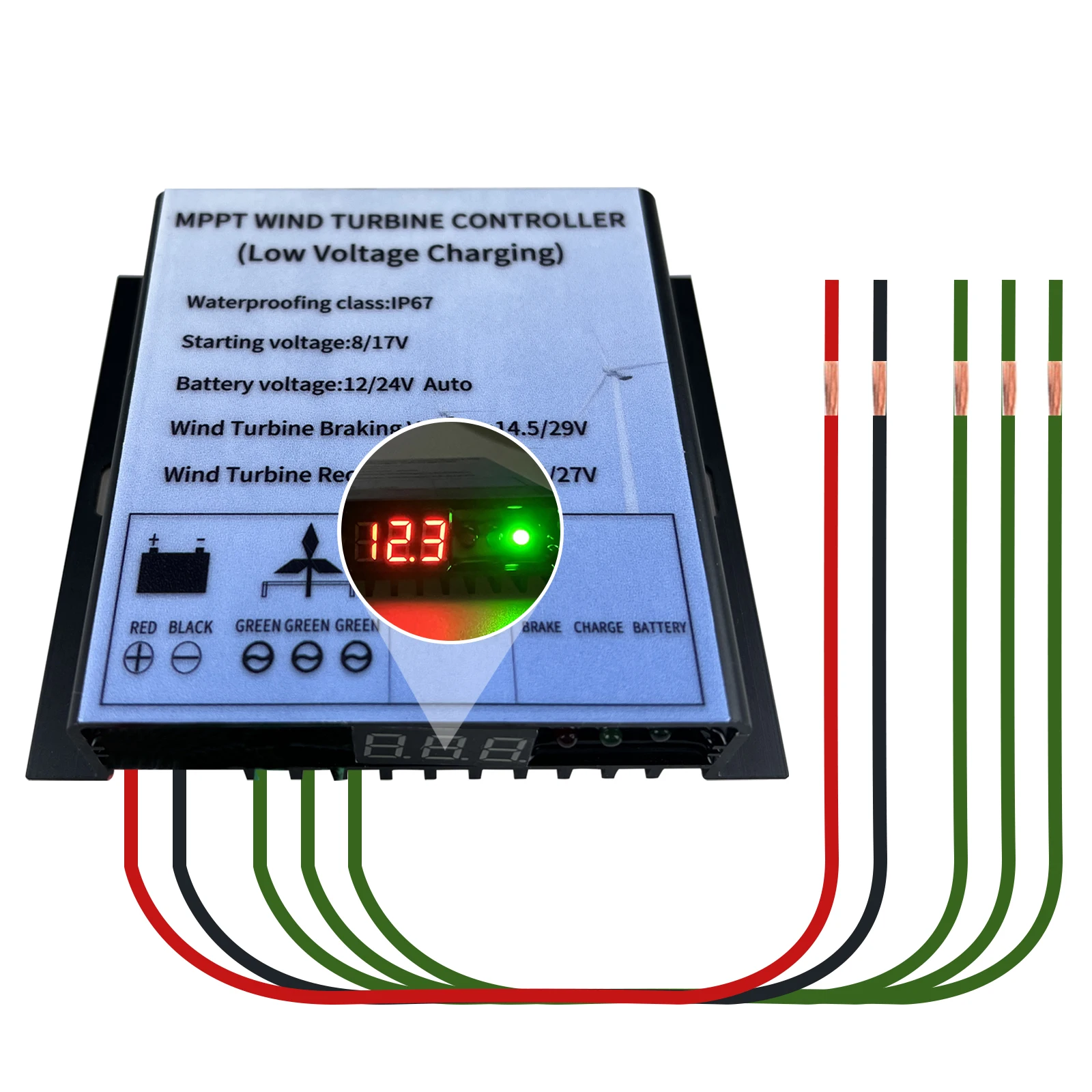
The lead wires are pre-stripped and tinned for oxidation resistance. The color-coding is standard: three green wires for the three-phase AC output from the turbine, and red/black for the battery DC connection. The wire insulation is a thick, flexible polymer that resists UV degradation. While the gauge is appropriate for the 600W-800W rating, ensure the external cable runs to the battery use a minimum of 10AWG to prevent voltage drop over distance. Low voltage systems are highly sensitive to resistance. Keep runs short. Tighten every connection. Loose wires cause fires.
The Visual Feedback Loop
A three-digit LED display provides immediate system status. Seeing '12.3' in bright red digits confirms the battery resting state. Adjacent to the numeric readout, status LEDs indicate charging and braking modes. A green light confirms the boost circuit is active and energy is flowing. A red light indicates the brake is engaged. This visual feedback is crucial during initial commissioning. It allows for immediate verification of phase alignment and battery health. No guessing is required. The data is right there.
Operational Efficiency in Variable Conditions
Typical turbines struggle to charge a 12V battery when the input is only 8V. This controller solves that. The boost function steps up that low voltage to the required charging level. It effectively lowers the cut-in wind speed of your turbine. You get more charging hours per day. Efficiency isn't just about peak power; it's about the total energy harvested over 24 hours. This controller wins in the low-wind margins. It turns a gentle breeze into usable current.
Mechanical Vibration Resistance
Wind systems vibrate. High-frequency oscillations can shake components loose on standard circuit Boards. The epoxy potting mentioned earlier serves a dual purpose: it dampens these vibrations. It anchors every capacitor, resistor, and wire lead into a solid block. This makes the controller essentially immune to the mechanical stresses of mounting on a vibrating pole or mast. It is built for movement. It is built for the outdoors.
Imagine the peace of mind knowing your battery bank is steadily climbing even on a calm afternoon. Picture your system surviving a coastal gale with the electromagnetic brake holding the turbine steady while other systems risk mechanical failure. The integration of this controller transforms a simple turbine into a smart energy harvester, ensuring that when the wind moves, your lights stay on. It turns the erratic power of nature into a steady, controlled stream of electricity for your cabin, boat, or remote station.