MT3608 Adjustable DC-DC Boost Converter Module
Official Store Deal
Expert Analysis Overview
The MT3608 DC-DC Boost Converter Module is a compact, yet potent, power regulation solution engineered for precise voltage step-up in low-power electronics. This device is critical for applications requiring a stable, higher voltage output from a lower voltage source, such as battery-powered systems or embedded projects. Its design prioritizes efficiency and adjustability, making it a staple for hobbyists and professional engineers alike who demand reliable power conversion without excessive bulk.
This module operates as a boost converter, specifically designed to elevate an input DC voltage to a higher, regulated DC output. The core of its operation lies in the MT3608 switching regulator IC, which facilitates high-frequency switching to achieve impressive conversion efficiencies. Unlike linear regulators that dissipate excess voltage as heat, the MT3608 employs a switching topology, significantly reducing power loss and extending battery life in portable applications. This efficiency is paramount for devices where every milliwatt counts.
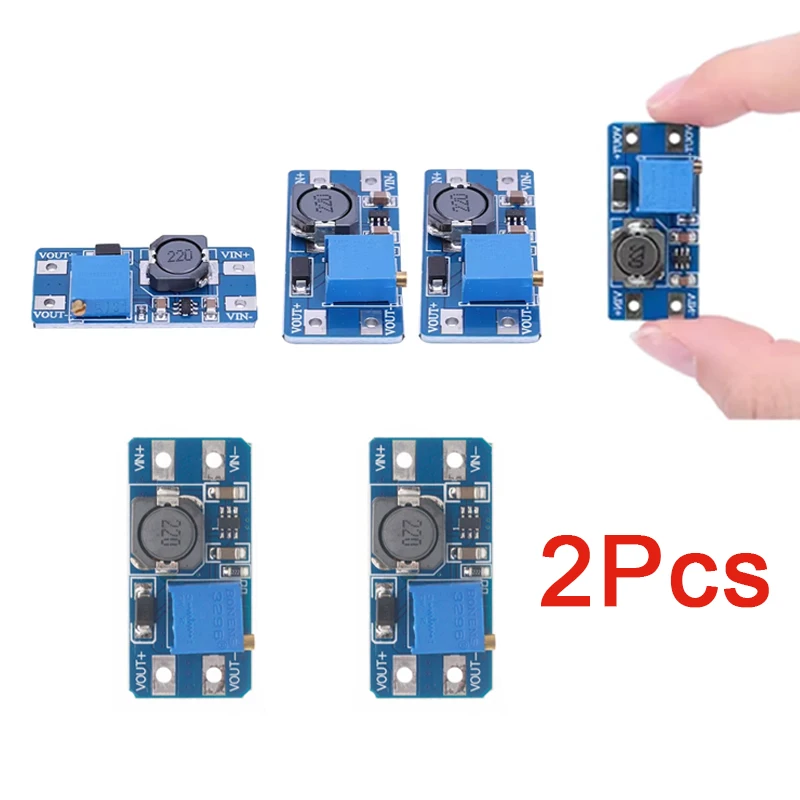
The visible inductor, a key component in any boost converter, is rated for 220 (likely microhenries), indicating its capacity for energy storage and release during the switching cycles. A properly sized inductor is crucial for maintaining stable output voltage and minimizing ripple. The module's ability to convert a wide input range of 2V-24V to an adjustable output of 5V-28V provides substantial flexibility. This wide range allows it to be powered by various sources, from single Li-ion cells to multi-cell battery packs, or even USB power, making it highly adaptable. The output voltage is precisely controlled via an onboard multi-turn potentiometer, enabling fine-tuning for specific load requirements. This adjustability is a significant advantage over fixed-output converters, offering greater utility across diverse projects.
Compared to standard linear regulators, which are often simpler but inherently less efficient, especially when the input-output voltage differential is large, this boost module offers a superior alternative. Linear regulators are suitable for small voltage drops and low currents, but for stepping up voltage or for larger voltage differences, they are entirely unsuitable. The MT3608 module fills this gap, providing a compact and efficient solution where a higher voltage is needed. It avoids the substantial heat generation associated with linear regulators when converting significant voltage differences, thereby enhancing overall system reliability and reducing the need for extensive heat sinking.
The module's printed circuit board (PCB) is a standard blue FR-4 material, a common choice for its electrical insulation properties and mechanical strength. The layout appears clean, with clearly marked input (VIN+, VIN-) and output (VOUT+, VOUT-) solder pads. These markings are essential for correct wiring, preventing accidental reverse polarity connections that could damage the module or connected components. Proper terminal quality is critical for maintaining low resistance connections and preventing localized heating, which can lead to power loss or even fire hazards. The solder pads appear adequately sized for typical wire gauges used in low-power electronics.
The components, including the MT3608 IC, the inductor, and the potentiometer, are surface-mounted (SMD), contributing to the module's small footprint. SMD components are generally more resistant to vibration and offer better high-frequency performance compared to through-hole components. The potentiometer, a blue cube with a small adjustment screw, is a multi-turn type, which allows for very precise voltage setting. This precision is vital for sensitive electronics that require exact voltage levels. The quality of these components directly impacts the module's stability and longevity. Inferior components can lead to premature failure or unstable output.
Unlike many generic, unbranded modules that might use questionable component sourcing, the visible markings on the inductor (220) and the general layout suggest a standard manufacturing process. While specific UL or CE certifications are not typically visible on such small, generic modules, adherence to good manufacturing practices is implied by the clear component placement and solder quality. Users must always verify the module's performance under their specific load conditions, especially regarding current draw and thermal management. The compact nature of the module means that thermal considerations become more pronounced under higher loads, necessitating careful design and potential external cooling solutions.
The MT3608 is rated for a maximum peak output current of 2A. However, it is crucial for electrical safety and component longevity to understand that this is a peak rating, not a continuous one, especially without additional cooling. For continuous operation, particularly when the input-output voltage difference is significant, the module's continuous current capability is typically closer to 1.5A or even less, depending on ambient temperature and airflow. Overloading the module beyond its continuous rating will lead to excessive heat generation, which can cause the MT3608 IC to enter thermal shutdown or, in extreme cases, lead to permanent damage. Proper wire gauge selection for both input and output connections is also paramount. Using wires too thin for the current draw can create resistance, leading to voltage drop and heat generation in the wiring itself, posing a fire risk.
Effective thermal management is not explicitly built into this small module, meaning users must account for it in their designs. For applications drawing close to the continuous current limit, integrating a small heatsink onto the MT3608 IC or ensuring adequate airflow around the module is highly recommended. This proactive approach prevents thermal runaway and ensures stable operation over extended periods. The module's small size, while a benefit for space-constrained projects, also means it has limited surface area for passive heat dissipation. Therefore, active cooling or careful load management becomes a design imperative for demanding applications.
Compared to larger, industrial-grade boost converters that often feature integrated heatsinks and robust thermal management circuitry, this compact module requires more user intervention in its thermal design. The trade-off for its small size and low cost is the responsibility placed on the designer to ensure it operates within safe thermal limits. For intermittent loads or very low continuous currents, the module performs admirably without additional cooling. However, for sustained operation at higher currents, neglecting thermal considerations is a common oversight that can lead to system instability or failure. Always monitor the temperature during initial testing.
Integrating the MT3608 module into an existing circuit is straightforward due to its clearly labeled input and output terminals. The module's small dimensions, approximately 37mm x 16mm x 6mm, allow it to fit into very tight enclosures or alongside other components on a breadboard or custom PCB. This compact form factor is particularly beneficial for portable devices, wearable technology, or IoT nodes where space is at a premium. The module's ability to provide a stable, higher voltage from a fluctuating battery source can significantly enhance the performance and reliability of such systems. It is a versatile building block.
Before connecting any load, it is critical to set the output voltage accurately using a multimeter. The multi-turn potentiometer allows for precise adjustment, but it requires careful manipulation. Turning the screw clockwise typically increases the voltage, while counter-clockwise decreases it. This manual adjustment process ensures that the connected load receives the exact voltage it requires, preventing over-voltage damage to sensitive components. The absence of a digital display for voltage output means that an external measurement device is indispensable during setup. This is a minor operational consideration.
Unlike more advanced power management ICs that might offer features like soft-start, over-current protection, or under-voltage lockout, this module provides a basic, yet highly effective, boost conversion function. Its simplicity makes it easy to understand and implement, reducing design complexity for many applications. However, for critical systems, designers may need to incorporate these additional protection features externally. The module serves as a fundamental power conversion block, offering a solid foundation upon which more complex power management strategies can be built. Its straightforward nature is a strength for rapid prototyping.
Adhering to strict operational safety protocols is non-negotiable when working with any electrical component, especially power converters. The MT3608 module, while robust within its specifications, requires careful handling to prevent electrical hazards. The primary safety concern is ensuring correct input voltage polarity. Reversing the input polarity will almost certainly destroy the module, as it lacks built-in reverse polarity protection. Double-checking connections with a multimeter before applying power is a fundamental safety practice that cannot be overstated. This simple step prevents costly damage.
Another critical safety aspect involves managing the output current. While the module can handle up to 2A peak, continuous operation at or near this limit without proper thermal management can lead to overheating. Overheating components are a fire hazard and can cause insulation breakdown in nearby wiring. Always ensure that the total current draw of the connected load remains within the module's safe continuous operating limits, factoring in ambient temperature and enclosure restrictions. If the load requires more current, a larger, more robust boost converter with integrated thermal solutions should be considered. Proper ventilation is key.
Finally, the adjustable output voltage feature, while beneficial, also presents a potential hazard if not handled correctly. Accidentally setting the output voltage too high can instantly damage sensitive downstream components. Always use a multimeter to verify the output voltage *before* connecting any load. This verification step is crucial for protecting valuable electronics. The module's simplicity means that the responsibility for safe operation largely rests with the user, emphasizing the need for careful setup and adherence to best electrical practices. This module is a tool, and like any tool, it requires knowledgeable and responsible use.
The longevity of the MT3608 module is directly tied to its operating conditions. When used within its specified voltage and current limits, with appropriate thermal considerations, these modules can provide stable power conversion for extended periods. The quality of the onboard components, particularly the inductor and capacitors, plays a significant role in long-term reliability. While these are not industrial-grade components, they are generally sufficient for hobbyist projects, educational purposes, and many low-power commercial applications. Regular inspection of solder joints and connections is advisable for any long-term installation.
The versatility of this module is one of its strongest attributes. It can power a wide array of devices, from microcontrollers like Arduino and ESP32, which often require 5V or 3.3V, to small motors, LED strips, or other components that need a higher voltage than available from a battery. Its compact size makes it ideal for integration into custom enclosures or portable projects where space is a premium. Imagine powering a remote weather station from a small solar panel and battery, boosting the voltage to run the necessary sensors and communication modules. This module makes such applications feasible.
This module offers a cost-effective alternative to custom-designed power supply circuits for many applications. Instead of designing and fabricating a boost converter from scratch, which involves component selection, PCB layout, and testing, this pre-assembled module provides a ready-to-use solution. This significantly reduces development time and cost, allowing engineers and hobbyists to focus on the core functionality of their projects. It is a practical choice for rapid prototyping and small-batch production, providing reliable power conversion without the overhead of complex power supply design. The value proposition is clear for those needing quick, efficient voltage step-up.
Imagine the satisfaction of completing a complex IoT project, knowing that its power supply is stable, efficient, and precisely tuned, thanks to a reliable component like the MT3608 module. This module empowers creators to build robust, battery-powered devices that operate longer and more reliably, transforming concepts into tangible, functional realities. It is a fundamental building block for innovation in portable electronics, ensuring your creations have the consistent power they demand.
Precision Power Amplification
This module operates as a boost converter, specifically designed to elevate an input DC voltage to a higher, regulated DC output. The core of its operation lies in the MT3608 switching regulator IC, which facilitates high-frequency switching to achieve impressive conversion efficiencies. Unlike linear regulators that dissipate excess voltage as heat, the MT3608 employs a switching topology, significantly reducing power loss and extending battery life in portable applications. This efficiency is paramount for devices where every milliwatt counts.
The visible inductor, a key component in any boost converter, is rated for 220 (likely microhenries), indicating its capacity for energy storage and release during the switching cycles. A properly sized inductor is crucial for maintaining stable output voltage and minimizing ripple. The module's ability to convert a wide input range of 2V-24V to an adjustable output of 5V-28V provides substantial flexibility. This wide range allows it to be powered by various sources, from single Li-ion cells to multi-cell battery packs, or even USB power, making it highly adaptable. The output voltage is precisely controlled via an onboard multi-turn potentiometer, enabling fine-tuning for specific load requirements. This adjustability is a significant advantage over fixed-output converters, offering greater utility across diverse projects.
Compared to standard linear regulators, which are often simpler but inherently less efficient, especially when the input-output voltage differential is large, this boost module offers a superior alternative. Linear regulators are suitable for small voltage drops and low currents, but for stepping up voltage or for larger voltage differences, they are entirely unsuitable. The MT3608 module fills this gap, providing a compact and efficient solution where a higher voltage is needed. It avoids the substantial heat generation associated with linear regulators when converting significant voltage differences, thereby enhancing overall system reliability and reducing the need for extensive heat sinking.
Circuit Integrity and Component Selection
The module's printed circuit board (PCB) is a standard blue FR-4 material, a common choice for its electrical insulation properties and mechanical strength. The layout appears clean, with clearly marked input (VIN+, VIN-) and output (VOUT+, VOUT-) solder pads. These markings are essential for correct wiring, preventing accidental reverse polarity connections that could damage the module or connected components. Proper terminal quality is critical for maintaining low resistance connections and preventing localized heating, which can lead to power loss or even fire hazards. The solder pads appear adequately sized for typical wire gauges used in low-power electronics.
The components, including the MT3608 IC, the inductor, and the potentiometer, are surface-mounted (SMD), contributing to the module's small footprint. SMD components are generally more resistant to vibration and offer better high-frequency performance compared to through-hole components. The potentiometer, a blue cube with a small adjustment screw, is a multi-turn type, which allows for very precise voltage setting. This precision is vital for sensitive electronics that require exact voltage levels. The quality of these components directly impacts the module's stability and longevity. Inferior components can lead to premature failure or unstable output.
Unlike many generic, unbranded modules that might use questionable component sourcing, the visible markings on the inductor (220) and the general layout suggest a standard manufacturing process. While specific UL or CE certifications are not typically visible on such small, generic modules, adherence to good manufacturing practices is implied by the clear component placement and solder quality. Users must always verify the module's performance under their specific load conditions, especially regarding current draw and thermal management. The compact nature of the module means that thermal considerations become more pronounced under higher loads, necessitating careful design and potential external cooling solutions.
Thermal Management and Load Handling
The MT3608 is rated for a maximum peak output current of 2A. However, it is crucial for electrical safety and component longevity to understand that this is a peak rating, not a continuous one, especially without additional cooling. For continuous operation, particularly when the input-output voltage difference is significant, the module's continuous current capability is typically closer to 1.5A or even less, depending on ambient temperature and airflow. Overloading the module beyond its continuous rating will lead to excessive heat generation, which can cause the MT3608 IC to enter thermal shutdown or, in extreme cases, lead to permanent damage. Proper wire gauge selection for both input and output connections is also paramount. Using wires too thin for the current draw can create resistance, leading to voltage drop and heat generation in the wiring itself, posing a fire risk.
Effective thermal management is not explicitly built into this small module, meaning users must account for it in their designs. For applications drawing close to the continuous current limit, integrating a small heatsink onto the MT3608 IC or ensuring adequate airflow around the module is highly recommended. This proactive approach prevents thermal runaway and ensures stable operation over extended periods. The module's small size, while a benefit for space-constrained projects, also means it has limited surface area for passive heat dissipation. Therefore, active cooling or careful load management becomes a design imperative for demanding applications.
Compared to larger, industrial-grade boost converters that often feature integrated heatsinks and robust thermal management circuitry, this compact module requires more user intervention in its thermal design. The trade-off for its small size and low cost is the responsibility placed on the designer to ensure it operates within safe thermal limits. For intermittent loads or very low continuous currents, the module performs admirably without additional cooling. However, for sustained operation at higher currents, neglecting thermal considerations is a common oversight that can lead to system instability or failure. Always monitor the temperature during initial testing.
Integration into Existing Systems
Integrating the MT3608 module into an existing circuit is straightforward due to its clearly labeled input and output terminals. The module's small dimensions, approximately 37mm x 16mm x 6mm, allow it to fit into very tight enclosures or alongside other components on a breadboard or custom PCB. This compact form factor is particularly beneficial for portable devices, wearable technology, or IoT nodes where space is at a premium. The module's ability to provide a stable, higher voltage from a fluctuating battery source can significantly enhance the performance and reliability of such systems. It is a versatile building block.
Before connecting any load, it is critical to set the output voltage accurately using a multimeter. The multi-turn potentiometer allows for precise adjustment, but it requires careful manipulation. Turning the screw clockwise typically increases the voltage, while counter-clockwise decreases it. This manual adjustment process ensures that the connected load receives the exact voltage it requires, preventing over-voltage damage to sensitive components. The absence of a digital display for voltage output means that an external measurement device is indispensable during setup. This is a minor operational consideration.
Unlike more advanced power management ICs that might offer features like soft-start, over-current protection, or under-voltage lockout, this module provides a basic, yet highly effective, boost conversion function. Its simplicity makes it easy to understand and implement, reducing design complexity for many applications. However, for critical systems, designers may need to incorporate these additional protection features externally. The module serves as a fundamental power conversion block, offering a solid foundation upon which more complex power management strategies can be built. Its straightforward nature is a strength for rapid prototyping.
Operational Safety Protocols
Adhering to strict operational safety protocols is non-negotiable when working with any electrical component, especially power converters. The MT3608 module, while robust within its specifications, requires careful handling to prevent electrical hazards. The primary safety concern is ensuring correct input voltage polarity. Reversing the input polarity will almost certainly destroy the module, as it lacks built-in reverse polarity protection. Double-checking connections with a multimeter before applying power is a fundamental safety practice that cannot be overstated. This simple step prevents costly damage.
Another critical safety aspect involves managing the output current. While the module can handle up to 2A peak, continuous operation at or near this limit without proper thermal management can lead to overheating. Overheating components are a fire hazard and can cause insulation breakdown in nearby wiring. Always ensure that the total current draw of the connected load remains within the module's safe continuous operating limits, factoring in ambient temperature and enclosure restrictions. If the load requires more current, a larger, more robust boost converter with integrated thermal solutions should be considered. Proper ventilation is key.
Finally, the adjustable output voltage feature, while beneficial, also presents a potential hazard if not handled correctly. Accidentally setting the output voltage too high can instantly damage sensitive downstream components. Always use a multimeter to verify the output voltage *before* connecting any load. This verification step is crucial for protecting valuable electronics. The module's simplicity means that the responsibility for safe operation largely rests with the user, emphasizing the need for careful setup and adherence to best electrical practices. This module is a tool, and like any tool, it requires knowledgeable and responsible use.
Longevity and Application Versatility
The longevity of the MT3608 module is directly tied to its operating conditions. When used within its specified voltage and current limits, with appropriate thermal considerations, these modules can provide stable power conversion for extended periods. The quality of the onboard components, particularly the inductor and capacitors, plays a significant role in long-term reliability. While these are not industrial-grade components, they are generally sufficient for hobbyist projects, educational purposes, and many low-power commercial applications. Regular inspection of solder joints and connections is advisable for any long-term installation.
The versatility of this module is one of its strongest attributes. It can power a wide array of devices, from microcontrollers like Arduino and ESP32, which often require 5V or 3.3V, to small motors, LED strips, or other components that need a higher voltage than available from a battery. Its compact size makes it ideal for integration into custom enclosures or portable projects where space is a premium. Imagine powering a remote weather station from a small solar panel and battery, boosting the voltage to run the necessary sensors and communication modules. This module makes such applications feasible.
This module offers a cost-effective alternative to custom-designed power supply circuits for many applications. Instead of designing and fabricating a boost converter from scratch, which involves component selection, PCB layout, and testing, this pre-assembled module provides a ready-to-use solution. This significantly reduces development time and cost, allowing engineers and hobbyists to focus on the core functionality of their projects. It is a practical choice for rapid prototyping and small-batch production, providing reliable power conversion without the overhead of complex power supply design. The value proposition is clear for those needing quick, efficient voltage step-up.
Imagine the satisfaction of completing a complex IoT project, knowing that its power supply is stable, efficient, and precisely tuned, thanks to a reliable component like the MT3608 module. This module empowers creators to build robust, battery-powered devices that operate longer and more reliably, transforming concepts into tangible, functional realities. It is a fundamental building block for innovation in portable electronics, ensuring your creations have the consistent power they demand.