Panel-Mount USB 2.0 Female Connector with PH2.0 Cable
Official Store Deal
Expert Analysis Overview
The Panel-Mount USB 2.0 Female Connector is a highly adaptable electrical component engineered for integrating universal serial bus connectivity into custom enclosures, repair projects, and embedded systems, offering both power delivery and data transfer capabilities. This component addresses the common need for a robust, accessible USB port in scenarios where standard motherboard headers or pre-built chassis ports are insufficient or unavailable. Its design prioritizes ease of installation and functional versatility, making it a practical solution for a wide array of electronic applications.
The product is available in two primary configurations: a 2-pin variant and a 4-pin variant. The 2-pin option is specifically designed for power delivery, typically utilizing the red and black wires for +5V and ground connections, respectively. This configuration is ideal for charging applications or powering low-current devices where data transfer is not required. It simplifies wiring. The absence of data lines reduces complexity, making it suitable for dedicated power injection points.
In contrast, the 4-pin variant incorporates the full USB 2.0 standard pinout, including data+ (white) and data(green) lines in addition to power. This allows for both charging and bidirectional data communication at USB 2.0 speeds, which typically max out at 480 Mbps. For projects requiring peripheral connectivity, such as connecting a keyboard, mouse, or flash drive to an embedded system, the 4-pin version is indispensable. It provides full functionality.
Unlike generic USB breakout boards that may require intricate soldering or custom cable assemblies, these connectors arrive pre-wired with a PH2.0-4P header. This pre-terminated cable significantly streamlines the integration process, reducing the potential for wiring errors and saving considerable assembly time. The PH2.0 connector is a common standard in hobby electronics and embedded systems, ensuring broad compatibility with many development boards and custom PCBs. This is a clear advantage.
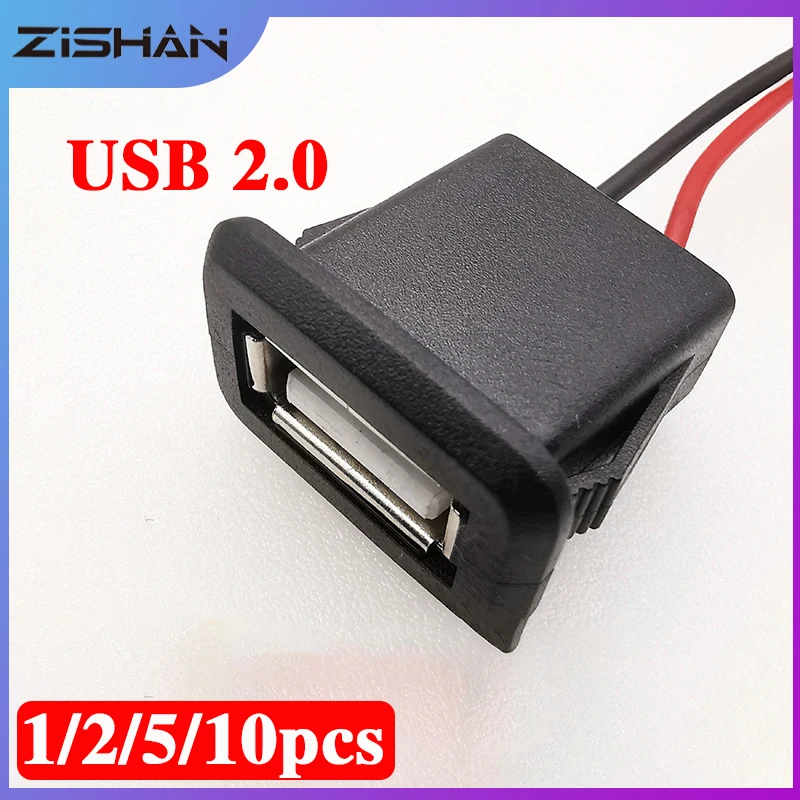
The connector features a compact, rectangular plastic housing designed for panel mounting. The visible material appears to be a durable, injection-molded ABS or similar polymer, providing adequate protection for the internal USB contacts. This type of housing is crucial for applications where the USB port needs to be flush-mounted into a chassis, dashboard, or project enclosure, offering a clean and professional finish. Its small footprint is beneficial.
Installation involves cutting an appropriately sized rectangular aperture in the target panel. The connector then snaps into place, often secured by friction or integrated clips within the housing design, as suggested by the visible flanges. This method of mounting eliminates the need for screws or additional fasteners, simplifying the installation procedure and reducing the overall component count. A secure fit is paramount.
Compared to bare USB receptacles that offer no mounting solution, or those requiring custom brackets, this integrated housing presents a significant upgrade. It provides a ready-to-mount solution that enhances the aesthetic and functional integrity of the final assembly. The robust plastic construction also helps to isolate the USB port from potential electrical shorts with a metal chassis, a critical consideration in many electronic designs. This improves safety.
For the 4-pin variant, maintaining signal integrity over the pre-attached wires is essential for reliable USB 2.0 data transmission. USB 2.0 operates at relatively high frequencies, and the quality of the cable and its shielding (though not explicitly visible, the gauge and insulation are) directly impacts data reliability. The color-coded wires (red, white, green, black) adhere to the standard USB wiring convention, which is beneficial for correct identification and connection. Proper wiring is critical.
The visible wire gauge appears sufficient for typical USB 2.0 applications, particularly for the short lengths shown in the product images. Thicker gauge wires, especially for the power lines, minimize voltage drop, ensuring that connected devices receive adequate power. For data lines, consistent impedance and minimal crosstalk are important, which are generally well-managed in short, twisted-pair configurations, though twisting is not explicitly visible in these pre-assembled cables. Short runs are less problematic.
Unlike improvised wiring solutions that might use unshielded or mismatched wires, these pre-assembled cables offer a standardized and more reliable pathway for both power and data. The use of a PH2.0 connector ensures a consistent and secure connection to the host board, minimizing intermittent contact issues that can plague hand-soldered or crimped connections. This enhances overall system stability. It provides peace of mind.
The durability of the USB female receptacle itself is a key factor in the long-term reliability of any project. The metal contacts within the USB-A port are designed to withstand repeated insertions and removals. The quality of these contacts, typically brass or phosphor bronze with a nickel or gold plating, dictates the number of mating cycles before wear becomes an issue. High-quality contacts are vital.
The plastic housing, while providing structural support, also protects the internal wiring connections from mechanical stress and environmental factors. For applications in environments with vibration or frequent handling, the integrity of the housing and its panel-mount retention mechanism is critical. A snug fit prevents movement and wear. The product's design suggests a focus on practical, everyday use rather than extreme industrial conditions.
Compared to exposed USB ports on development boards or internal PC headers, these panel-mount connectors offer superior protection and accessibility. They are designed to be the user-facing interface, absorbing the mechanical stresses of cable connection and disconnection, thereby protecting the more delicate internal components. This extends the lifespan of the host device. It is a smart design choice.
For electronics enthusiasts, hobbyists, and repair technicians, these connectors represent a significant economic advantage. Instead of replacing an entire device due to a damaged or missing USB port, this component allows for a targeted, cost-effective repair. A broken USB port on a custom arcade cabinet or a car stereo can be easily remedied. This saves money and resources.
Furthermore, the ability to integrate a USB port into a custom enclosure opens up possibilities for bespoke projects. Imagine a custom charging station, an embedded media player, or a diagnostic port for a DIY smart home device. These connectors provide the necessary interface without requiring complex PCB design or manufacturing. They empower creators.
Unlike proprietary connectors or specialized components that can be difficult and expensive to source, the USB 2.0 standard is ubiquitous. This ensures that replacement parts are readily available and that the integrated port will be compatible with a vast ecosystem of USB devices. This universal compatibility is a core strength. It simplifies future upgrades.
The pre-attached cables, terminating in a PH2.0-4P connector, simplify the wiring process considerably. The standard color coding (red for +5V, black for ground, white for Data-, green for Data+) makes it straightforward to connect to a compatible header on a microcontroller board, single-board computer, or custom PCB. This reduces the likelihood of incorrect polarity or data line assignment. Correct wiring is crucial.
For systems that do not feature a PH2.0 header, the wires can be easily cut and stripped for direct soldering or connection to screw terminals. This flexibility ensures that the connector can be adapted to almost any electronic project, regardless of the existing interface. The visible insulation on the wires appears robust enough to protect against incidental short circuits during installation. Adaptability is a key feature.
Compared to raw USB receptacles that demand precise soldering of individual wires, often under magnification, these pre-wired units are a significant time-saver and reduce the skill level required for integration. This makes advanced customization accessible to a broader audience, from seasoned engineers to enthusiastic beginners. It democratizes design.
These panel-mount USB connectors are not merely replacement parts; they are tools for enhancement. Consider automotive applications where adding a flush-mounted USB charging port to a dashboard or console can significantly improve user convenience. Or in industrial settings, where a robust, easily accessible diagnostic USB port can streamline maintenance. They add functionality.
For existing equipment lacking modern connectivity, integrating one of these ports can extend its useful life and expand its capabilities. An older audio system could gain USB playback, or a custom-built machine could receive firmware updates via a newly added port. This type of upgrade is often more practical and sustainable than replacing the entire unit. It promotes longevity.
Unlike external USB hubs or dongles that clutter workspaces and are prone to damage, an integrated panel-mount port offers a clean, permanent, and more durable solution. It seamlessly blends into the device's design, providing a professional finish that external adapters simply cannot match. This elevates the user experience. It offers a refined solution.
Imagine the satisfaction of completing a custom electronics project with a perfectly integrated, functional USB port, or the relief of easily repairing a piece of equipment that would otherwise be discarded. This connector provides the essential interface, ensuring reliable power and data flow for your creations and repairs. The simplicity of installation, combined with its robust design, means less time troubleshooting and more time enjoying the functionality. It is a foundational component for any maker or technician looking to add or restore USB connectivity with confidence and precision, ensuring your devices remain connected and powered efficiently for years to come.
Connectivity Architecture: Pin Configurations and Power Delivery
The product is available in two primary configurations: a 2-pin variant and a 4-pin variant. The 2-pin option is specifically designed for power delivery, typically utilizing the red and black wires for +5V and ground connections, respectively. This configuration is ideal for charging applications or powering low-current devices where data transfer is not required. It simplifies wiring. The absence of data lines reduces complexity, making it suitable for dedicated power injection points.
In contrast, the 4-pin variant incorporates the full USB 2.0 standard pinout, including data+ (white) and data
Unlike generic USB breakout boards that may require intricate soldering or custom cable assemblies, these connectors arrive pre-wired with a PH2.0-4P header. This pre-terminated cable significantly streamlines the integration process, reducing the potential for wiring errors and saving considerable assembly time. The PH2.0 connector is a common standard in hobby electronics and embedded systems, ensuring broad compatibility with many development boards and custom PCBs. This is a clear advantage.
Mechanical Integration: Housing Durability and Mounting Versatility
The connector features a compact, rectangular plastic housing designed for panel mounting. The visible material appears to be a durable, injection-molded ABS or similar polymer, providing adequate protection for the internal USB contacts. This type of housing is crucial for applications where the USB port needs to be flush-mounted into a chassis, dashboard, or project enclosure, offering a clean and professional finish. Its small footprint is beneficial.
Installation involves cutting an appropriately sized rectangular aperture in the target panel. The connector then snaps into place, often secured by friction or integrated clips within the housing design, as suggested by the visible flanges. This method of mounting eliminates the need for screws or additional fasteners, simplifying the installation procedure and reducing the overall component count. A secure fit is paramount.
Compared to bare USB receptacles that offer no mounting solution, or those requiring custom brackets, this integrated housing presents a significant upgrade. It provides a ready-to-mount solution that enhances the aesthetic and functional integrity of the final assembly. The robust plastic construction also helps to isolate the USB port from potential electrical shorts with a metal chassis, a critical consideration in many electronic designs. This improves safety.
Signal Pathway Integrity: Data Transmission Considerations
For the 4-pin variant, maintaining signal integrity over the pre-attached wires is essential for reliable USB 2.0 data transmission. USB 2.0 operates at relatively high frequencies, and the quality of the cable and its shielding (though not explicitly visible, the gauge and insulation are) directly impacts data reliability. The color-coded wires (red, white, green, black) adhere to the standard USB wiring convention, which is beneficial for correct identification and connection. Proper wiring is critical.
The visible wire gauge appears sufficient for typical USB 2.0 applications, particularly for the short lengths shown in the product images. Thicker gauge wires, especially for the power lines, minimize voltage drop, ensuring that connected devices receive adequate power. For data lines, consistent impedance and minimal crosstalk are important, which are generally well-managed in short, twisted-pair configurations, though twisting is not explicitly visible in these pre-assembled cables. Short runs are less problematic.
Unlike improvised wiring solutions that might use unshielded or mismatched wires, these pre-assembled cables offer a standardized and more reliable pathway for both power and data. The use of a PH2.0 connector ensures a consistent and secure connection to the host board, minimizing intermittent contact issues that can plague hand-soldered or crimped connections. This enhances overall system stability. It provides peace of mind.
Longevity in the Field: Material Science and Connection Reliability
The durability of the USB female receptacle itself is a key factor in the long-term reliability of any project. The metal contacts within the USB-A port are designed to withstand repeated insertions and removals. The quality of these contacts, typically brass or phosphor bronze with a nickel or gold plating, dictates the number of mating cycles before wear becomes an issue. High-quality contacts are vital.
The plastic housing, while providing structural support, also protects the internal wiring connections from mechanical stress and environmental factors. For applications in environments with vibration or frequent handling, the integrity of the housing and its panel-mount retention mechanism is critical. A snug fit prevents movement and wear. The product's design suggests a focus on practical, everyday use rather than extreme industrial conditions.
Compared to exposed USB ports on development boards or internal PC headers, these panel-mount connectors offer superior protection and accessibility. They are designed to be the user-facing interface, absorbing the mechanical stresses of cable connection and disconnection, thereby protecting the more delicate internal components. This extends the lifespan of the host device. It is a smart design choice.
The DIY Advantage: Customization and Repair Economics
For electronics enthusiasts, hobbyists, and repair technicians, these connectors represent a significant economic advantage. Instead of replacing an entire device due to a damaged or missing USB port, this component allows for a targeted, cost-effective repair. A broken USB port on a custom arcade cabinet or a car stereo can be easily remedied. This saves money and resources.
Furthermore, the ability to integrate a USB port into a custom enclosure opens up possibilities for bespoke projects. Imagine a custom charging station, an embedded media player, or a diagnostic port for a DIY smart home device. These connectors provide the necessary interface without requiring complex PCB design or manufacturing. They empower creators.
Unlike proprietary connectors or specialized components that can be difficult and expensive to source, the USB 2.0 standard is ubiquitous. This ensures that replacement parts are readily available and that the integrated port will be compatible with a vast ecosystem of USB devices. This universal compatibility is a core strength. It simplifies future upgrades.
Installation Dynamics: Wiring and Compatibility
The pre-attached cables, terminating in a PH2.0-4P connector, simplify the wiring process considerably. The standard color coding (red for +5V, black for ground, white for Data-, green for Data+) makes it straightforward to connect to a compatible header on a microcontroller board, single-board computer, or custom PCB. This reduces the likelihood of incorrect polarity or data line assignment. Correct wiring is crucial.
For systems that do not feature a PH2.0 header, the wires can be easily cut and stripped for direct soldering or connection to screw terminals. This flexibility ensures that the connector can be adapted to almost any electronic project, regardless of the existing interface. The visible insulation on the wires appears robust enough to protect against incidental short circuits during installation. Adaptability is a key feature.
Compared to raw USB receptacles that demand precise soldering of individual wires, often under magnification, these pre-wired units are a significant time-saver and reduce the skill level required for integration. This makes advanced customization accessible to a broader audience, from seasoned engineers to enthusiastic beginners. It democratizes design.
Beyond the Standard: Enhancing Existing Systems
These panel-mount USB connectors are not merely replacement parts; they are tools for enhancement. Consider automotive applications where adding a flush-mounted USB charging port to a dashboard or console can significantly improve user convenience. Or in industrial settings, where a robust, easily accessible diagnostic USB port can streamline maintenance. They add functionality.
For existing equipment lacking modern connectivity, integrating one of these ports can extend its useful life and expand its capabilities. An older audio system could gain USB playback, or a custom-built machine could receive firmware updates via a newly added port. This type of upgrade is often more practical and sustainable than replacing the entire unit. It promotes longevity.
Unlike external USB hubs or dongles that clutter workspaces and are prone to damage, an integrated panel-mount port offers a clean, permanent, and more durable solution. It seamlessly blends into the device's design, providing a professional finish that external adapters simply cannot match. This elevates the user experience. It offers a refined solution.
Imagine the satisfaction of completing a custom electronics project with a perfectly integrated, functional USB port, or the relief of easily repairing a piece of equipment that would otherwise be discarded. This connector provides the essential interface, ensuring reliable power and data flow for your creations and repairs. The simplicity of installation, combined with its robust design, means less time troubleshooting and more time enjoying the functionality. It is a foundational component for any maker or technician looking to add or restore USB connectivity with confidence and precision, ensuring your devices remain connected and powered efficiently for years to come.