PIR Motion & Light Sensor Switch
Official Store Deal
Expert Analysis Overview
The Foundational Trigger: PIR Motion and Light Sensor Switch
The PIR Motion and Light Sensor Switch is a robust, standalone environmental trigger designed for local automation, specifically targeting lighting control within both conventional and nascent smart home ecosystems. This device acts as a crucial input for systems prioritizing immediate, localized responses, sidestepping the potential latency inherent in cloud-dependent smart protocols. Its primary function is to detect human movement and ambient light levels to intelligently activate or deactivate connected fixtures.
Core Detection Mechanics
At its operational heart, this sensor integrates both Passive Infrared (PIR) motion detection and an ambient light sensor. The PIR element registers changes in infrared radiation, which is emitted by moving warm bodies, making it highly effective for detecting human presence. This is a simple, effective method.
This dual-sensor approach ensures that lighting is only engaged when both conditions—motion and insufficient ambient light—are met. For instance, the system will not trigger lights during daylight hours, even if motion is detected, thereby conserving energy. This intelligent gatekeeping is fundamental for efficient automation.
Compared to basic motion sensors that only react to movement, the inclusion of a light sensor elevates its utility, preventing unnecessary activations. This integrated design offers a more nuanced control scheme than single-function alternatives.
Precision Calibration Controls
The sensor provides three distinct adjustable parameters: TIME, LUX, and SENS. These dials allow for granular control over the sensor's behavior, adapting it to specific environmental and user requirements. Each adjustment directly influences the sensor's operational logic.
The TIME setting dictates the duration the connected light fixture remains active after motion ceases. This delay can typically range from a few seconds to several minutes, preventing lights from flickering off prematurely if a person remains stationary for a short period. A well-calibrated delay enhances user comfort.
Adjusting the TIME parameter is crucial for tailoring the sensor's responsiveness. Setting it too short can lead to lights turning off while still in the area, a common frustration. Conversely, an excessively long delay wastes energy, keeping lights on unnecessarily.
Many entry-level sensors offer fixed or very limited time delay options. This sensor's adjustable range provides a significant advantage for fine-tuning the user experience and optimizing energy consumption.
Ambient Light Threshold (LUX)
The LUX setting determines the ambient light level at which the sensor becomes active. When set to the 'sun' icon, the sensor operates 24 hours a day, detecting motion regardless of natural light. When set to the 'moon' icon, the sensor only activates in low-light conditions, typically at dusk or night. This is a key energy-saving feature.
This threshold prevents lights from turning on during bright daylight, even with motion, ensuring that artificial lighting is only used when genuinely needed. It's an intelligent way to manage power consumption. Proper LUX calibration is essential.
Generic sensors often lack this precise control, leading to lights activating in broad daylight. The LUX adjustment provides a critical layer of intelligence, making the system more efficient than simpler, always-on motion detectors.
Motion Sensitivity (SENS)
The SENS control allows adjustment of the PIR sensor's sensitivity to motion. Increasing sensitivity makes the sensor more responsive to subtle movements or at greater distances, while decreasing it helps prevent false triggers from small animals or distant, irrelevant motion. This fine-tuning is vital for reliable operation.
Optimizing the SENS setting is paramount for minimizing nuisance activations. In high-traffic outdoor areas, a lower sensitivity might be preferred to avoid triggering lights for passing cars or pedestrians not directly entering the monitored zone. Conversely, a higher sensitivity might be needed in a quiet hallway for immediate detection.
Many basic motion sensors come with a fixed sensitivity, often leading to either missed detections or constant false alarms. The adjustable SENS feature allows the installer to dial in the perfect balance for the specific installation environment, outperforming non-adjustable models.
Versatile Voltage and Load Compatibility
A significant advantage of this sensor is its multi-voltage support, explicitly listing 12V, 110V, and 220V compatibility. This broad range makes it adaptable to diverse electrical systems, from low-voltage DC applications common in DIY smart home projects or specialized LED setups to standard AC mains wiring globally. This flexibility is uncommon.
For low-voltage 12V systems, this sensor can directly integrate with LED strips or other DC-powered lighting without requiring additional transformers, simplifying installation and reducing component count. This is particularly useful for custom cabinet lighting or outdoor low-voltage landscape lighting. Direct integration minimizes conversion losses.
Its compatibility with 110V and 220V AC circuits means it can directly control standard household and commercial lighting fixtures, including traditional incandescent, energy-saving CFLs, and modern LED bulbs. This wide range of supported load types ensures it can be a drop-in replacement or addition to almost any existing electrical setup.
Robust Design for Diverse Deployment Scenarios
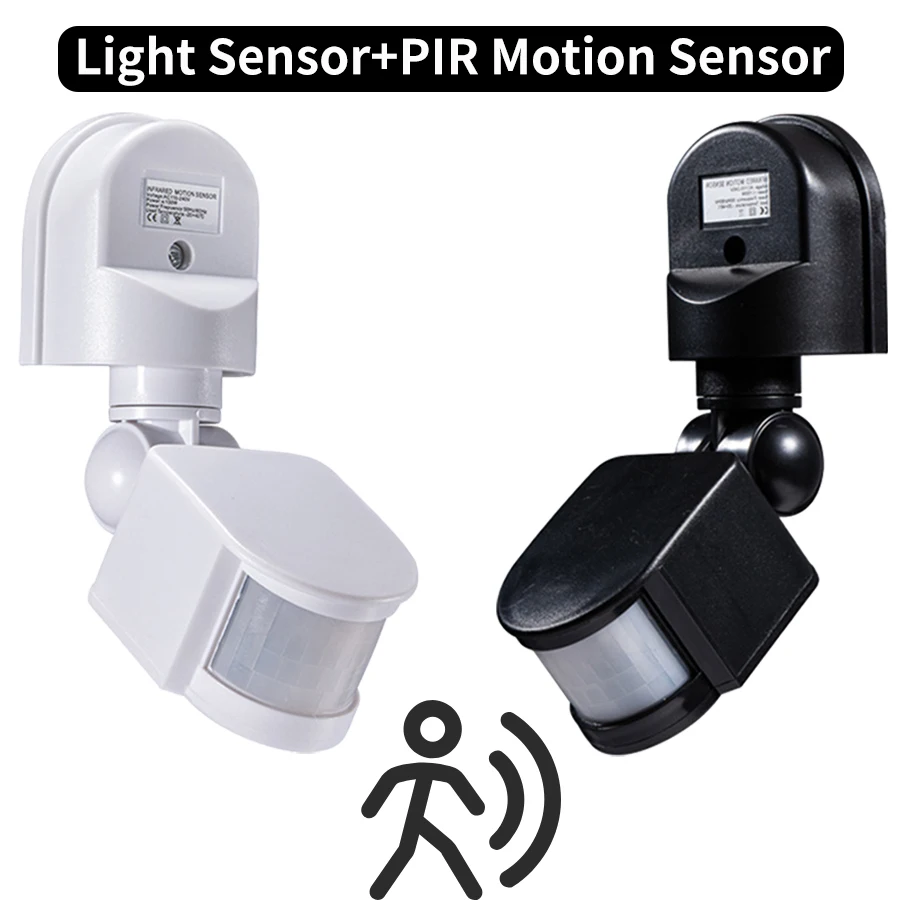
The physical design, available in both white and black, features a 180° rotating head, allowing for precise aiming of the detection zone. This adjustability ensures optimal coverage and helps to avoid triggering from unwanted areas. The visible housing suggests a durable plastic construction, suitable for both indoor and outdoor applications.
The stated sensing range of 3-8 meters and a 120° sensing angle make it suitable for a variety of spaces, from narrow corridors to wider outdoor courtyards. The ability to articulate the sensor head means the detection pattern can be precisely directed. This adaptability is key.
For outdoor use, the robust plastic casing implies a degree of weather resistance, though a specific IP rating is not provided. However, its design for outdoor light switching suggests it can withstand environmental elements, making it a practical choice for exterior security or convenience lighting. Proper sealing around wiring is always advised for outdoor installations.
Integration within a Home Automation Framework
While this sensor does not inherently possess Wi-Fi, Zigbee, or Z-Wave capabilities, its strength lies in its ability to act as a hardwired trigger for smart home systems. For automation engineers, this means it can be integrated with smart relays (e.g., Shelly, Sonoff Basic R3, or similar ESP32/ESP8266-based devices flashed with Tasmota/ESPHome) that expose dry contact inputs or can be configured to react to a change in voltage. This approach ensures local control and minimal response delay.
By connecting the sensor's output to a smart relay, the motion event is immediately converted into a digital signal that a local Home Assistant instance or other hub can process. This bypasses cloud latency entirely, providing near-instantaneous lighting activation, which is critical for safety and user experience in high-traffic areas like staircases or hallways. The responsiveness is paramount.
This method also provides a fallback: even if the smart home hub goes offline, the sensor can still directly control the light if wired appropriately, offering a layer of reliability often missing in purely wireless smart sensors. This hybrid approach leverages the best of both worlds: local, reliable triggering with smart system flexibility.
Value Proposition and Strategic Transparency
The sensor's simplicity and hardwired nature translate to a highly cost-effective solution compared to fully integrated smart sensors that include wireless communication modules. For users building a smart home on a budget, or those who prefer to keep their core automation logic local and robust, this sensor represents excellent value. It's a foundational component.
The trade-off, as noted, is the lack of native wireless smart home protocols. This means it's not a plug-and-play device for a Zigbee or Z-Wave network. However, for an engineer accustomed to integrating diverse components, this is not a limitation but an opportunity to build a highly customized and reliable system. The cost savings can then be allocated to the smart relays or controllers.
This sensor excels as a reliable, unintelligent input device that feeds data (motion/no motion, light/dark) to a more intelligent controller. Its straightforward operation and robust design make it a workhorse for automating basic lighting functions without overcomplicating the underlying infrastructure. It just works.
Envisioning an Automated Environment
Imagine stepping into your garage, and the lights instantly illuminate as you enter, dimming gracefully after you've moved inside. Picture a hallway where illumination appears precisely when needed, guiding your path without the need to fumble for switches. Consider the energy savings from lights never being left on unnecessarily in a restroom or stairwell. This sensor facilitates a responsive, intuitive environment, enhancing both convenience and energy efficiency. It integrates seamlessly into the rhythm of daily life, providing automated comfort and security that simply becomes part of the home's fabric, always ready to react with precision and purpose.