PowMr Hybrid Solar Inverter with MPPT Charger
Official Store Deal
Expert Analysis Overview
The PowMr Hybrid Solar Inverter is a sophisticated power management unit engineered for both off-grid and grid-tied photovoltaic systems, targeting users who demand robust energy conversion and comprehensive battery management. This device integrates a pure sine wave inverter with a high-efficiency MPPT solar charge controller, providing a versatile solution for residential and small commercial installations. Its dual output capability and support for various battery chemistries underscore its adaptability in diverse energy setups. The internal architecture suggests a focus on stable power delivery and system longevity, critical factors for any solar investment.
This inverter is available in 4.2KW and 6.2KW configurations, operating at 24V or 48V DC input and delivering a stable 230V AC pure sine wave output. The pure sine wave output is paramount for sensitive electronics, ensuring that appliances receive clean, consistent power without the harmonic distortion common in modified sine wave inverters. This prevents potential damage to motors, compressors, and delicate control Boards, a frequent concern with lower-tier power solutions. The dual output feature allows for segregated load management, enabling users to prioritize critical loads or distribute power more efficiently across their system.
Compared to basic grid-tie inverters that simply feed power back to the utility, this hybrid unit offers significant operational flexibility. It allows for energy storage, providing independence during grid outages or optimizing self-consumption. The internal components are designed to handle continuous power flow, minimizing heat generation and extending the lifespan of the unit. This is not a simple pass-through device.
At the heart of its solar charging capability is a 120A MPPT (Maximum Power Point Tracking) solar charger. MPPT technology is crucial for maximizing energy harvest from solar panels. It dynamically adjusts the electrical operating point of the solar array to extract the maximum available power, especially under varying weather conditions or partial shading. This contrasts sharply with older PWM (Pulse Width Modulation) controllers, which are less efficient and can leave significant solar energy uncaptured. The 120A capacity supports substantial solar arrays, allowing for rapid battery recharging or direct power supply during peak sunlight hours. This efficiency directly translates into more usable energy.
Consider a scenario where solar irradiance fluctuates throughout the day. A PWM controller would struggle to maintain optimal power transfer. The MPPT controller, however, continuously scans and locks onto the array's peak power point, ensuring that every available watt is converted into usable electricity. This capability makes a tangible difference in system performance, particularly in regions with inconsistent sunlight. The internal thermal management for the MPPT section appears robust, a critical aspect for high-current charge controllers.
Compatibility with multiple battery types is a significant advantage of this inverter. It supports AGM, GEL, FLD (Flooded), LI (Lithium), SLD (Sealed Lead-Acid), and USER-defined settings. This broad compatibility means the inverter can be integrated into existing battery banks or adapted to future battery technology upgrades without requiring a complete system overhaul. The maximum battery charging current of 120A ensures that even large battery banks can be charged efficiently from the solar array or utility grid.
Proper battery charging algorithms are essential for battery longevity and performance. The ability to select specific battery types or define custom parameters allows for precise charging profiles, preventing overcharging or undercharging which can severely degrade battery health. For lithium batteries, the system includes an activation feature where solar energy can activate the battery after 3 seconds, a common requirement for many LiFePO4 battery management systems. This intelligent management extends the service life of expensive battery banks. It protects your investment.
The inverter offers selectable Solar Priority and Utility Priority modes. Solar Priority ensures that solar energy is utilized first, minimizing reliance on the grid and maximizing self-consumption. This is ideal for reducing electricity bills and achieving greater energy independence. Utility Priority, conversely, ensures that the grid is the primary power source, with solar acting as a supplementary or backup source. This flexibility allows users to tailor their energy strategy to their specific needs, whether it's maximizing savings or ensuring uninterrupted power.
Imagine a situation during a prolonged power outage. With Solar Priority, the system will continue to draw power from the solar array and batteries, keeping essential appliances running. If the batteries run low, the inverter can seamlessly switch to the utility (if available) or shed non-critical loads. This intelligent switching capability provides a critical layer of redundancy, ensuring continuous power supply. The system's ability to display its current operating mode via an RGB LED pattern (Purple for PV, Blue for Utility, Red for Battery) offers immediate visual feedback, simplifying operational status checks.
A Smart Protection System is integrated, offering multiple protection modes crucial for system safety and reliability. These include protection against charge low/high temperature, discharge low/high temperature, discharge overcurrent, charging overcurrent, charging undervoltage, short circuit, solar panel reverse connection, battery overvoltage, over temperature, and overload. These safeguards prevent damage to the inverter, batteries, and connected appliances, ensuring long-term operational integrity. Safety is paramount.
Remote monitoring and control are available via the SMARTESS app, downloadable from the App Store and Google Play. This feature, requiring an optional WiFi module, allows users to monitor system performance, adjust settings, and receive alerts from anywhere with an internet connection. The ability to remotely check battery status, solar production, and load consumption provides peace of mind and enables proactive system management. This is a significant upgrade over inverters that require physical presence for all adjustments.
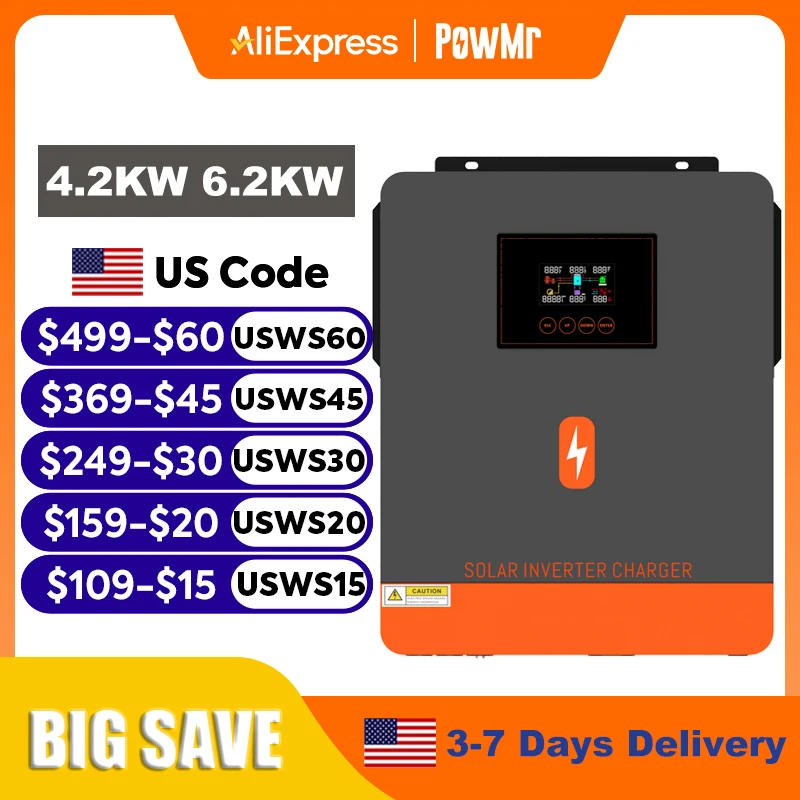
The physical construction of the inverter appears robust, with a matte grey and orange finish that suggests industrial-grade durability. The display is clear and provides essential operational data at a glance. The unit's design prioritizes heat dissipation, a critical factor for electronic components operating under high loads. Effective cooling prevents premature component failure and maintains efficiency over time. This unit is built to last.
Compared to entry-level inverters that often feature flimsy plastic casings and minimal thermal management, the PowMr unit presents a more substantial build. The internal wiring and connection points, while not visible in detail, are expected to meet the demands of high-current applications, minimizing resistive losses and ensuring stable power delivery. The comprehensive protection suite further enhances its resilience against common electrical faults, providing a reliable backbone for any solar power system.
Installation of a hybrid inverter requires careful attention to wiring and system sizing. The dual output configuration and various input/output terminals necessitate a clear understanding of electrical circuits. While the unit itself simplifies many aspects of solar power management, professional installation is recommended to ensure optimal performance and adherence to safety standards. The clear labeling of inputs and outputs on the unit facilitates correct wiring, reducing potential errors during setup. A clean installation is a safe installation.
For those upgrading an existing system, the PowMr inverter's compatibility with diverse battery types and its flexible priority settings make it an attractive option. It can seamlessly integrate into setups that previously relied on separate charge controllers and inverters, consolidating components and simplifying overall system management. This consolidation often leads to a more efficient and reliable system with fewer potential points of failure. The ability to use existing battery banks saves money.
This PowMr Hybrid Solar Inverter represents a significant step forward for those seeking a reliable and adaptable power solution. Imagine the peace of mind knowing your home or business is powered by a system that intelligently manages solar input, battery storage, and grid interaction, ensuring continuous power and optimized energy consumption. Picture a future where energy independence is not just a concept, but a tangible reality, supported by robust and intelligent Hardware.
Power Conversion Architecture
This inverter is available in 4.2KW and 6.2KW configurations, operating at 24V or 48V DC input and delivering a stable 230V AC pure sine wave output. The pure sine wave output is paramount for sensitive electronics, ensuring that appliances receive clean, consistent power without the harmonic distortion common in modified sine wave inverters. This prevents potential damage to motors, compressors, and delicate control Boards, a frequent concern with lower-tier power solutions. The dual output feature allows for segregated load management, enabling users to prioritize critical loads or distribute power more efficiently across their system.
Compared to basic grid-tie inverters that simply feed power back to the utility, this hybrid unit offers significant operational flexibility. It allows for energy storage, providing independence during grid outages or optimizing self-consumption. The internal components are designed to handle continuous power flow, minimizing heat generation and extending the lifespan of the unit. This is not a simple pass-through device.
Integrated Charge Controller
At the heart of its solar charging capability is a 120A MPPT (Maximum Power Point Tracking) solar charger. MPPT technology is crucial for maximizing energy harvest from solar panels. It dynamically adjusts the electrical operating point of the solar array to extract the maximum available power, especially under varying weather conditions or partial shading. This contrasts sharply with older PWM (Pulse Width Modulation) controllers, which are less efficient and can leave significant solar energy uncaptured. The 120A capacity supports substantial solar arrays, allowing for rapid battery recharging or direct power supply during peak sunlight hours. This efficiency directly translates into more usable energy.
Consider a scenario where solar irradiance fluctuates throughout the day. A PWM controller would struggle to maintain optimal power transfer. The MPPT controller, however, continuously scans and locks onto the array's peak power point, ensuring that every available watt is converted into usable electricity. This capability makes a tangible difference in system performance, particularly in regions with inconsistent sunlight. The internal thermal management for the MPPT section appears robust, a critical aspect for high-current charge controllers.
Battery Management Dynamics
Compatibility with multiple battery types is a significant advantage of this inverter. It supports AGM, GEL, FLD (Flooded), LI (Lithium), SLD (Sealed Lead-Acid), and USER-defined settings. This broad compatibility means the inverter can be integrated into existing battery banks or adapted to future battery technology upgrades without requiring a complete system overhaul. The maximum battery charging current of 120A ensures that even large battery banks can be charged efficiently from the solar array or utility grid.
Proper battery charging algorithms are essential for battery longevity and performance. The ability to select specific battery types or define custom parameters allows for precise charging profiles, preventing overcharging or undercharging which can severely degrade battery health. For lithium batteries, the system includes an activation feature where solar energy can activate the battery after 3 seconds, a common requirement for many LiFePO4 battery management systems. This intelligent management extends the service life of expensive battery banks. It protects your investment.
Prioritization and Redundancy
The inverter offers selectable Solar Priority and Utility Priority modes. Solar Priority ensures that solar energy is utilized first, minimizing reliance on the grid and maximizing self-consumption. This is ideal for reducing electricity bills and achieving greater energy independence. Utility Priority, conversely, ensures that the grid is the primary power source, with solar acting as a supplementary or backup source. This flexibility allows users to tailor their energy strategy to their specific needs, whether it's maximizing savings or ensuring uninterrupted power.
Imagine a situation during a prolonged power outage. With Solar Priority, the system will continue to draw power from the solar array and batteries, keeping essential appliances running. If the batteries run low, the inverter can seamlessly switch to the utility (if available) or shed non-critical loads. This intelligent switching capability provides a critical layer of redundancy, ensuring continuous power supply. The system's ability to display its current operating mode via an RGB LED pattern (Purple for PV, Blue for Utility, Red for Battery) offers immediate visual feedback, simplifying operational status checks.
System Integration and Monitoring
A Smart Protection System is integrated, offering multiple protection modes crucial for system safety and reliability. These include protection against charge low/high temperature, discharge low/high temperature, discharge overcurrent, charging overcurrent, charging undervoltage, short circuit, solar panel reverse connection, battery overvoltage, over temperature, and overload. These safeguards prevent damage to the inverter, batteries, and connected appliances, ensuring long-term operational integrity. Safety is paramount.
Remote monitoring and control are available via the SMARTESS app, downloadable from the App Store and Google Play. This feature, requiring an optional WiFi module, allows users to monitor system performance, adjust settings, and receive alerts from anywhere with an internet connection. The ability to remotely check battery status, solar production, and load consumption provides peace of mind and enables proactive system management. This is a significant upgrade over inverters that require physical presence for all adjustments.
Operational Resilience
The physical construction of the inverter appears robust, with a matte grey and orange finish that suggests industrial-grade durability. The display is clear and provides essential operational data at a glance. The unit's design prioritizes heat dissipation, a critical factor for electronic components operating under high loads. Effective cooling prevents premature component failure and maintains efficiency over time. This unit is built to last.
Compared to entry-level inverters that often feature flimsy plastic casings and minimal thermal management, the PowMr unit presents a more substantial build. The internal wiring and connection points, while not visible in detail, are expected to meet the demands of high-current applications, minimizing resistive losses and ensuring stable power delivery. The comprehensive protection suite further enhances its resilience against common electrical faults, providing a reliable backbone for any solar power system.
Installation Considerations
Installation of a hybrid inverter requires careful attention to wiring and system sizing. The dual output configuration and various input/output terminals necessitate a clear understanding of electrical circuits. While the unit itself simplifies many aspects of solar power management, professional installation is recommended to ensure optimal performance and adherence to safety standards. The clear labeling of inputs and outputs on the unit facilitates correct wiring, reducing potential errors during setup. A clean installation is a safe installation.
For those upgrading an existing system, the PowMr inverter's compatibility with diverse battery types and its flexible priority settings make it an attractive option. It can seamlessly integrate into setups that previously relied on separate charge controllers and inverters, consolidating components and simplifying overall system management. This consolidation often leads to a more efficient and reliable system with fewer potential points of failure. The ability to use existing battery banks saves money.
This PowMr Hybrid Solar Inverter represents a significant step forward for those seeking a reliable and adaptable power solution. Imagine the peace of mind knowing your home or business is powered by a system that intelligently manages solar input, battery storage, and grid interaction, ensuring continuous power and optimized energy consumption. Picture a future where energy independence is not just a concept, but a tangible reality, supported by robust and intelligent Hardware.