PowMr MPPT 60A Solar Charge Controller
Official Store Deal
Expert Analysis Overview
The PowMr MPPT 60A Solar Charge Controller is a high-performance energy management solution engineered for serious off-grid and mobile power enthusiasts. It is designed to maximize solar energy harvest across a wide spectrum of battery voltages, making it an indispensable component for self-sustaining energy systems. This device doesn't merely regulate power; it actively optimizes the entire charging process, ensuring batteries receive the most efficient and healthy charge possible.
At its heart, this controller employs Maximum Power Point Tracking (MPPT) technology. Unlike simpler Pulse Width Modulation (PWM) controllers that essentially clip excess voltage, MPPT actively scans the solar array's output to find the precise voltage and current combination that yields the highest power output. This dynamic optimization is crucial.
Consider a cloudy day. A PWM controller might only deliver a fraction of the panel's potential. This MPPT controller, however, will constantly adjust, squeezing out every available watt. The difference in energy harvest can be substantial, often ranging from 10% to 30% more power, especially in fluctuating weather conditions or when panel temperatures vary. For a system relying on every electron, this efficiency gain is paramount.
Compared to earlier generations of charge controllers, which often struggled with varying irradiance or temperature, the PowMr unit maintains a 99% MPPT tracking efficiency. This means almost no solar energy is wasted during the conversion process from the panels to the battery bank. Such a high efficiency rate directly translates into faster battery charging times and a more robust, reliable power supply for connected loads.
The controller's ability to automatically detect and work with 12V, 24V, 36V, and 48V battery systems sets it apart. This broad compatibility offers immense flexibility for system designers and users alike. One unit handles multiple configurations.
Imagine upgrading a small 12V RV setup to a more powerful 48V off-grid cabin system. With this controller, the core charging component remains constant. This adaptability reduces the need for multiple specialized controllers and simplifies inventory for installers. The user simply connects their battery bank, and the unit intelligently identifies the voltage, adjusting its charging parameters accordingly.
This versatility extends to various battery chemistries as well. Whether using traditional sealed lead-acid, vented lead-acid, gel, or modern lithium-ion batteries, the PowMr controller can be configured to deliver the appropriate charging profile. This ensures optimal battery health and extends the lifespan of expensive energy storage components, preventing common issues like overcharging or undercharging that can degrade battery performance over time.
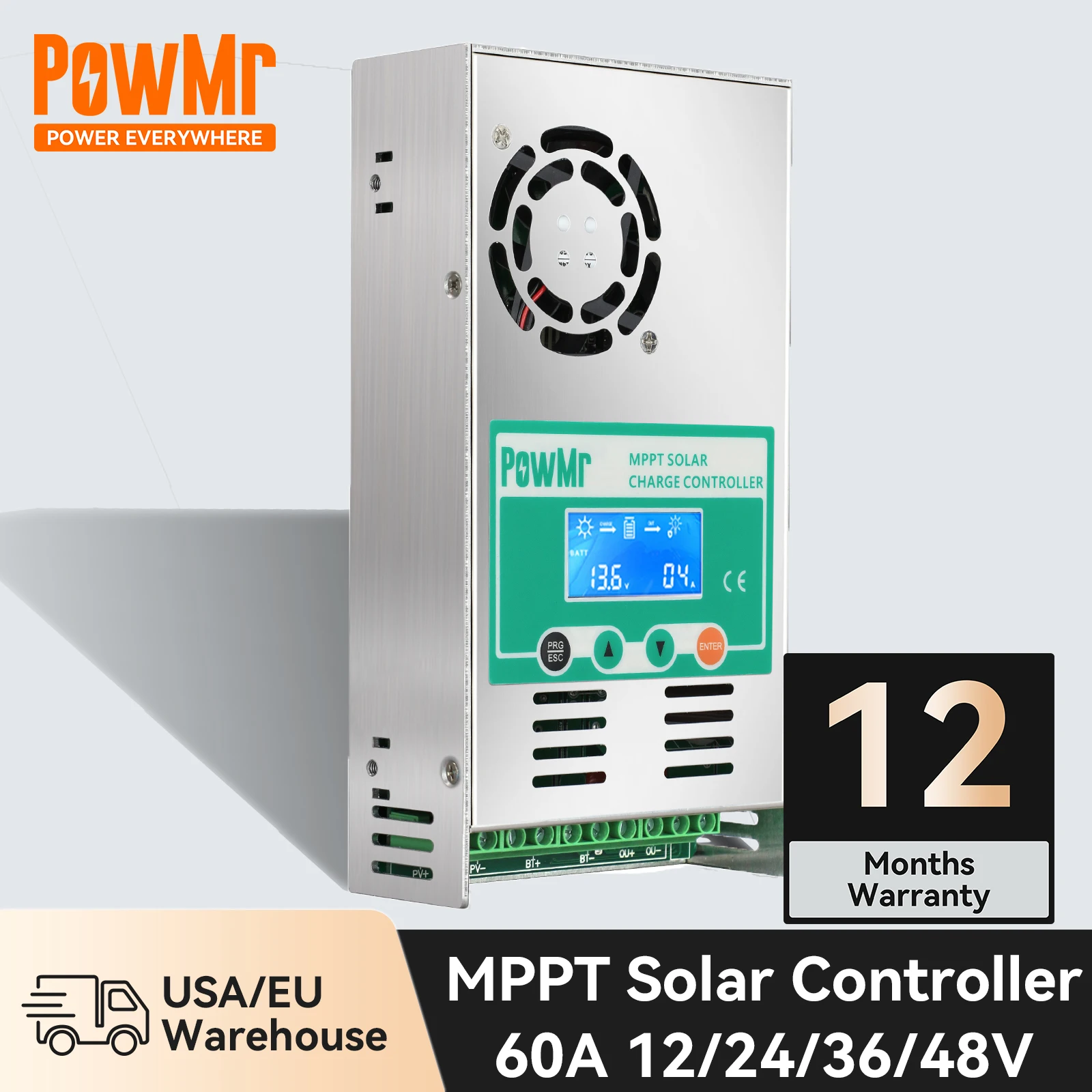
Visually, the unit presents a sturdy, almost industrial aesthetic. The metal casing suggests durability, designed to withstand the rigors of an outdoor or utility room installation. Its construction feels dense.
The integrated fan cooling system is a critical design choice. High-current electronics generate heat, and efficient heat dissipation is vital for long-term reliability and consistent performance. This active cooling mechanism prevents thermal throttling, ensuring the controller can deliver its full 60A charging capacity even during peak solar production or in warmer environments. The fan's operation, while audible, is a necessary trade-off for sustained high-power output.
A clearly visible backlit LCD screen provides immediate feedback on system status. Key metrics like battery voltage, charging current, and PV input voltage are displayed. This immediate data access allows users to quickly assess system health and performance without needing external monitoring devices. The interface is intuitive enough for quick checks.
One of the most significant advantages for larger installations is the Max PV Input Voltage of 160VDC. This higher voltage tolerance on the solar panel side simplifies array wiring considerably. Instead of multiple parallel strings of fewer panels, users can connect more panels in series.
Connecting panels in series inherently reduces the current flowing through the wiring. Lower current means thinner, less expensive wiring can be used, and power losses due to resistance are minimized over longer cable runs. This is particularly beneficial for installations where the solar array is located a significant distance from the battery bank and charge controller. It saves on material costs.
For a 48V battery system, the controller can handle up to 2880W of PV input power. This capacity allows for substantial solar arrays, capable of generating significant energy for demanding loads. Even with a 12V system, the 720W input capacity is ample for many RV or small cabin setups. This power handling capability positions the controller as a scalable solution for evolving energy needs.
The PowMr controller integrates a suite of multiple protection features, offering peace of mind for any solar energy system owner. These safeguards are not merely optional extras; they are fundamental to reliable and safe operation. The system protects itself.
It includes battery overcharge protection, preventing damage to batteries from excessive voltage. Over-discharge protection ensures batteries are not drained beyond a safe limit, which can severely shorten their lifespan. Reverse polarity protection is critical during installation, guarding against accidental incorrect wiring of either the battery or solar panels. This prevents costly damage to the controller and other components.
Further protections include PV short circuit protection and battery short circuit protection, which immediately shut down power flow in the event of an electrical fault. The controller overheating protection works in conjunction with the fan cooling system to prevent internal components from reaching dangerous temperatures. These layers of defense ensure the longevity of the entire solar power system.
For those with growing energy demands, the controller offers the invaluable feature of parallel operation. This means two 60A units can be connected in tandem to effectively create a 120A charging system. This scalability is a significant benefit.
Imagine starting with a modest solar array and a single battery bank. As energy needs increase—perhaps adding more appliances or expanding the living space—the existing controller doesn't become obsolete. A second unit can be seamlessly integrated. This modular approach allows for gradual system expansion without a complete overhaul, saving both time and resources.
This capability is particularly attractive for larger off-grid homes or commercial applications where a single 60A controller might be insufficient. The ability to double the charging current provides a robust solution for managing substantial power flows from large solar arrays into sizable battery banks. It makes future-proofing simpler.
The controller employs a sophisticated 3-stage charging algorithm to optimize battery health and maximize lifespan. This is far superior to single-stage charging methods that can stress batteries. Each stage serves a specific purpose.
The first stage is Bulk Charging. During this phase, the controller delivers the maximum possible current to rapidly bring the battery up to approximately 80-90% of its capacity. The goal is to quickly replenish energy. This is where the 60A output shines.
Next is the Absorption Stage. Once the battery reaches a certain voltage, the controller switches to a constant voltage mode, gradually reducing the current. This allows the battery to absorb the remaining charge slowly and safely, preventing overcharging and gassing. This stage ensures a full charge without stressing the battery.
Finally, the Float Charging Stage maintains the battery at a slightly lower, constant voltage. This trickle charge compensates for self-discharge and keeps the battery topped off without overcharging, ready for use. This gentle maintenance extends battery life significantly. This thoughtful charging process is a key differentiator for battery longevity.
For the solar energy hobbyist or professional installer, this PowMr controller represents a compelling value proposition. Its robust feature set, particularly the high MPPT efficiency and multi-voltage support, positions it as a superior alternative to many entry-level or mid-range controllers. It delivers performance where it counts.
Compared to generic PWM controllers, the energy yield increase alone often justifies the initial investment. The ability to handle higher PV input voltages also simplifies array design and reduces installation costs. This controller is built for reliability.
While the user interface, accessed via the backlit LCD, might not be as graphically rich as some premium controllers with dedicated app integration, it provides all essential information clearly. The physical buttons offer tactile feedback. For users prioritizing raw performance and robust protection over smartphone connectivity, this is an excellent choice. The fan noise, while present, is a minor trade-off for the thermal management it provides, ensuring the unit operates within safe temperature limits. This is a workhorse.
Imagine a remote cabin, powered entirely by solar. With this controller managing the energy flow, the occupants experience consistent power, knowing their battery bank is being charged efficiently and safely. Picture an RV journey where reliable power for appliances and electronics is non-negotiable. This controller provides that assurance. Its robust design and comprehensive features make it a cornerstone for any well-designed off-grid power system, offering both immediate performance benefits and long-term reliability. The peace of mind is invaluable.
Unpacking the Core Technology: MPPT Mastery
At its heart, this controller employs Maximum Power Point Tracking (MPPT) technology. Unlike simpler Pulse Width Modulation (PWM) controllers that essentially clip excess voltage, MPPT actively scans the solar array's output to find the precise voltage and current combination that yields the highest power output. This dynamic optimization is crucial.
Consider a cloudy day. A PWM controller might only deliver a fraction of the panel's potential. This MPPT controller, however, will constantly adjust, squeezing out every available watt. The difference in energy harvest can be substantial, often ranging from 10% to 30% more power, especially in fluctuating weather conditions or when panel temperatures vary. For a system relying on every electron, this efficiency gain is paramount.
Compared to earlier generations of charge controllers, which often struggled with varying irradiance or temperature, the PowMr unit maintains a 99% MPPT tracking efficiency. This means almost no solar energy is wasted during the conversion process from the panels to the battery bank. Such a high efficiency rate directly translates into faster battery charging times and a more robust, reliable power supply for connected loads.
Versatile Power Management Across Battery Chemistries
The controller's ability to automatically detect and work with 12V, 24V, 36V, and 48V battery systems sets it apart. This broad compatibility offers immense flexibility for system designers and users alike. One unit handles multiple configurations.
Imagine upgrading a small 12V RV setup to a more powerful 48V off-grid cabin system. With this controller, the core charging component remains constant. This adaptability reduces the need for multiple specialized controllers and simplifies inventory for installers. The user simply connects their battery bank, and the unit intelligently identifies the voltage, adjusting its charging parameters accordingly.
This versatility extends to various battery chemistries as well. Whether using traditional sealed lead-acid, vented lead-acid, gel, or modern lithium-ion batteries, the PowMr controller can be configured to deliver the appropriate charging profile. This ensures optimal battery health and extends the lifespan of expensive energy storage components, preventing common issues like overcharging or undercharging that can degrade battery performance over time.
Architectural Integrity and Operational Prowess
Visually, the unit presents a sturdy, almost industrial aesthetic. The metal casing suggests durability, designed to withstand the rigors of an outdoor or utility room installation. Its construction feels dense.
The integrated fan cooling system is a critical design choice. High-current electronics generate heat, and efficient heat dissipation is vital for long-term reliability and consistent performance. This active cooling mechanism prevents thermal throttling, ensuring the controller can deliver its full 60A charging capacity even during peak solar production or in warmer environments. The fan's operation, while audible, is a necessary trade-off for sustained high-power output.
A clearly visible backlit LCD screen provides immediate feedback on system status. Key metrics like battery voltage, charging current, and PV input voltage are displayed. This immediate data access allows users to quickly assess system health and performance without needing external monitoring devices. The interface is intuitive enough for quick checks.
High Voltage Input: Streamlining Solar Array Design
One of the most significant advantages for larger installations is the Max PV Input Voltage of 160VDC. This higher voltage tolerance on the solar panel side simplifies array wiring considerably. Instead of multiple parallel strings of fewer panels, users can connect more panels in series.
Connecting panels in series inherently reduces the current flowing through the wiring. Lower current means thinner, less expensive wiring can be used, and power losses due to resistance are minimized over longer cable runs. This is particularly beneficial for installations where the solar array is located a significant distance from the battery bank and charge controller. It saves on material costs.
For a 48V battery system, the controller can handle up to 2880W of PV input power. This capacity allows for substantial solar arrays, capable of generating significant energy for demanding loads. Even with a 12V system, the 720W input capacity is ample for many RV or small cabin setups. This power handling capability positions the controller as a scalable solution for evolving energy needs.
Safeguarding Your Investment: Comprehensive Protection Protocols
The PowMr controller integrates a suite of multiple protection features, offering peace of mind for any solar energy system owner. These safeguards are not merely optional extras; they are fundamental to reliable and safe operation. The system protects itself.
It includes battery overcharge protection, preventing damage to batteries from excessive voltage. Over-discharge protection ensures batteries are not drained beyond a safe limit, which can severely shorten their lifespan. Reverse polarity protection is critical during installation, guarding against accidental incorrect wiring of either the battery or solar panels. This prevents costly damage to the controller and other components.
Further protections include PV short circuit protection and battery short circuit protection, which immediately shut down power flow in the event of an electrical fault. The controller overheating protection works in conjunction with the fan cooling system to prevent internal components from reaching dangerous temperatures. These layers of defense ensure the longevity of the entire solar power system.
Scaling Up: Parallel Operation for Enhanced Capacity
For those with growing energy demands, the controller offers the invaluable feature of parallel operation. This means two 60A units can be connected in tandem to effectively create a 120A charging system. This scalability is a significant benefit.
Imagine starting with a modest solar array and a single battery bank. As energy needs increase—perhaps adding more appliances or expanding the living space—the existing controller doesn't become obsolete. A second unit can be seamlessly integrated. This modular approach allows for gradual system expansion without a complete overhaul, saving both time and resources.
This capability is particularly attractive for larger off-grid homes or commercial applications where a single 60A controller might be insufficient. The ability to double the charging current provides a robust solution for managing substantial power flows from large solar arrays into sizable battery banks. It makes future-proofing simpler.
The Intelligent Charge Cycle: 3-Stage Battery Care
The controller employs a sophisticated 3-stage charging algorithm to optimize battery health and maximize lifespan. This is far superior to single-stage charging methods that can stress batteries. Each stage serves a specific purpose.
The first stage is Bulk Charging. During this phase, the controller delivers the maximum possible current to rapidly bring the battery up to approximately 80-90% of its capacity. The goal is to quickly replenish energy. This is where the 60A output shines.
Next is the Absorption Stage. Once the battery reaches a certain voltage, the controller switches to a constant voltage mode, gradually reducing the current. This allows the battery to absorb the remaining charge slowly and safely, preventing overcharging and gassing. This stage ensures a full charge without stressing the battery.
Finally, the Float Charging Stage maintains the battery at a slightly lower, constant voltage. This trickle charge compensates for self-discharge and keeps the battery topped off without overcharging, ready for use. This gentle maintenance extends battery life significantly. This thoughtful charging process is a key differentiator for battery longevity.
Real-World Application and Value Proposition
For the solar energy hobbyist or professional installer, this PowMr controller represents a compelling value proposition. Its robust feature set, particularly the high MPPT efficiency and multi-voltage support, positions it as a superior alternative to many entry-level or mid-range controllers. It delivers performance where it counts.
Compared to generic PWM controllers, the energy yield increase alone often justifies the initial investment. The ability to handle higher PV input voltages also simplifies array design and reduces installation costs. This controller is built for reliability.
While the user interface, accessed via the backlit LCD, might not be as graphically rich as some premium controllers with dedicated app integration, it provides all essential information clearly. The physical buttons offer tactile feedback. For users prioritizing raw performance and robust protection over smartphone connectivity, this is an excellent choice. The fan noise, while present, is a minor trade-off for the thermal management it provides, ensuring the unit operates within safe temperature limits. This is a workhorse.
Imagine a remote cabin, powered entirely by solar. With this controller managing the energy flow, the occupants experience consistent power, knowing their battery bank is being charged efficiently and safely. Picture an RV journey where reliable power for appliances and electronics is non-negotiable. This controller provides that assurance. Its robust design and comprehensive features make it a cornerstone for any well-designed off-grid power system, offering both immediate performance benefits and long-term reliability. The peace of mind is invaluable.