PWM DC Motor Speed Controller Module (4.5V-35V, 5A)
Official Store Deal
Expert Analysis Overview
Precision Power Management for DC Motors
The PWM DC Motor Speed Controller Module is a highly efficient solution for regulating the rotational speed of direct current motors, specifically designed for hobbyists and professionals building or optimizing low-voltage DC systems. This compact unit, with its broad 4.5V to 35V input range and 5A/90W capacity, provides granular control over motor output, making it an indispensable component for solar-powered applications, robotics, and custom automation projects where precise speed adjustment is critical.
This module stands apart from simpler resistive dimmers. Unlike those, which dissipate excess energy as heat, this controller employs Pulse Width Modulation (PWM). PWM works by rapidly switching the power to the motor on and off, varying the 'on' time (duty cycle) to control the average voltage supplied. This method significantly reduces energy waste, ensuring that more of your precious solar-generated power is converted into mechanical work rather than lost as heat. For anyone focused on maximizing the efficiency of their off-grid or battery-powered systems, this is a fundamental advantage.
The Core of Control: Pulse Width Modulation
At its heart, this module utilizes Pulse Width Modulation (PWM), a technique that allows for efficient control of average power delivered to an electrical load. Instead of reducing voltage directly, which can lead to significant energy loss, PWM rapidly switches the power supply to the motor between fully on and fully off states. The proportion of time the power is 'on' during each cycle, known as the duty cycle, determines the average power supplied to the motor.
This method offers substantial benefits. It ensures that the transistor, the primary switching element, operates either in saturation (fully on) or cutoff (fully off), minimizing power dissipation across the component. This translates directly into cooler operation and higher energy efficiency, a critical factor for battery-powered or solar-dependent applications where every watt-hour counts. The visible components, including the main IC and associated passive elements on the PCB, are configured to execute this precise switching, enabling smooth and responsive motor speed adjustments.
Compared to traditional linear regulators or simple rheostats, which essentially act as variable resistors in series with the motor, PWM controllers are vastly superior in terms of efficiency. Linear regulators dissipate excess voltage as heat, meaning a significant portion of the input power can be wasted. This inefficiency is particularly detrimental in solar energy systems where power generation can be limited. The PWM approach ensures that the energy drawn from your power source, whether a solar panel or battery, is utilized effectively, extending battery life and optimizing system performance.
Power Handling and System Integration
The module is engineered to handle a DC input voltage range of 4.5V to 35V. This wide operational window makes it highly adaptable to various power sources commonly found in solar energy setups, including 6V, 12V, and 24V battery banks or directly from certain solar panels with appropriate voltage regulation. The ability to accept such a broad input simplifies integration into existing systems without requiring additional voltage converters for the controller itself.
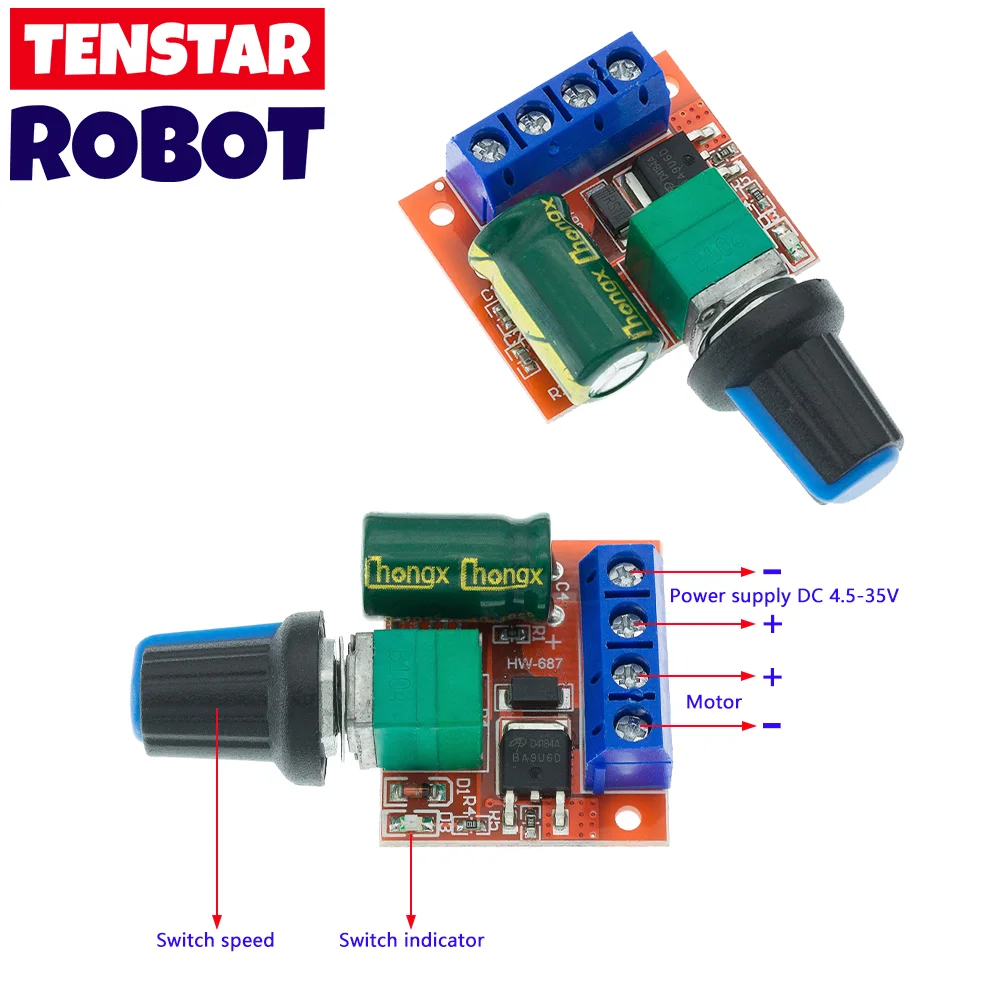
With a maximum continuous current of 5A and a peak power output of 90W, this controller is well-suited for a range of small to medium-sized DC motors. This capacity covers typical applications such as small water pumps for irrigation, ventilation fans for enclosures, robotic drive motors, or even small conveyors in automated systems. The robust terminal blocks, clearly labeled for power supply and motor connections, facilitate secure and straightforward wiring, minimizing the risk of accidental disconnections or short circuits.
Many generic motor controllers on the market offer a narrower voltage range or lower current capabilities, often forcing users to purchase multiple controllers for different system voltages or to upgrade prematurely. This module's specifications provide a more flexible and future-proof solution for hobbyists. It means a single type of controller can be stocked for various projects, simplifying inventory and reducing overall project costs, especially for those experimenting with different solar panel configurations or battery types.
Intuitive Control and Feedback
User interaction with the module is straightforward, primarily through the potentiometer with an integrated switch. This control knob allows for continuous, smooth adjustment of the motor's speed from zero to its maximum RPM. The integrated switch functionality means the motor can be completely turned off without needing a separate power switch, simplifying the overall circuit design and reducing component count.
The inclusion of a switch indicator LED provides immediate visual feedback on the module's operational status. When the module is powered and the switch is 'on', the LED illuminates, confirming that the circuit is active and ready to control the motor. This simple visual cue is invaluable for troubleshooting and ensuring correct operation, preventing guesswork in complex setups or when integrating the module into a larger system.
Compared to controllers that might require external switches or lack clear operational indicators, this integrated design enhances user convenience and safety. The tactile feel of the potentiometer allows for precise adjustments, which is crucial for applications requiring fine-tuned motor speeds, such as peristaltic pumps for chemical dosing or robotic grippers needing delicate control. This level of integrated functionality is often found in more expensive industrial controllers, making its presence here a significant value add for the price point.
Durability and Installation Considerations
The module is built on a compact PCB (Printed Circuit Board), featuring clearly marked connections and surface-mounted components. The visible soldering appears clean, indicating a reasonable level of manufacturing quality for a component in this price bracket. The small footprint allows for easy integration into tight enclosures or custom project boxes, which is a common requirement in DIY solar projects where space is often at a premium.
While the open-board design is typical for modules of this type, it necessitates careful installation to protect the electronics from environmental factors such as dust, moisture, and accidental short circuits. Enclosing the module within a project box is highly recommended, especially for outdoor or semi-exposed solar applications. The mounting nut and washer included with the potentiometer facilitate secure panel mounting, allowing the control knob to be easily accessible on the exterior of an enclosure.
Many off-the-shelf solutions come with bulky enclosures or fixed mounting options that limit flexibility. This module's design, while requiring user-supplied protection, offers the freedom to customize the installation to specific project needs. This flexibility is particularly appealing to solar energy hobbyists who often adapt components to unique housing solutions, from weatherproof junction boxes to custom 3D-printed enclosures designed for specific aesthetic or functional requirements. The robust terminal blocks further contribute to a reliable and secure connection, crucial for long-term operation in various environments.
Optimizing Solar-Powered Systems
For the solar energy enthusiast, this PWM controller is more than just a motor speed regulator; it is a tool for system optimization and energy conservation. By precisely controlling the speed of DC loads, users can match power consumption to available solar generation, preventing unnecessary battery drain or maximizing the utility of intermittent solar input. For instance, a solar-powered water pump can be slowed down during cloudy periods to conserve energy, or a ventilation fan can be adjusted to maintain optimal temperatures without overdrawing power.
This level of control contributes directly to the longevity and stability of off-grid systems. Overloading motors or running them at suboptimal speeds can reduce their lifespan and efficiency. The ability to fine-tune operation ensures motors run within their ideal parameters, reducing wear and tear. This is a crucial consideration for remote installations where maintenance access might be limited, and system reliability is paramount.
Ultimately, integrating this controller into a solar setup allows for more intelligent and adaptive energy management. Imagine a greenhouse ventilation system that automatically adjusts fan speed based on internal temperature and available solar power, or a small hydroponic pump that delivers nutrients at a precisely regulated flow rate throughout the day. This module enables these advanced functionalities, transforming a basic solar power system into a sophisticated, self-regulating energy solution. It empowers the user to build a more resilient and efficient off-grid infrastructure, turning raw solar energy into precisely controlled mechanical work.