PWM DC Motor Speed Controller with Forward/Reverse Switch
Official Store Deal
Expert Analysis Overview
The PWM DC Motor Speed Controller is a compact, versatile power management unit designed for hobbyists and small-scale industrial applications requiring precise control over DC motors. This device stands out as a practical solution for those building self-sustaining energy systems, offering the capability to fine-tune motor operations for optimal efficiency and performance within a solar-powered context. Its integrated forward and reverse control switch provides an immediate advantage over basic speed controllers, enabling dynamic system adjustments. This is a critical feature for applications like solar trackers or automated ventilation systems where directional control is paramount. The unit's design emphasizes ease of integration, making it accessible even for those with moderate electrical experience. It ensures a stable and adjustable power output, crucial for protecting sensitive DC motors from sudden voltage spikes or inconsistent power delivery often encountered in off-grid setups.
This controller utilizes Pulse Width Modulation (PWM) technology. PWM is a modulation technique used to encode a message into a pulsing signal, effectively controlling the average power delivered to an electrical load by varying the duty cycle of the pulses. The visible potentiometer allows for continuous adjustment of this duty cycle. This provides smooth, granular control over motor speed, preventing abrupt changes that can stress mechanical components or draw excessive current.
Unlike simpler, resistive speed controllers that dissipate excess power as heat, PWM controllers are significantly more efficient. This efficiency is vital in solar energy applications, where every watt saved contributes directly to the longevity of battery banks and the overall sustainability of the system. The precise control ensures that motors operate at their most efficient RPM for a given task, minimizing energy waste. Imagine optimizing a solar pump's flow rate precisely to match water demand, conserving precious stored energy.
Standard DC motor control often involves simple voltage reduction, leading to significant power loss and reduced motor torque at lower speeds. This PWM controller, however, maintains higher torque across its speed range. It truly delivers superior performance for demanding tasks.
For solar energy enthusiasts, the ability to control motor speed precisely translates directly into enhanced system efficiency. Consider a solar tracking array: the motors need to adjust their position slowly and accurately throughout the day. A controller like this allows for minute adjustments, ensuring the panels remain perfectly aligned with the sun's path. This maximizes energy capture.
The controller's 80W power rating suggests suitability for small to medium DC motors commonly found in hobby projects, small robotics, or low-power agricultural applications. This capacity is sufficient for managing actuators in a DIY solar tracker or controlling small ventilation fans in an off-grid cabin. Verifying compatibility with existing solar setups involves matching the motor's voltage and current requirements against the controller's specifications. The unit typically operates within a 6V to 28V DC range, making it compatible with common 12V and 24V solar battery systems.
Calculating efficiency losses becomes simpler with a PWM controller. Because it reduces power loss, more energy reaches the motor. This contrasts sharply with linear regulators, which can waste a substantial portion of input power as heat, especially when significant voltage drops are required. The integrated heatsink on the PCB further aids in thermal management, ensuring stable operation even under continuous load, which is critical for long-term reliability in unattended solar installations.
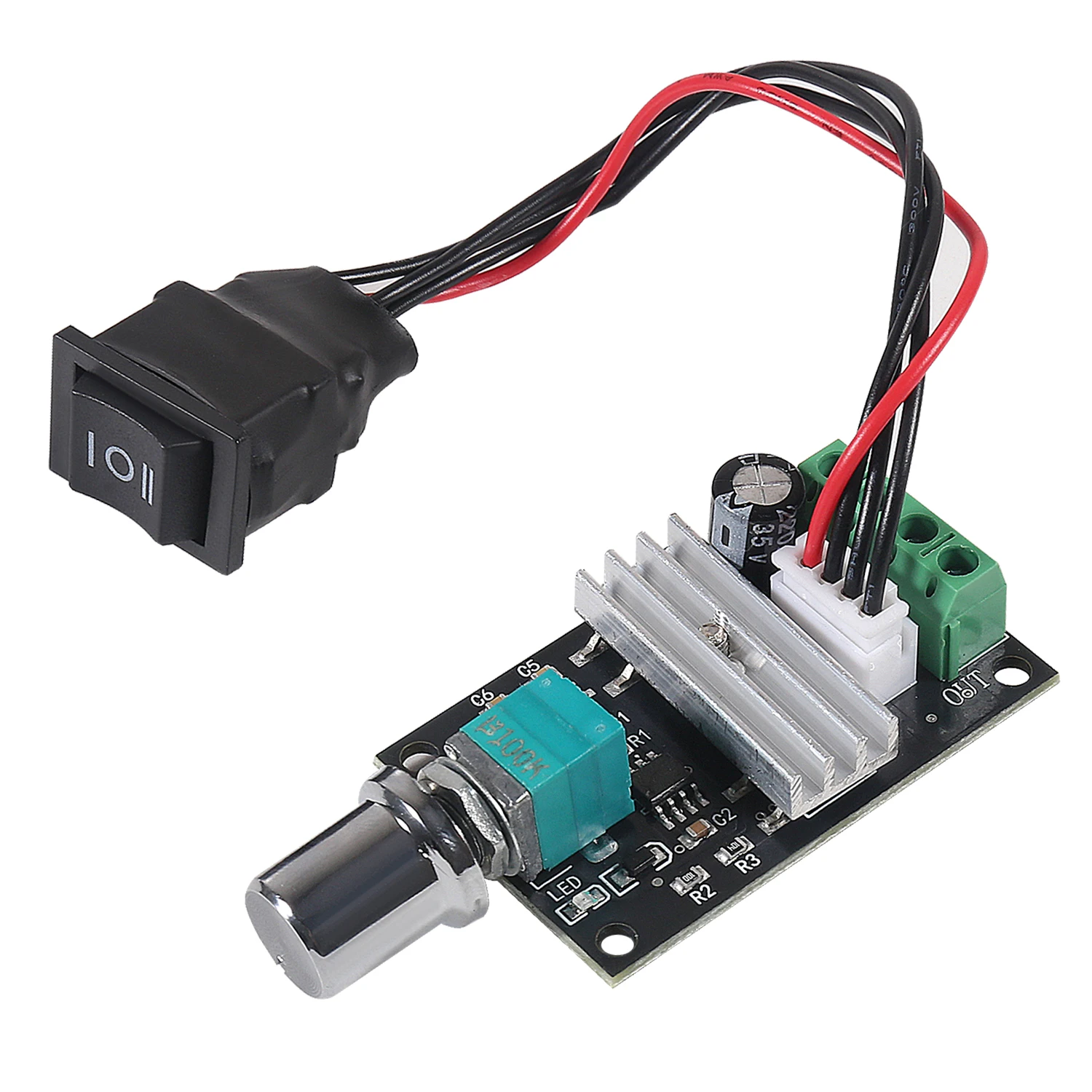
The physical construction of this controller reveals several thoughtful design choices. The main PCB is compact, featuring clearly labeled input and output terminals. These screw terminals facilitate secure and reliable connections, reducing the risk of intermittent contacts that could disrupt motor operation. The presence of a heatsink directly over the power transistor is a clear indicator of its design for sustained operation. This component is essential for dissipating heat generated during power conversion, preventing thermal runaway and extending the lifespan of the device.
The silicone wires connecting the main board to the forward/reverse switch are a notable upgrade. These wires are specifically chosen for their high-temperature resistance and flexibility. This material choice enhances durability, especially in environments where temperatures might fluctuate or where the wiring needs to withstand repeated bending or vibration. Standard PVC wires often become brittle over time, leading to potential failures. This is a small but significant detail that speaks to the product's overall reliability.
The separate forward and reverse control switch is a highly practical feature. This switch allows for instant changes in motor direction without needing to re-wire or use a separate H-bridge circuit. For applications requiring bidirectional movement, such as automated gates, robotic arms, or even a small wind turbine's yaw control, this integrated switch simplifies the control logic and reduces the overall component count. It is a user-friendly addition.
The clearly marked input and output terminals on the PCB, along with the Chinese labels for Power+, Power-, Motor1, and Motor2, provide a straightforward wiring experience. Even for those new to electronics, connecting a DC power source and a DC motor is relatively intuitive. This ease of connection minimizes setup time and potential wiring errors, allowing users to focus on the application itself rather than complex electrical configurations. The simplicity of the interface makes it ideal for rapid prototyping and project development.
This PWM DC motor speed controller empowers solar energy hobbyists to build more sophisticated and autonomous systems. Imagine a greenhouse with automated vents that open and close based on temperature readings, driven by motors precisely controlled by this unit. Or a small water pump for irrigation, whose flow rate can be adjusted to conserve water and energy. The ability to fine-tune speed and direction opens up a myriad of possibilities for energy-efficient automation.
By incorporating this controller, users gain the ability to create systems that are not only self-sustaining but also highly adaptable. The precise control over motor output allows for detailed calibration, ensuring that mechanical systems operate within their optimal parameters, reducing wear and tear. This leads to longer operational life for motors and associated components, translating into long-term savings and reduced maintenance. It is an investment in system longevity.
This device provides the foundational control necessary for many advanced solar-powered projects. It moves beyond simple on/off functionality, offering a level of control that can significantly improve the performance and efficiency of any DC motor application. The combination of precise speed adjustment, bidirectional control, and robust components makes it a valuable asset for anyone looking to push the boundaries of their solar energy endeavors. Envision the satisfaction of a perfectly optimized solar-powered device, running smoothly and efficiently, all thanks to intelligent motor control.
This controller becomes the brain for mechanical actions in your solar setup. It allows for dynamic responses to environmental conditions, making your projects more intelligent and energy-conscious. The simplicity of its operation belies the power it puts into your hands, enabling you to build, innovate, and optimize with confidence. It's an essential building block for any serious solar hobbyist. With this controller, your solar projects will not just function; they will thrive, offering reliable performance day in and day out, making your energy dreams a tangible reality.
Precision Power Regulation
This controller utilizes Pulse Width Modulation (PWM) technology. PWM is a modulation technique used to encode a message into a pulsing signal, effectively controlling the average power delivered to an electrical load by varying the duty cycle of the pulses. The visible potentiometer allows for continuous adjustment of this duty cycle. This provides smooth, granular control over motor speed, preventing abrupt changes that can stress mechanical components or draw excessive current.
Unlike simpler, resistive speed controllers that dissipate excess power as heat, PWM controllers are significantly more efficient. This efficiency is vital in solar energy applications, where every watt saved contributes directly to the longevity of battery banks and the overall sustainability of the system. The precise control ensures that motors operate at their most efficient RPM for a given task, minimizing energy waste. Imagine optimizing a solar pump's flow rate precisely to match water demand, conserving precious stored energy.
Standard DC motor control often involves simple voltage reduction, leading to significant power loss and reduced motor torque at lower speeds. This PWM controller, however, maintains higher torque across its speed range. It truly delivers superior performance for demanding tasks.
Optimizing Energy Flow
For solar energy enthusiasts, the ability to control motor speed precisely translates directly into enhanced system efficiency. Consider a solar tracking array: the motors need to adjust their position slowly and accurately throughout the day. A controller like this allows for minute adjustments, ensuring the panels remain perfectly aligned with the sun's path. This maximizes energy capture.
The controller's 80W power rating suggests suitability for small to medium DC motors commonly found in hobby projects, small robotics, or low-power agricultural applications. This capacity is sufficient for managing actuators in a DIY solar tracker or controlling small ventilation fans in an off-grid cabin. Verifying compatibility with existing solar setups involves matching the motor's voltage and current requirements against the controller's specifications. The unit typically operates within a 6V to 28V DC range, making it compatible with common 12V and 24V solar battery systems.
Calculating efficiency losses becomes simpler with a PWM controller. Because it reduces power loss, more energy reaches the motor. This contrasts sharply with linear regulators, which can waste a substantial portion of input power as heat, especially when significant voltage drops are required. The integrated heatsink on the PCB further aids in thermal management, ensuring stable operation even under continuous load, which is critical for long-term reliability in unattended solar installations.
Robust Component Integration
The physical construction of this controller reveals several thoughtful design choices. The main PCB is compact, featuring clearly labeled input and output terminals. These screw terminals facilitate secure and reliable connections, reducing the risk of intermittent contacts that could disrupt motor operation. The presence of a heatsink directly over the power transistor is a clear indicator of its design for sustained operation. This component is essential for dissipating heat generated during power conversion, preventing thermal runaway and extending the lifespan of the device.
The silicone wires connecting the main board to the forward/reverse switch are a notable upgrade. These wires are specifically chosen for their high-temperature resistance and flexibility. This material choice enhances durability, especially in environments where temperatures might fluctuate or where the wiring needs to withstand repeated bending or vibration. Standard PVC wires often become brittle over time, leading to potential failures. This is a small but significant detail that speaks to the product's overall reliability.
Seamless System Integration
The separate forward and reverse control switch is a highly practical feature. This switch allows for instant changes in motor direction without needing to re-wire or use a separate H-bridge circuit. For applications requiring bidirectional movement, such as automated gates, robotic arms, or even a small wind turbine's yaw control, this integrated switch simplifies the control logic and reduces the overall component count. It is a user-friendly addition.
The clearly marked input and output terminals on the PCB, along with the Chinese labels for Power+, Power-, Motor1, and Motor2, provide a straightforward wiring experience. Even for those new to electronics, connecting a DC power source and a DC motor is relatively intuitive. This ease of connection minimizes setup time and potential wiring errors, allowing users to focus on the application itself rather than complex electrical configurations. The simplicity of the interface makes it ideal for rapid prototyping and project development.
The Path to Autonomous Control
This PWM DC motor speed controller empowers solar energy hobbyists to build more sophisticated and autonomous systems. Imagine a greenhouse with automated vents that open and close based on temperature readings, driven by motors precisely controlled by this unit. Or a small water pump for irrigation, whose flow rate can be adjusted to conserve water and energy. The ability to fine-tune speed and direction opens up a myriad of possibilities for energy-efficient automation.
By incorporating this controller, users gain the ability to create systems that are not only self-sustaining but also highly adaptable. The precise control over motor output allows for detailed calibration, ensuring that mechanical systems operate within their optimal parameters, reducing wear and tear. This leads to longer operational life for motors and associated components, translating into long-term savings and reduced maintenance. It is an investment in system longevity.
This device provides the foundational control necessary for many advanced solar-powered projects. It moves beyond simple on/off functionality, offering a level of control that can significantly improve the performance and efficiency of any DC motor application. The combination of precise speed adjustment, bidirectional control, and robust components makes it a valuable asset for anyone looking to push the boundaries of their solar energy endeavors. Envision the satisfaction of a perfectly optimized solar-powered device, running smoothly and efficiently, all thanks to intelligent motor control.
Frequently Asked Questions
This controller becomes the brain for mechanical actions in your solar setup. It allows for dynamic responses to environmental conditions, making your projects more intelligent and energy-conscious. The simplicity of its operation belies the power it puts into your hands, enabling you to build, innovate, and optimize with confidence. It's an essential building block for any serious solar hobbyist. With this controller, your solar projects will not just function; they will thrive, offering reliable performance day in and day out, making your energy dreams a tangible reality.