RF-JKM SMA RG316 Coaxial Jumper Pigtail Cable
Official Store Deal
Expert Analysis Overview
High-Frequency Precision in Conductive Pathing
RF-JKM SMA RG316 jumper cables are professional-grade high-frequency assemblies designed for stable signal transmission in telecommunications and radio frequency environments. These cables serve as the mandatory bridge between antennas, receivers, and transmitters where signal integrity cannot be sacrificed for cost. Every component reflects industrial standards. Precision defines this assembly. The RG316 coaxial standard provides a specific balance between flexibility and signal attenuation that outclasses basic PVC-jacketed alternatives. Unlike generic RG174 cables that melt under soldering iron heat, the Teflon-based FEP jacket here withstands extreme thermal stress. This durability is necessary for tight enclosures.
The Metallurgy of Signal Transmission
The connectors utilize heavy gold plating to ensure minimal contact resistance and prevent oxidation over long-term deployments. Gold prevents signal degradation. When inspecting the SMA male and female ends, the machining of the 1/4-36 UNS threading shows high precision, ensuring a snug fit that prevents RF leakage. The center pins are properly aligned and rigid. They do not wobble. This mechanical stability is fundamental for maintaining a 50-ohm characteristic impedance across the entire signal path. Poorly machined pins cause VSWR spikes. These cables avoid that pitfall.
Thermal Stability and Dielectric Integrity
The RG316 cable core features a silver-coated copper-clad steel conductor. This material choice enhances tensile strength. It also provides excellent conductivity for high-frequency signals which travel primarily on the surface of the conductor due to the skin effect. The dielectric is solid PTFE (Polytetrafluoroethylene). It maintains a consistent distance between the center conductor and the shield. This consistency is mandatory. It prevents impedance mismatches. Heat resistance is a standout feature of the FEP jacket. It resists chemical corrosion. Most cables fail in engine bays or near heat sinks. This one survives.
Shielding Against Electromagnetic Interference
Effective shielding is achieved through a silver-coated copper braid that provides high coverage. It blocks unwanted noise. In dense electronic environments where EMI (Electromagnetic Interference) is rampant, this braid acts as a Faraday cage for the signal. The shielding effectiveness ensures that GPS, Wi-Fi, or cellular signals remain pure. Interference destroys data packets. Proper shielding prevents packet loss. The transition from the cable to the connector is protected by thick heat-shrink tubing. This tubing provides strain relief. It prevents the cable from snapping at the solder joint.
Solving Space Constraints with Right-Angle Geometry
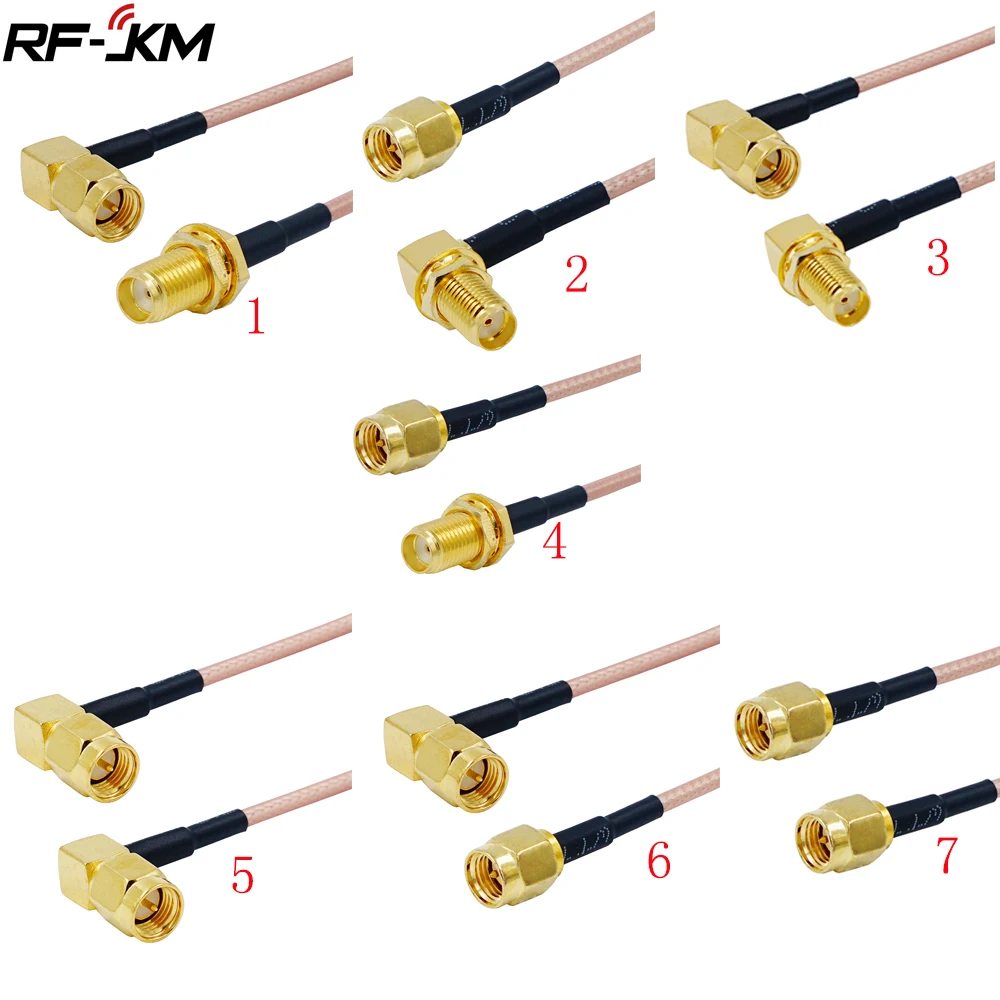
The availability of right-angle SMA connectors (as seen in variations 2, 3, 4, 5, and 6) solves the common problem of vertical clearance in compact enclosures. Tight bends kill cables. A pre-formed right-angle connector removes the stress of a sharp radius bend on the coaxial wire itself. This geometry preserves the internal structure of the dielectric. It keeps the signal clean. For builders of SDR (Software Defined Radio) arrays or drone telemetry systems, these right-angle options are mandatory. They allow for a cleaner layout. Space is often limited.
Performance Analytics and Real-World Loss
RG316 is rated for frequencies up to 3 GHz and beyond, though its sweet spot is between DC and 2.4 GHz. Loss is expected. At 1 GHz, one can expect an attenuation of approximately 0.5 to 0.7 dB per meter. Shorter pigtails minimize this impact. For a 15cm or 30cm jumper, the loss is negligible. It is virtually undetectable. This makes them ideal for internal cabinet wiring. Always keep jumpers short. Long runs require thicker LMR-type cables. For pigtail use, RG316 is the standard.
Connector Versatility and Interface Types
The variety of configurations—including SMA Male to SMA Female, bulkhead mounts, and straight to right-angle—covers almost every interface requirement for modern RF Hardware. Bulkhead connectors (Option 1 and 4) allow for secure mounting through a chassis wall. The included nut and washer provide a mechanical lock. It stays in place. This is vital for external antenna ports. Vibration will not loosen it. Standard SMA connectors use a 5/16 inch hex nut for tightening. Proper torque is 3-5 inch-pounds. Do not over-tighten them.
Mechanical Longevity and Environmental Resistance
The silver-coated copper braid doesn't just help with signal; it adds significant structural integrity. The cable feels dense. It lacks the hollow, mushy feel of cheap consumer-grade patch cords. Even after repeated mating cycles, the gold plating remains intact on the contact surfaces. Quality plating is thick. The FEP jacket is also non-flammable. This is a safety requirement for aerospace and automotive applications. Fire is a risk. This cable mitigates that risk.
Cost-Efficiency and Procurement Logic
At this price point, the ROI is found in the reduction of troubleshooting time. A faulty jumper cable is the most frustrating failure in an RF system. It hides from plain sight. These cables are factory-tested to ensure DC continuity and proper impedance. Buying pre-made assemblies is cheaper than buying the crimp tools and raw materials for small batches. Tools are expensive. Precision crimping takes practice. These factory terminations are consistent.
Implementation in Modern Wireless Systems
Whether connecting a LoRaWAN gateway or a custom-built 4G LTE repeater, these cables handle the load. They are rated for low power applications. Do not use them for high-wattage VHF/UHF transmitters. They handle up to 100 watts at lower frequencies, but power handling drops as frequency rises. For signal-level data, they are perfect. Most IoT devices use them. They are the industry workhorse.
Imagine a setup where every signal is crisp, the connectors lock with a reassuring mechanical click, and the cables route perfectly around components without the risk of melting or cracking under pressure. The stability of your wireless network depends on these small, often overlooked junctions. Installing these high-temperature, low-loss jumpers ensures that the hardware you invested in actually performs at its theoretical maximum. The peace of mind knowing your RF path is secure and shielded allows you to focus on the data, not the hardware failure. Reliability starts here.