SANJODS 3/16" Concrete Anchor Screws Kit
Official Store Deal
Expert Analysis Overview
The SANJODS 3/16" Concrete Anchor Screws Kit is a strong anchoring solution designed for professionals and dedicated DIY enthusiasts undertaking projects that demand secure, lasting fastenings into challenging substrates. This kit specifically targets masonry, brick, block, cement, and stucco applications, offering a direct and efficient method of attachment. The inclusion of a precise drill bit and a variety of screw lengths streamlines the installation process, positioning this set as an indispensable asset for structural integrity.
Such specialized fasteners are crucial. Restoration projects, in particular, often involve working with aged and sometimes delicate building materials. The choice of anchoring hardware directly impacts the longevity and safety of the repair or addition. Generic fasteners can fail prematurely.
Compared to traditional methods, these specialized concrete screws offer a distinct advantage. They provide a simpler, more direct fastening path than expansion anchors or lead shields. This direct engagement with the base material minimizes stress on historical components, preserving the authentic composition of the structure.
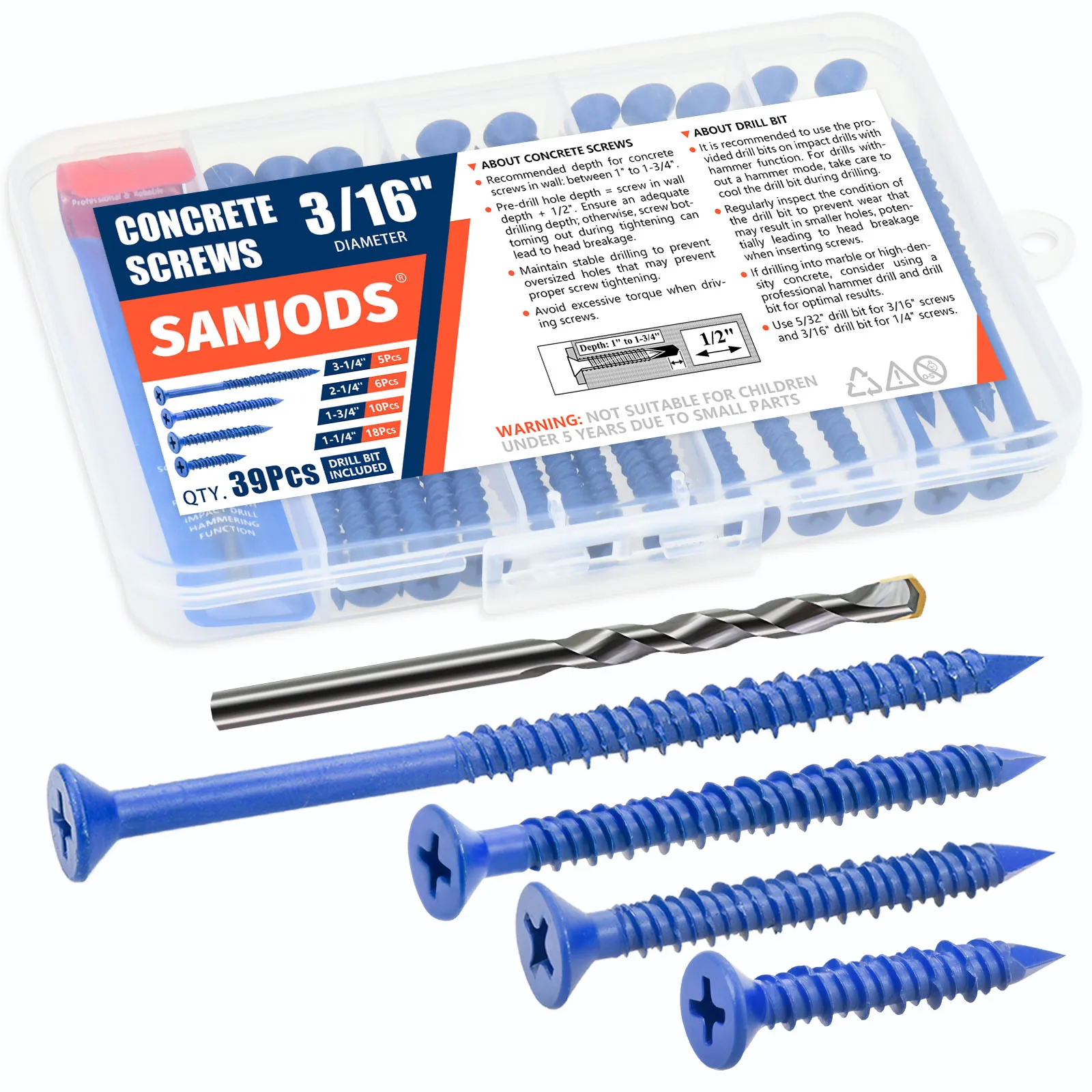
The SANJODS kit presents itself as a complete package, clearly visible in a transparent, organized case. Within this container, a collection of 39 blue flat head concrete screws in four distinct lengths is systematically arranged. An essential 5/32" carbide drill bit accompanies these fasteners, ensuring users have the correct tool for pilot hole preparation right from the start.
Users are not left searching. This thoughtful presentation underscores the product's immediate utility. The clear case allows for quick identification of screw sizes, a small but significant detail on a busy job site.
Many standard screw kits often omit the necessary drill bit, forcing users to purchase it separately. This oversight can lead to project delays or, worse, the use of an incorrect drill bit size, compromising the anchor's holding power. The SANJODS approach ensures a cohesive setup, a notable upgrade from fragmented hardware solutions.
At the heart of these concrete screws lies a carefully engineered design optimized for masonry applications. The visible Hi-Lo thread profile is a critical feature, characterized by alternating high and low threads. This design maximizes thread engagement within brittle materials like concrete and brick, providing exceptional grip. The blue anti-rust coating, a prominent visual aspect, suggests a commitment to long-term durability.
This provides exceptional grip. This thread design directly translates to superior pull-out resistance. When anchoring items to an old brick wall, for instance, the Hi-Lo threads cut aggressively into the masonry without excessively pulverizing the material. Fastening success relies on this.
Generic screws, often designed for wood or metal, lack the specific thread geometry required for dense, abrasive substrates. Their uniform threads can strip out concrete or fail to achieve adequate embedment, leading to premature loosening or complete failure. The specialized thread profile of the SANJODS screws represents a significant advancement over such general-purpose alternatives, ensuring more reliable connections for any restoration effort.
The anti-rust blue coating is not merely aesthetic; it serves a crucial protective function. This coating, tested to withstand 1000 hours in a salt spray environment, provides a robust barrier against moisture and corrosive elements. Such protection is essential for installations exposed to the elements or high humidity.
It preserves aesthetic integrity. Consider a scenario where these screws are used to secure a historical plaque to an exterior masonry wall. Without adequate corrosion protection, the screws would quickly degrade, leading to rust streaks on the valuable facade and, eventually, a weakened attachment. The blue coating prevents such degradation.
Unprotected or minimally coated fasteners quickly succumb to oxidation, especially in regions with high rainfall or coastal proximity. This deterioration compromises integrity of the fastening and can lead to unsightly staining on the surrounding material, a significant concern in the preservation of heritage structures. The extended salt spray test rating offers a tangible measure of this product's enhanced longevity compared to standard zinc-plated options.
The material composition of these screws, while not explicitly detailed beyond being "concrete screws" with a specific coating, implies a hardened steel core. This inherent strength is essential for penetrating dense materials without bending or snapping. The flat head design further contributes to a clean installation.
Bending during installation wastes time. A strong core material ensures consistent performance. When driving screws into old, sometimes inconsistent concrete, the screw must maintain its structural integrity.
Many low-cost fasteners utilize softer steels that are prone to deformation or shearing, particularly when encountering unexpected hard spots within masonry. This necessitates re-drilling and re-installation, increasing project costs and frustration. The implied durable construction of these screws represents a necessary standard for demanding restoration work.
The flat head with a cross-drive recess allows for flush mounting, which is often a critical aesthetic consideration in restoration. When securing trim, framing, or fixtures, a protruding screw head can be unsightly or even hazardous. A flush finish is always best.
This detail is often overlooked. Imagine mounting a wooden trim piece around a window in a renovated historical building. A countersunk flat head screw allows the trim to sit perfectly flat against the wall, creating a seamless and authentic appearance. It shapes the finished look.
Domed or pan-head screws, while suitable for some applications, can create an unfinished or industrial look when exposed. They also prevent attached elements from sitting flush, which can compromise structural stability or aesthetic coherence. The flat head design helps, a clear advantage for projects requiring a refined, discreet fastening solution.
The inclusion of a 5/32" carbide drill bit is a significant convenience and a functional necessity. Carbide-tipped bits are specifically designed to cut through hard materials like concrete, brick, and stone with efficiency. The precise sizing ensures optimal engagement for the 3/16" screws.
Simplicity is key for efficiency. Using the correct drill bit size is non-negotiable for concrete anchors. A hole that is too small risks stripping the screw or cracking the material. A hole that is too large reduces holding power significantly.
Generic drill bits, particularly those not carbide-tipped, quickly dull when attempting to penetrate masonry, leading to inefficient drilling, excessive heat generation, and potentially inaccurate hole sizes. The provision of a purpose-built carbide bit ensures that users can achieve the necessary precision and durability from the outset, avoiding common installation pitfalls and ensuring the anchor's full performance.
The visual instructions provided with the kit clearly outline a two-step installation process: drill the pre-hole, then screw into the wall. This straightforward approach highlights the user-friendly design of the system. Simplicity is key for efficiency.
Missteps lead to rework. This clear guidance minimizes the learning curve for new users and standardizes the installation method for experienced professionals. Missteps during anchor installation can lead to costly rework.
Without explicit instructions, users might inadvertently skip crucial steps or employ incorrect techniques, such as failing to clean the pilot hole or applying excessive torque. This can lead to compromised holding strength or damage to the substrate. The provided two-step guide offers a distinct advantage by promoting correct and efficient installation practices, thereby enhancing overall reliability of the anchor system.
The kit's offering of four different screw lengths—1-1/4", 1-3/4", 2-1/4", and 3-1/4"—caters to a broad spectrum of anchoring requirements. This adaptability is crucial for restoration work, where material thicknesses can vary significantly. A complete selection reduces purchases.
This is important. Different applications demand different screw lengths. Attaching a thin electrical conduit cover to a concrete wall requires a shorter screw than securing a substantial wooden ledger board. The variety allows for optimal embedment.
A kit with limited length options forces users to either compromise on embedment depth, potentially weakening the hold, or purchase additional specialized screws, adding to project costs and complexity. The SANJODS assortment provides a practical solution for adapting to diverse structural conditions without sacrificing performance.
The stated pulling force of 600 lbs, tested in 2500 lbs of concrete, provides a clear metric of the screws' strong holding capability. This specification is vital for ensuring that the chosen fastener can adequately support the intended load without failure. Performance metrics matter.
Exceeding expectations is always beneficial. Knowing the pull-out strength allows engineers and builders to confidently select the appropriate anchor for the job, adhering to safety standards and structural requirements. Underestimating the required holding force can lead to catastrophic failure.
Many generic screws lack explicit performance ratings, leaving users to guess at their capabilities. This ambiguity introduces significant risk, particularly in structural or safety-critical applications. The clearly defined 600 lbs pulling force provides a tangible benchmark, offering peace of mind and a verifiable performance advantage over unrated alternatives.
The product is explicitly designed for a wide range of masonry materials, including concrete, brick, block, and stucco. This broad compatibility makes the kit highly adaptable for various restoration and construction scenarios. Flexibility saves time and resources.
One solution fits many needs. Whether working on a solid concrete foundation, a traditional red brick wall, or a hollow block partition, these screws are engineered for effective anchoring. This eliminates the need for different types of fasteners for each material.
Specialized anchors are often required for each specific masonry type, adding complexity to inventory and procurement. A universal solution like these concrete screws simplifies the planning and execution of multi-material projects, making them efficient, a more efficient choice than a collection of disparate, material-specific anchors.
The aesthetic appeal of the blue coating, while primarily functional for corrosion resistance, also presents a distinct visual. For concealed applications, this color is irrelevant. However, in exposed settings, its presence must be considered.
The vibrant blue stands out. When the screws are hidden behind plaster or trim, the color is inconsequential. However, if exposed, the vibrant blue might not align with the desired historical or subtle aesthetic of a restoration project.
Many traditional fasteners are unplated or have a dull gray finish, which can blend more seamlessly into exposed masonry. The distinct blue color, while excellent for protection, might require additional steps, such as painting, to achieve a more historically accurate or discreet appearance, a minor trade-off exists for its superior corrosion properties.
The SANJODS 3/16" Concrete Anchor Screws Kit embodies the principles of effective anchoring for demanding environments. Its blend of specialized thread design, corrosion-resistant coating, and comprehensive sizing options positions it as a reliable choice for long-term structural integrity. The correct drill bit helps, further enhancing its value, making it accessible for a range of skill levels. For tasks ranging from securing structural elements in a century-old brick building to fastening modern fixtures to a concrete slab, this kit provides the confidence that comes with strong, proven fastening technology.
This kit empowers specialists. Imagine completing a challenging restoration project, knowing that every attachment is secured with fasteners engineered for endurance. The peace of mind that comes from using corrosion-resistant, high-strength anchors allows focus to remain on the aesthetic and historical accuracy of the work, confident in the underlying structural stability. This kit empowers restoration specialists to achieve both durability and authenticity, ensuring that the legacy of any structure is maintained for future generations.
Such specialized fasteners are crucial. Restoration projects, in particular, often involve working with aged and sometimes delicate building materials. The choice of anchoring hardware directly impacts the longevity and safety of the repair or addition. Generic fasteners can fail prematurely.
Compared to traditional methods, these specialized concrete screws offer a distinct advantage. They provide a simpler, more direct fastening path than expansion anchors or lead shields. This direct engagement with the base material minimizes stress on historical components, preserving the authentic composition of the structure.
Securing the Legacy: An Overview of the Concrete Anchoring System
The SANJODS kit presents itself as a complete package, clearly visible in a transparent, organized case. Within this container, a collection of 39 blue flat head concrete screws in four distinct lengths is systematically arranged. An essential 5/32" carbide drill bit accompanies these fasteners, ensuring users have the correct tool for pilot hole preparation right from the start.
Users are not left searching. This thoughtful presentation underscores the product's immediate utility. The clear case allows for quick identification of screw sizes, a small but significant detail on a busy job site.
Many standard screw kits often omit the necessary drill bit, forcing users to purchase it separately. This oversight can lead to project delays or, worse, the use of an incorrect drill bit size, compromising the anchor's holding power. The SANJODS approach ensures a cohesive setup, a notable upgrade from fragmented hardware solutions.
The Foundation of Fastening: Material and Design Integrity
At the heart of these concrete screws lies a carefully engineered design optimized for masonry applications. The visible Hi-Lo thread profile is a critical feature, characterized by alternating high and low threads. This design maximizes thread engagement within brittle materials like concrete and brick, providing exceptional grip. The blue anti-rust coating, a prominent visual aspect, suggests a commitment to long-term durability.
This provides exceptional grip. This thread design directly translates to superior pull-out resistance. When anchoring items to an old brick wall, for instance, the Hi-Lo threads cut aggressively into the masonry without excessively pulverizing the material. Fastening success relies on this.
Generic screws, often designed for wood or metal, lack the specific thread geometry required for dense, abrasive substrates. Their uniform threads can strip out concrete or fail to achieve adequate embedment, leading to premature loosening or complete failure. The specialized thread profile of the SANJODS screws represents a significant advancement over such general-purpose alternatives, ensuring more reliable connections for any restoration effort.
The anti-rust blue coating is not merely aesthetic; it serves a crucial protective function. This coating, tested to withstand 1000 hours in a salt spray environment, provides a robust barrier against moisture and corrosive elements. Such protection is essential for installations exposed to the elements or high humidity.
It preserves aesthetic integrity. Consider a scenario where these screws are used to secure a historical plaque to an exterior masonry wall. Without adequate corrosion protection, the screws would quickly degrade, leading to rust streaks on the valuable facade and, eventually, a weakened attachment. The blue coating prevents such degradation.
Unprotected or minimally coated fasteners quickly succumb to oxidation, especially in regions with high rainfall or coastal proximity. This deterioration compromises integrity of the fastening and can lead to unsightly staining on the surrounding material, a significant concern in the preservation of heritage structures. The extended salt spray test rating offers a tangible measure of this product's enhanced longevity compared to standard zinc-plated options.
Enduring Materials: Longevity in Restoration
The material composition of these screws, while not explicitly detailed beyond being "concrete screws" with a specific coating, implies a hardened steel core. This inherent strength is essential for penetrating dense materials without bending or snapping. The flat head design further contributes to a clean installation.
Bending during installation wastes time. A strong core material ensures consistent performance. When driving screws into old, sometimes inconsistent concrete, the screw must maintain its structural integrity.
Many low-cost fasteners utilize softer steels that are prone to deformation or shearing, particularly when encountering unexpected hard spots within masonry. This necessitates re-drilling and re-installation, increasing project costs and frustration. The implied durable construction of these screws represents a necessary standard for demanding restoration work.
The flat head with a cross-drive recess allows for flush mounting, which is often a critical aesthetic consideration in restoration. When securing trim, framing, or fixtures, a protruding screw head can be unsightly or even hazardous. A flush finish is always best.
This detail is often overlooked. Imagine mounting a wooden trim piece around a window in a renovated historical building. A countersunk flat head screw allows the trim to sit perfectly flat against the wall, creating a seamless and authentic appearance. It shapes the finished look.
Domed or pan-head screws, while suitable for some applications, can create an unfinished or industrial look when exposed. They also prevent attached elements from sitting flush, which can compromise structural stability or aesthetic coherence. The flat head design helps, a clear advantage for projects requiring a refined, discreet fastening solution.
Precision in Placement: The Role of the Included Drill Bit
The inclusion of a 5/32" carbide drill bit is a significant convenience and a functional necessity. Carbide-tipped bits are specifically designed to cut through hard materials like concrete, brick, and stone with efficiency. The precise sizing ensures optimal engagement for the 3/16" screws.
Simplicity is key for efficiency. Using the correct drill bit size is non-negotiable for concrete anchors. A hole that is too small risks stripping the screw or cracking the material. A hole that is too large reduces holding power significantly.
Generic drill bits, particularly those not carbide-tipped, quickly dull when attempting to penetrate masonry, leading to inefficient drilling, excessive heat generation, and potentially inaccurate hole sizes. The provision of a purpose-built carbide bit ensures that users can achieve the necessary precision and durability from the outset, avoiding common installation pitfalls and ensuring the anchor's full performance.
The visual instructions provided with the kit clearly outline a two-step installation process: drill the pre-hole, then screw into the wall. This straightforward approach highlights the user-friendly design of the system. Simplicity is key for efficiency.
Missteps lead to rework. This clear guidance minimizes the learning curve for new users and standardizes the installation method for experienced professionals. Missteps during anchor installation can lead to costly rework.
Without explicit instructions, users might inadvertently skip crucial steps or employ incorrect techniques, such as failing to clean the pilot hole or applying excessive torque. This can lead to compromised holding strength or damage to the substrate. The provided two-step guide offers a distinct advantage by promoting correct and efficient installation practices, thereby enhancing overall reliability of the anchor system.
The Upgrade for Authentic Holds: Flexibility and Performance
The kit's offering of four different screw lengths—1-1/4", 1-3/4", 2-1/4", and 3-1/4"—caters to a broad spectrum of anchoring requirements. This adaptability is crucial for restoration work, where material thicknesses can vary significantly. A complete selection reduces purchases.
This is important. Different applications demand different screw lengths. Attaching a thin electrical conduit cover to a concrete wall requires a shorter screw than securing a substantial wooden ledger board. The variety allows for optimal embedment.
A kit with limited length options forces users to either compromise on embedment depth, potentially weakening the hold, or purchase additional specialized screws, adding to project costs and complexity. The SANJODS assortment provides a practical solution for adapting to diverse structural conditions without sacrificing performance.
The stated pulling force of 600 lbs, tested in 2500 lbs of concrete, provides a clear metric of the screws' strong holding capability. This specification is vital for ensuring that the chosen fastener can adequately support the intended load without failure. Performance metrics matter.
Exceeding expectations is always beneficial. Knowing the pull-out strength allows engineers and builders to confidently select the appropriate anchor for the job, adhering to safety standards and structural requirements. Underestimating the required holding force can lead to catastrophic failure.
Many generic screws lack explicit performance ratings, leaving users to guess at their capabilities. This ambiguity introduces significant risk, particularly in structural or safety-critical applications. The clearly defined 600 lbs pulling force provides a tangible benchmark, offering peace of mind and a verifiable performance advantage over unrated alternatives.
Addressing Common Restoration Challenges: Adaptability Across Substrates
The product is explicitly designed for a wide range of masonry materials, including concrete, brick, block, and stucco. This broad compatibility makes the kit highly adaptable for various restoration and construction scenarios. Flexibility saves time and resources.
One solution fits many needs. Whether working on a solid concrete foundation, a traditional red brick wall, or a hollow block partition, these screws are engineered for effective anchoring. This eliminates the need for different types of fasteners for each material.
Specialized anchors are often required for each specific masonry type, adding complexity to inventory and procurement. A universal solution like these concrete screws simplifies the planning and execution of multi-material projects, making them efficient, a more efficient choice than a collection of disparate, material-specific anchors.
The aesthetic appeal of the blue coating, while primarily functional for corrosion resistance, also presents a distinct visual. For concealed applications, this color is irrelevant. However, in exposed settings, its presence must be considered.
The vibrant blue stands out. When the screws are hidden behind plaster or trim, the color is inconsequential. However, if exposed, the vibrant blue might not align with the desired historical or subtle aesthetic of a restoration project.
Many traditional fasteners are unplated or have a dull gray finish, which can blend more seamlessly into exposed masonry. The distinct blue color, while excellent for protection, might require additional steps, such as painting, to achieve a more historically accurate or discreet appearance, a minor trade-off exists for its superior corrosion properties.
A Worthy Addition to the Restoration Toolkit
The SANJODS 3/16" Concrete Anchor Screws Kit embodies the principles of effective anchoring for demanding environments. Its blend of specialized thread design, corrosion-resistant coating, and comprehensive sizing options positions it as a reliable choice for long-term structural integrity. The correct drill bit helps, further enhancing its value, making it accessible for a range of skill levels. For tasks ranging from securing structural elements in a century-old brick building to fastening modern fixtures to a concrete slab, this kit provides the confidence that comes with strong, proven fastening technology.
This kit empowers specialists. Imagine completing a challenging restoration project, knowing that every attachment is secured with fasteners engineered for endurance. The peace of mind that comes from using corrosion-resistant, high-strength anchors allows focus to remain on the aesthetic and historical accuracy of the work, confident in the underlying structural stability. This kit empowers restoration specialists to achieve both durability and authenticity, ensuring that the legacy of any structure is maintained for future generations.