SMA to UHF RF Jumper Cable
Official Store Deal
Expert Analysis Overview
Bridging RF Worlds: The SMA to UHF Interconnect
The SMA to UHF RF Jumper Cable is a critical interconnect solution designed for radio enthusiasts, electronics technicians, and hobbyists requiring seamless adaptation between disparate radio frequency interfaces. This specialized pigtail cable facilitates the connection of devices equipped with SMA connectors to those utilizing the venerable UHF connector standard, a common requirement in amateur radio, CB radio, and various test and measurement setups. Its construction prioritizes signal integrity and mechanical durability, essential for reliable operation in demanding RF environments.
The Coaxial Conduit: RG316 Cable Engineering
At the core of this jumper cable is the RG316 coaxial cable. This specific cable type is chosen for its robust characteristics and suitability for short-run RF applications where flexibility and temperature resistance are paramount. The visible construction of RG316 typically involves a silver-plated copper-clad steel inner conductor, a PTFE (Polytetrafluoroethylene) dielectric, a silver-plated copper braid shield, and an FEP (Fluorinated Ethylene Propylene) outer jacket. This layered design is not merely aesthetic; it is fundamental to the cable's electrical performance.
The PTFE dielectric, for instance, offers superior electrical properties compared to polyethylene, particularly in terms of lower dielectric loss and a higher operating temperature range. This translates directly into more stable impedance characteristics and reduced signal attenuation, especially at higher frequencies where dielectric losses become more pronounced. For users operating equipment in varied thermal conditions, the FEP jacket provides excellent chemical resistance and a wide temperature tolerance, ensuring the cable maintains its physical and electrical integrity over time. This is a durable choice.
Compared to more common cables like RG58 or RG174, RG316 strikes a balance. While RG58 offers lower attenuation for longer runs, its larger diameter and polyethylene dielectric limit flexibility and high-temperature performance. RG174 is thinner and more flexible but suffers from higher attenuation. RG316, therefore, presents an optimal solution for short jumper applications where a compact, flexible, and thermally stable connection is required without excessive signal loss. It's a smart compromise.
Connector Craftsmanship: SMA and UHF Standards
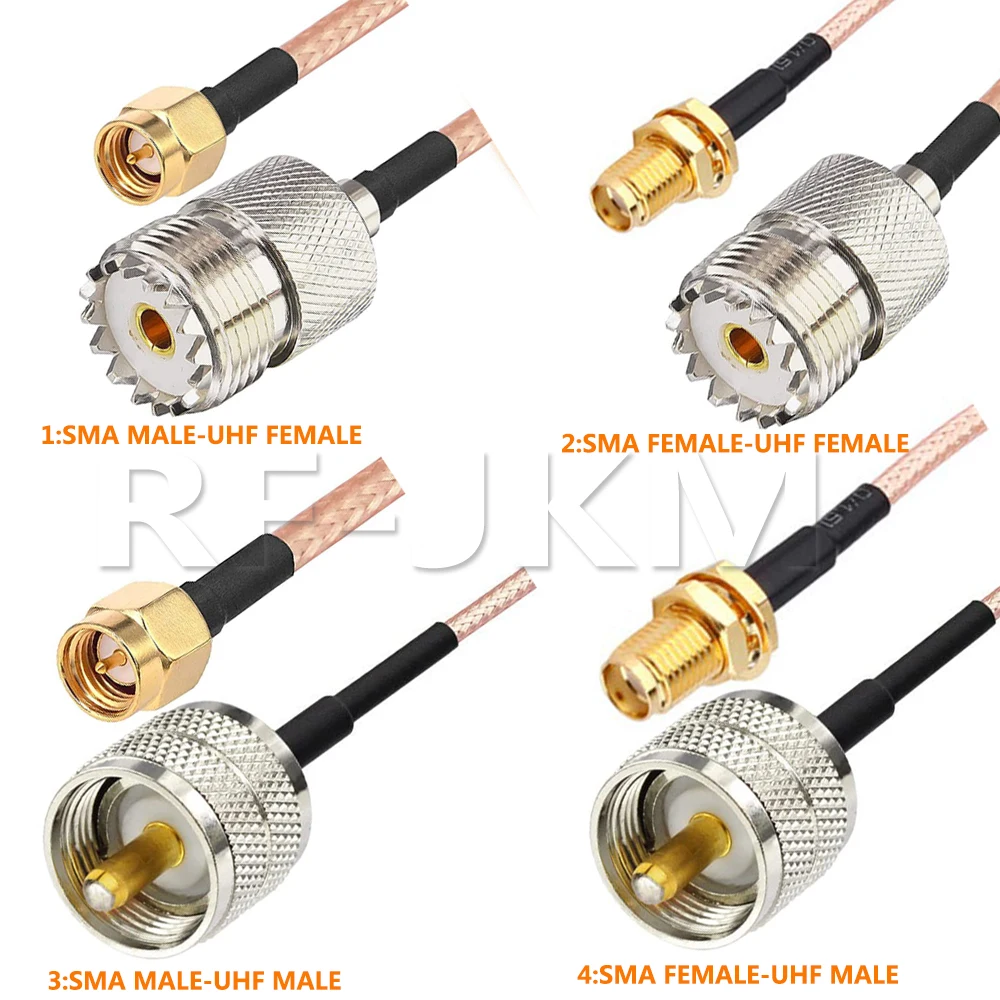
The cable features two distinct connector types: SMA (SubMiniature version A) and UHF (Ultra High Frequency), often referred to as PL-259 (male) and SO-239 (female). These connectors serve different purposes and operate within different historical contexts of RF engineering. The images clearly show variations including SMA male to UHF female, SMA female to UHF male, SMA male to UHF male, and SMA female to UHF female configurations, providing versatility for various connectivity needs.
SMA connectors are precision, threaded coaxial connectors designed for frequencies up to 18 GHz, though some variants can extend higher. Their small size and secure threaded coupling make them ideal for applications requiring high performance and compact form factors, such as Wi-Fi antennas, cellular modems, GPS receivers, and many modern test instruments. The gold plating visible on the SMA connectors in the images suggests an emphasis on minimizing contact resistance and preventing oxidation, which are crucial for maintaining consistent impedance and low insertion loss at microwave frequencies. This plating is a key detail.
UHF connectors, conversely, are older, non-constant impedance connectors primarily designed for frequencies below 300 MHz, though they are often used up to 500 MHz with acceptable performance in amateur radio applications. The PL-259 (male) and SO-239 (female) are robust, easy-to-connect, and widely adopted in CB radio, ham radio transceivers, and older RF equipment. The nickel-plated brass construction, evident in the images, offers good mechanical strength and corrosion resistance, suitable for the less stringent impedance requirements of their typical frequency range. Their larger size makes them easy to handle.
The selection of these specific connector types and their robust construction directly impacts the capability of the cable. For instance, connecting a modern Software Defined Radio (SDR) with an SMA port to a traditional ham radio antenna using a UHF connector becomes effortless and reliable. The threaded coupling of the SMA ensures a secure, vibration-resistant connection, while the larger UHF connector provides a sturdy interface to bulkier antenna cables. This adaptability is invaluable.
Signal Integrity and Impedance Matching
Maintaining signal integrity across different connector types is paramount in RF applications. While SMA connectors are 50-ohm impedance matched, UHF connectors are technically non-constant impedance. However, for the frequencies typically associated with UHF connector usage (HF, VHF, low UHF), the impedance mismatch is often negligible for short jumper cables, especially in amateur radio contexts where the primary goal is simply connection. The RG316 cable itself is a 50-ohm coaxial cable, ensuring that the cable segment introduces minimal impedance discontinuity.
Visible crimping and soldering points, though not microscopically detailed in the provided images, are critical for the overall performance. High-quality crimping ensures a secure mechanical connection and low resistance electrical path between the cable shield and the connector body. Proper soldering of the center conductor is equally important to prevent signal reflections and maintain the specified impedance. Any imperfections in these areas can lead to increased VSWR (Voltage Standing Wave Ratio) and signal loss, degrading the overall system performance. A clean connection is vital.
In a scenario where a user is connecting a low-power handheld transceiver to a larger base station antenna, the minimal loss characteristics of RG316 combined with well-terminated connectors ensure that the maximum possible power is transferred to the antenna, optimizing transmission range and reception sensitivity. Unlike poorly manufactured generic adapters that might introduce significant signal degradation, these cables are engineered to preserve the signal path. This directly impacts operational efficiency.
Durability and Longevity in the Field
The materials chosen for these cables contribute significantly to their expected lifespan and performance under various conditions. Brass, a common material for RF connectors, provides excellent machinability and strength. The plating—gold for SMA and nickel for UHF—serves to protect against corrosion and enhance conductivity. Gold is particularly effective for high-frequency applications due to its superior conductivity and resistance to oxidation, ensuring stable contact over many mating cycles. Nickel offers a durable, hard-wearing surface that resists abrasion and corrosion.
The flexibility of the RG316 cable, combined with its FEP jacket, means it can withstand repeated bending and movement without internal damage to the conductors or shield. This is particularly beneficial in test environments where cables are frequently reconfigured, or in mobile installations where vibrations and movement are common. Unlike cables with brittle PVC jackets, the FEP material resists cracking and degradation from UV exposure or chemical spills, extending the cable's service life. This resilience is a practical advantage.
Consider a field technician who frequently connects different pieces of test equipment. The robust construction of these jumper cables means less time spent troubleshooting intermittent connections and more time focused on diagnostics. The secure threaded SMA connection prevents accidental disconnections, while the sturdy UHF connector can handle the rigors of repeated attachment and detachment. This reliability translates into operational efficiency and reduced equipment downtime, making the initial investment a long-term saving.
Versatile Applications and Value Proposition
These SMA to UHF jumper cables find their utility across a broad spectrum of electronic and radio communication applications. From connecting an SDR dongle to a large outdoor antenna, adapting a handheld amateur radio to a mobile antenna, or integrating different components in a custom RF project, their adaptability is a key selling point. The availability of various male/female combinations ensures that almost any SMA-to-UHF conversion scenario can be addressed with a single product line.
The affordability of these components, especially when compared to the cost of specialized equipment or custom-made cables, makes them an attractive solution for both professional and hobbyist users. They allow for the interoperability of expensive radio equipment without requiring costly modifications or replacements. This provides a cost-effective pathway to expand system capabilities. It's an economical choice.
Imagine a scenario where a radio amateur acquires a new antenna with a UHF connector, but their existing transceiver uses an SMA port. Instead of purchasing a new radio or undertaking complex modifications, this simple jumper cable provides an immediate, reliable, and high-performance solution. The ability to quickly and effectively bridge these different RF standards ensures that valuable equipment can be utilized to its full potential, maximizing the return on investment for existing gear. This cable empowers connectivity.
Seamless RF Integration for Enhanced Performance
This range of SMA to UHF RF Jumper Cables offers a practical and high-quality solution for common RF connectivity challenges. The careful selection of RG316 coaxial cable, known for its flexibility and thermal stability, combined with precision-engineered SMA and UHF connectors, ensures reliable signal transmission across diverse applications. From amateur radio setups to critical test environments, these cables provide the necessary bridge for interoperability, maintaining signal integrity and offering long-term durability. For anyone seeking to integrate different RF components with confidence, these cables deliver a clear, stable connection, allowing for optimal performance from their electronic systems. The consistent signal flow will enhance all your RF projects.