TAXNELE TXBD1-63 DC Mini Circuit Breaker for PV Systems
Official Store Deal
Expert Analysis Overview
The TAXNELE TXBD1-63 DC Mini Circuit Breaker is a critical safety component engineered for direct current (DC) photovoltaic (PV) systems, providing essential overcurrent and short-circuit protection for solar arrays and battery circuits. This device is specifically designed to manage the unique characteristics of DC electricity, which differs significantly from alternating current (AC) in its fault interruption requirements. Its robust construction and adherence to international standards position it as a reliable choice for safeguarding valuable solar installations.
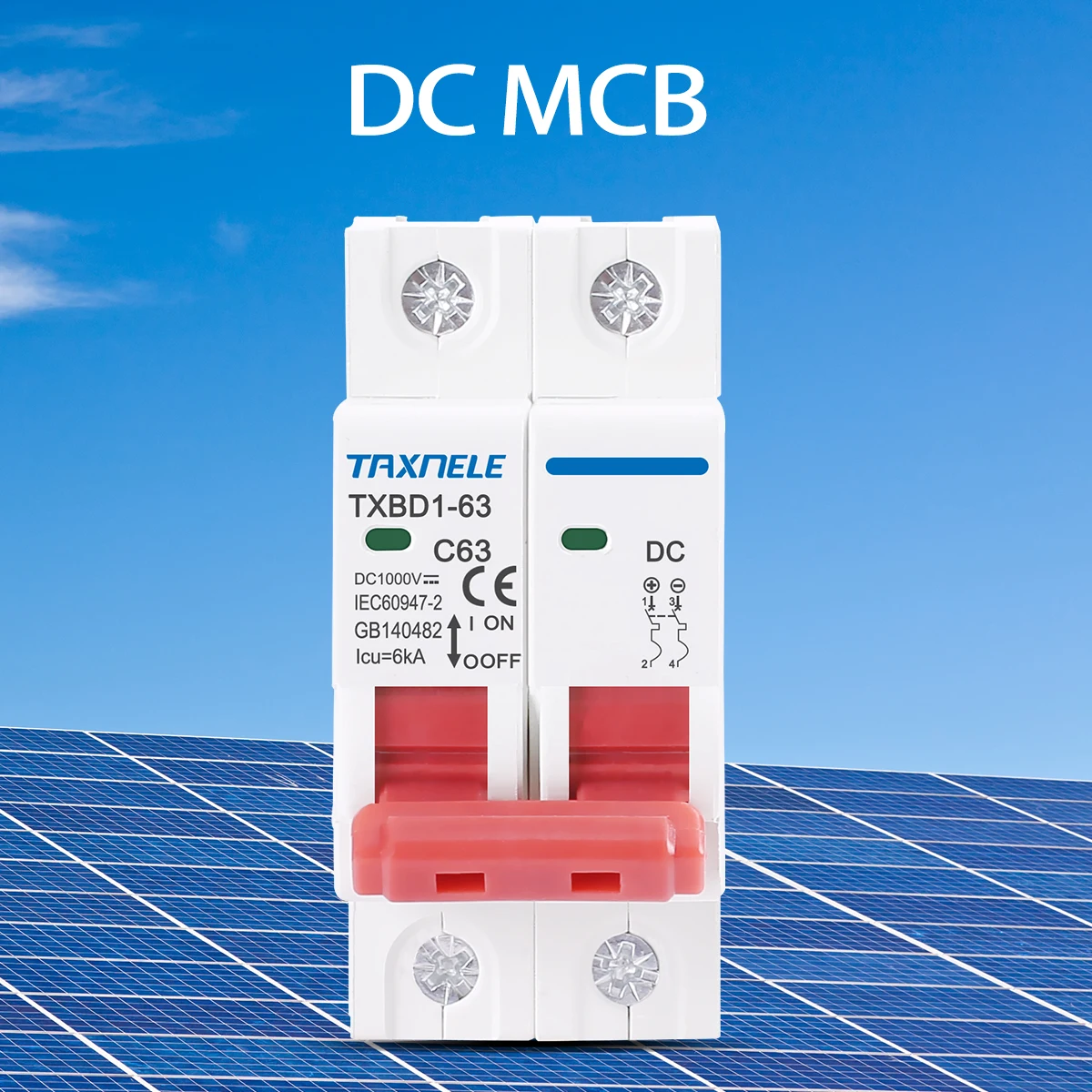
The visible markings on the circuit breaker, such as "TXBD1-63", "DC 1000V", "C63", "CE", "GB14048.2", and "IEC60947-2", provide a clear indication of its intended application and compliance. The "DC 1000V" rating signifies its capability to operate safely within high-voltage DC environments, typical of modern string inverter solar systems. The "C63" designation refers to a C-type trip curve with a 63-ampere nominal current rating, indicating its response characteristics to overloads and short circuits. The "CE" mark confirms compliance with European Union safety, health, and environmental protection directives, while "GB14048.2" and "IEC60947-2" denote adherence to specific Chinese and International Electrotechnical Commission standards for low-voltage switchgear and controlgear.
These technical specifications translate directly into real-world operational benefits. The high voltage rating ensures the breaker can effectively interrupt faults in large-scale solar arrays without degradation, a crucial factor for system longevity and safety. The C-type trip curve is generally suitable for circuits with moderate inrush currents, such as those found in PV systems, preventing nuisance tripping while still offering rapid protection against dangerous overcurrents. This balance is vital for maintaining system uptime while ensuring component safety. A quick trip is paramount.
Unlike generic AC circuit breakers, which are ill-suited for DC applications due to their inability to effectively quench the sustained arcs produced by direct current faults, this dedicated DC MCB is purpose-built. Standard AC breakers can fail to clear a DC fault, leading to prolonged arcing, significant heat generation, and a high risk of electrical fires. The specialized design of a DC breaker, including its arc chute and magnetic blow-out features, ensures reliable interruption of DC arcs, a fundamental requirement for the safe operation of any photovoltaic installation.
The C63 rating, or other available amperages like 6A, 10A, 16A, 20A, 25A, 32A, 40A, or 50A as indicated in the product title, defines the breaker's nominal current capacity. The visible red lever acts as the manual trip and reset mechanism, providing a clear visual indication of the breaker's status (ON/OFF). This mechanical robustness is essential for reliable operation in the field.
Understanding the C-type trip curve is critical for proper system design. A C-curve breaker allows for a temporary surge of current, typically 5 to 10 times its nominal rating, before tripping. This characteristic is beneficial in PV systems where initial charging currents or inverter startup surges might otherwise cause immediate tripping with a more sensitive breaker. However, for sustained overloads or direct short circuits, the breaker will rapidly interrupt the circuit, protecting the wiring, solar panels, inverters, and battery banks from damage. This precise response safeguards the entire electrical infrastructure.
Comparing C-curve breakers to Bor D-curve alternatives highlights their specific application niche. B-curve breakers are more sensitive, tripping at lower overload multiples, making them suitable for purely resistive loads. D-curve breakers are less sensitive, tolerating very high inrush currents, often used for motors or transformers. For most solar PV applications, the C-curve offers an optimal balance, providing robust protection without excessive nuisance tripping, which can be a significant operational headache in remote or unattended installations.
The DC 1000V rating is a standout feature, directly addressing the increasing voltage requirements of modern solar installations. As solar panel technology advances, higher voltage strings are becoming more common to improve efficiency and reduce current, thereby minimizing cable losses. A breaker rated for 1000V DC is therefore essential for compatibility with contemporary PV system designs, ensuring that the protective device can withstand and interrupt faults at these elevated potentials.
The unique challenges of DC circuits, particularly at high voltages, cannot be overstated. Unlike AC, which naturally extinguishes arcs as the current crosses zero, DC current is unidirectional, making arc quenching significantly more difficult. A sustained DC arc can reach extremely high temperatures, melting conductors, igniting insulation, and causing severe damage or fire. This breaker's design explicitly accounts for these phenomena, incorporating features to rapidly extinguish DC arcs, a fundamental safety requirement that differentiates it from any AC counterpart. It protects against catastrophic failures.
As previously noted, the use of standard AC breakers in DC applications is a dangerous misapplication. Their internal mechanisms are not designed to handle the continuous current flow and arc characteristics of DC. This dedicated DC MCB, with its specific arc suppression capabilities, is an indispensable component for any safe and compliant photovoltaic system. It ensures that in the event of a fault, the circuit is reliably and quickly de-energized, preventing widespread damage and ensuring personnel safety.
One of the images clearly illustrates the 35mm standard DIN rail installation capability. This feature is a significant advantage for installers, as DIN rails are a universal mounting standard in electrical enclosures and distribution boards. The modularity offered by DIN rail mounting allows for quick and secure installation alongside other protective devices, such as surge protective devices (SPDs) and terminal blocks, creating a neat and organized electrical panel.
The visible screw terminals facilitate wiring connections. Proper termination of conductors is paramount in any electrical installation, especially in high-current DC circuits. Loose connections can lead to increased resistance, localized heating, and potential fire hazards. Installers must ensure that the appropriate wire gauge is selected for the specific amperage rating of the breaker and that all terminal screws are torqued to the manufacturer's specifications. This attention to detail prevents hotspots and ensures long-term reliability.
Compared to custom mounting solutions or panel-mount breakers that require specific cutouts, DIN rail compatibility offers superior flexibility and ease of maintenance. It allows for straightforward expansion or modification of the electrical system, as components can be easily added or replaced without extensive rework. This standardization streamlines installation processes and reduces labor costs, making it a practical choice for both small residential and larger commercial PV installations.
The visible plastic housing of the breaker appears to be constructed from a durable, flame-retardant material, a standard expectation for electrical safety devices. The prominent "CE" marking is not merely a label; it signifies that the product has undergone a conformity assessment and meets the essential requirements of relevant European directives. This includes rigorous testing for electrical safety, electromagnetic compatibility, and environmental impact. The "GB14048.2" and "IEC60947-2" standards further reinforce its compliance with globally recognized benchmarks for circuit breakers, providing an additional layer of assurance regarding its design and manufacturing quality.
These certifications are not just bureaucratic hurdles; they are critical indicators of a product's reliability and safety. For PV systems, where components are often exposed to harsh environmental conditions and are expected to operate reliably for decades, using certified equipment is non-negotiable. Uncertified or substandard components can lead to premature failures, system inefficiencies, and, most critically, significant safety hazards, including electrical fires. Investing in certified components like this breaker protects the entire system and its occupants.
Discussing the importance of certified components in PV systems extends beyond mere compliance; it impacts insurance coverage, warranty validity, and the overall bankability of a solar project. Many jurisdictions and financial institutions require the use of certified electrical components to approve installations or provide financing. This breaker's adherence to multiple international standards makes it a suitable choice for a wide range of global markets, simplifying procurement and ensuring project viability.
The screw terminals, clearly visible in the product images, are the interface between the breaker and the system wiring. The quality of these terminals directly impacts the electrical integrity of the connection. While the visual inspection suggests standard terminal blocks, the onus remains on the installer to ensure meticulous wiring practices. Proper wire stripping, insertion, and torque application are essential to create a low-resistance, high-integrity connection.
Overheating at terminal connections is a common failure mode in electrical systems, often resulting from loose screws, improper wire insertion, or using an undersized wire gauge for the current load. Such overheating can degrade insulation, melt plastic components, and eventually lead to arcing faults or fires. The compact form factor of the breaker necessitates careful attention during wiring to ensure adequate space for bending conductors and proper tool access.
Inferior terminal designs or materials can lead to premature failure, even with perfect installation. While this product appears to use standard, functional terminals, the critical takeaway is that the user must always verify the appropriate wire gauge for the selected amperage rating. For a 63A breaker, for instance, significantly thicker conductors are required compared to a 6A breaker. Consulting electrical codes and manufacturer specifications for wire sizing is not optional; it is a fundamental safety requirement to prevent conductor overheating and ensure the long-term reliability of the entire PV system.
Imagine the peace of mind that comes with a solar power system reliably protected by a purpose-built DC circuit breaker. Envision a scenario where your investment in renewable energy is safeguarded against unexpected electrical faults, ensuring continuous power generation and preventing costly damage. This breaker provides that foundational layer of safety, allowing you to focus on the benefits of sustainable energy without constant worry about electrical integrity. It is a small component with a monumental role in the safety and efficiency of your photovoltaic array, operating silently to protect your power generation for years to come.
Unwavering Circuit Protection: The Core of System Integrity
The visible markings on the circuit breaker, such as "TXBD1-63", "DC 1000V", "C63", "CE", "GB14048.2", and "IEC60947-2", provide a clear indication of its intended application and compliance. The "DC 1000V" rating signifies its capability to operate safely within high-voltage DC environments, typical of modern string inverter solar systems. The "C63" designation refers to a C-type trip curve with a 63-ampere nominal current rating, indicating its response characteristics to overloads and short circuits. The "CE" mark confirms compliance with European Union safety, health, and environmental protection directives, while "GB14048.2" and "IEC60947-2" denote adherence to specific Chinese and International Electrotechnical Commission standards for low-voltage switchgear and controlgear.
These technical specifications translate directly into real-world operational benefits. The high voltage rating ensures the breaker can effectively interrupt faults in large-scale solar arrays without degradation, a crucial factor for system longevity and safety. The C-type trip curve is generally suitable for circuits with moderate inrush currents, such as those found in PV systems, preventing nuisance tripping while still offering rapid protection against dangerous overcurrents. This balance is vital for maintaining system uptime while ensuring component safety. A quick trip is paramount.
Unlike generic AC circuit breakers, which are ill-suited for DC applications due to their inability to effectively quench the sustained arcs produced by direct current faults, this dedicated DC MCB is purpose-built. Standard AC breakers can fail to clear a DC fault, leading to prolonged arcing, significant heat generation, and a high risk of electrical fires. The specialized design of a DC breaker, including its arc chute and magnetic blow-out features, ensures reliable interruption of DC arcs, a fundamental requirement for the safe operation of any photovoltaic installation.
The Heart of Safety: Overcurrent and Short-Circuit Defense
The C63 rating, or other available amperages like 6A, 10A, 16A, 20A, 25A, 32A, 40A, or 50A as indicated in the product title, defines the breaker's nominal current capacity. The visible red lever acts as the manual trip and reset mechanism, providing a clear visual indication of the breaker's status (ON/OFF). This mechanical robustness is essential for reliable operation in the field.
Understanding the C-type trip curve is critical for proper system design. A C-curve breaker allows for a temporary surge of current, typically 5 to 10 times its nominal rating, before tripping. This characteristic is beneficial in PV systems where initial charging currents or inverter startup surges might otherwise cause immediate tripping with a more sensitive breaker. However, for sustained overloads or direct short circuits, the breaker will rapidly interrupt the circuit, protecting the wiring, solar panels, inverters, and battery banks from damage. This precise response safeguards the entire electrical infrastructure.
Comparing C-curve breakers to B
Engineered for Photovoltaic Demands: Performance in Practice
The DC 1000V rating is a standout feature, directly addressing the increasing voltage requirements of modern solar installations. As solar panel technology advances, higher voltage strings are becoming more common to improve efficiency and reduce current, thereby minimizing cable losses. A breaker rated for 1000V DC is therefore essential for compatibility with contemporary PV system designs, ensuring that the protective device can withstand and interrupt faults at these elevated potentials.
The unique challenges of DC circuits, particularly at high voltages, cannot be overstated. Unlike AC, which naturally extinguishes arcs as the current crosses zero, DC current is unidirectional, making arc quenching significantly more difficult. A sustained DC arc can reach extremely high temperatures, melting conductors, igniting insulation, and causing severe damage or fire. This breaker's design explicitly accounts for these phenomena, incorporating features to rapidly extinguish DC arcs, a fundamental safety requirement that differentiates it from any AC counterpart. It protects against catastrophic failures.
As previously noted, the use of standard AC breakers in DC applications is a dangerous misapplication. Their internal mechanisms are not designed to handle the continuous current flow and arc characteristics of DC. This dedicated DC MCB, with its specific arc suppression capabilities, is an indispensable component for any safe and compliant photovoltaic system. It ensures that in the event of a fault, the circuit is reliably and quickly de-energized, preventing widespread damage and ensuring personnel safety.
Installation and Integration: A Secure Fit
One of the images clearly illustrates the 35mm standard DIN rail installation capability. This feature is a significant advantage for installers, as DIN rails are a universal mounting standard in electrical enclosures and distribution boards. The modularity offered by DIN rail mounting allows for quick and secure installation alongside other protective devices, such as surge protective devices (SPDs) and terminal blocks, creating a neat and organized electrical panel.
The visible screw terminals facilitate wiring connections. Proper termination of conductors is paramount in any electrical installation, especially in high-current DC circuits. Loose connections can lead to increased resistance, localized heating, and potential fire hazards. Installers must ensure that the appropriate wire gauge is selected for the specific amperage rating of the breaker and that all terminal screws are torqued to the manufacturer's specifications. This attention to detail prevents hotspots and ensures long-term reliability.
Compared to custom mounting solutions or panel-mount breakers that require specific cutouts, DIN rail compatibility offers superior flexibility and ease of maintenance. It allows for straightforward expansion or modification of the electrical system, as components can be easily added or replaced without extensive rework. This standardization streamlines installation processes and reduces labor costs, making it a practical choice for both small residential and larger commercial PV installations.
Durability and Compliance: A Foundation of Trust
The visible plastic housing of the breaker appears to be constructed from a durable, flame-retardant material, a standard expectation for electrical safety devices. The prominent "CE" marking is not merely a label; it signifies that the product has undergone a conformity assessment and meets the essential requirements of relevant European directives. This includes rigorous testing for electrical safety, electromagnetic compatibility, and environmental impact. The "GB14048.2" and "IEC60947-2" standards further reinforce its compliance with globally recognized benchmarks for circuit breakers, providing an additional layer of assurance regarding its design and manufacturing quality.
These certifications are not just bureaucratic hurdles; they are critical indicators of a product's reliability and safety. For PV systems, where components are often exposed to harsh environmental conditions and are expected to operate reliably for decades, using certified equipment is non-negotiable. Uncertified or substandard components can lead to premature failures, system inefficiencies, and, most critically, significant safety hazards, including electrical fires. Investing in certified components like this breaker protects the entire system and its occupants.
Discussing the importance of certified components in PV systems extends beyond mere compliance; it impacts insurance coverage, warranty validity, and the overall bankability of a solar project. Many jurisdictions and financial institutions require the use of certified electrical components to approve installations or provide financing. This breaker's adherence to multiple international standards makes it a suitable choice for a wide range of global markets, simplifying procurement and ensuring project viability.
Terminal Quality and Wire Gauge Verification
The screw terminals, clearly visible in the product images, are the interface between the breaker and the system wiring. The quality of these terminals directly impacts the electrical integrity of the connection. While the visual inspection suggests standard terminal blocks, the onus remains on the installer to ensure meticulous wiring practices. Proper wire stripping, insertion, and torque application are essential to create a low-resistance, high-integrity connection.
Overheating at terminal connections is a common failure mode in electrical systems, often resulting from loose screws, improper wire insertion, or using an undersized wire gauge for the current load. Such overheating can degrade insulation, melt plastic components, and eventually lead to arcing faults or fires. The compact form factor of the breaker necessitates careful attention during wiring to ensure adequate space for bending conductors and proper tool access.
Inferior terminal designs or materials can lead to premature failure, even with perfect installation. While this product appears to use standard, functional terminals, the critical takeaway is that the user must always verify the appropriate wire gauge for the selected amperage rating. For a 63A breaker, for instance, significantly thicker conductors are required compared to a 6A breaker. Consulting electrical codes and manufacturer specifications for wire sizing is not optional; it is a fundamental safety requirement to prevent conductor overheating and ensure the long-term reliability of the entire PV system.
Imagine the peace of mind that comes with a solar power system reliably protected by a purpose-built DC circuit breaker. Envision a scenario where your investment in renewable energy is safeguarded against unexpected electrical faults, ensuring continuous power generation and preventing costly damage. This breaker provides that foundational layer of safety, allowing you to focus on the benefits of sustainable energy without constant worry about electrical integrity. It is a small component with a monumental role in the safety and efficiency of your photovoltaic array, operating silently to protect your power generation for years to come.