TOMZN 1P DC Circuit Breaker for PV Systems
Official Store Deal
Expert Analysis Overview
The TOMZN 1P DC Circuit Breaker for PV Systems is a foundational safety component designed for solar photovoltaic and battery storage applications. This device offers critical overcurrent and short-circuit protection, safeguarding valuable DC electrical infrastructure. Its straightforward design and robust construction make it a practical choice for solar energy hobbyists and professional installers alike.
Circuit breakers are non-negotiable in any electrical setup. They prevent catastrophic damage. This TOMZN unit provides a crucial line of defense.
The primary role of this 1P DC MCB is to interrupt the flow of current when an overload or short circuit occurs within a direct current (DC) system. This protection is vital for solar PV arrays, battery banks, and DC loads, preventing overheating, fire, and damage to expensive equipment. Imagine a scenario where a short circuit develops in a solar panel string; without proper overcurrent protection, the fault current could rapidly escalate, leading to cable meltdown or even a fire. This breaker acts as an automatic, resettable fuse, isolating the faulty section of the circuit. Its rapid response ensures system integrity.
Compared to traditional fuses, which require replacement after each trip, a circuit breaker offers the convenience of being reset, making troubleshooting and system restoration much simpler. This translates to less downtime and reduced operational costs over the lifespan of a solar installation. The ability to quickly restore power after a temporary fault is a significant operational advantage.
The design of the TOMZN DC MCB reflects a clear understanding of solar energy system requirements. It is built to handle the unique characteristics of DC power.
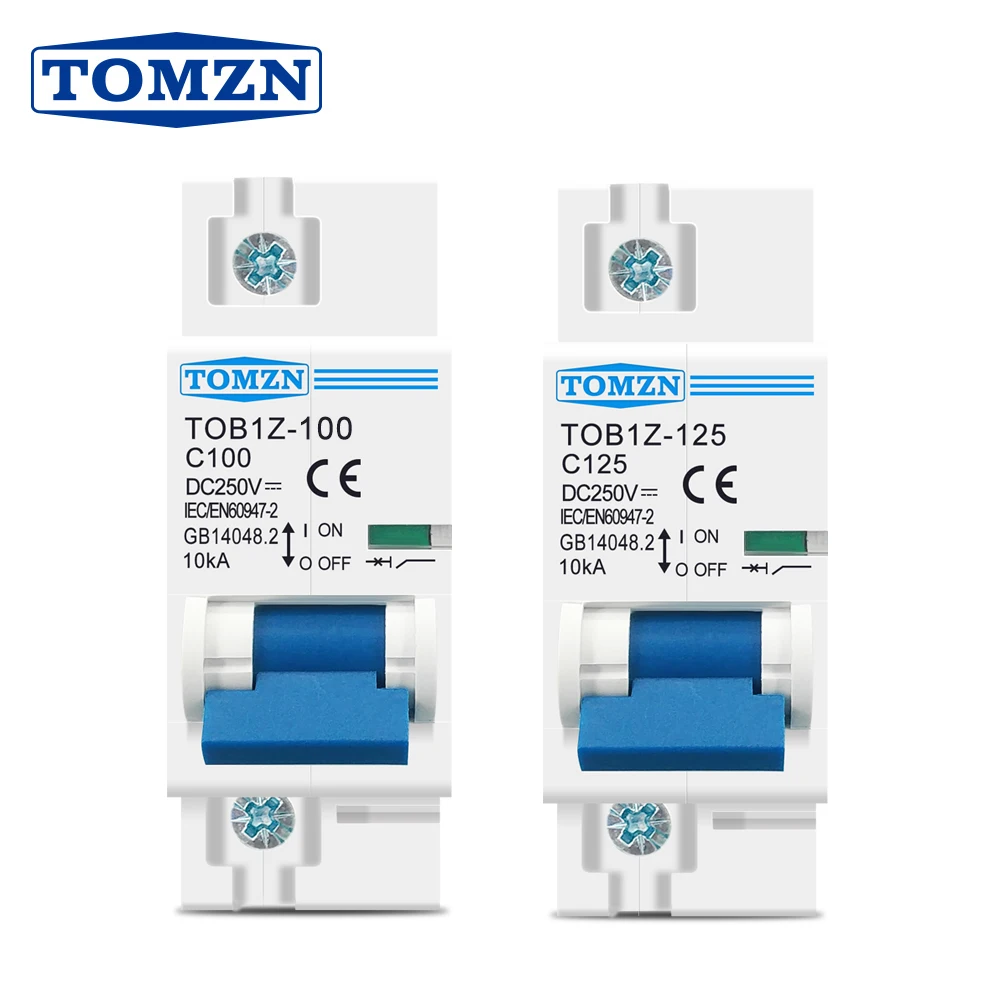
This breaker is rated for DC 250V, making it compatible with a wide range of common solar PV string configurations and battery voltages. Many residential and small commercial solar systems operate within this voltage range. Available in 80A, 100A, and 125A current ratings, it allows for precise sizing to match the specific current demands of different solar arrays or battery banks. Choosing the correct amperage is paramount. An undersized breaker will nuisance trip, while an oversized one may not offer adequate protection.
Unlike generic AC breakers, which are not designed to interrupt DC arcs effectively, this unit features internal mechanisms specifically engineered for DC current interruption. DC arcs are notoriously difficult to extinguish due to the lack of zero-crossing points in the waveform, which AC inherently provides. This specialized design ensures reliable and safe disconnection under fault conditions, a critical safety feature often overlooked by novices. The visual indicators on the front panel clearly show the ON/OFF status.
The C-curve tripping characteristic is a key feature for solar applications. This means the breaker will trip instantaneously when the current reaches 5 to 10 times its rated current. For solar systems, which can sometimes experience moderate inrush currents (e.g., when connecting to an inverter or charging controller), the C-curve provides a balance between nuisance tripping and fast fault isolation. It handles motor starts.
For example, if a 100A C-curve breaker is installed, it will trip immediately if the current exceeds 500A to 1000A. This characteristic is particularly beneficial when protecting circuits that might experience temporary current surges, such as those connected to inverters or charge controllers that draw higher current momentarily during startup. Standard B-curve breakers, designed for purely resistive loads, might trip prematurely in such scenarios, whereas D-curve breakers, for very high inrush loads, might be too slow for general solar protection. This breaker hits a sweet spot.
Ease of installation and the physical integrity of electrical components are crucial for long-term reliability. The TOMZN MCB performs well in these areas.
The breaker is designed for 35mm DIN rail mounting. This is the industry standard for electrical panel components, ensuring quick and secure installation into existing or new distribution Boards and enclosures. The robust plastic housing feels solid. Screw terminals provide secure connections for wiring.
The compact, single-pole form factor means it occupies minimal space within an electrical panel, a significant advantage where panel real estate is often at a premium. This efficiency in design allows for more components in a smaller footprint, or simply provides more breathing room for wiring, reducing clutter and improving heat dissipation. Wiring multiple strings becomes manageable.
Constructed from what appears to be a high-grade, fire-retardant plastic, the housing offers good mechanical protection and insulation. The visual inspection suggests precise molding. The blue toggle switch operates with a satisfying, firm click, indicating positive engagement and disengagement. This tactile feedback is important.
The product adheres to international standards like IEC60947-2 and GB14048.2, signifying that it has undergone rigorous testing for performance and safety. These certifications provide assurance that the breaker meets specific criteria for low-voltage switchgear and control gear, crucial for reliable operation in demanding PV environments. This compliance is not just a label; it represents a commitment to safety and functionality.
Integrating this breaker into a solar setup enhances both safety and operational efficiency. It simplifies system management.
For those building or expanding an off-grid solar system, this DC MCB is an indispensable component. Imagine powering a remote cabin or RV; reliable protection for your solar panels and battery bank is paramount. A single faulty panel or a short in the battery wiring could compromise the entire system without proper circuit isolation. This breaker provides that crucial isolation, allowing for quick identification and resolution of faults without affecting the rest of your power supply. It ensures continuous energy flow.
The ability to easily isolate a specific PV string or battery bank for maintenance or troubleshooting is a major benefit. Instead of having to disconnect entire sections of the system, a simple flip of the breaker switch allows for safe work on individual components. This reduces downtime and enhances the overall serviceability of the system. It's a small investment for significant peace of mind.
While a circuit breaker itself does not directly impact conversion efficiency, its reliable operation prevents conditions that *would* lead to efficiency losses. For instance, an undetected short circuit can cause excessive current draw, leading to voltage drops and power loss across the entire system. By promptly interrupting such faults, the breaker ensures the solar array and battery bank operate within their optimal parameters, maintaining peak efficiency. Minimal voltage drop across the breaker itself is also expected, ensuring power flows efficiently.
Furthermore, by protecting components from overcurrent damage, the breaker extends the lifespan of expensive equipment like charge controllers and inverters. Damaged components often operate inefficiently or fail entirely, necessitating costly replacements and system downtime. This breaker helps maintain system health.
While highly effective, careful consideration of system design is always necessary. This breaker excels in specific roles.
The single-pole design means that for multi-string PV arrays or higher voltage battery banks (e.g., 48V or more where multiple breakers might be needed for different poles), multiple units will be required. For instance, a common practice is to use one breaker per PV string for individual protection. While this adds to the component count, it also provides granular control and fault isolation for each string, which can be an advantage for larger systems. It offers flexibility.
For systems exceeding 250V DC, a higher voltage rated breaker would be necessary. This particular model is best suited for scenarios where the maximum open-circuit voltage of the PV array or the battery bank voltage does not exceed 250V DC. Always check your system's voltage requirements.
Verifying compatibility with existing solar setups is straightforward. This breaker integrates seamlessly into standard DC distribution boxes and combiner boxes. Its DIN rail mounting ensures universal fit. For hobbyists expanding an existing system, adding this breaker for a new string or battery bank provides an easy way to upgrade safety without extensive modifications. It's a simple addition.
The clear ON/OFF indicator and robust toggle make it easy to identify the status of each protected circuit, which is invaluable during system commissioning or troubleshooting. This visual clarity reduces potential errors during operation.
The TOMZN 1P DC MCB represents excellent value for money, especially considering its critical safety function in solar energy systems. At its price point, it offers robust protection that is essential for the longevity and safety of any DC electrical installation. This is not an area to cut corners. For anyone serious about building a reliable and safe solar power system, this breaker is a fundamental component. It delivers peace of mind. Imagine your solar panels diligently converting sunlight into power, your batteries storing that energy, and this compact device silently standing guard, ready to protect your entire investment from unexpected electrical faults. This breaker ensures your self-sustaining energy system operates safely and efficiently for years to come.
Essential Protection for DC Systems
Circuit breakers are non-negotiable in any electrical setup. They prevent catastrophic damage. This TOMZN unit provides a crucial line of defense.
The Core Function: Safeguarding Your Investment
The primary role of this 1P DC MCB is to interrupt the flow of current when an overload or short circuit occurs within a direct current (DC) system. This protection is vital for solar PV arrays, battery banks, and DC loads, preventing overheating, fire, and damage to expensive equipment. Imagine a scenario where a short circuit develops in a solar panel string; without proper overcurrent protection, the fault current could rapidly escalate, leading to cable meltdown or even a fire. This breaker acts as an automatic, resettable fuse, isolating the faulty section of the circuit. Its rapid response ensures system integrity.
Compared to traditional fuses, which require replacement after each trip, a circuit breaker offers the convenience of being reset, making troubleshooting and system restoration much simpler. This translates to less downtime and reduced operational costs over the lifespan of a solar installation. The ability to quickly restore power after a temporary fault is a significant operational advantage.
Engineering for Solar Demands
The design of the TOMZN DC MCB reflects a clear understanding of solar energy system requirements. It is built to handle the unique characteristics of DC power.
Voltage and Current Handling
This breaker is rated for DC 250V, making it compatible with a wide range of common solar PV string configurations and battery voltages. Many residential and small commercial solar systems operate within this voltage range. Available in 80A, 100A, and 125A current ratings, it allows for precise sizing to match the specific current demands of different solar arrays or battery banks. Choosing the correct amperage is paramount. An undersized breaker will nuisance trip, while an oversized one may not offer adequate protection.
Unlike generic AC breakers, which are not designed to interrupt DC arcs effectively, this unit features internal mechanisms specifically engineered for DC current interruption. DC arcs are notoriously difficult to extinguish due to the lack of zero-crossing points in the waveform, which AC inherently provides. This specialized design ensures reliable and safe disconnection under fault conditions, a critical safety feature often overlooked by novices. The visual indicators on the front panel clearly show the ON/OFF status.
Tripping Characteristics: The C-Curve Advantage
The C-curve tripping characteristic is a key feature for solar applications. This means the breaker will trip instantaneously when the current reaches 5 to 10 times its rated current. For solar systems, which can sometimes experience moderate inrush currents (e.g., when connecting to an inverter or charging controller), the C-curve provides a balance between nuisance tripping and fast fault isolation. It handles motor starts.
For example, if a 100A C-curve breaker is installed, it will trip immediately if the current exceeds 500A to 1000A. This characteristic is particularly beneficial when protecting circuits that might experience temporary current surges, such as those connected to inverters or charge controllers that draw higher current momentarily during startup. Standard B-curve breakers, designed for purely resistive loads, might trip prematurely in such scenarios, whereas D-curve breakers, for very high inrush loads, might be too slow for general solar protection. This breaker hits a sweet spot.
Installation and Build Quality
Ease of installation and the physical integrity of electrical components are crucial for long-term reliability. The TOMZN MCB performs well in these areas.
Streamlined Integration
The breaker is designed for 35mm DIN rail mounting. This is the industry standard for electrical panel components, ensuring quick and secure installation into existing or new distribution Boards and enclosures. The robust plastic housing feels solid. Screw terminals provide secure connections for wiring.
The compact, single-pole form factor means it occupies minimal space within an electrical panel, a significant advantage where panel real estate is often at a premium. This efficiency in design allows for more components in a smaller footprint, or simply provides more breathing room for wiring, reducing clutter and improving heat dissipation. Wiring multiple strings becomes manageable.
Durability and Compliance
Constructed from what appears to be a high-grade, fire-retardant plastic, the housing offers good mechanical protection and insulation. The visual inspection suggests precise molding. The blue toggle switch operates with a satisfying, firm click, indicating positive engagement and disengagement. This tactile feedback is important.
The product adheres to international standards like IEC60947-2 and GB14048.2, signifying that it has undergone rigorous testing for performance and safety. These certifications provide assurance that the breaker meets specific criteria for low-voltage switchgear and control gear, crucial for reliable operation in demanding PV environments. This compliance is not just a label; it represents a commitment to safety and functionality.
Real-World Application and Efficiency
Integrating this breaker into a solar setup enhances both safety and operational efficiency. It simplifies system management.
Protecting Your Off-Grid Aspirations
For those building or expanding an off-grid solar system, this DC MCB is an indispensable component. Imagine powering a remote cabin or RV; reliable protection for your solar panels and battery bank is paramount. A single faulty panel or a short in the battery wiring could compromise the entire system without proper circuit isolation. This breaker provides that crucial isolation, allowing for quick identification and resolution of faults without affecting the rest of your power supply. It ensures continuous energy flow.
The ability to easily isolate a specific PV string or battery bank for maintenance or troubleshooting is a major benefit. Instead of having to disconnect entire sections of the system, a simple flip of the breaker switch allows for safe work on individual components. This reduces downtime and enhances the overall serviceability of the system. It's a small investment for significant peace of mind.
Minimizing Efficiency Losses
While a circuit breaker itself does not directly impact conversion efficiency, its reliable operation prevents conditions that *would* lead to efficiency losses. For instance, an undetected short circuit can cause excessive current draw, leading to voltage drops and power loss across the entire system. By promptly interrupting such faults, the breaker ensures the solar array and battery bank operate within their optimal parameters, maintaining peak efficiency. Minimal voltage drop across the breaker itself is also expected, ensuring power flows efficiently.
Furthermore, by protecting components from overcurrent damage, the breaker extends the lifespan of expensive equipment like charge controllers and inverters. Damaged components often operate inefficiently or fail entirely, necessitating costly replacements and system downtime. This breaker helps maintain system health.
Considerations for System Design
While highly effective, careful consideration of system design is always necessary. This breaker excels in specific roles.
Single Pole Limitations
The single-pole design means that for multi-string PV arrays or higher voltage battery banks (e.g., 48V or more where multiple breakers might be needed for different poles), multiple units will be required. For instance, a common practice is to use one breaker per PV string for individual protection. While this adds to the component count, it also provides granular control and fault isolation for each string, which can be an advantage for larger systems. It offers flexibility.
For systems exceeding 250V DC, a higher voltage rated breaker would be necessary. This particular model is best suited for scenarios where the maximum open-circuit voltage of the PV array or the battery bank voltage does not exceed 250V DC. Always check your system's voltage requirements.
Integration with Existing Setups
Verifying compatibility with existing solar setups is straightforward. This breaker integrates seamlessly into standard DC distribution boxes and combiner boxes. Its DIN rail mounting ensures universal fit. For hobbyists expanding an existing system, adding this breaker for a new string or battery bank provides an easy way to upgrade safety without extensive modifications. It's a simple addition.
The clear ON/OFF indicator and robust toggle make it easy to identify the status of each protected circuit, which is invaluable during system commissioning or troubleshooting. This visual clarity reduces potential errors during operation.
The Verdict on Value
The TOMZN 1P DC MCB represents excellent value for money, especially considering its critical safety function in solar energy systems. At its price point, it offers robust protection that is essential for the longevity and safety of any DC electrical installation. This is not an area to cut corners. For anyone serious about building a reliable and safe solar power system, this breaker is a fundamental component. It delivers peace of mind. Imagine your solar panels diligently converting sunlight into power, your batteries storing that energy, and this compact device silently standing guard, ready to protect your entire investment from unexpected electrical faults. This breaker ensures your self-sustaining energy system operates safely and efficiently for years to come.