TOMZN TPNL DPNL Residual Current Breaker
Official Store Deal
Expert Analysis Overview
The TOMZN TPNL DPNL Residual Current Breaker is a critical safety component, integrating multiple protection mechanisms into a single unit for single-phase 230V electrical systems. This device serves as a guardian for both electrical installations and human safety, meticulously engineered to detect and interrupt hazardous conditions. Its compact form factor belies its comprehensive capabilities, offering a streamlined solution for modern electrical panels. The design prioritizes immediate fault detection.
This breaker combines overcurrent protection, short-circuit protection, and residual current (earth leakage) protection within a single 1P+N module. The integration of these three critical safety functions simplifies circuit design and reduces the physical footprint required in consumer units or distribution Boards. Each function operates independently yet synergistically to provide a robust safety net.
Overcurrent protection, often associated with Miniature Circuit Breakers (MCBs), safeguards wiring and connected appliances from damage due to sustained loads exceeding their rated capacity. When an appliance draws too much current for an extended period, the internal thermal mechanism of the breaker heats up and trips, preventing insulation degradation and potential fires. This prevents costly equipment failures.
Short-circuit protection, also an MCB function, acts with extreme rapidity to interrupt massive fault currents that occur when live and neutral (or live and earth) conductors make direct contact. The electromagnetic trip unit within the breaker reacts almost instantaneously, breaking the circuit before destructive energy can be released. This rapid response is crucial for preventing severe damage to the electrical system and mitigating arc flash hazards. Compared to older fuse-based systems, this offers immediate reset capability.
Residual current protection, the hallmark of Residual Current Devices (RCDs) or Residual Current Circuit Breakers with Overcurrent protection (RCBOs), detects imbalances between the current flowing into a circuit and the current flowing out. A difference, typically 30mA for human protection, indicates current leaking to earth, often through a person. The device trips in less than 0.1 seconds, a timeframe critical for preventing fatal electric shocks. This sensitivity is paramount. Unlike standard MCBs, which only protect against overloads and short circuits, the TPNL DPNL adds this vital layer of personal safety.
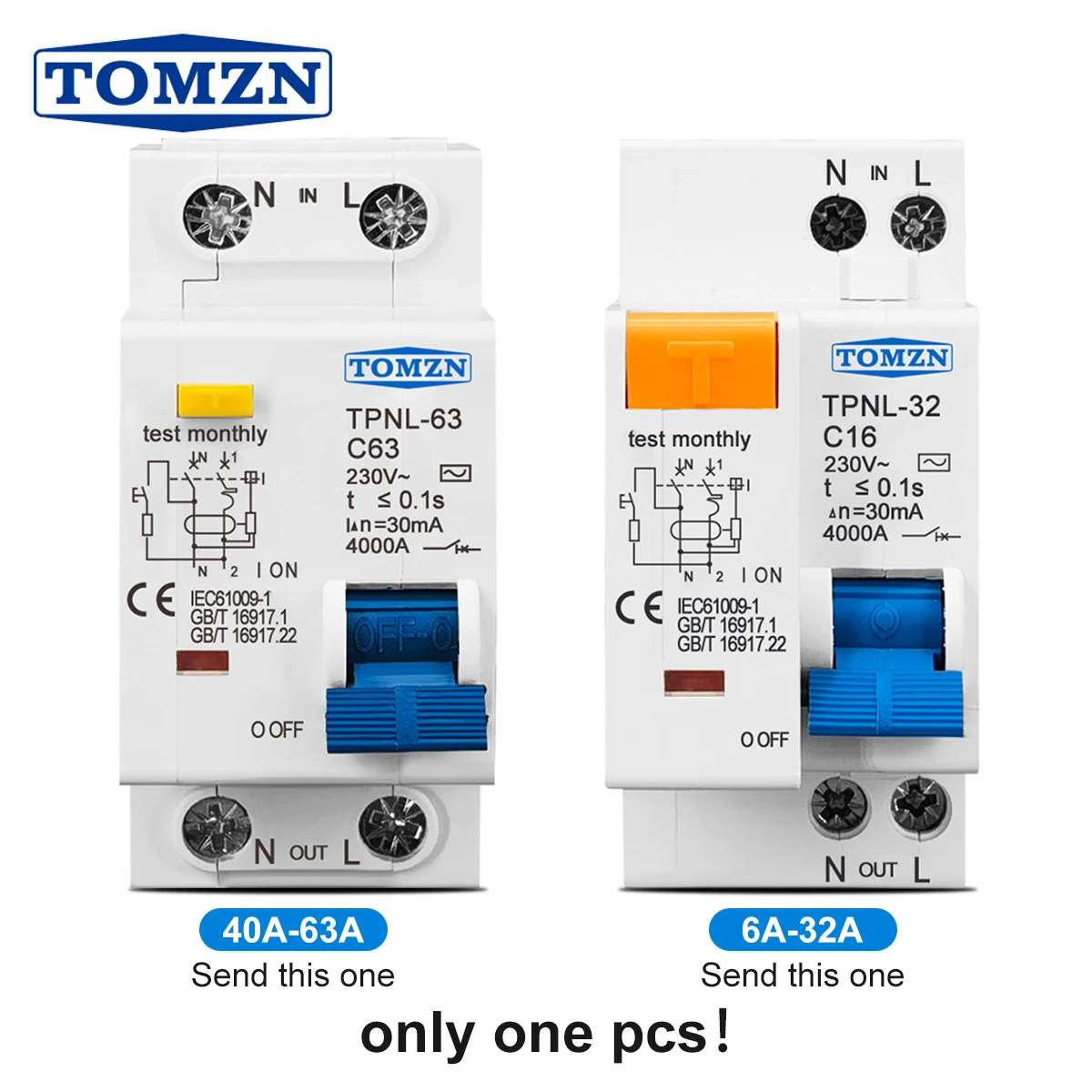
The external housing of the TOMZN TPNL DPNL breaker presents a clean, matte white plastic finish, indicating a focus on functional aesthetics and insulation properties. The tactile feedback from the blue operating lever is firm, providing a distinct click when switched between the "ON" and "OFF" positions. This ensures positive engagement. The yellow "test monthly" button, prominently positioned, allows for easy verification of the residual current device's integrity.
Internally, the precision of the trip mechanisms dictates the device's reliability. The thermal and magnetic trip units for overcurrent and short-circuit protection must operate within tight tolerances, ensuring that nuisance tripping is minimized while genuine faults are swiftly addressed. The residual current detection coil, a critical component, requires meticulous winding and calibration to accurately sense minute current imbalances. Poorly manufactured coils can lead to either false trips or, worse, a failure to trip during a genuine leakage event.
Compared to generic circuit breakers that may prioritize cost over consistent performance, the TOMZN unit appears to adhere to recognized international standards like IEC61009-1. This adherence suggests a commitment to consistent manufacturing quality and predictable operational characteristics. The robust construction is evident. The terminal screws, visible in the imagery, appear substantial enough to secure wiring effectively, a common point of failure in lesser quality components where loose connections can lead to overheating and arcing.
Installation is designed for standard 35mm DIN rail mounting, a universal standard in electrical distribution panels. This ensures compatibility with existing infrastructure, making upgrades or new installations straightforward. The input terminals are clearly marked "N" and "L" at the top, with corresponding "N out" and "L" at the bottom, facilitating intuitive and correct wiring. Up-side input simplifies wiring.
The visual indicator windows provide immediate feedback on the breaker's status. A white window signifies an open circuit, indicating the breaker has tripped or is manually switched off. Conversely, a red window confirms a closed circuit, meaning power is flowing. This clear visual cue is invaluable for rapid fault identification and troubleshooting, reducing downtime during electrical issues. Users can quickly assess circuit status.
Unlike older circuit protection methods that might require a multimeter to confirm circuit continuity after a trip, these indicators offer instant visual confirmation. The "test monthly" button is a critical user interface element. Regular activation confirms the RCD portion of the breaker is functioning correctly, a vital maintenance step for ensuring ongoing personal safety. This simple action provides peace of mind.
The rated short-circuit breaking capacity (Icn) of 4000A is a significant specification. This value indicates the maximum fault current the breaker can safely interrupt without sustaining damage itself. For typical residential and light commercial applications, 4000A is generally sufficient to handle prospective fault currents. Exceeding this rating could result in breaker failure, leading to more extensive system damage.
The tripping time of less than 0.1 seconds for residual current detection is crucial for human safety. The human body can withstand a 30mA current for only a very short duration before serious physiological effects occur. A trip time faster than 100 milliseconds significantly reduces the risk of ventricular fibrillation or other severe injuries. This rapid response is non-negotiable.
The availability of various current ratings (6A to 63A) across the TPNL-32 and TPNL-63 models allows for precise matching to specific circuit loads. Using an appropriately rated breaker prevents both nuisance tripping on normal loads and inadequate protection for heavier circuits. For example, a 16A breaker is suitable for general-purpose outlets, while a 63A unit might protect a main incoming supply or a high-power appliance circuit. This ensures optimal system performance.
Investing in a combined RCBO like the TOMZN TPNL DPNL represents a strategic decision for long-term electrical system integrity. By integrating multiple protection types into one device, it streamlines panel layouts and potentially reduces overall installation costs compared to separate MCB and RCD units. This consolidation simplifies maintenance.
The cost-effectiveness of this unit, especially when considering the critical safety functions it provides, positions it as a compelling upgrade from basic MCBs. It offers a superior level of protection without a prohibitive price point, making advanced safety accessible for a broader range of applications. This translates to significant return on investment in terms of safety and avoided repair costs. Unlike older installations that might rely solely on fuses or basic MCBs, this device actively monitors for dangerous earth leakage, a silent killer that traditional breakers often miss.
Ensuring clean signal transmission and long-term reliability of connections is paramount in any electrical setup. The robust terminal design and adherence to standards contribute directly to this. Loose connections are a primary cause of intermittent faults and heat buildup, leading to system degradation over time. This breaker mitigates such risks.
Adherence to standards such as IEC61009-1, GB16917.1, and GB16917.22 signifies that the TOMZN TPNL DPNL has undergone rigorous testing. These standards define the performance and safety requirements for Residual Current Operated Circuit-Breakers with Integral Overcurrent Protection (RCBOs) for household and similar uses. Compliance ensures the device meets specific criteria for electrical safety, operational reliability, and environmental resilience. This provides user confidence.
The "CE" marking, visible on the device, further indicates conformity with health, safety, and environmental protection standards for products sold within the European Economic Area. While this product originates from a different market, its design principles align with global safety expectations. Such certifications are not merely labels; they represent a commitment to engineering practices that prioritize user safety.
Imagine the peace of mind knowing your home or workshop is protected by a device specifically designed to guard against the most common and dangerous electrical faults. Picture a scenario where a faulty appliance develops an earth leakage, and within milliseconds, the power is cut, preventing potential injury or fire. This breaker delivers that assurance. The TOMZN TPNL DPNL Residual Current Breaker is not just another component; it is an active sentinel, constantly monitoring your electrical environment. Its integrated design and adherence to safety standards make it an intelligent choice for anyone seeking to enhance the safety and reliability of their 230V single-phase electrical circuits. This is a smart investment.
Unified Protection Philosophy
This breaker combines overcurrent protection, short-circuit protection, and residual current (earth leakage) protection within a single 1P+N module. The integration of these three critical safety functions simplifies circuit design and reduces the physical footprint required in consumer units or distribution Boards. Each function operates independently yet synergistically to provide a robust safety net.
Overcurrent protection, often associated with Miniature Circuit Breakers (MCBs), safeguards wiring and connected appliances from damage due to sustained loads exceeding their rated capacity. When an appliance draws too much current for an extended period, the internal thermal mechanism of the breaker heats up and trips, preventing insulation degradation and potential fires. This prevents costly equipment failures.
Short-circuit protection, also an MCB function, acts with extreme rapidity to interrupt massive fault currents that occur when live and neutral (or live and earth) conductors make direct contact. The electromagnetic trip unit within the breaker reacts almost instantaneously, breaking the circuit before destructive energy can be released. This rapid response is crucial for preventing severe damage to the electrical system and mitigating arc flash hazards. Compared to older fuse-based systems, this offers immediate reset capability.
Residual current protection, the hallmark of Residual Current Devices (RCDs) or Residual Current Circuit Breakers with Overcurrent protection (RCBOs), detects imbalances between the current flowing into a circuit and the current flowing out. A difference, typically 30mA for human protection, indicates current leaking to earth, often through a person. The device trips in less than 0.1 seconds, a timeframe critical for preventing fatal electric shocks. This sensitivity is paramount. Unlike standard MCBs, which only protect against overloads and short circuits, the TPNL DPNL adds this vital layer of personal safety.
Precision Engineering and Durability
The external housing of the TOMZN TPNL DPNL breaker presents a clean, matte white plastic finish, indicating a focus on functional aesthetics and insulation properties. The tactile feedback from the blue operating lever is firm, providing a distinct click when switched between the "ON" and "OFF" positions. This ensures positive engagement. The yellow "test monthly" button, prominently positioned, allows for easy verification of the residual current device's integrity.
Internally, the precision of the trip mechanisms dictates the device's reliability. The thermal and magnetic trip units for overcurrent and short-circuit protection must operate within tight tolerances, ensuring that nuisance tripping is minimized while genuine faults are swiftly addressed. The residual current detection coil, a critical component, requires meticulous winding and calibration to accurately sense minute current imbalances. Poorly manufactured coils can lead to either false trips or, worse, a failure to trip during a genuine leakage event.
Compared to generic circuit breakers that may prioritize cost over consistent performance, the TOMZN unit appears to adhere to recognized international standards like IEC61009-1. This adherence suggests a commitment to consistent manufacturing quality and predictable operational characteristics. The robust construction is evident. The terminal screws, visible in the imagery, appear substantial enough to secure wiring effectively, a common point of failure in lesser quality components where loose connections can lead to overheating and arcing.
Seamless Integration and User Feedback
Installation is designed for standard 35mm DIN rail mounting, a universal standard in electrical distribution panels. This ensures compatibility with existing infrastructure, making upgrades or new installations straightforward. The input terminals are clearly marked "N" and "L" at the top, with corresponding "N out" and "L" at the bottom, facilitating intuitive and correct wiring. Up-side input simplifies wiring.
The visual indicator windows provide immediate feedback on the breaker's status. A white window signifies an open circuit, indicating the breaker has tripped or is manually switched off. Conversely, a red window confirms a closed circuit, meaning power is flowing. This clear visual cue is invaluable for rapid fault identification and troubleshooting, reducing downtime during electrical issues. Users can quickly assess circuit status.
Unlike older circuit protection methods that might require a multimeter to confirm circuit continuity after a trip, these indicators offer instant visual confirmation. The "test monthly" button is a critical user interface element. Regular activation confirms the RCD portion of the breaker is functioning correctly, a vital maintenance step for ensuring ongoing personal safety. This simple action provides peace of mind.
Performance Under Electrical Stress
The rated short-circuit breaking capacity (Icn) of 4000A is a significant specification. This value indicates the maximum fault current the breaker can safely interrupt without sustaining damage itself. For typical residential and light commercial applications, 4000A is generally sufficient to handle prospective fault currents. Exceeding this rating could result in breaker failure, leading to more extensive system damage.
The tripping time of less than 0.1 seconds for residual current detection is crucial for human safety. The human body can withstand a 30mA current for only a very short duration before serious physiological effects occur. A trip time faster than 100 milliseconds significantly reduces the risk of ventricular fibrillation or other severe injuries. This rapid response is non-negotiable.
The availability of various current ratings (6A to 63A) across the TPNL-32 and TPNL-63 models allows for precise matching to specific circuit loads. Using an appropriately rated breaker prevents both nuisance tripping on normal loads and inadequate protection for heavier circuits. For example, a 16A breaker is suitable for general-purpose outlets, while a 63A unit might protect a main incoming supply or a high-power appliance circuit. This ensures optimal system performance.
Value in Electrical System Integrity
Investing in a combined RCBO like the TOMZN TPNL DPNL represents a strategic decision for long-term electrical system integrity. By integrating multiple protection types into one device, it streamlines panel layouts and potentially reduces overall installation costs compared to separate MCB and RCD units. This consolidation simplifies maintenance.
The cost-effectiveness of this unit, especially when considering the critical safety functions it provides, positions it as a compelling upgrade from basic MCBs. It offers a superior level of protection without a prohibitive price point, making advanced safety accessible for a broader range of applications. This translates to significant return on investment in terms of safety and avoided repair costs. Unlike older installations that might rely solely on fuses or basic MCBs, this device actively monitors for dangerous earth leakage, a silent killer that traditional breakers often miss.
Ensuring clean signal transmission and long-term reliability of connections is paramount in any electrical setup. The robust terminal design and adherence to standards contribute directly to this. Loose connections are a primary cause of intermittent faults and heat buildup, leading to system degradation over time. This breaker mitigates such risks.
Regulatory Compliance
Adherence to standards such as IEC61009-1, GB16917.1, and GB16917.22 signifies that the TOMZN TPNL DPNL has undergone rigorous testing. These standards define the performance and safety requirements for Residual Current Operated Circuit-Breakers with Integral Overcurrent Protection (RCBOs) for household and similar uses. Compliance ensures the device meets specific criteria for electrical safety, operational reliability, and environmental resilience. This provides user confidence.
The "CE" marking, visible on the device, further indicates conformity with health, safety, and environmental protection standards for products sold within the European Economic Area. While this product originates from a different market, its design principles align with global safety expectations. Such certifications are not merely labels; they represent a commitment to engineering practices that prioritize user safety.
Concluding Perspective
Imagine the peace of mind knowing your home or workshop is protected by a device specifically designed to guard against the most common and dangerous electrical faults. Picture a scenario where a faulty appliance develops an earth leakage, and within milliseconds, the power is cut, preventing potential injury or fire. This breaker delivers that assurance. The TOMZN TPNL DPNL Residual Current Breaker is not just another component; it is an active sentinel, constantly monitoring your electrical environment. Its integrated design and adherence to safety standards make it an intelligent choice for anyone seeking to enhance the safety and reliability of their 230V single-phase electrical circuits. This is a smart investment.