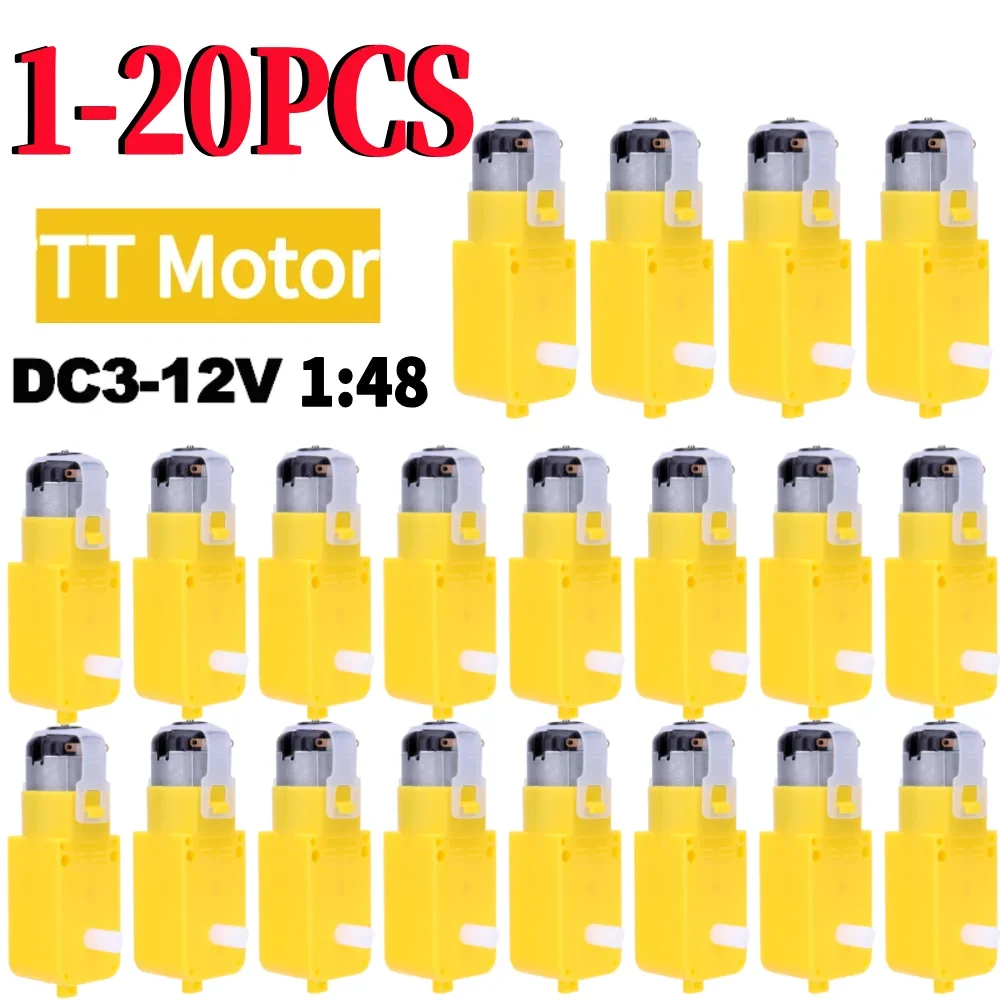
TT Motor Dual Shaft Geared Motor DC 3-12V 1:48 for DIY Robotics
Official Store Deal
Expert Analysis Overview
Precision Engineering for Hobbyist Robotics
The TT Motor Dual Shaft Geared Motor is a foundational component for hobbyist robotics and educational projects, offering a balanced blend of accessible voltage requirements and a practical gear ratio. This motor is specifically engineered for low-voltage direct current (DC) applications, making it ideal for battery-powered systems where safety and efficiency are paramount. Its design prioritizes ease of integration into various DIY platforms, from smart cars to small robotic arms, providing a reliable power source for motion control.
Electrical Integrity and Power Delivery
Operating within a DC 3-12V range, this motor accommodates common power sources found in hobby electronics. The voltage flexibility allows for diverse project requirements, from a simple 3V battery pack for basic movement to a 12V supply for increased torque and speed. Proper voltage selection is critical; exceeding the maximum rated voltage can lead to premature motor failure and potential overheating, posing a significant electrical hazard. The motor's internal windings are designed for this specific voltage envelope, ensuring optimal performance and longevity when operated within its specified parameters.
When integrating this motor, careful attention to the power supply's current capacity is essential. A power source incapable of delivering the necessary current under load will result in sluggish performance or complete operational failure. For instance, a 9V battery, while providing sufficient voltage, may lack the sustained current output required for continuous operation, especially when the motor encounters resistance. Always verify the power supply's amperage rating to prevent brownouts or damage to both the motor and the power source. This ensures the motor receives a stable and consistent power flow, crucial for predictable robotic movement.
Compared to generic un-geared DC motors, the integrated gearbox of the TT motor significantly enhances its utility. Un-geared motors often require external gearing mechanisms to achieve usable torque at lower speeds, adding complexity and bulk to a project. This integrated solution streamlines the design process, reducing the need for additional mechanical components and simplifying assembly. The gearbox itself is a critical element, translating high-speed, low-torque motor output into lower-speed, higher-torque output, which is precisely what most mobile robotic platforms require for effective locomotion.
Mechanical Design and Durability
The motor features a robust plastic housing, providing adequate protection for the internal gearing and motor components. The yellow casing is visually distinct. This plastic construction contributes to the motor's lightweight profile, a significant advantage in mobile robotics where overall mass directly impacts battery life and maneuverability. The housing is securely fastened, indicating a design intended for repeated use and minor impacts typical in educational or hobby environments. The visible screws suggest a degree of serviceability, allowing for potential inspection or maintenance of the gearbox if required.
The dual shaft design is a key differentiator, offering versatility for various mechanical linkages. One shaft typically connects to a wheel or drive mechanism, while the other can be used for encoder feedback, additional mechanical attachments, or simply as a pass-through. This dual output capability simplifies complex drive systems, eliminating the need for additional coupling components or custom shaft extensions. The shafts themselves appear to be standard diameter, ensuring compatibility with a wide range of off-the-shelf wheels and couplers.
Unlike many open-frame motors, the TT motor's enclosed gearbox protects the gears from dust and debris. This sealed environment is crucial for maintaining the integrity of the gear train, preventing foreign particles from interfering with smooth operation or causing premature wear. The gear ratio of 1:48 is a common standard in hobby robotics, providing a good balance between speed and torque for small to medium-sized robots. This ratio means that for every 48 rotations of the motor's armature, the output shaft completes one rotation, effectively multiplying the motor's torque by a factor of 48 (minus efficiency losses).
Integration and Application Versatility
This motor is a staple for DIY smart car robots. Its compact dimensions allow for easy mounting on chassis plates. The standardized mounting holes facilitate quick and secure attachment, reducing fabrication time. Imagine designing a line-following robot; the precise, controlled movement offered by these geared motors is indispensable for accurate navigation. The consistent output speed across multiple units ensures symmetrical movement for differential drive systems.
For educational settings, these motors are invaluable. Students can quickly assemble and test prototypes. The low voltage operation minimizes safety risks during experimentation. Picture a classroom project where students are tasked with building a simple obstacle-avoiding robot; these motors provide the fundamental propulsion system, allowing students to focus on programming and sensor integration rather than complex mechanical design. Their widespread availability and affordability make them an excellent choice for bulk purchases in educational kits.
Compared to stepper motors, which offer precise positional control but require more complex driver circuitry, these DC geared motors provide continuous rotation with simpler control. While they may not offer the same level of absolute positioning accuracy as a stepper, their ease of use and cost-effectiveness make them superior for applications requiring continuous motion, such as driving wheels. The simplicity of control—often just a H-bridge driver—reduces the barrier to entry for beginners in robotics.
Electrical Safety and Best Practices
As a Certified Electrician, the importance of proper wiring cannot be overstated. When connecting these motors, always use appropriate wire gauges for the anticipated current draw. Undersized wires can overheat, leading to insulation breakdown and potential fire hazards. While these motors operate at low voltages, the principles of electrical safety remain paramount. Ensure all connections are secure and insulated to prevent accidental short circuits, which can damage the motor, power supply, or even cause battery fires.
Terminal quality is another critical aspect. The motor's terminals, while small, must provide a reliable electrical connection. Soldering connections directly to the motor terminals is often the most secure method, but if using crimp connectors, ensure they are properly sized and crimped to achieve a low-resistance connection. Loose or corroded terminals introduce resistance, leading to voltage drop and heat generation, which degrades performance and poses a safety risk. Regularly inspect connections for signs of wear or corrosion, especially in projects that experience vibration or frequent handling.
Compliance with safety standards, even for low-voltage components, is a best practice. While these motors may not carry specific UL or CE ratings for individual sale, the overall design of the robotic project should consider these standards. For instance, ensuring that battery compartments are properly ventilated and that wiring is routed away from moving parts or sharp edges contributes to the project's overall safety profile. The inherent low voltage of these motors makes them relatively safe, but good electrical practices are always necessary to prevent unforeseen issues.
The Driving Force for Your Next Creation
This TT Motor Dual Shaft Geared Motor provides a reliable and accessible solution for a wide array of DIY robotics and educational projects. Its robust plastic construction, versatile dual shaft design, and practical 1:48 gear ratio make it an excellent choice for hobbyists and educators alike. The motor's compatibility with common DC 3-12V power sources simplifies integration, while its integrated gearbox eliminates the need for complex external gearing. By adhering to sound electrical practices—such as using appropriate wire gauges and ensuring secure connections—users can maximize the motor's performance and longevity while maintaining a safe operating environment. Imagine the satisfaction of seeing your custom-built robot navigate a complex maze, powered by these dependable units, or the excitement of students as their first autonomous vehicle comes to life. This motor is not just a component; it is the driving force behind countless innovative possibilities, enabling creators to bring their robotic visions to fruition with confidence and precision.