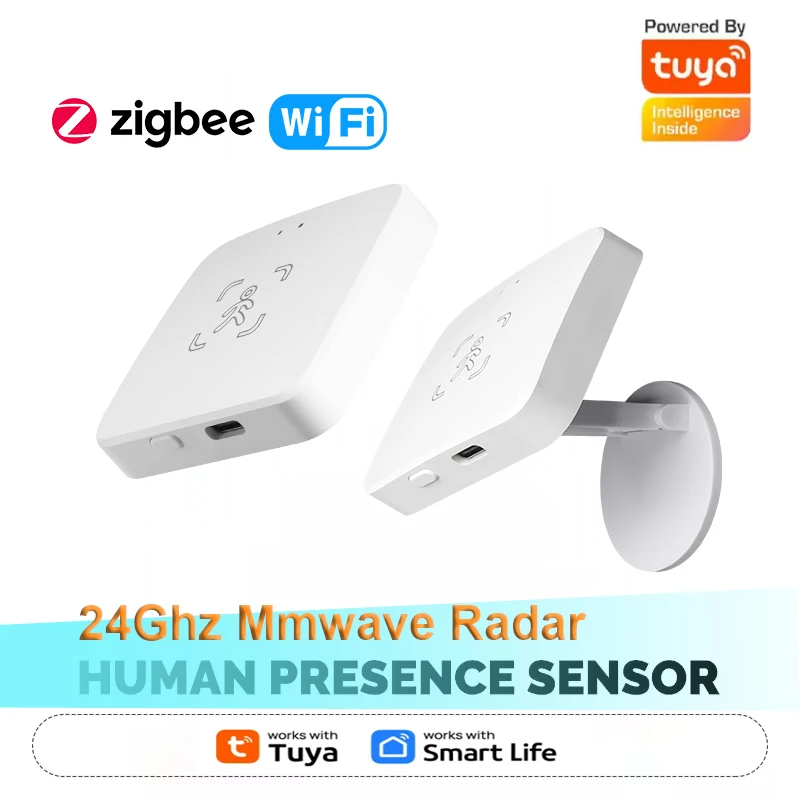
Tuya 24GHz mmWave Human Presence Sensor (Zigbee/WiFi)
Official Store Deal
Expert Analysis Overview
The Unblinking Eye of Automation
The Tuya 24GHz mmWave Human Presence Sensor is a smart home essential designed for users demanding precise, hands-free automation and seamless voice control integration. This device elevates traditional motion sensing by detecting subtle human presence, not just movement, preventing those frustrating moments where lights turn off while you are still in the room. It is a critical upgrade for any smart home aiming for true convenience.
The Radar's Keen Eye
At its core, the sensor utilizes advanced 24GHz mmWave radar technology. This radar operates by emitting continuous millimeter waves and analyzing their reflections. The sensor detects minute changes in these wave patterns caused by breathing, heartbeats, or even the slightest fidgeting. This sophisticated method ensures detection even when occupants are stationary, a significant limitation of older Passive Infrared (PIR) sensors.
Unlike conventional motion detectors that often fail to register a motionless individual, this mmWave radar provides consistent presence information. It means lights, climate control, or entertainment systems can remain active as long as a person is within the detection zone. Such precision is paramount for a truly responsive smart home experience.
The implications for a voice-controlled environment are substantial. Imagine never having to tell your voice assistant, "Alexa, turn the lights back on, I'm still here." The sensor handles it. This proactive detection capability eliminates common smart home annoyances, making automation feel intuitive. It's a fundamental step towards a truly autonomous living space.
The Network Nexus: Zigbee or Wi-Fi
The sensor offers two distinct connectivity versions: Wi-Fi and Zigbee. The Wi-Fi version connects directly to your home router, offering simplicity for those without an existing smart home hub. This direct connection simplifies initial setup, requiring no additional bridge hardware.
Conversely, the Zigbee version requires a Zigbee gateway (hub) to function. While this adds an extra component to the setup, Zigbee connectivity often provides a more robust and energy-efficient mesh network for smart home devices. Mesh networks extend the range and reliability of connected devices, crucial for larger homes or those with many smart gadgets. A hub provides a centralized control point.
Choosing between Wi-Fi and Zigbee depends on an existing smart home infrastructure. For a nascent smart home, Wi-Fi offers a lower barrier to entry. For an established system with multiple Zigbee devices, the Zigbee variant integrates seamlessly, leveraging the existing mesh network's stability. Both versions integrate with the Tuya and Smart Life applications, ensuring broad compatibility with a vast ecosystem of smart devices.
Orchestrating the Smart Home
Integration with the Tuya and Smart Life apps is a major selling point. These platforms allow for comprehensive control and automation of the sensor's functions. Users can adjust detection sensitivity, set up custom scenes, and link the sensor to other smart devices within their home ecosystem. This deep integration is key.
One of the most compelling applications is its ability to work with smart light switches. The sensor can automatically trigger lights when presence is detected and turn them off when a room becomes vacant. This eliminates the need for physical switches, offering true hands-free operation. For voice control enthusiasts, this means fewer direct commands; the environment adapts automatically.
The sensor also features luminance detection, adding another layer of intelligence to automation routines. It can sense ambient light levels, allowing for more nuanced control over lighting. For example, lights might only activate upon presence detection if the room's natural light falls below a certain threshold. This conserves energy and tailors lighting to actual needs.
Imagine walking into a room. Lights automatically adjust to the perfect brightness. This level of automation is what smart homes strive for. Voice commands can then be used for fine-tuning, rather than basic on/off functions. It makes the home feel alive and responsive.
Precision in Placement and Reach
The device boasts a 90-degree detection angle for both side and down views, coupled with an impressive 10-meter detection distance. This wide coverage ensures that a single sensor can effectively monitor a substantial area, such as a living room or office space. The broad angle minimizes blind spots.
Such a detection range and angle are superior to many standard motion sensors, which often have narrower fields of view or shorter effective distances. The ability to monitor a 10-meter radius means fewer sensors are needed to cover larger rooms. This translates to cost savings and a simpler installation process.
For voice control, this extended reach is beneficial. A user entering a large room can trigger a welcome scene before reaching the center, allowing voice commands to be issued in an already prepared environment. It ensures the home reacts promptly, enhancing the perception of intelligent design. The sensor acts as a vigilant guardian.
The Power of Multi-Scene Linkage
The concept of "Linkage for multi scene" is where this sensor truly shines for the voice control fanatic. It enables intelligent automation scenarios that go beyond simple on/off commands. For instance, the sensor can be linked with smart lights to adjust brightness based on presence and ambient light levels. If a user is present in a study room and the light dims, the smart bulb can automatically brighten to protect their eyes. This proactive adjustment enhances comfort.
This capability empowers users to create sophisticated routines that respond to their presence and environmental conditions. It means less manual intervention and more reliance on the home's automated intelligence. Voice commands can then be used for overriding or initiating complex scenes, rather than managing basic device states. It's about sophisticated automation.
Compared to basic motion sensors that only offer binary states (motion/no motion), this sensor's ability to detect continuous presence and luminance allows for a much richer set of automation possibilities. This depth of control is what truly differentiates a smart home from a merely connected one. It offers a truly personalized experience.
Simplicity in Command
APP control is designed to be simple and easy to operate. The intuitive interface allows users to quickly configure settings, monitor device status, and create automation rules. This user-friendly design ensures that even those new to smart home technology can harness the sensor's full potential. A simple interface is key.
For the voice control enthusiast, a well-designed app is crucial for setting up the underlying logic that voice commands will trigger. Creating complex scenes or adjusting sensitivity is straightforward, ensuring that subsequent voice interactions are seamless and effective. It's the foundation for voice mastery.
This ease of use contrasts sharply with more complex or proprietary smart home systems that often require extensive technical knowledge. The Tuya/Smart Life platform provides a standardized and accessible way to manage smart devices, democratizing advanced home automation. Setup is quick and painless.
The Unseen Hand of Automation
This 24GHz mmWave human presence sensor represents a significant leap forward in smart home automation. Its ability to detect subtle human presence, combined with luminance sensing and broad app compatibility, makes it an indispensable tool for creating a truly intelligent living space. The choice between Wi-Fi and Zigbee offers flexibility for various home network setups. For those who value a home that anticipates their needs and responds without explicit commands, this sensor is a powerful ally.
Imagine a home where your environment adjusts to you effortlessly. Lights come on as you enter, dimming when natural light is abundant. Climate control adjusts based on occupancy, saving energy when rooms are vacant. Your voice commands become less about basic control and more about orchestrating comfort and convenience. This sensor brings that vision closer to reality, transforming a house into a truly responsive, intelligent sanctuary. It simply works, allowing you to relax.