Tuya Smart Life Multi-Mode Smart Home Gateway
Official Store Deal
Expert Analysis Overview
The Tuya Smart Life Multi-mode Gateway is a crucial connectivity hub engineered for expanding smart home ecosystems with seamless multi-protocol integration. This compact device serves as the central nervous system for a diverse array of smart devices, unifying Wi-Fi, Bluetooth Mesh, and Zigbee protocols under a single, cohesive control interface. Its design addresses the common fragmentation issues prevalent in modern smart homes, where users often find themselves juggling multiple apps and hubs for different device types. This gateway consolidates that complexity, offering a streamlined approach to home automation that is both powerful and user-friendly. It's a small device, easily integrated into any decor. The matte white plastic finish suggests durability without drawing undue attention.
The most significant advantage of this gateway lies in its multi-protocol support. It acts as a bridge for 2.4G Wi-Fi, Bluetooth Mesh, and Zigbee 3.0 devices. This triple-threat capability means users no longer need separate hubs for their Zigbee sensors, Bluetooth-enabled smart locks, and Wi-Fi smart plugs. All these disparate technologies can communicate through one central point. This simplifies installation. For example, a home might feature Zigbee door/window sensors, Bluetooth temperature sensors, and Wi-Fi smart lights; this gateway brings them all into a single network.
Consider a scenario where a traditional smart home setup requires a dedicated Zigbee hub for lighting, another hub for Bluetooth-enabled security devices, and then relies on the main Wi-Fi router for general smart plugs. This creates network congestion and management overhead. This multi-mode gateway eliminates that redundancy, consolidating communication paths and freeing up valuable network resources. Compared to single-protocol gateways, this unit offers a dramatic reduction in physical Hardware and simplifies the overall network topology. Its ability to manage multiple protocols concurrently also enhances the reliability of the smart home network, as it can intelligently route commands and data.
This gateway supports a broad spectrum of Tuya and Smart Life compatible devices. This includes common smart home components such as door/window sensors, PIR motion sensors, flood sensors, smart plugs, light switches, smart bulbs, and humidity sensors. The extensive compatibility means users are not locked into a single brand or ecosystem for their peripheral devices. The device works with countless sensors.
Imagine setting up a new smart home or upgrading an existing one. Instead of meticulously checking each device's protocol and ensuring it matches an existing hub, this gateway provides a universal connection point for the most common low-power wireless standards. This flexibility allows for greater choice in smart home device selection, often leading to more cost-effective solutions without sacrificing functionality. Unlike older, proprietary hubs that limited device selection to a single manufacturer, this gateway opens up the entire Tuya/Smart Life ecosystem, which is one of the largest and most diverse in the smart home market.
Control of the smart home ecosystem is primarily managed through the Tuya Smart Life app, available on both Android and iOS platforms. This intuitive application allows users to add devices, create smart groups, and configure intricate smart scenes and automations. The app interface is clean and straightforward, making device management accessible even for those new to smart home technology. The app provides a centralized dashboard.
Remote control capabilities are a core feature, enabling users to manage their smart devices from anywhere with an internet connection. This means adjusting lighting, checking sensor status, or activating security features even when away from home. The convenience of remote access is paramount for modern lifestyles, offering peace of mind and energy efficiency. Compared to basic Wi-Fi-only devices that might struggle with complex scene creation, the gateway's ability to orchestrate multiple protocols through the app enables far more sophisticated and responsive automations.
For hands-free operation, the gateway integrates seamlessly with popular voice assistants, including Amazon Alexa and Google Assistant. This allows users to control connected devices using simple voice commands, enhancing convenience and accessibility. Imagine dimming the lights or locking the doors with just your voice. Voice control offers a natural interaction.
This integration means a user can issue a command like "Alexa, turn on the living room light" or "Hey Google, set the thermostat to 22 degrees," and the gateway translates this into the appropriate Zigbee or Bluetooth command for the respective device. This eliminates the need to physically interact with switches or open an app, providing a truly smart and responsive home experience. The voice control functionality elevates the user experience beyond basic app control, placing this gateway on par with more expensive, dedicated smart home controllers in terms of usability.
Performance is critical for a responsive smart home. The gateway's ability to manage Zigbee and Bluetooth Mesh devices inherently offers lower latency compared to many Wi-Fi-only solutions for sensor data and simple commands. Zigbee and Bluetooth Mesh are designed for low-power, low-latency communication, making them ideal for instantaneous sensor triggers and quick light switching. Response times are quick.
When a door sensor detects an open event, the Zigbee protocol allows for near-instantaneous communication to the gateway, which can then trigger an automation, such as turning on a light or sending a notification. This rapid response is crucial for security and convenience, ensuring that automations execute precisely when needed. Unlike purely Wi-Fi-based sensor networks, which can sometimes suffer from congestion and higher latency due to the protocol's overhead, the dedicated low-power mesh networks managed by this gateway provide a more reliable and faster communication path for critical smart home events.
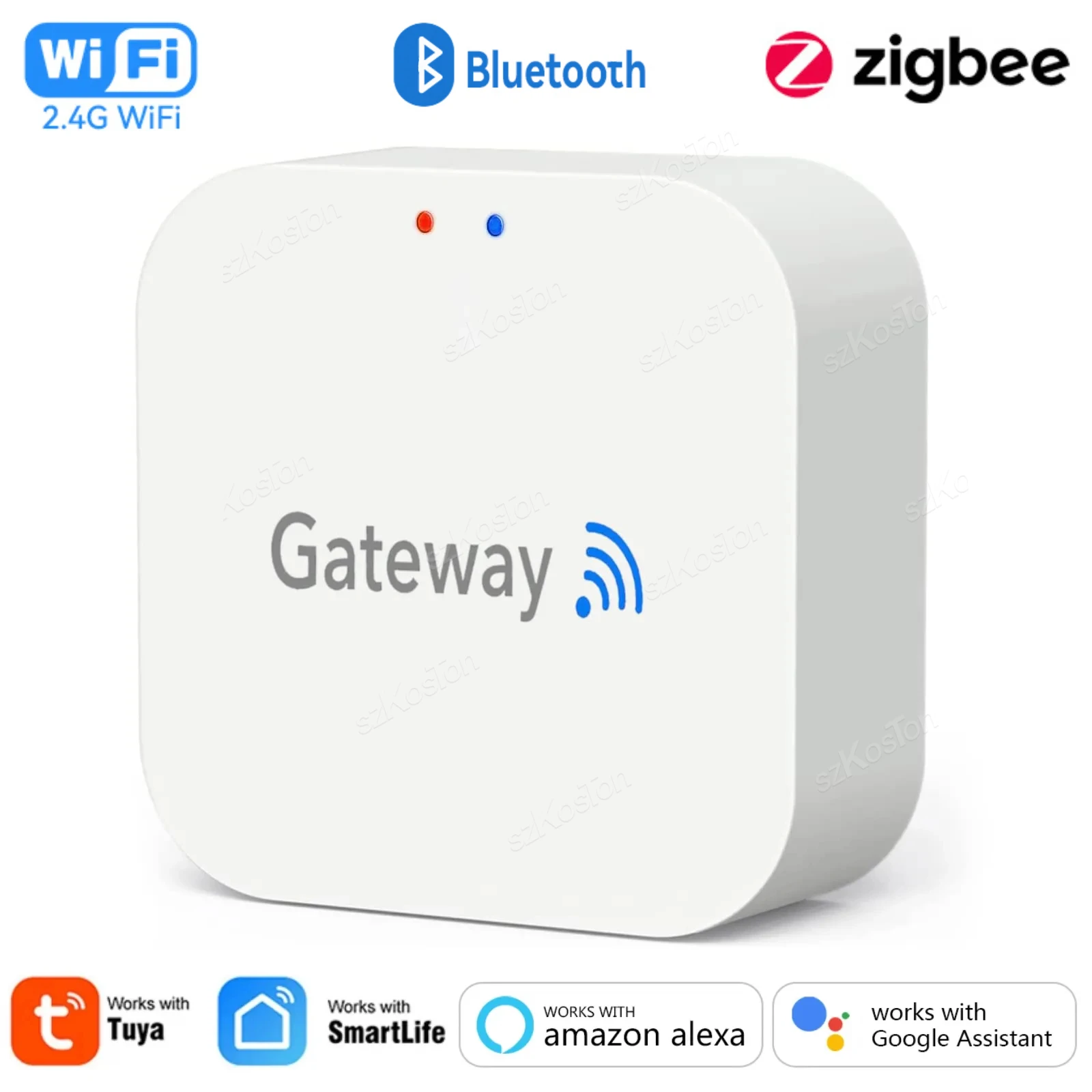
The physical design of the gateway is minimalist and unobtrusive. It features a compact, square form factor with rounded edges, finished in a matte white plastic. This aesthetic allows it to blend seamlessly into various home environments without standing out. The device feels solid. Two small LED indicators, one red and one blue, provide visual feedback on its operational status.
The compact dimensions (5cm x 5cm x 1.1cm) make it easy to place discreetly on a shelf, desk, or even mount it out of sight. The Micro USB power input is standard, making it easy to power with common adapters or even a spare USB port on a router. This thoughtful design ensures that the gateway is not just a functional component but also an aesthetically pleasing addition to the smart home. The build quality, while simple, feels robust enough for its intended indoor use, suggesting a long operational lifespan without concern for premature wear or failure.
Operating on a DC 5V/1A Micro USB input, the gateway is highly power-efficient. Its working voltage range of 3.0V-3.6V indicates low power consumption, which is beneficial for continuous operation. Low power consumption is always a plus.
This efficiency ensures that the gateway can remain powered on 24/7 without significantly impacting household energy consumption, a critical factor for always-on smart home infrastructure. The stable power delivery contributes to its reliability, ensuring consistent communication with all connected devices. Compared to older, bulkier hubs that might draw more power, this unit's efficient design aligns with modern expectations for environmentally conscious and cost-effective smart home devices.
For advanced users, the Tuya ecosystem, while primarily cloud-dependent, does offer avenues for deeper integration. While direct local control without the cloud can be challenging for some Tuya devices, the gateway's role in managing Zigbee and Bluetooth Mesh devices locally before pushing data to the cloud inherently reduces reliance on internet connectivity for immediate device-to-gateway commands. This local processing within the gateway is a key differentiator. It handles local device communication efficiently.
Integrating this gateway into a Home Assistant setup, for example, often involves leveraging Tuya's developer APIs or community-developed integrations that can sometimes provide more granular control and even a degree of local control for specific device types. This level of customization allows enthusiasts to build highly personalized and robust smart home automations that transcend the standard app functionalities. This approach offers a significant upgrade over basic setups, providing a more resilient and customizable smart home experience that can be tailored to exact user requirements, a feature often sought after by the home automation community.
Imagine a home where every light, sensor, and appliance responds not just to your voice, but to complex, intelligent sequences you've designed. This gateway is the foundational piece that makes such a vision attainable, transforming a collection of smart gadgets into a truly intelligent living space. Its ability to harmonize diverse protocols means less frustration and more seamless interaction with your environment. This device doesn't just connect; it empowers your entire smart home ecosystem, making daily routines smoother and more intuitive, ensuring your smart home truly works for you, effortlessly and reliably, every single day.
Unified Protocol Architecture
The most significant advantage of this gateway lies in its multi-protocol support. It acts as a bridge for 2.4G Wi-Fi, Bluetooth Mesh, and Zigbee 3.0 devices. This triple-threat capability means users no longer need separate hubs for their Zigbee sensors, Bluetooth-enabled smart locks, and Wi-Fi smart plugs. All these disparate technologies can communicate through one central point. This simplifies installation. For example, a home might feature Zigbee door/window sensors, Bluetooth temperature sensors, and Wi-Fi smart lights; this gateway brings them all into a single network.
Consider a scenario where a traditional smart home setup requires a dedicated Zigbee hub for lighting, another hub for Bluetooth-enabled security devices, and then relies on the main Wi-Fi router for general smart plugs. This creates network congestion and management overhead. This multi-mode gateway eliminates that redundancy, consolidating communication paths and freeing up valuable network resources. Compared to single-protocol gateways, this unit offers a dramatic reduction in physical Hardware and simplifies the overall network topology. Its ability to manage multiple protocols concurrently also enhances the reliability of the smart home network, as it can intelligently route commands and data.
Enhanced Device Compatibility
This gateway supports a broad spectrum of Tuya and Smart Life compatible devices. This includes common smart home components such as door/window sensors, PIR motion sensors, flood sensors, smart plugs, light switches, smart bulbs, and humidity sensors. The extensive compatibility means users are not locked into a single brand or ecosystem for their peripheral devices. The device works with countless sensors.
Imagine setting up a new smart home or upgrading an existing one. Instead of meticulously checking each device's protocol and ensuring it matches an existing hub, this gateway provides a universal connection point for the most common low-power wireless standards. This flexibility allows for greater choice in smart home device selection, often leading to more cost-effective solutions without sacrificing functionality. Unlike older, proprietary hubs that limited device selection to a single manufacturer, this gateway opens up the entire Tuya/Smart Life ecosystem, which is one of the largest and most diverse in the smart home market.
Seamless Control and Integration
Control of the smart home ecosystem is primarily managed through the Tuya Smart Life app, available on both Android and iOS platforms. This intuitive application allows users to add devices, create smart groups, and configure intricate smart scenes and automations. The app interface is clean and straightforward, making device management accessible even for those new to smart home technology. The app provides a centralized dashboard.
Remote control capabilities are a core feature, enabling users to manage their smart devices from anywhere with an internet connection. This means adjusting lighting, checking sensor status, or activating security features even when away from home. The convenience of remote access is paramount for modern lifestyles, offering peace of mind and energy efficiency. Compared to basic Wi-Fi-only devices that might struggle with complex scene creation, the gateway's ability to orchestrate multiple protocols through the app enables far more sophisticated and responsive automations.
Voice Command Integration
For hands-free operation, the gateway integrates seamlessly with popular voice assistants, including Amazon Alexa and Google Assistant. This allows users to control connected devices using simple voice commands, enhancing convenience and accessibility. Imagine dimming the lights or locking the doors with just your voice. Voice control offers a natural interaction.
This integration means a user can issue a command like "Alexa, turn on the living room light" or "Hey Google, set the thermostat to 22 degrees," and the gateway translates this into the appropriate Zigbee or Bluetooth command for the respective device. This eliminates the need to physically interact with switches or open an app, providing a truly smart and responsive home experience. The voice control functionality elevates the user experience beyond basic app control, placing this gateway on par with more expensive, dedicated smart home controllers in terms of usability.
Performance and Latency Considerations
Performance is critical for a responsive smart home. The gateway's ability to manage Zigbee and Bluetooth Mesh devices inherently offers lower latency compared to many Wi-Fi-only solutions for sensor data and simple commands. Zigbee and Bluetooth Mesh are designed for low-power, low-latency communication, making them ideal for instantaneous sensor triggers and quick light switching. Response times are quick.
When a door sensor detects an open event, the Zigbee protocol allows for near-instantaneous communication to the gateway, which can then trigger an automation, such as turning on a light or sending a notification. This rapid response is crucial for security and convenience, ensuring that automations execute precisely when needed. Unlike purely Wi-Fi-based sensor networks, which can sometimes suffer from congestion and higher latency due to the protocol's overhead, the dedicated low-power mesh networks managed by this gateway provide a more reliable and faster communication path for critical smart home events.
Build Quality and Design
The physical design of the gateway is minimalist and unobtrusive. It features a compact, square form factor with rounded edges, finished in a matte white plastic. This aesthetic allows it to blend seamlessly into various home environments without standing out. The device feels solid. Two small LED indicators, one red and one blue, provide visual feedback on its operational status.
The compact dimensions (5cm x 5cm x 1.1cm) make it easy to place discreetly on a shelf, desk, or even mount it out of sight. The Micro USB power input is standard, making it easy to power with common adapters or even a spare USB port on a router. This thoughtful design ensures that the gateway is not just a functional component but also an aesthetically pleasing addition to the smart home. The build quality, while simple, feels robust enough for its intended indoor use, suggesting a long operational lifespan without concern for premature wear or failure.
Power Efficiency and Reliability
Operating on a DC 5V/1A Micro USB input, the gateway is highly power-efficient. Its working voltage range of 3.0V-3.6V indicates low power consumption, which is beneficial for continuous operation. Low power consumption is always a plus.
This efficiency ensures that the gateway can remain powered on 24/7 without significantly impacting household energy consumption, a critical factor for always-on smart home infrastructure. The stable power delivery contributes to its reliability, ensuring consistent communication with all connected devices. Compared to older, bulkier hubs that might draw more power, this unit's efficient design aligns with modern expectations for environmentally conscious and cost-effective smart home devices.
Advanced Integration Potential
For advanced users, the Tuya ecosystem, while primarily cloud-dependent, does offer avenues for deeper integration. While direct local control without the cloud can be challenging for some Tuya devices, the gateway's role in managing Zigbee and Bluetooth Mesh devices locally before pushing data to the cloud inherently reduces reliance on internet connectivity for immediate device-to-gateway commands. This local processing within the gateway is a key differentiator. It handles local device communication efficiently.
Integrating this gateway into a Home Assistant setup, for example, often involves leveraging Tuya's developer APIs or community-developed integrations that can sometimes provide more granular control and even a degree of local control for specific device types. This level of customization allows enthusiasts to build highly personalized and robust smart home automations that transcend the standard app functionalities. This approach offers a significant upgrade over basic setups, providing a more resilient and customizable smart home experience that can be tailored to exact user requirements, a feature often sought after by the home automation community.
Imagine a home where every light, sensor, and appliance responds not just to your voice, but to complex, intelligent sequences you've designed. This gateway is the foundational piece that makes such a vision attainable, transforming a collection of smart gadgets into a truly intelligent living space. Its ability to harmonize diverse protocols means less frustration and more seamless interaction with your environment. This device doesn't just connect; it empowers your entire smart home ecosystem, making daily routines smoother and more intuitive, ensuring your smart home truly works for you, effortlessly and reliably, every single day.