Tuya Smart Temperature & Humidity Sensor
Official Store Deal
Expert Analysis Overview
Precision Environmental Monitoring for the Modern Smart Home
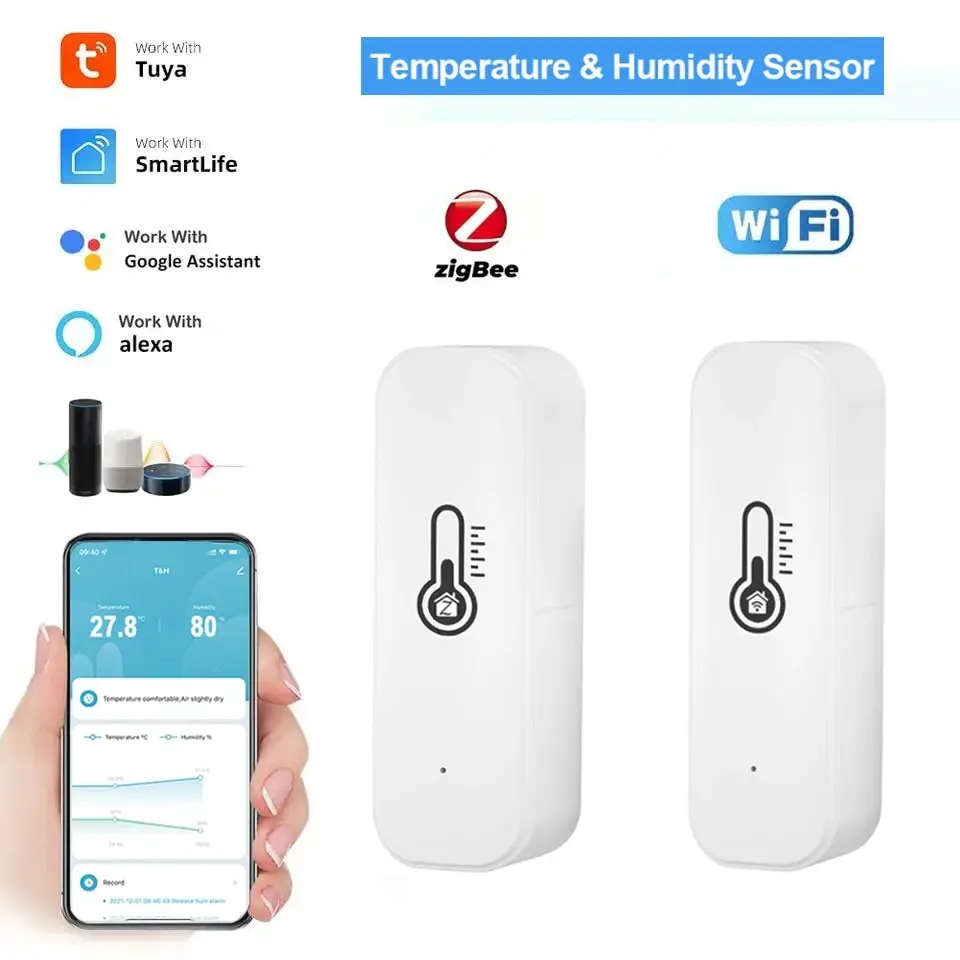
The Tuya Smart Temperature & Humidity Sensor is a critical environmental monitoring device engineered for seamless integration into modern smart home ecosystems, catering to users prioritizing granular climate control and automation. Unlike generic, standalone thermometers, this sensor provides real-time data directly to a central smart home hub, enabling sophisticated conditional automations. Its compact form factor and dual-protocol support (Zigbee or Wi-Fi) position it as a versatile tool for enhancing indoor comfort and energy efficiency.
Connectivity Protocols: The Backbone of Your Smart Home
This sensor arrives in two distinct connectivity flavors: Wi-Fi and Zigbee. The Wi-Fi variant connects directly to your home's 2.4GHz network, requiring no additional hub beyond your existing router. Its setup is straightforward, typically involving pairing through the Tuya Smart or Smart Life application. This direct connection simplifies initial deployment for users already invested in Wi-Fi-only smart devices.
The Zigbee version, conversely, operates on the Zigbee 3.0 standard. This necessitates a compatible Zigbee gateway or hub, such as a Tuya Zigbee hub, SmartThings, Home Assistant with Zigbee2MQTT or ZHA, or Philips Hue Bridge. Zigbee's mesh networking capability is a significant advantage; devices communicate with each other, extending the network's range and improving reliability. This creates a more robust and responsive smart home infrastructure.
When considering response delay, the Zigbee protocol often outperforms Wi-Fi for sensor data transmission. Zigbee devices typically wake up, transmit data, and return to a low-power state quickly. This leads to lower latency for critical automation triggers. Imagine a scenario where a sudden temperature spike needs to activate an air conditioner instantly; Zigbee's efficiency ensures that trigger happens with minimal delay. Wi-Fi devices, while convenient, can sometimes experience higher latency due to network congestion or polling intervals.
Precision Environmental Data Acquisition
The primary function of this device is to accurately measure ambient temperature and relative humidity. The sensor provides readings in both Fahrenheit and Celsius, a user-selectable option within the companion application. This flexibility accommodates regional preferences without requiring manual conversion. Data refresh rates are configurable, allowing users to balance battery life with the need for frequent updates. More frequent updates mean faster responses to environmental changes.
Accurate environmental data is paramount for effective home automation. Inaccurate readings can lead to inefficient HVAC operation, suboptimal humidifier usage, or even discomfort. This sensor aims for precision, providing the necessary data points for informed decision-time decisions. For instance, maintaining an optimal humidity level can prevent mold growth or preserve wooden furniture. The sensor enables this proactive management.
Compared to basic analog thermometers or hygrometers, this smart sensor offers continuous digital monitoring and historical data logging. The application displays trends over time, allowing users to identify patterns in their home's climate. This historical insight can be invaluable for diagnosing insulation issues, understanding seasonal variations, or optimizing energy consumption. A simple glance reveals the climate history.
Intelligent Automation and Voice Integration
One of the most compelling features is its Smart Linkage Function. This allows the sensor's readings to trigger actions across other smart devices within the Tuya/Smart Life ecosystem. For example, if the indoor temperature exceeds a predefined threshold (e.g., 28.2°C), the sensor can automatically command a Wi-Fi-enabled air conditioner to activate. Similarly, if humidity drops below a set percentage (e.g., 72%), a smart humidifier can be engaged.
This level of automation transforms a reactive home into a proactive one. Instead of manually adjusting climate control devices, the home responds autonomously to maintain optimal conditions. This saves time and ensures consistent comfort. Picture a hot summer day: the AC turns on before the room becomes stifling. This is genuine convenience.
Voice control compatibility with Amazon Alexa and Google Assistant further enhances usability. Users can simply ask for the current temperature or humidity in a specific room. This hands-free operation is particularly useful when occupied with other tasks. "Alexa, what's the temperature in the living room?" provides an instant update. Voice commands offer immediate access to data.
Physical Design and Deployment
The sensor exhibits a minimalist, compact design. It is a small, matte white plastic rectangle, roughly 7.2cm (2.834 inches) tall, 2.5cm (0.984 inches) wide, and 2cm (0.787 inches) deep. The thermometer icon on the front is subtly integrated, maintaining a clean aesthetic. This unobtrusive form factor allows it to blend seamlessly into various home decors without drawing undue attention. It fits almost anywhere.
The build quality feels solid, with no discernible creaks or flex in the plastic casing. The matte finish helps resist fingerprints and minor scuffs, maintaining its appearance over time. Its lightweight nature suggests a design optimized for battery operation and easy placement. Placement flexibility is a key advantage.
Installation is straightforward. Being battery-powered (2x AAA batteries, not included), it requires no wiring, offering complete freedom in placement. It can be placed on a shelf, table, or mounted to a wall using adhesive or a small screw. This portability allows users to monitor different rooms or even specific areas within a room, like a nursery or a wine cellar. No complex tools are needed.
Powering Your Smart Environment
This sensor operates on two AAA batteries. While the product images do not specify battery life, similar low-power Zigbee and Wi-Fi sensors typically offer several months to over a year of operation, depending on the reporting frequency and network conditions. Battery status is usually monitored within the Tuya/Smart Life app, providing notifications when replacement is due. This prevents unexpected downtime.
The decision to use AAA batteries is a deliberate trade-off. It offers unparalleled placement flexibility and avoids the need for power outlets, but requires periodic battery replacement. For users who prefer a completely maintenance-free experience, a USB-powered alternative might be more suitable. However, for discreet monitoring in areas without readily available power, battery operation is ideal. Powering your home is easy.
Compared to sensors with integrated rechargeable batteries, AAA batteries offer the convenience of quick replacement without waiting for a recharge cycle. This ensures continuous monitoring with minimal interruption. A fresh pair of batteries gets the sensor back online instantly. This design prioritizes uptime.
Ecosystem Compatibility and Long-Term Value
The sensor's compatibility with the Tuya Smart and Smart Life platforms is a significant advantage. These applications serve as central hubs for a vast array of smart devices from different manufacturers, creating a unified control experience. This broad ecosystem support means the sensor can interact with virtually any Tuya-compatible device, from smart plugs to lighting. Integration is effortless.
For those seeking more advanced local control capabilities, the Zigbee variant, when paired with a Home Assistant setup running Zigbee2MQTT or ZHA, offers potential for local processing of automation rules. This reduces reliance on cloud services, enhancing privacy and ensuring automations function even if internet connectivity is temporarily lost. Local control provides robust performance.
Considering the relatively low price point, this sensor offers substantial long-term value. Its ability to enable energy-saving automations (e.g., turning off HVAC when a room reaches target temperature) can lead to reduced utility bills over time. The insights gained from historical data can also help optimize home insulation or ventilation strategies, contributing to a more comfortable and efficient living space. It's an investment in efficiency.
This sensor is more than just a device that tells you the temperature. It is a foundational element for a truly intelligent home, providing the environmental awareness necessary for sophisticated automation. Imagine walking into a perfectly conditioned room, the air crisp and comfortable, without ever touching a thermostat. Picture knowing exactly when to ventilate a room to prevent stuffiness, or when to humidify to protect sensitive instruments or your family's health. This sensor quietly works in the background, ensuring your home adapts to your needs, creating an environment that anticipates and responds, making your living space smarter, more efficient, and ultimately, more comfortable. It empowers your home to think for itself, allowing you to focus on what truly matters, all while saving energy and enhancing well-being.