Tuya TH03Pro & ZTH03Pro Smart Temperature Humidity Sensor
Official Store Deal
Expert Analysis Overview
Precision Climate Sensing for the Modern Smart Home Architect
The Tuya TH03Pro/ZTH03Pro represents a pivotal component for the discerning home automation engineer, offering dual-protocol flexibility essential for crafting robust smart home ecosystems. This compact device directly addresses a fundamental requirement within intelligent living spaces: the acquisition of reliable, real-time climate data to facilitate informed decision-making and orchestrate advanced automated comfort routines. Its thoughtful design prioritizes both immediate, local display utility and deep, seamless digital integration, distinguishing it sharply from more generic, single-protocol environmental monitoring solutions prevalent in the market. This is a critical building block.
The Dual-Protocol Advantage: Architecting Flexible Networks
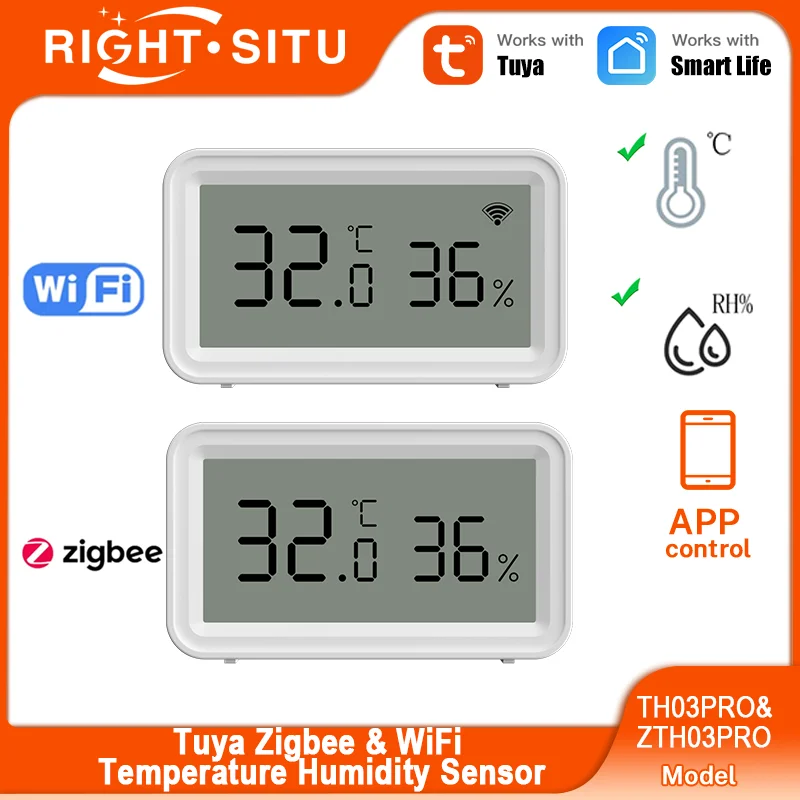
This environmental sensor is strategically offered in two distinct wireless communication variants: a WiFi 2.4GHz model (TH03Pro) and a Zigbee 3.0 version (ZTH03Pro). Both iterations are engineered to leverage the expansive and widely adopted Tuya smart home platform, providing robust cloud connectivity and enabling comprehensive remote access to environmental metrics from virtually any location. The strategic decision between these two versions for a given installation hinges critically on the existing smart home infrastructure and the specific performance priorities of the user. Each offers unique benefits.
The WiFi model connects directly to the homeowner's existing 2.4GHz WiFi router, offering a straightforward and often preferred initial setup for individuals who may not yet possess a dedicated smart home hub. In this configuration, environmental data originates from the sensor, traverses the local WiFi network, ascends to the Tuya Cloud services for processing and storage, and is subsequently pushed down to the user's smartphone application for display and interaction. This direct, hub-less connection positions the WiFi variant as an exceptionally accessible and low-barrier entry point into smart climate monitoring. It is remarkably simple.
In stark contrast, the Zigbee 3.0 variant necessitates the presence of a compatible Tuya Zigbee hub to function within the smart home network. While this requirement introduces an additional Hardware component and an initial setup consideration, it unlocks a suite of significant advantages for the more technically inclined home automation engineer. Zigbee, by its very nature, operates as a self-healing mesh network; each powered Zigbee device acts as a repeater, effectively extending the overall wireless range and significantly enhancing network resilience and reliability. Furthermore, unlike the potentially congested 2.4GHz WiFi band, which is shared by numerous devices, Zigbee utilizes a dedicated, low-power communication channel. This often translates directly into lower latency for data transmission and more immediate response times for critical automation triggers. Compared to older, less standardized Zigbee implementations, the Zigbee 3.0 protocol offers vastly improved interoperability across different manufacturers' devices and incorporates enhanced security features, making it a more robust choice for mission-critical environmental control. It builds a stronger network.
Environmental Monitoring Precision and Readability
The sensor integrates a clear, high-contrast LCD display on its front fascia, designed to provide an immediate and easily digestible visual representation of the current ambient temperature and relative humidity. The digital readouts are sufficiently large and well-defined, ensuring legibility from a considerable distance across a room. This local display offers an indispensable, at-a-glance snapshot of environmental conditions without requiring interaction with a smartphone application.
Regarding its measurement capabilities, the device accurately monitors temperatures across a practical range from -9.9°C to 60°C (equivalent to 14.18°F to 140°F). This broad spectrum accommodates typical indoor climate variations, from cooler basements to warmer attics. The stated temperature resolution of ±1°C provides a useful level of accuracy for general residential climate control and monitoring applications, allowing for effective broad environmental assessment. Simultaneously, relative humidity is precisely tracked from 0% to 100% RH, with a resolution of ±5% RH. This range is comprehensive enough to identify conditions conducive to mold growth or overly dry air, both of which impact comfort and health.
For highly specialized applications, such as the meticulous climate control required for scientific laboratories, sensitive archival storage, or precise hydroponic cultivation, the ±1°C and ±5% RH resolutions might necessitate the consideration of a more specialized, scientific-grade instrumentation. However, for the overwhelming majority of residential scenarios, encompassing the maintenance of general household comfort, proactive energy management, or the prevention of humidity-related issues like mold and mildew, this specific level of precision is more than adequate. It performs its duty reliably.
Intelligent Linkage: Orchestrating Environmental Automation
Beyond its fundamental role as a passive monitoring device, the TH03Pro/ZTH03Pro truly differentiates itself through its sophisticated intelligent scene linkage capabilities. This feature, accessible and configurable directly within the intuitive Tuya/Smart Life application, empowers users to establish highly granular and responsive automation rules that react dynamically to changes in environmental data. Picture a common scenario: the sensor, strategically placed in a living room, detects that the ambient temperature has exceeded a predefined threshold, perhaps 26°C.
This precise temperature trigger can then be configured to automatically initiate an action, such as activating an IR-controlled air conditioner via a separate Tuya-compatible IR remote control, thereby proactively working to restore the room to a more comfortable, pre-set temperature. The underlying logic for such an automation is remarkably straightforward to configure, yet its impact on daily living is profound. This type of conditional, data-driven automation transcends mere reactive manual adjustments, instead forging a truly proactive and intelligent smart home environment. Compared to relying on basic timers or constant manual intervention, this dynamic climate control system significantly conserves energy by only engaging appliances when necessary and dramatically enhances occupant comfort by maintaining ideal conditions effortlessly. It truly automates comfort.
Seamless Voice Assistant Integration for Effortless Inquiry
The integration of this sensor with leading voice assistant platforms, including Amazon Alexa, Google Assistant, and Yandex Alice, provides an exceptionally convenient and hands-free methodology for querying current environmental conditions. A simple verbal command is all that is required.
Users possess the capability to effortlessly inquire, for instance, "Alexa, what is the current temperature in the living room?" or "Hey Google, what is the humidity level in the bedroom?" and receive an immediate, clear verbal response from their smart speaker. This level of convenience effectively eliminates the necessity of physically locating and checking the sensor's display or, more commonly, opening and navigating through a smartphone application to retrieve essential information. Such seamless voice integration significantly elevates the overall user experience, making environmental data readily accessible and interactive, setting it apart from non-voice-enabled sensors. It truly is effortless.
Thoughtful Design and Efficient Power Management
Encased within a compact, aesthetically pleasing white ABS plastic housing, the sensor boasts dimensions of 75mm x 44.4mm x 17.5mm. This minimalist and unobtrusive aesthetic ensures that the device can seamlessly integrate into a wide array of interior décors without becoming an unwelcome focal point. The choice of a matte finish for the plastic casing is a practical one, as it effectively resists the accumulation of fingerprints and smudges, maintaining a clean appearance over time. Its small footprint is discreet.
Powering the unit are two standard AAA (LR03-1.5V) batteries. While the batteries themselves are not included in the purchase, the reliance on readily available AAA cells guarantees effortless replacement and widespread availability, avoiding proprietary battery formats. The inherent low-power consumption characteristics of the Zigbee protocol, in particular, contribute significantly to extended battery life, thereby minimizing the frequency of maintenance and battery changes. This strategic design choice prioritizes unparalleled placement flexibility within the home.
Unlike traditional wired sensors, which are inherently constrained by the proximity of electrical outlets, this battery-operated unit offers complete freedom in its positioning. This liberation allows the user to strategically place the sensor in locations that are truly representative of the ambient room conditions, away from confounding variables such as direct sunlight, drafts from windows or doors, or the immediate vicinity of heat-generating appliances like televisions or HVAC vents. Optimal placement ensures the acquisition of the most accurate and representative environmental readings possible, which is paramount for effective automation. This flexibility is a key advantage.
The Strategic Value Proposition for the Advanced Smart Home Architect
Fundamentally, the Tuya TH03Pro/ZTH03Pro sensor delivers an exceptionally cost-effective and highly functional solution for comprehensive environmental monitoring within the sophisticated framework of a modern smart home. Its crucial dual-protocol availability means it can be seamlessly integrated into a diverse array of existing smart home setups, whether the primary network infrastructure is predominantly WiFi-based or leverages a robust Zigbee mesh network for enhanced reliability and performance. This device offers substantial, tangible benefits to the user.
The combined capability to precisely monitor, intelligently automate, and effortlessly query climate data via a dedicated smartphone application or intuitive voice assistant fundamentally transforms a previously passive and unresponsive living environment into a truly responsive, intelligent, and adaptive living space. This level of environmental control empowers users with proactive energy management strategies, significantly improved personal comfort levels, and even contributes to tangible health benefits by enabling the maintenance of optimal humidity levels that deter allergens and mold. Compared to a fragmented collection of disparate, non-communicating devices, this integrated and cohesive approach offers vastly superior control and a more harmonious user experience.
Imagine a home where the ambient air quality is consistently ideal, where the heating or cooling systems anticipate and adjust themselves proactively before any discomfort is even perceived, and where you can instantly verify any environmental condition with nothing more than a simple, natural voice command. This versatile sensor is not merely a gadget; it is a critical, foundational component in the architectural blueprint for achieving such a seamlessly integrated and intelligently responsive smart environment. It promises to deliver profound peace of mind and effortless, precise control over your indoor climate, fundamentally enhancing the quality of daily living. It truly elevates the home experience.