Tuya WiFi 15-in-1 Smart Air Quality Monitor
Official Store Deal
Expert Analysis Overview
The Tuya WiFi 15-in-1 Smart Air Quality Monitor is a comprehensive environmental sensing hub designed for the smart home enthusiast seeking granular control and actionable data. Unlike basic single-parameter detectors, this device provides a panoramic view of indoor air quality, making it a critical component for proactive environmental management within an intelligent dwelling.
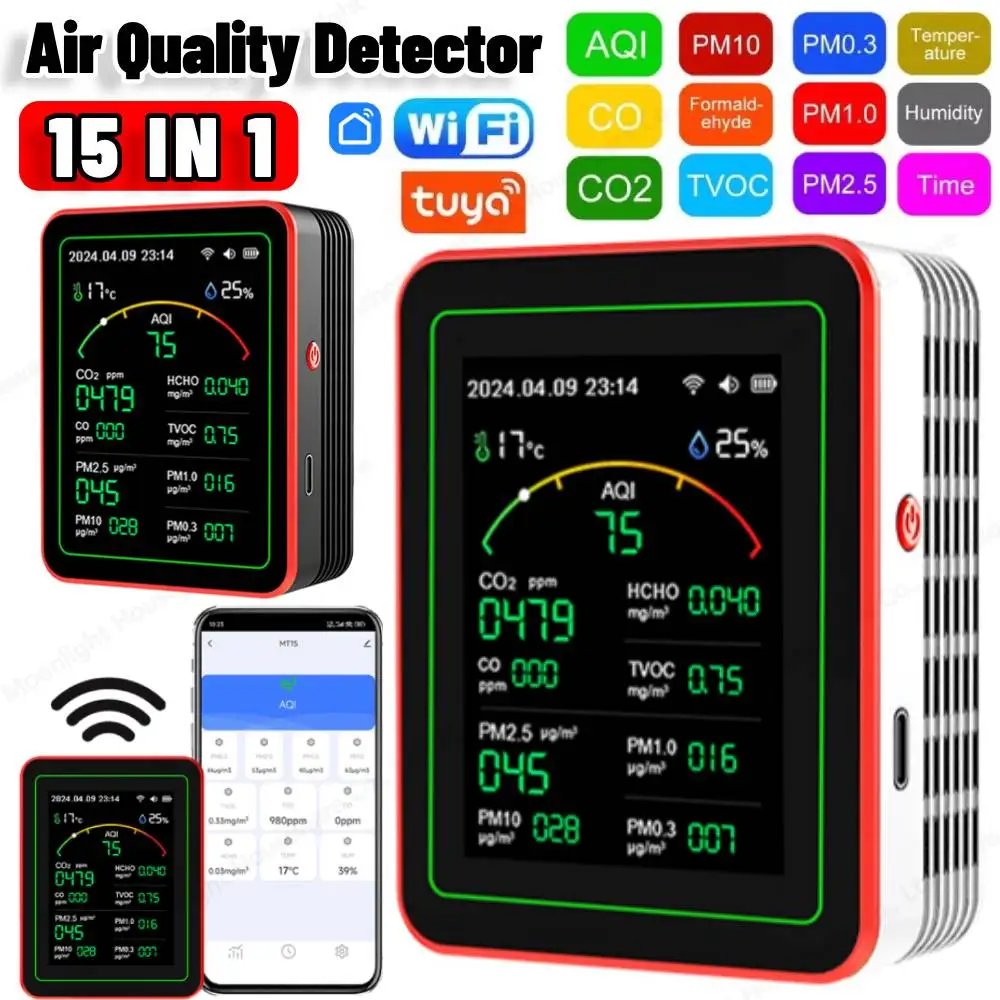
This air quality monitor integrates a sophisticated 15-in-1 sensor array, meticulously designed to detect a broad spectrum of airborne pollutants and environmental factors. The unit actively monitors carbon monoxide (CO), carbon dioxide (CO2), formaldehyde (HCHO), total volatile organic compounds (TVOC), and particulate matter across various sizes including PM0.3, PM1.0, PM2.5, and PM10. Beyond pollutants, it also provides real-time temperature and humidity readings, alongside an aggregated Air Quality Index (AQI).
Observing these multiple metrics simultaneously offers a profound understanding of the indoor atmosphere. For instance, elevated CO2 levels, often a byproduct of human respiration in poorly ventilated spaces, can directly impact cognitive function and lead to drowsiness. Monitoring HCHO and TVOC is crucial for identifying off-gassing from new furniture, paints, or cleaning products, which are known irritants and potential long-term health hazards. Particulate matter, particularly the finer PM2.5 and PM0.3, penetrates deep into the respiratory system, necessitating constant vigilance. This device provides that vigilance.
Compared to entry-level air quality sensors that typically only report PM2.5 or CO2, this monitor's expanded sensor suite is a significant upgrade. It moves beyond symptomatic readings to provide a diagnostic capability, allowing users to pinpoint specific sources of pollution or ventilation issues rather than just reacting to a generalized 'bad air' alert. Its breadth of data is truly impressive.
Connectivity is handled via an integrated WiFi module, leveraging the ubiquitous Tuya Smart Life ecosystem. This allows for seamless integration into existing Tuya-based smart home setups, enabling remote monitoring of all 15 parameters from anywhere with an internet connection. The device pushes real-time data to the accompanying mobile application, presenting historical trends and allowing for custom alert thresholds.
Imagine optimizing HVAC operation based on real-time CO2 levels; the device can trigger smart vents or air purifiers when thresholds are exceeded. This proactive automation not only enhances comfort and health but also contributes to energy efficiency by only running systems when necessary. The ability to receive push notifications for critical changes, such as a sudden spike in CO, adds a layer of safety that generic environmental sensors often lack. Remote access is seamless.
While the Tuya platform offers robust cloud-based automation, the reliance on a cloud service for full smart integration might be a consideration for privacy-conscious users or those seeking absolute local control. For advanced Home Assistant users, direct local API access is not explicitly advertised, suggesting integration would primarily occur through Tuya's cloud-based Home Assistant integration, which introduces a slight latency compared to direct local protocols like Zigbee or Z-Wave. This is a common trade-off with WiFi-only devices.
The monitor features a vibrant 2.8-inch TFT color HD display, presenting all 15 data points in a clear, organized, and easily digestible format. The interface utilizes color-coded indicators and a composite AQI score to provide an immediate visual assessment of air quality, ranging from 'Safety' to 'Danger'. Key metrics like CO2, HCHO, TVOC, and PM values are prominently displayed with their respective units.
The user experience with the display is notably intuitive. Data is presented in a hierarchical manner, with the most critical metrics easily identifiable at a glance. The color-coded AQI bar at the bottom provides a quick reference, allowing users to understand the overall air health without needing to interpret individual sensor readings. This immediate feedback loop is crucial for quick decision-making, such as opening a window or activating an air purifier. It's very user-friendly.
Compared to simpler LED segment displays or monochrome screens found on less advanced models, this HD color display significantly enhances usability and data comprehension. The graphical representation of trends and the clear numerical readouts eliminate ambiguity, ensuring that even non-technical users can accurately interpret the environmental data. The visual clarity is a distinct advantage.
The device exhibits a compact and modern design, featuring a matte finish on its casing that resists fingerprints and offers a comfortable tactile feel. Its relatively small footprint allows for discreet placement in various rooms without drawing undue attention. The power input is typically a standard USB-C port, offering flexibility in power sources, from wall adapters to power banks, making it highly portable for temporary monitoring in different locations.
This portability is a significant benefit. Users can easily move the monitor between a child's bedroom, a home office, or even a garage to identify specific areas with poor air quality. The built-in battery, while not designed for extended off-grid operation, provides enough power for short-term relocation or during power outages, ensuring continuous monitoring without interruption. Placement flexibility is key.
While the construction feels solid for a consumer-grade device, it is not designed for rugged outdoor use or harsh industrial environments. The precision molding of the plastic components suggests a reasonable level of durability for indoor applications, aligning with expectations for a device intended for continuous home monitoring. The buttons offer a satisfying, tactile click, indicating decent switch quality.
The true power of this monitor lies in its potential as an orchestrator within a sophisticated smart home ecosystem. Through the Tuya Smart Life app, users can create intricate automation routines. For example, if PM2.5 levels exceed a predefined threshold, the device can automatically trigger a Tuya-compatible air purifier. Similarly, a rise in CO2 could activate a smart fan or open a smart window. This capability moves beyond mere data reporting to active environmental control.
For those invested in Home Assistant, integrating Tuya devices often involves the Tuya cloud integration. While this provides functionality, it does introduce a dependency on external servers and can result in minor response delays compared to direct local control. Enthusiasts often explore custom firmware or local Tuya API workarounds to achieve lower latency and greater privacy, though this requires a higher technical skill level and is not officially supported. The community is always exploring new avenues.
This device, when effectively integrated, becomes more than just a sensor; it transforms into an intelligent agent. It provides the necessary data to make a home react autonomously to its environment, optimizing air quality for health and comfort without constant manual intervention. This level of environmental responsiveness is a significant upgrade from isolated smart devices, showcasing its value in a truly intelligent home.
The sensors within this unit provide consumer-grade accuracy, which is highly suitable for general home monitoring and identifying significant environmental changes. It is crucial to understand that while these sensors offer excellent utility for daily use, they are not intended to replace certified, laboratory-grade equipment used for scientific research or regulatory compliance. For most homeowners, the provided accuracy is more than sufficient for actionable insights.
Several factors can influence the accuracy of the readings, including the device's placement, ambient temperature fluctuations, and the presence of other chemicals that might cross-react with specific sensors. Proper placement, away from direct drafts, heat sources, or immediate proximity to pollutant sources (like cooking fumes), is essential for obtaining consistent and representative readings. Regular ventilation of the room can also help maintain sensor health and accuracy. Environmental factors matter.
To maintain optimal performance, occasional calibration or cross-referencing with other known good sensors can be beneficial. While the device typically performs self-calibration for some sensors, understanding its operational limits helps manage expectations. The unit serves as an excellent early warning system and trend indicator, empowering users to make informed decisions about their indoor environment. This provides peace of mind.
Considering its comprehensive sensor suite and smart integration capabilities, the monitor presents a compelling value proposition. The initial investment is quickly offset by the potential for improved health outcomes, enhanced comfort, and even energy savings through intelligent automation. It's an investment in understanding and controlling a fundamental aspect of daily living: the air breathed indoors.
The long-term value extends beyond mere cost. By providing continuous insights into air quality, the device allows homeowners to identify and mitigate potential health risks from pollutants like HCHO and PM2.5, which can have cumulative effects over time. Furthermore, by enabling smart automation of HVAC and air purification systems, it can lead to more efficient energy consumption, reducing utility bills in the long run. This is a smart investment.
Unlike simply buying an air purifier and running it blindly, this monitor provides the data necessary for targeted, efficient air quality management. It transforms a reactive approach into a proactive strategy, ensuring that environmental controls are engaged precisely when and where they are needed. This intelligent approach makes it a worthwhile upgrade for any smart home aiming for optimal living conditions.
Imagine a home that actively breathes with you, where the air purifier kicks in silently as CO2 levels rise during a family dinner, or the ventilation system gently purges formaldehyde after a new piece of furniture arrives. This monitor makes it possible, providing the critical data backbone for a truly responsive and health-conscious living space, allowing occupants to enjoy an invisible layer of protection and comfort every single day.
Unveiling the Invisible: Comprehensive Environmental Sensing
This air quality monitor integrates a sophisticated 15-in-1 sensor array, meticulously designed to detect a broad spectrum of airborne pollutants and environmental factors. The unit actively monitors carbon monoxide (CO), carbon dioxide (CO2), formaldehyde (HCHO), total volatile organic compounds (TVOC), and particulate matter across various sizes including PM0.3, PM1.0, PM2.5, and PM10. Beyond pollutants, it also provides real-time temperature and humidity readings, alongside an aggregated Air Quality Index (AQI).
Observing these multiple metrics simultaneously offers a profound understanding of the indoor atmosphere. For instance, elevated CO2 levels, often a byproduct of human respiration in poorly ventilated spaces, can directly impact cognitive function and lead to drowsiness. Monitoring HCHO and TVOC is crucial for identifying off-gassing from new furniture, paints, or cleaning products, which are known irritants and potential long-term health hazards. Particulate matter, particularly the finer PM2.5 and PM0.3, penetrates deep into the respiratory system, necessitating constant vigilance. This device provides that vigilance.
Compared to entry-level air quality sensors that typically only report PM2.5 or CO2, this monitor's expanded sensor suite is a significant upgrade. It moves beyond symptomatic readings to provide a diagnostic capability, allowing users to pinpoint specific sources of pollution or ventilation issues rather than just reacting to a generalized 'bad air' alert. Its breadth of data is truly impressive.
The Connectivity Nexus: Tuya Integration and WiFi Dynamics
Connectivity is handled via an integrated WiFi module, leveraging the ubiquitous Tuya Smart Life ecosystem. This allows for seamless integration into existing Tuya-based smart home setups, enabling remote monitoring of all 15 parameters from anywhere with an internet connection. The device pushes real-time data to the accompanying mobile application, presenting historical trends and allowing for custom alert thresholds.
Imagine optimizing HVAC operation based on real-time CO2 levels; the device can trigger smart vents or air purifiers when thresholds are exceeded. This proactive automation not only enhances comfort and health but also contributes to energy efficiency by only running systems when necessary. The ability to receive push notifications for critical changes, such as a sudden spike in CO, adds a layer of safety that generic environmental sensors often lack. Remote access is seamless.
While the Tuya platform offers robust cloud-based automation, the reliance on a cloud service for full smart integration might be a consideration for privacy-conscious users or those seeking absolute local control. For advanced Home Assistant users, direct local API access is not explicitly advertised, suggesting integration would primarily occur through Tuya's cloud-based Home Assistant integration, which introduces a slight latency compared to direct local protocols like Zigbee or Z-Wave. This is a common trade-off with WiFi-only devices.
Visualizing the Invisible: The Intuitive Display Interface
The monitor features a vibrant 2.8-inch TFT color HD display, presenting all 15 data points in a clear, organized, and easily digestible format. The interface utilizes color-coded indicators and a composite AQI score to provide an immediate visual assessment of air quality, ranging from 'Safety' to 'Danger'. Key metrics like CO2, HCHO, TVOC, and PM values are prominently displayed with their respective units.
The user experience with the display is notably intuitive. Data is presented in a hierarchical manner, with the most critical metrics easily identifiable at a glance. The color-coded AQI bar at the bottom provides a quick reference, allowing users to understand the overall air health without needing to interpret individual sensor readings. This immediate feedback loop is crucial for quick decision-making, such as opening a window or activating an air purifier. It's very user-friendly.
Compared to simpler LED segment displays or monochrome screens found on less advanced models, this HD color display significantly enhances usability and data comprehension. The graphical representation of trends and the clear numerical readouts eliminate ambiguity, ensuring that even non-technical users can accurately interpret the environmental data. The visual clarity is a distinct advantage.
Engineering for Everyday Use: Build Quality and Portability
The device exhibits a compact and modern design, featuring a matte finish on its casing that resists fingerprints and offers a comfortable tactile feel. Its relatively small footprint allows for discreet placement in various rooms without drawing undue attention. The power input is typically a standard USB-C port, offering flexibility in power sources, from wall adapters to power banks, making it highly portable for temporary monitoring in different locations.
This portability is a significant benefit. Users can easily move the monitor between a child's bedroom, a home office, or even a garage to identify specific areas with poor air quality. The built-in battery, while not designed for extended off-grid operation, provides enough power for short-term relocation or during power outages, ensuring continuous monitoring without interruption. Placement flexibility is key.
While the construction feels solid for a consumer-grade device, it is not designed for rugged outdoor use or harsh industrial environments. The precision molding of the plastic components suggests a reasonable level of durability for indoor applications, aligning with expectations for a device intended for continuous home monitoring. The buttons offer a satisfying, tactile click, indicating decent switch quality.
The Smart Home Orchestrator: Advanced Integration Potential
The true power of this monitor lies in its potential as an orchestrator within a sophisticated smart home ecosystem. Through the Tuya Smart Life app, users can create intricate automation routines. For example, if PM2.5 levels exceed a predefined threshold, the device can automatically trigger a Tuya-compatible air purifier. Similarly, a rise in CO2 could activate a smart fan or open a smart window. This capability moves beyond mere data reporting to active environmental control.
For those invested in Home Assistant, integrating Tuya devices often involves the Tuya cloud integration. While this provides functionality, it does introduce a dependency on external servers and can result in minor response delays compared to direct local control. Enthusiasts often explore custom firmware or local Tuya API workarounds to achieve lower latency and greater privacy, though this requires a higher technical skill level and is not officially supported. The community is always exploring new avenues.
This device, when effectively integrated, becomes more than just a sensor; it transforms into an intelligent agent. It provides the necessary data to make a home react autonomously to its environment, optimizing air quality for health and comfort without constant manual intervention. This level of environmental responsiveness is a significant upgrade from isolated smart devices, showcasing its value in a truly intelligent home.
Accuracy and Calibration Considerations: Understanding the Data
The sensors within this unit provide consumer-grade accuracy, which is highly suitable for general home monitoring and identifying significant environmental changes. It is crucial to understand that while these sensors offer excellent utility for daily use, they are not intended to replace certified, laboratory-grade equipment used for scientific research or regulatory compliance. For most homeowners, the provided accuracy is more than sufficient for actionable insights.
Several factors can influence the accuracy of the readings, including the device's placement, ambient temperature fluctuations, and the presence of other chemicals that might cross-react with specific sensors. Proper placement, away from direct drafts, heat sources, or immediate proximity to pollutant sources (like cooking fumes), is essential for obtaining consistent and representative readings. Regular ventilation of the room can also help maintain sensor health and accuracy. Environmental factors matter.
To maintain optimal performance, occasional calibration or cross-referencing with other known good sensors can be beneficial. While the device typically performs self-calibration for some sensors, understanding its operational limits helps manage expectations. The unit serves as an excellent early warning system and trend indicator, empowering users to make informed decisions about their indoor environment. This provides peace of mind.
The Value Proposition: Investing in a Healthier Home
Considering its comprehensive sensor suite and smart integration capabilities, the monitor presents a compelling value proposition. The initial investment is quickly offset by the potential for improved health outcomes, enhanced comfort, and even energy savings through intelligent automation. It's an investment in understanding and controlling a fundamental aspect of daily living: the air breathed indoors.
The long-term value extends beyond mere cost. By providing continuous insights into air quality, the device allows homeowners to identify and mitigate potential health risks from pollutants like HCHO and PM2.5, which can have cumulative effects over time. Furthermore, by enabling smart automation of HVAC and air purification systems, it can lead to more efficient energy consumption, reducing utility bills in the long run. This is a smart investment.
Unlike simply buying an air purifier and running it blindly, this monitor provides the data necessary for targeted, efficient air quality management. It transforms a reactive approach into a proactive strategy, ensuring that environmental controls are engaged precisely when and where they are needed. This intelligent approach makes it a worthwhile upgrade for any smart home aiming for optimal living conditions.
Imagine a home that actively breathes with you, where the air purifier kicks in silently as CO2 levels rise during a family dinner, or the ventilation system gently purges formaldehyde after a new piece of furniture arrives. This monitor makes it possible, providing the critical data backbone for a truly responsive and health-conscious living space, allowing occupants to enjoy an invisible layer of protection and comfort every single day.