Tuya Zigbee 4-in-1 MmWave Smart Sensor
Official Store Deal
Expert Analysis Overview
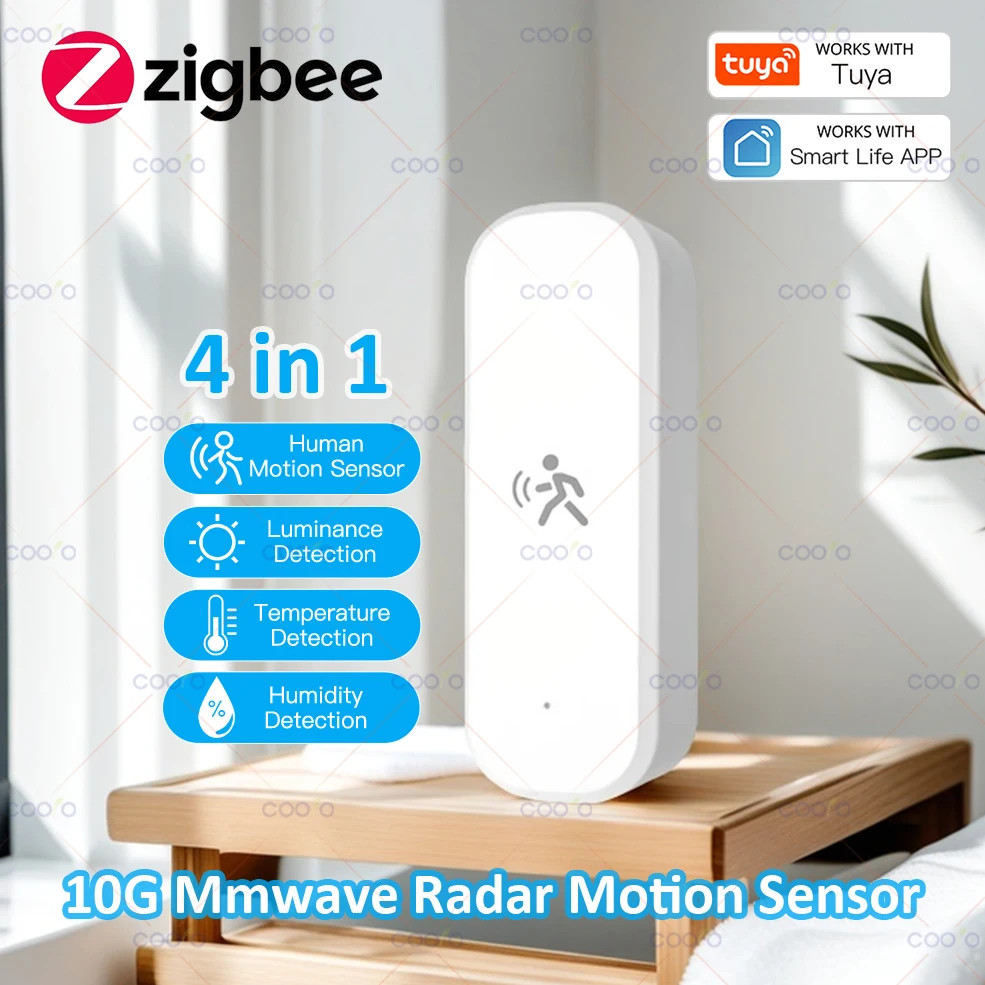
The Tuya Zigbee 4-in-1 MmWave Smart Sensor is a sophisticated environmental and presence detection device engineered for advanced smart home ecosystems that demand granular data and robust automation capabilities. This unit represents a significant leap from conventional motion sensors, integrating four crucial environmental monitoring functions into a single, sleek form factor. Its core lies in the 10G MmWave radar technology, which fundamentally redefines how a smart home perceives human occupancy. This is not merely a motion detector; it is an intelligent observer.
This capability is a game-changer for occupancy-based automation. Traditional PIR sensors often fail when an occupant is stationary, leading to lights turning off prematurely or climate control systems disengaging. The MmWave technology ensures continuous presence detection, even if someone is reading a book or working at a desk without significant motion. The detection range is adjustable from 0.5 to 10 meters. This precise control over the detection zone prevents unwanted triggers from activity outside the intended area.
Compared to the previous generation of smart home motion detectors, which were almost exclusively PIR-based, the MmWave sensor offers a vastly superior user experience. It eliminates the frustration of lights suddenly extinguishing while an individual remains in the room, a common annoyance with older technology. This advanced detection method provides a more reliable foundation for complex automation routines. The 110-degree detection angle covers a substantial area. This means fewer sensors are needed for comprehensive room coverage.
The luminance sensor measures ambient light levels, enabling dynamic lighting control. Imagine a scenario where lights only activate if motion is detected AND the room's natural light falls below a certain threshold. This conserves energy significantly. The sensor provides real-time light data.
The precision temperature sensor allows for fine-tuned climate control. When integrated with a smart thermostat or HVAC system, the sensor can provide localized temperature readings, ensuring comfort in specific zones rather than relying on a single thermostat's reading. This leads to more efficient heating and cooling. Humidity detection further enhances environmental control. It allows for the automation of humidifiers or dehumidifiers, maintaining optimal indoor air quality and preventing issues like mold growth or excessively dry air. This comprehensive data stream empowers truly adaptive smart homes.
Compared to standalone sensors for each of these environmental factors, the 4-in-1 unit simplifies installation and reduces clutter. Instead of deploying separate devices for motion, light, temperature, and humidity, a single compact unit handles all these tasks. This streamlines the setup process. The consolidated data stream also simplifies automation logic within the smart home platform, as all relevant environmental variables are sourced from one endpoint.
The choice of Zigbee 3.0 as the communication protocol is a deliberate engineering decision that benefits the end-user significantly. Zigbee is a low-power, mesh networking standard widely adopted in smart home ecosystems, known for its reliability and scalability. This ensures the sensor integrates smoothly into an existing Zigbee network.
A Zigbee mesh network allows devices to communicate with each other, extending the range and robustness of the entire system. Each mains-powered Zigbee device acts as a repeater, strengthening the signal across the home. This creates a highly resilient network. The sensor leverages this architecture, providing a stable connection even in larger homes where a single Wi-Fi router might struggle to reach every corner. Its low power consumption is also a major advantage.
Compared to Wi-Fi-based smart sensors, Zigbee devices typically consume far less power, leading to longer battery life for battery-powered sensors (though this unit appears to be USB powered, indicating continuous operation). More critically for automation, Zigbee offers lower latency. Commands sent to Zigbee devices execute almost instantaneously, which is paramount for responsive lighting or security systems. This near-instantaneous response is crucial. The Tuya ecosystem compatibility means it will work with a vast array of other Tuya-branded or Tuya-compatible Zigbee devices, expanding automation possibilities.
Furthermore, the capability for local control is a defining characteristic of advanced smart home setups. While many Tuya devices can operate via the cloud, a well-configured Zigbee gateway allows the sensor to trigger automations entirely within the local network. This means that even if the internet connection drops, critical automations like presence detection for lighting or security can continue to function. This level of independence is invaluable. It enhances both reliability and privacy.
Compared to devices that are solely cloud-dependent, the local control potential of this Zigbee sensor provides a robust failsafe. It also reduces reliance on external servers, which can introduce points of failure or privacy concerns. For users building a truly resilient and private smart home, the Zigbee protocol with local control capability is not just a feature; it's a fundamental requirement. The speed of execution is noticeably superior.
Picture this: You enter your living room. The MmWave sensor detects your presence, even as you settle onto the couch. The luminance sensor reports low light. This triggers the smart lighting to gently fade on, adjusting to a comfortable brightness. Simultaneously, the temperature sensor registers a slight chill, prompting the smart thermostat to adjust the heating. If the humidity is too low, a smart humidifier might activate. This creates a truly adaptive environment.
This goes far beyond simple motion-triggered lights. It enables proactive environmental management. The sensor can differentiate between a pet moving around and a human, reducing false triggers. It can also be integrated into security systems, sending immediate notifications to your smartphone if unexpected human presence is detected in a specific zone during away hours. The versatility is immense. This level of integrated intelligence transforms a house into a responsive dwelling.
The physical design of the sensor is a testament to functional minimalism. Its compact, elongated oval form factor, rendered in a clean white finish, ensures it blends seamlessly into a variety of interior aesthetics. The device feels dense for its size. This suggests a well-engineered internal structure.
Its small footprint allows for flexible placement options without drawing undue attention. Unlike some bulkier multi-sensors, this unit can sit inconspicuously on a shelf, be mounted subtly on a wall, or even be integrated into a ceiling fixture. The compact dimensions are a clear advantage. This design philosophy aligns with modern smart home aesthetics, where technology should enhance living spaces without dominating them visually.
Compared to older, more utilitarian-looking smart home sensors, this unit offers a more refined and integrated appearance. Its clean lines and neutral color palette ensure it complements contemporary decor. The build quality feels solid. It avoids the cheap, hollow plastic feel sometimes associated with entry-level smart devices.
The 110-degree detection angle and 0.5-10 meter adjustable range offer substantial flexibility in deployment. For a large living room, it can be positioned to cover the entire space from a central location. In a smaller office, the range can be reduced to prevent detection in adjacent hallways. This adaptability is key. The ability to fine-tune sensitivity is invaluable.
Compared to sensors with fixed detection zones or limited adjustability, this unit provides the user with superior control over its operational parameters. This translates directly into more precise and effective automation. The sensor can be optimized for specific use cases, whether it's general room occupancy or highly localized presence detection in a workstation.
Evaluating the Tuya Zigbee 4-in-1 MmWave Smart Sensor goes beyond its initial purchase price. Its true value lies in the advanced capabilities it brings to a smart home ecosystem and the long-term benefits derived from its comprehensive data collection. This is an investment in intelligent living.
The enhanced accuracy of MmWave presence detection reduces false negatives, leading to more reliable and less frustrating automations. This saves energy by ensuring lights and climate control are only active when truly needed. The long-term energy savings can be substantial. The peace of mind offered by consistent performance also adds intangible value. This avoids the need for constant manual overrides.
Compared to piecemeal smart home setups where various sensors from different manufacturers might be cobbled together, the integrated nature of this sensor within the Tuya Zigbee ecosystem offers a streamlined experience. Compatibility issues are minimized. The unified data stream simplifies automation logic, reducing the time and effort required for configuration and troubleshooting.
The comprehensive environmental data collected by the sensor provides a foundation for increasingly sophisticated automations as smart home platforms evolve. As AI and machine learning become more prevalent in home automation, having rich, multi-dimensional data from a single device will be invaluable for creating truly predictive and personalized environments. This sensor is ready for tomorrow's smart home.
The durable construction and discreet design mean the sensor will continue to function effectively and blend into its surroundings for an extended period. It is built to last. This avoids the need for frequent replacements. Investing in a high-quality, multi-functional sensor like this minimizes future upgrade cycles and maximizes the return on investment in a smart home infrastructure.
Imagine a home that anticipates your needs, where lighting adjusts seamlessly as you move from room to room, climate control maintains perfect comfort without manual intervention, and security systems are intelligent enough to differentiate between a pet and an intruder. This sensor is a cornerstone for such an environment. It provides the precise, real-time data necessary to transform a house into a truly responsive, intuitive living space, allowing occupants to simply exist within a perfectly optimized ecosystem.
The Next Generation of Presence Detection
Millimeter-Wave Mastery: Beyond Basic Motion
The sensor's primary innovation is its 10G MmWave radar. Unlike passive infrared (PIR) sensors, which detect changes in infrared radiation (heat signatures) caused by movement, millimeter-wave radar emits high-frequency radio waves and analyzes the reflections. This allows for detection of incredibly subtle movements. A person sitting perfectly still will still be detected.This capability is a game-changer for occupancy-based automation. Traditional PIR sensors often fail when an occupant is stationary, leading to lights turning off prematurely or climate control systems disengaging. The MmWave technology ensures continuous presence detection, even if someone is reading a book or working at a desk without significant motion. The detection range is adjustable from 0.5 to 10 meters. This precise control over the detection zone prevents unwanted triggers from activity outside the intended area.
Compared to the previous generation of smart home motion detectors, which were almost exclusively PIR-based, the MmWave sensor offers a vastly superior user experience. It eliminates the frustration of lights suddenly extinguishing while an individual remains in the room, a common annoyance with older technology. This advanced detection method provides a more reliable foundation for complex automation routines. The 110-degree detection angle covers a substantial area. This means fewer sensors are needed for comprehensive room coverage.
Environmental Intelligence: A Holistic View
Beyond its advanced motion capabilities, this device incorporates three additional critical environmental sensors: luminance, temperature, and humidity. These integrated sensors transform the unit from a simple motion detector into a comprehensive environmental monitoring station. This multi-sensor approach provides a richer dataset for more intelligent home automation.The luminance sensor measures ambient light levels, enabling dynamic lighting control. Imagine a scenario where lights only activate if motion is detected AND the room's natural light falls below a certain threshold. This conserves energy significantly. The sensor provides real-time light data.
The precision temperature sensor allows for fine-tuned climate control. When integrated with a smart thermostat or HVAC system, the sensor can provide localized temperature readings, ensuring comfort in specific zones rather than relying on a single thermostat's reading. This leads to more efficient heating and cooling. Humidity detection further enhances environmental control. It allows for the automation of humidifiers or dehumidifiers, maintaining optimal indoor air quality and preventing issues like mold growth or excessively dry air. This comprehensive data stream empowers truly adaptive smart homes.
Compared to standalone sensors for each of these environmental factors, the 4-in-1 unit simplifies installation and reduces clutter. Instead of deploying separate devices for motion, light, temperature, and humidity, a single compact unit handles all these tasks. This streamlines the setup process. The consolidated data stream also simplifies automation logic within the smart home platform, as all relevant environmental variables are sourced from one endpoint.
Seamless Integration into the Zigbee Fabric
The choice of Zigbee 3.0 as the communication protocol is a deliberate engineering decision that benefits the end-user significantly. Zigbee is a low-power, mesh networking standard widely adopted in smart home ecosystems, known for its reliability and scalability. This ensures the sensor integrates smoothly into an existing Zigbee network.
A Zigbee mesh network allows devices to communicate with each other, extending the range and robustness of the entire system. Each mains-powered Zigbee device acts as a repeater, strengthening the signal across the home. This creates a highly resilient network. The sensor leverages this architecture, providing a stable connection even in larger homes where a single Wi-Fi router might struggle to reach every corner. Its low power consumption is also a major advantage.
Compared to Wi-Fi-based smart sensors, Zigbee devices typically consume far less power, leading to longer battery life for battery-powered sensors (though this unit appears to be USB powered, indicating continuous operation). More critically for automation, Zigbee offers lower latency. Commands sent to Zigbee devices execute almost instantaneously, which is paramount for responsive lighting or security systems. This near-instantaneous response is crucial. The Tuya ecosystem compatibility means it will work with a vast array of other Tuya-branded or Tuya-compatible Zigbee devices, expanding automation possibilities.
Latency and Local Control: The Automation Imperative
For any home automation engineer, minimizing response delay is a top priority. The Zigbee protocol, by its nature, offers significantly lower latency than cloud-dependent Wi-Fi devices. Data from the sensor travels directly to the Zigbee gateway and then to the automation engine, often bypassing external servers entirely. This results in near-instantaneous reactions. Imagine walking into a dark room and the lights illuminating without any perceptible lag.Furthermore, the capability for local control is a defining characteristic of advanced smart home setups. While many Tuya devices can operate via the cloud, a well-configured Zigbee gateway allows the sensor to trigger automations entirely within the local network. This means that even if the internet connection drops, critical automations like presence detection for lighting or security can continue to function. This level of independence is invaluable. It enhances both reliability and privacy.
Compared to devices that are solely cloud-dependent, the local control potential of this Zigbee sensor provides a robust failsafe. It also reduces reliance on external servers, which can introduce points of failure or privacy concerns. For users building a truly resilient and private smart home, the Zigbee protocol with local control capability is not just a feature; it's a fundamental requirement. The speed of execution is noticeably superior.
Powering Smart Scenarios: Automation Unleashed
The combination of granular data from four sensors and the low-latency Zigbee protocol unlocks a myriad of sophisticated automation scenarios. This sensor acts as the eyes and ears of a truly intelligent home. Consider the possibilities.Picture this: You enter your living room. The MmWave sensor detects your presence, even as you settle onto the couch. The luminance sensor reports low light. This triggers the smart lighting to gently fade on, adjusting to a comfortable brightness. Simultaneously, the temperature sensor registers a slight chill, prompting the smart thermostat to adjust the heating. If the humidity is too low, a smart humidifier might activate. This creates a truly adaptive environment.
This goes far beyond simple motion-triggered lights. It enables proactive environmental management. The sensor can differentiate between a pet moving around and a human, reducing false triggers. It can also be integrated into security systems, sending immediate notifications to your smartphone if unexpected human presence is detected in a specific zone during away hours. The versatility is immense. This level of integrated intelligence transforms a house into a responsive dwelling.
Design and Installation: Discreet yet Potent
The physical design of the sensor is a testament to functional minimalism. Its compact, elongated oval form factor, rendered in a clean white finish, ensures it blends seamlessly into a variety of interior aesthetics. The device feels dense for its size. This suggests a well-engineered internal structure.
Physical Footprint and Materiality
The sensor's housing appears to be constructed from a high-quality, durable plastic with a smooth, matte finish. This tactile quality suggests resistance to fingerprints and minor scuffs, maintaining its discreet appearance over time. The absence of visible buttons or complex interfaces on its front face further contributes to its unobtrusive nature. It is designed to be seen, yet not noticed.Its small footprint allows for flexible placement options without drawing undue attention. Unlike some bulkier multi-sensors, this unit can sit inconspicuously on a shelf, be mounted subtly on a wall, or even be integrated into a ceiling fixture. The compact dimensions are a clear advantage. This design philosophy aligns with modern smart home aesthetics, where technology should enhance living spaces without dominating them visually.
Compared to older, more utilitarian-looking smart home sensors, this unit offers a more refined and integrated appearance. Its clean lines and neutral color palette ensure it complements contemporary decor. The build quality feels solid. It avoids the cheap, hollow plastic feel sometimes associated with entry-level smart devices.
Deployment Flexibility
The sensor's design facilitates straightforward installation. While specific mounting Hardware isn't detailed in the images, its light weight and compact size suggest adhesive strips or small screws would suffice for wall or ceiling mounting. The USB power input, while requiring a power source, eliminates concerns about battery replacement schedules. This ensures continuous operation.The 110-degree detection angle and 0.5-10 meter adjustable range offer substantial flexibility in deployment. For a large living room, it can be positioned to cover the entire space from a central location. In a smaller office, the range can be reduced to prevent detection in adjacent hallways. This adaptability is key. The ability to fine-tune sensitivity is invaluable.
Compared to sensors with fixed detection zones or limited adjustability, this unit provides the user with superior control over its operational parameters. This translates directly into more precise and effective automation. The sensor can be optimized for specific use cases, whether it's general room occupancy or highly localized presence detection in a workstation.
The Value Proposition: Investing in Advanced Automation
Evaluating the Tuya Zigbee 4-in-1 MmWave Smart Sensor goes beyond its initial purchase price. Its true value lies in the advanced capabilities it brings to a smart home ecosystem and the long-term benefits derived from its comprehensive data collection. This is an investment in intelligent living.
Cost-Benefit Analysis
At first glance, a multi-sensor might seem more expensive than a basic PIR motion sensor. However, when considering the cost of acquiring separate devices for motion, luminance, temperature, and humidity, the 4-in-1 unit often presents a more economical solution. It consolidates four distinct functions. This reduces not only the upfront hardware cost but also simplifies installation and management.The enhanced accuracy of MmWave presence detection reduces false negatives, leading to more reliable and less frustrating automations. This saves energy by ensuring lights and climate control are only active when truly needed. The long-term energy savings can be substantial. The peace of mind offered by consistent performance also adds intangible value. This avoids the need for constant manual overrides.
Compared to piecemeal smart home setups where various sensors from different manufacturers might be cobbled together, the integrated nature of this sensor within the Tuya Zigbee ecosystem offers a streamlined experience. Compatibility issues are minimized. The unified data stream simplifies automation logic, reducing the time and effort required for configuration and troubleshooting.
Long-Term Reliability and Future-Proofing
The choice of Zigbee 3.0 provides a degree of future-proofing. As a widely adopted and evolving standard, Zigbee devices tend to have a longer support lifespan and broader compatibility compared to proprietary wireless protocols. The robust mesh network architecture contributes to overall system reliability. This ensures consistent performance for years.The comprehensive environmental data collected by the sensor provides a foundation for increasingly sophisticated automations as smart home platforms evolve. As AI and machine learning become more prevalent in home automation, having rich, multi-dimensional data from a single device will be invaluable for creating truly predictive and personalized environments. This sensor is ready for tomorrow's smart home.
The durable construction and discreet design mean the sensor will continue to function effectively and blend into its surroundings for an extended period. It is built to last. This avoids the need for frequent replacements. Investing in a high-quality, multi-functional sensor like this minimizes future upgrade cycles and maximizes the return on investment in a smart home infrastructure.
Imagine a home that anticipates your needs, where lighting adjusts seamlessly as you move from room to room, climate control maintains perfect comfort without manual intervention, and security systems are intelligent enough to differentiate between a pet and an intruder. This sensor is a cornerstone for such an environment. It provides the precise, real-time data necessary to transform a house into a truly responsive, intuitive living space, allowing occupants to simply exist within a perfectly optimized ecosystem.