Tuya ZigBee Wireless Scene Switch
Official Store Deal
Expert Analysis Overview
The Tuya ZigBee Wireless Scene Switch is a compact, dedicated input device engineered for augmenting smart home automation within the Tuya ecosystem. This peripheral is not a standalone solution; it functions as a critical component, translating physical user input into digital commands via the robust Zigbee 3.0 protocol. It targets users seeking to expand their smart home control beyond smartphone apps, offering tangible, intuitive interaction with their automated environments.
The operational backbone of this scene switch is the Zigbee 3.0 communication protocol. Unlike Wi-Fi, which often contends with network congestion and higher power draw, Zigbee is specifically designed for low-power, low-bandwidth mesh networking. This architectural choice is paramount for devices like scene switches. A single press consumes minimal energy.
Zigbee's mesh topology allows each device, including this switch, to potentially relay signals from other devices, effectively extending the network's reach and enhancing signal reliability. This means commands do not solely rely on direct line-of-sight to the central gateway. In a multi-story home, this creates a resilient network. A 30-meter open-area working range is specified.
This inherent mesh capability provides a significant advantage over point-to-point wireless solutions, particularly in environments with physical obstructions or interference. The protocol's efficiency minimizes data overhead, contributing to the swift execution of commands. Users experience near-instantaneous responses. This efficiency translates directly into a more fluid and less frustrating smart home experience, crucial for actions like lighting control where noticeable delays can detract from the convenience.
The design of the Tuya ZigBee Wireless Scene Switch centers around a single, tactile push button, yet its functionality is far from singular. It supports three distinct interaction types: a single press, a double press, and a long press (held for over 3 seconds). This multi-action capability is a cornerstone of its utility. Three distinct commands are available.
Each of these press actions can be meticulously configured within the Tuya or Smart Life application, allowing for a high degree of customization. For instance, a single press could activate a "Welcome Home" scene, illuminating entryways and adjusting the thermostat. A double press might trigger a "Movie Night" scene, dimming lights, closing smart blinds, and powering on entertainment systems. The long press could serve as a universal "Goodnight" command, deactivating all lights and locking smart doors. This granular control transforms a simple button into a powerful automation trigger.
This versatility significantly elevates the user experience by providing a physical interface for complex automations that would otherwise require navigating a smartphone app. It reduces screen time. Such a dedicated control point is particularly beneficial for household members who may not have constant access to a smartphone or prefer a more traditional interaction method. The ease of programming these actions ensures that even novice smart home users can quickly adapt the switch to their specific needs.
The Tuya ZigBee Wireless Scene Switch is deeply embedded within the Tuya/Smart Life ecosystem. This integration provides a streamlined setup and management experience for users already invested in this popular smart home platform. The application serves as the central hub for defining scenes, assigning actions, and monitoring device status. All configuration happens in the app.
A critical point of understanding is the absolute necessity of a Zigbee gateway (or hub) for this device to function. The switch does not directly connect to a Wi-Fi router. The gateway acts as a translator, bridging the Zigbee network to the home's IP network and, subsequently, to the Tuya cloud services. Without this intermediary, the switch remains an inert piece of hardware. This requirement is a fundamental aspect of Zigbee architecture.
This gateway requirement is a deliberate design choice that enhances network stability and scalability, but it also represents an initial investment for new Zigbee users. Unlike standalone Wi-Fi smart devices, Zigbee devices form their own robust mesh network, which the gateway manages. For advanced users, a third-party universal Zigbee hub like Home Assistant can potentially integrate this switch, offering local control and broader compatibility, bypassing some cloud dependencies. This offers greater flexibility.
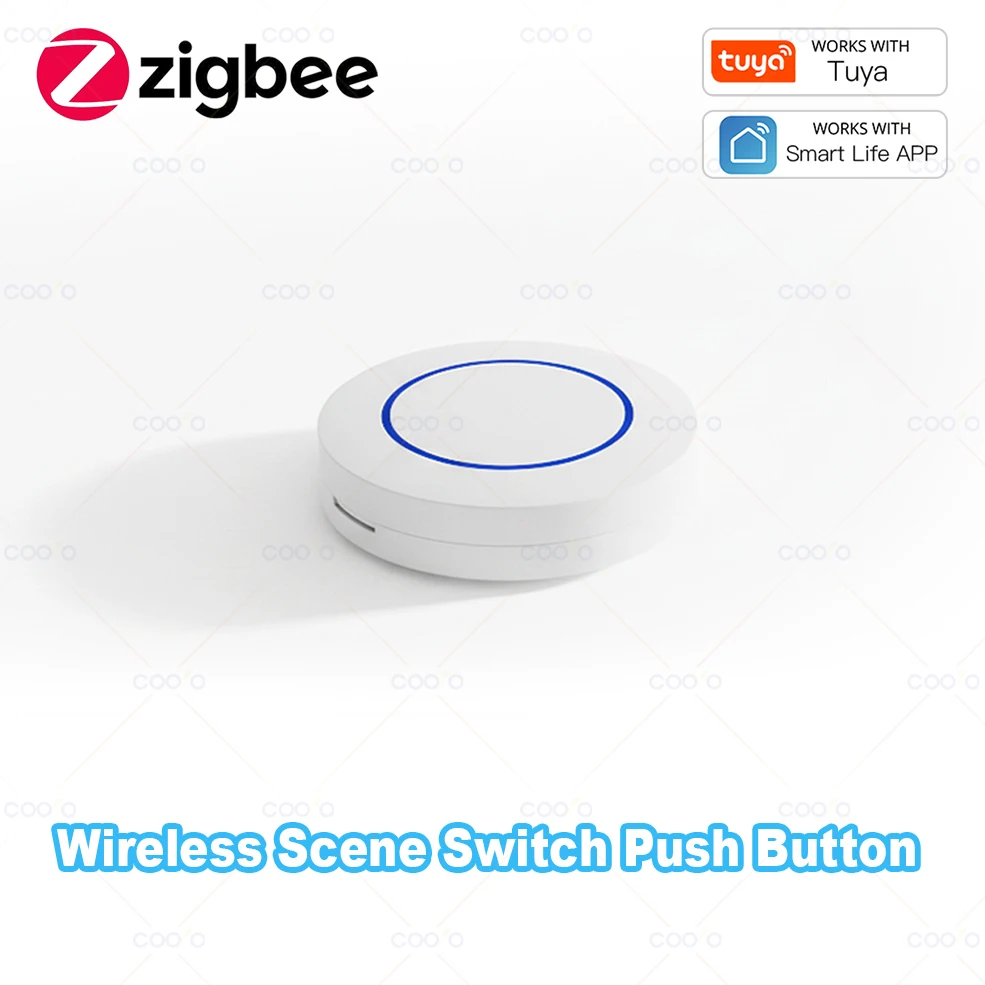
Visually, the Tuya ZigBee Wireless Scene Switch presents a minimalist, circular aesthetic, predominantly in white with a subtle blue accent ring. Its compact dimensions, measuring 45 x 45 x 14 mm, ensure it can be discreetly placed or mounted in virtually any location without drawing undue attention. It blends with decor. The visible materials imply a standard ABS plastic construction, offering a balance of lightweight design and everyday durability.
The tactile feedback from the push button appears to be a simple mechanical click, typical of such devices. While the images do not provide a microscopic view of internal components, the overall construction suggests a product designed for functional longevity. The stated life cycle of 30,000 presses or 2 years for the battery, whichever comes first, points to a reasonable expectation of durability for its intended use. This is a practical lifespan.
The absence of complex moving parts or external ports contributes to its resilience against dust and minor spills, making it suitable for various indoor environments. Its wireless nature means no unsightly cables are required, enhancing its aesthetic appeal and placement flexibility. The simplicity of its form factor is a strength. This design philosophy prioritizes unobtrusive integration into the smart home, allowing the technology to fade into the background while providing seamless control.
From a performance standpoint, the choice of Zigbee 3.0 is a significant differentiator. This protocol typically delivers lower latency compared to many Wi-Fi-based smart home devices. Commands issued via the switch are processed and executed with minimal delay, which is crucial for actions requiring immediate feedback, such as turning lights on or off. Responsiveness is key.
The low power consumption inherent to Zigbee devices is another major operational advantage, directly impacting battery life. The switch is powered by a standard CR2032 or CR2450 coin cell battery, which is included. The estimated 2-year lifespan or 30,000 presses before replacement is a testament to its energy efficiency. This minimizes maintenance. Users can expect extended periods of operation without needing to worry about frequent battery changes, contributing to a hassle-free experience.
Furthermore, the ability to operate in a "remote mode" allows the switch to function as a direct dimmer for compatible Zigbee bulbs within the Tuya ecosystem. This provides an additional layer of convenience, offering a physical control point for lighting adjustments without relying solely on the app. This direct control is very useful. This capability underscores the switch's versatility, moving beyond mere scene activation to include direct device manipulation.
This wireless scene switch represents a significant upgrade from solely app-based smart home control. Unlike the constant need to pull out a smartphone, unlock it, open an app, and navigate to a specific device or scene, this physical button offers immediate, tactile interaction. It provides instant access. This is especially valuable for quick actions or for situations where a phone might not be readily accessible, such as entering a room.
The strategic placement of multiple switches throughout a home can create a truly intuitive and responsive environment. Imagine a switch by the bed for "Goodnight" routines, another by the door for "Leaving Home" automations, and one in the living room for media control. This distributed control architecture empowers users to interact with their smart home naturally. It simplifies daily routines. This approach contrasts sharply with relying on voice assistants, which, while convenient, may not always be appropriate or private in every context.
The ability to integrate this device into complex Home Assistant setups, provided the gateway supports it, offers an additional layer of local control and customization. This moves beyond the default Tuya cloud reliance, appealing to advanced users who prioritize privacy and robust, offline functionality. Local control is a powerful feature. This flexibility ensures the switch remains a valuable asset even as smart home ecosystems evolve.
Considering its price point, the Tuya ZigBee Wireless Scene Switch offers substantial value as an automation trigger. Compared to hardwired smart switches, which often require electrical work and permanent installation, this wireless button provides unparalleled flexibility. It avoids wiring complexities. Its portability means it can be repositioned as needs change, without any tools or professional assistance.
When juxtaposed with other wireless smart buttons, its adherence to the Zigbee 3.0 standard is a key advantage. Many generic wireless buttons might use proprietary protocols or older, less efficient versions of Zigbee. The 3.0 standard ensures broader compatibility within the Zigbee ecosystem and often guarantees better performance. This is a modern standard. The integration with the ubiquitous Tuya platform also simplifies the user journey, as many smart home devices already operate within this framework.
The long battery life further cements its value, reducing the total cost of ownership over time. While the initial investment in a Zigbee gateway is necessary, this switch leverages that existing infrastructure efficiently. It makes the gateway more useful. For users already possessing a Tuya Zigbee gateway, this scene switch is a highly cost-effective and impactful addition, significantly enhancing their smart home control capabilities.
Imagine a home where every interaction is seamless, intuitive, and perfectly tailored to your routines. With a subtle press of this compact switch, your living room transforms into a cinematic haven, lights dimming to the perfect ambiance as your smart TV hums to life. Picture waking up, a single touch initiating your morning ritual: blinds gently rising, coffee maker starting, and soft lighting guiding your way. This switch isn't just a button; it's a gateway to effortless living, providing instant command over your environment without ever needing to reach for your phone. It simplifies your smart home. This tactile control fosters a more natural and integrated experience, making your automated space truly feel like an extension of your intentions.
The Zigbee Protocol Foundation
The operational backbone of this scene switch is the Zigbee 3.0 communication protocol. Unlike Wi-Fi, which often contends with network congestion and higher power draw, Zigbee is specifically designed for low-power, low-bandwidth mesh networking. This architectural choice is paramount for devices like scene switches. A single press consumes minimal energy.
Zigbee's mesh topology allows each device, including this switch, to potentially relay signals from other devices, effectively extending the network's reach and enhancing signal reliability. This means commands do not solely rely on direct line-of-sight to the central gateway. In a multi-story home, this creates a resilient network. A 30-meter open-area working range is specified.
This inherent mesh capability provides a significant advantage over point-to-point wireless solutions, particularly in environments with physical obstructions or interference. The protocol's efficiency minimizes data overhead, contributing to the swift execution of commands. Users experience near-instantaneous responses. This efficiency translates directly into a more fluid and less frustrating smart home experience, crucial for actions like lighting control where noticeable delays can detract from the convenience.
Intuitive Control Mechanisms
The design of the Tuya ZigBee Wireless Scene Switch centers around a single, tactile push button, yet its functionality is far from singular. It supports three distinct interaction types: a single press, a double press, and a long press (held for over 3 seconds). This multi-action capability is a cornerstone of its utility. Three distinct commands are available.
Each of these press actions can be meticulously configured within the Tuya or Smart Life application, allowing for a high degree of customization. For instance, a single press could activate a "Welcome Home" scene, illuminating entryways and adjusting the thermostat. A double press might trigger a "Movie Night" scene, dimming lights, closing smart blinds, and powering on entertainment systems. The long press could serve as a universal "Goodnight" command, deactivating all lights and locking smart doors. This granular control transforms a simple button into a powerful automation trigger.
This versatility significantly elevates the user experience by providing a physical interface for complex automations that would otherwise require navigating a smartphone app. It reduces screen time. Such a dedicated control point is particularly beneficial for household members who may not have constant access to a smartphone or prefer a more traditional interaction method. The ease of programming these actions ensures that even novice smart home users can quickly adapt the switch to their specific needs.
Ecosystem Integration and Gateway Imperative
The Tuya ZigBee Wireless Scene Switch is deeply embedded within the Tuya/Smart Life ecosystem. This integration provides a streamlined setup and management experience for users already invested in this popular smart home platform. The application serves as the central hub for defining scenes, assigning actions, and monitoring device status. All configuration happens in the app.
A critical point of understanding is the absolute necessity of a Zigbee gateway (or hub) for this device to function. The switch does not directly connect to a Wi-Fi router. The gateway acts as a translator, bridging the Zigbee network to the home's IP network and, subsequently, to the Tuya cloud services. Without this intermediary, the switch remains an inert piece of hardware. This requirement is a fundamental aspect of Zigbee architecture.
This gateway requirement is a deliberate design choice that enhances network stability and scalability, but it also represents an initial investment for new Zigbee users. Unlike standalone Wi-Fi smart devices, Zigbee devices form their own robust mesh network, which the gateway manages. For advanced users, a third-party universal Zigbee hub like Home Assistant can potentially integrate this switch, offering local control and broader compatibility, bypassing some cloud dependencies. This offers greater flexibility.
Physical Design and Durability Considerations
Visually, the Tuya ZigBee Wireless Scene Switch presents a minimalist, circular aesthetic, predominantly in white with a subtle blue accent ring. Its compact dimensions, measuring 45 x 45 x 14 mm, ensure it can be discreetly placed or mounted in virtually any location without drawing undue attention. It blends with decor. The visible materials imply a standard ABS plastic construction, offering a balance of lightweight design and everyday durability.
The tactile feedback from the push button appears to be a simple mechanical click, typical of such devices. While the images do not provide a microscopic view of internal components, the overall construction suggests a product designed for functional longevity. The stated life cycle of 30,000 presses or 2 years for the battery, whichever comes first, points to a reasonable expectation of durability for its intended use. This is a practical lifespan.
The absence of complex moving parts or external ports contributes to its resilience against dust and minor spills, making it suitable for various indoor environments. Its wireless nature means no unsightly cables are required, enhancing its aesthetic appeal and placement flexibility. The simplicity of its form factor is a strength. This design philosophy prioritizes unobtrusive integration into the smart home, allowing the technology to fade into the background while providing seamless control.
Performance Metrics and Operational Advantages
From a performance standpoint, the choice of Zigbee 3.0 is a significant differentiator. This protocol typically delivers lower latency compared to many Wi-Fi-based smart home devices. Commands issued via the switch are processed and executed with minimal delay, which is crucial for actions requiring immediate feedback, such as turning lights on or off. Responsiveness is key.
The low power consumption inherent to Zigbee devices is another major operational advantage, directly impacting battery life. The switch is powered by a standard CR2032 or CR2450 coin cell battery, which is included. The estimated 2-year lifespan or 30,000 presses before replacement is a testament to its energy efficiency. This minimizes maintenance. Users can expect extended periods of operation without needing to worry about frequent battery changes, contributing to a hassle-free experience.
Furthermore, the ability to operate in a "remote mode" allows the switch to function as a direct dimmer for compatible Zigbee bulbs within the Tuya ecosystem. This provides an additional layer of convenience, offering a physical control point for lighting adjustments without relying solely on the app. This direct control is very useful. This capability underscores the switch's versatility, moving beyond mere scene activation to include direct device manipulation.
Expanding Smart Home Capabilities
This wireless scene switch represents a significant upgrade from solely app-based smart home control. Unlike the constant need to pull out a smartphone, unlock it, open an app, and navigate to a specific device or scene, this physical button offers immediate, tactile interaction. It provides instant access. This is especially valuable for quick actions or for situations where a phone might not be readily accessible, such as entering a room.
The strategic placement of multiple switches throughout a home can create a truly intuitive and responsive environment. Imagine a switch by the bed for "Goodnight" routines, another by the door for "Leaving Home" automations, and one in the living room for media control. This distributed control architecture empowers users to interact with their smart home naturally. It simplifies daily routines. This approach contrasts sharply with relying on voice assistants, which, while convenient, may not always be appropriate or private in every context.
The ability to integrate this device into complex Home Assistant setups, provided the gateway supports it, offers an additional layer of local control and customization. This moves beyond the default Tuya cloud reliance, appealing to advanced users who prioritize privacy and robust, offline functionality. Local control is a powerful feature. This flexibility ensures the switch remains a valuable asset even as smart home ecosystems evolve.
Value Proposition and Comparative Analysis
Considering its price point, the Tuya ZigBee Wireless Scene Switch offers substantial value as an automation trigger. Compared to hardwired smart switches, which often require electrical work and permanent installation, this wireless button provides unparalleled flexibility. It avoids wiring complexities. Its portability means it can be repositioned as needs change, without any tools or professional assistance.
When juxtaposed with other wireless smart buttons, its adherence to the Zigbee 3.0 standard is a key advantage. Many generic wireless buttons might use proprietary protocols or older, less efficient versions of Zigbee. The 3.0 standard ensures broader compatibility within the Zigbee ecosystem and often guarantees better performance. This is a modern standard. The integration with the ubiquitous Tuya platform also simplifies the user journey, as many smart home devices already operate within this framework.
The long battery life further cements its value, reducing the total cost of ownership over time. While the initial investment in a Zigbee gateway is necessary, this switch leverages that existing infrastructure efficiently. It makes the gateway more useful. For users already possessing a Tuya Zigbee gateway, this scene switch is a highly cost-effective and impactful addition, significantly enhancing their smart home control capabilities.
The Future of Interaction
Imagine a home where every interaction is seamless, intuitive, and perfectly tailored to your routines. With a subtle press of this compact switch, your living room transforms into a cinematic haven, lights dimming to the perfect ambiance as your smart TV hums to life. Picture waking up, a single touch initiating your morning ritual: blinds gently rising, coffee maker starting, and soft lighting guiding your way. This switch isn't just a button; it's a gateway to effortless living, providing instant command over your environment without ever needing to reach for your phone. It simplifies your smart home. This tactile control fosters a more natural and integrated experience, making your automated space truly feel like an extension of your intentions.