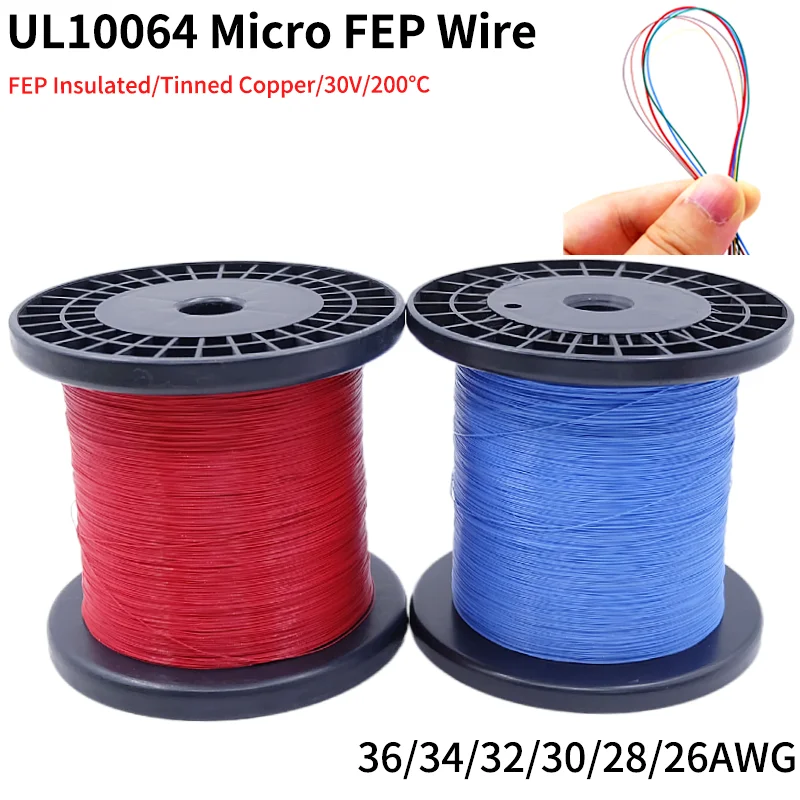
UL10064 Micro FEP Tinned Copper Wire
Official Store Deal
Expert Analysis Overview
Precision Conductors for Micro-Electronics
The UL10064 Micro FEP Wire is a specialized, high-performance conductor critically engineered for demanding miniature electronic applications where thermal stability and precise signal integrity are paramount. This wire is not a general-purpose solution. It addresses the specific needs of intricate circuit work, offering a robust yet incredibly fine-gauge option for professionals and advanced hobbyists. The UL10064 designation immediately signals adherence to recognized safety and performance standards, a non-negotiable aspect for any electrical component. Its construction, featuring FEP insulation and tinned copper conductors, positions it as a superior choice over standard PVC-insulated wires for environments requiring enhanced thermal and chemical resistance.The Art of Ultra-Fine Gauges
This product offers a comprehensive range of ultra-fine American Wire Gauges (AWG), specifically 36, 34, 32, 30, 28, and 26 AWG. Each gauge is meticulously specified, for instance, 26AWG features 7 strands of 0.16mm tinned copper (7/0.16TS) with an outer diameter (OD) of 0.70mm, while the incredibly fine 36AWG uses 7 strands of 0.05mm tinned copper (7/0.05TS) resulting in an OD of just 0.28mm. These precise dimensions are critical. Such minute diameters allow for wiring in extremely confined spaces, a common challenge in modern compact electronics.The implication of these fine gauges extends directly to current carrying capacity and signal integrity. Smaller gauges inherently carry less current, making careful load calculations essential to prevent overheating. However, their primary benefit lies in their ability to facilitate complex routing and high-density interconnections within miniaturized devices. This capability is often unattainable with larger, more rigid wires. Compared to standard hook-up wires, which typically start at 24AWG or larger, these micro FEP wires open up possibilities for repairs and custom builds in devices like smartwatches, drones, or intricate sensor arrays where space is the ultimate constraint.
Thermal Resilience and Dielectric Strength
Central to this wire's performance is its FEP (Fluorinated Ethylene Propylene) insulation, a type of PTFE plastic. FEP is renowned for its exceptional thermal stability, chemical inertness, and superior dielectric properties. The wire is rated for an impressive 200°C (392°F) operating temperature. This high-temperature rating is a significant advantage.In practical applications, this means the wire can withstand considerable heat generated by nearby components or during the soldering process without degrading. This prevents insulation breakdown, which is a common failure point in less robust wires. For instance, in a tightly packed circuit board where heat dissipation is limited, FEP insulation maintains its integrity far better than conventional PVC. Standard PVC insulation typically has a maximum operating temperature of 80-105°C, making FEP a vastly more reliable choice for high-thermal environments.
Furthermore, FEP's excellent dielectric strength ensures minimal signal loss and prevents electrical leakage, even at its rated 30V. This is crucial for sensitive electronic circuits where signal fidelity is paramount. The material's resistance to various chemicals, oils, and solvents also contributes to its longevity and reliability in harsh operating conditions, offering a level of protection that standard insulations cannot match.
Precision Conductivity Core: Tinned Copper
The conductor material is tinned copper, a deliberate choice that enhances both performance and ease of use. Copper is an excellent electrical conductor, known for its low resistance. The tin plating serves multiple critical functions. It significantly improves solderability, allowing for quicker and more reliable connections, especially with such fine strands. This is a major time-saver.The tin coating also provides superior corrosion resistance compared to bare copper. This protection is vital for the long-term reliability of connections, particularly in environments with humidity or exposure to corrosive agents. Over time, bare copper can oxidize, increasing resistance and potentially leading to intermittent connections or complete circuit failure. Tinned copper mitigates this risk, ensuring stable electrical pathways for the lifespan of the device. Unlike untinned copper, which can be challenging to solder cleanly and is prone to oxidation, tinned copper offers a robust and user-friendly solution for intricate wiring tasks.
Strategic Procurement and Project Planning
The product's shipping notes detail important considerations for ordering, particularly regarding length. For "POP orders," the product is supplied in a continuous length, meaning if 10 meters are ordered, a single 10-meter piece is received. Conversely, "Choice Day orders" will result in the product being cut to the order quantity, so two 5-meter quantities would yield two 5-meter pieces. This distinction is crucial for project planning.Understanding this policy prevents unexpected shortages or excess waste, especially for projects requiring specific continuous lengths. For instance, if a long, uninterrupted run is necessary for a sensor array, a "POP order" ensures continuity. This level of transparency in shipping practices allows for precise material management, which is often overlooked but vital for efficient project execution. Unlike many generic suppliers who may ship arbitrary lengths, this clear policy enables electricians and technicians to order with confidence, knowing exactly what to expect for their specific wiring needs.
Additionally, orders less than 50 meters are shipped with cardboard packaging, while orders exceeding 50 meters are provided on a wire reel. This packaging strategy is practical. The reels prevent tangling and damage to longer lengths during transit and storage, maintaining the wire's integrity until use. Smaller quantities are adequately protected by cardboard, reducing unnecessary packaging waste. This thoughtful approach to packaging ensures the wire arrives in optimal condition, regardless of the quantity purchased.
Ensuring Electrical Safety and Compliance
The UL10064 designation is not merely a label; it signifies that the wire has been tested and meets specific safety standards established by Underwriters Laboratories. This standard is particularly relevant for internal wiring of electronic equipment. Adherence to UL standards provides assurance regarding the wire's insulation integrity, temperature resistance, and overall safety performance. It is a critical factor for any component intended for integration into consumer or industrial electronics.For electricians and product developers, using UL-listed components simplifies compliance with broader electrical codes and safety regulations. This minimizes the risk of electrical fires, short circuits, or other hazards that can arise from substandard wiring. The 30V rating, while low, is appropriate for the intended micro-electronic applications, ensuring that the wire's insulation is robust enough for typical low-voltage control and signal circuits. Unlike unrated or generic wires, the UL10064 certification provides a verifiable benchmark for quality and safety, reducing liability and enhancing the overall reliability of the final product.
The Long-Term Value Proposition
Investing in specialized wire like the UL10064 Micro FEP wire might appear to have a higher initial cost per meter compared to bulk, general-purpose wire. However, its long-term value proposition is substantial. The superior thermal, chemical, and electrical properties of FEP insulation combined with the corrosion resistance and solderability of tinned copper significantly reduce the likelihood of premature failure in critical applications. This translates directly into reduced maintenance, fewer reworks, and enhanced product longevity.For complex or high-value electronic assemblies, the cost of a wire failure far outweighs the marginal savings from using an inferior product. The reliability offered by this wire ensures that intricate repairs or custom builds perform as intended for extended periods, protecting the investment in components and labor. This is not merely a purchase; it is an investment in the reliability and performance of the electronic systems it will power. Unlike cheaper alternatives that might necessitate frequent replacements or lead to system instability, this wire provides a foundation of dependable performance, ultimately saving time and resources over the product's lifecycle.
Imagine the satisfaction of completing an intricate electronic repair or a custom build, knowing that every connection is robust, thermally stable, and chemically resistant. The precision of the ultra-fine gauges allows for clean, professional routing in the tightest enclosures, while the FEP insulation provides peace of mind against thermal stress and environmental degradation. This wire empowers the creation of reliable, high-performance micro-electronic devices, ensuring that your meticulous work stands the test of time and operational demands. It is the foundation for projects that demand uncompromising quality and enduring functionality. This wire is a critical enabler for innovation in miniaturized electronics, allowing for designs that push the boundaries of what is possible in compact form factors. It ensures that the internal wiring is not a weak link but a strong, reliable component in the overall system architecture. The ability to work with such fine, yet durable, conductors opens up new avenues for intricate circuit design and repair, making previously challenging tasks achievable with greater precision and confidence. This is the kind of component that elevates a project from functional to exceptional, providing the underlying reliability that complex electronics demand. The peace of mind that comes from using a UL-rated, high-performance wire in sensitive applications is invaluable, preventing costly failures and ensuring consistent operation. It is a testament to engineering excellence, designed to meet the rigorous demands of modern micro-electronics. The wire's ability to maintain signal integrity and withstand harsh conditions means that once installed, it can be trusted to perform its function without compromise, allowing the focus to remain on the device's primary functionality rather than its internal connections. This is the kind of foundational quality that underpins truly reliable electronic systems, enabling innovation and ensuring long-term success in demanding applications.