Ultra-Quiet Submersible Water Fountain Pump
Official Store Deal
Expert Analysis Overview
The Ultra-Quiet Submersible Water Fountain Pump is a versatile aquatic circulation device designed for maintaining optimal water conditions in a range of environments, from small aquariums to medium-sized fish ponds and decorative fountains. This pump is engineered to deliver consistent water flow and filtration, directly contributing to the cleanliness and overall health of aquatic ecosystems. Its primary function is to circulate water, preventing stagnation and promoting aeration, which are critical factors for preventing foul odors and inhibiting the growth of harmful bacteria and algae.
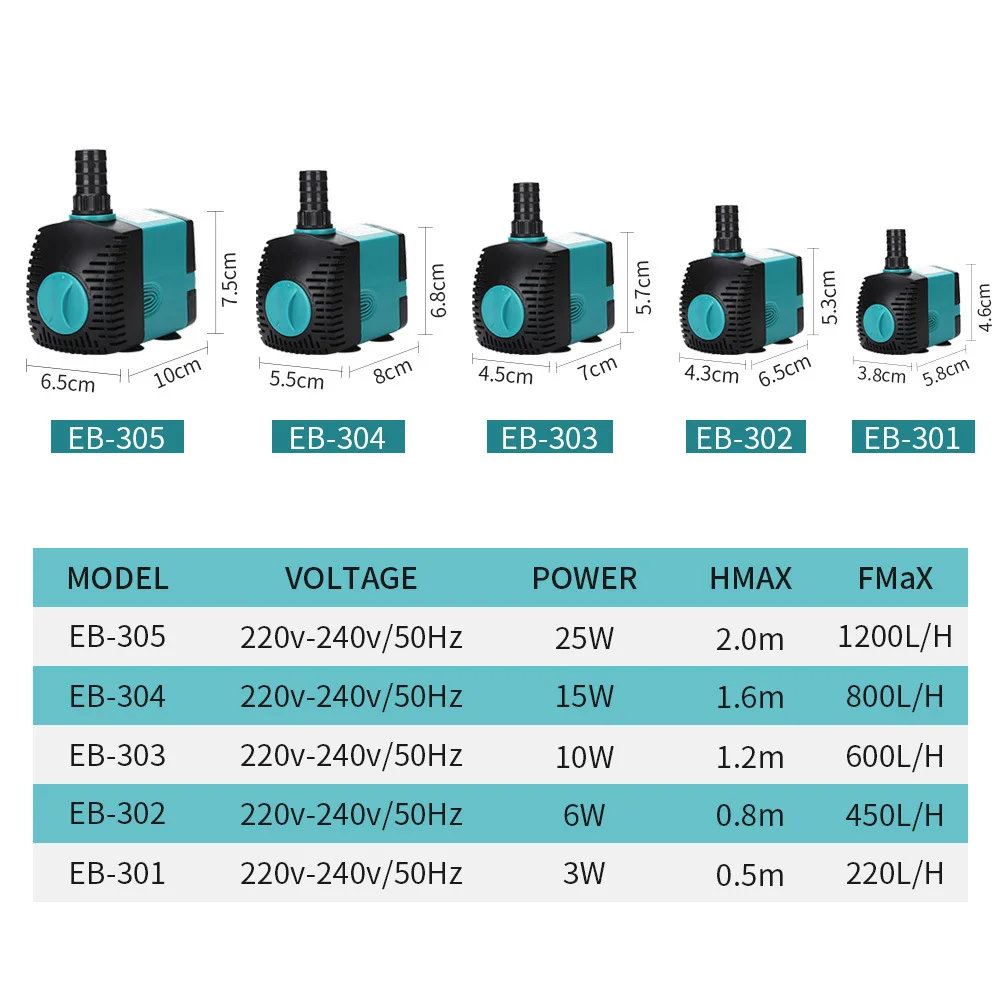
This series of submersible pumps offers a range of power outputs, from a modest 3W for smaller applications (EB-301) up to a robust 25W for more demanding tasks (EB-305). The voltage requirement is a standard 220V-240V at 50Hz, ensuring compatibility with most European and certain international electrical grids. These power ratings directly correlate with the pump's ability to move water efficiently and effectively.
In practical terms, a higher wattage pump like the EB-305 (25W) can achieve a maximum head (HMAX) of 2.0 meters and a maximum flow rate (FMAX) of 1200 liters per hour. This capability is crucial for larger aquariums or ponds, where significant water turnover is required to maintain clarity and oxygenation. Conversely, the smaller 3W EB-301 model, with its 0.5m HMAX and 220 L/H FMAX, is perfectly suited for desktop fountains or nano tanks, where excessive flow would be disruptive.
Compared to older, less efficient pump designs, these models offer improved power-to-flow ratios. Many entry-level pumps often consume more power for less output, leading to higher electricity bills and less effective water management. This series provides a tailored solution for various needs, ensuring that users can select a pump that matches their specific volumetric requirements without unnecessary energy expenditure. Efficient operation is key.
The flow rate, or FMAX, is a critical specification for any water pump, indicating the volume of water the pump can move per hour. For this series, flow rates range from 220 L/H to 1200 L/H, providing a spectrum of options for different aquatic setups. The head height, or HMAX, defines the maximum vertical distance the pump can push water against gravity.
Consider an aquarium owner with a 200-liter tank. A pump with a 600 L/H flow rate (like the EB-303) would cycle the entire tank volume three times an hour, which is generally considered a healthy turnover rate for maintaining water quality. This consistent movement prevents the formation of stagnant zones where detritus can accumulate and decompose, leading to unpleasant odors and poor water hygiene. Proper circulation is essential.
Many generic pumps often overstate their flow rates or provide inconsistent performance under real-world conditions, especially when pushing water to higher elevations. This series provides clear, graduated performance metrics, allowing for precise selection. This transparency helps users avoid the frustration of an underperforming pump that fails to keep their aquatic environment clean and fresh.
A standout feature of these pumps is the adjustable flow rate mechanism. A simple dial or lever on the pump's intake allows users to increase or decrease the water flow according to their specific needs. This adjustability is a significant advantage for fine-tuning the aquatic environment.
Imagine setting up a delicate planted aquarium where strong currents could damage plants or stress sensitive fish. The ability to dial down the flow ensures a gentle, yet effective, circulation. Conversely, for a pond filter system that requires a robust flow to push water through multiple media layers, the pump can be set to its maximum output. This flexibility prevents common issues like excessive turbulence or insufficient filtration.
Unlike fixed-output pumps, which often force users to compromise on either too much or too little flow, the adjustable design provides granular control. This adaptability extends the pump's utility across various applications, from creating a subtle ripple in a small water feature to powering a vigorous waterfall in a larger pond. It offers true customization.
The construction of these pumps emphasizes durability and resistance to the harsh aquatic environment. Key internal components include a high-quality magnet for efficient motor operation, a stainless steel axis for corrosion resistance and longevity, and durable plastic material for the impeller and housing. These choices are crucial for a device constantly submerged in water.
When operating in a fish pond or an aquarium, the pump is continuously exposed to waterborne particles, dissolved organic matter, and the potential for mineral buildup. The robust plastic housing is designed to resist degradation and prevent leaks, while the stainless steel axis ensures the impeller spins smoothly without succumbing to rust or wear. This prevents premature failure and maintains consistent performance, which is vital for uninterrupted filtration and hygiene.
Many budget pumps utilize lower-grade plastics and carbon steel components that quickly corrode or become brittle, leading to pump failure and potential water contamination. The use of a stainless steel axis, in particular, is an upgrade over less durable alternatives, ensuring the pump's core mechanism remains functional over extended periods. This contributes to a cleaner environment.
From a hygiene specialist's perspective, the design and performance of this pump directly address common issues in aquatic environments: odor control, ease of cleaning, and prevention of debris accumulation. The consistent circulation of water is the first line of defense against stagnant odors, which arise from anaerobic decomposition of organic matter.
Regular water movement, facilitated by the pump, ensures oxygenation throughout the water column, promoting aerobic bacterial activity that breaks down waste more effectively. This process significantly reduces the likelihood of unpleasant smells emanating from the tank or pond. A well-circulated system inherently smells cleaner.
Furthermore, the pump's design, particularly its ease of disassembly, simplifies routine maintenance. Users can readily access the impeller and internal chambers for cleaning, removing accumulated sludge, algae, or pet hair that might otherwise clog the system. This direct access is a significant improvement over sealed units that are difficult or impossible to clean thoroughly, leading to reduced efficiency and potential hygiene issues over time. Preventing clogs is crucial.
The intake design of these pumps features a grated cover that acts as a pre-filter, preventing larger debris, such as leaves, uneaten food, or pet hair, from entering the impeller chamber. This is particularly important in environments with pets, where shed fur can quickly foul a pump.
By keeping larger particles out, the pump's internal components remain cleaner, reducing the frequency of deep cleaning required. This also ensures the pump maintains its optimal flow rate, as a clogged impeller cannot move water efficiently. For pet owners, this means less worry about pump failure due to hair entanglement and a consistently clearer water column.
Compared to pumps with wide-open intakes, which are prone to sucking in and jamming on various forms of detritus, this pump's protective grating is a thoughtful addition. It minimizes the effort required to keep the pump running smoothly and the water free from visible floating debris. This design choice directly supports a cleaner, healthier aquatic habitat. Less debris means less mess.
The product's title highlights its
Sustaining Aquatic Vitality: Power and Performance
This series of submersible pumps offers a range of power outputs, from a modest 3W for smaller applications (EB-301) up to a robust 25W for more demanding tasks (EB-305). The voltage requirement is a standard 220V-240V at 50Hz, ensuring compatibility with most European and certain international electrical grids. These power ratings directly correlate with the pump's ability to move water efficiently and effectively.
In practical terms, a higher wattage pump like the EB-305 (25W) can achieve a maximum head (HMAX) of 2.0 meters and a maximum flow rate (FMAX) of 1200 liters per hour. This capability is crucial for larger aquariums or ponds, where significant water turnover is required to maintain clarity and oxygenation. Conversely, the smaller 3W EB-301 model, with its 0.5m HMAX and 220 L/H FMAX, is perfectly suited for desktop fountains or nano tanks, where excessive flow would be disruptive.
Compared to older, less efficient pump designs, these models offer improved power-to-flow ratios. Many entry-level pumps often consume more power for less output, leading to higher electricity bills and less effective water management. This series provides a tailored solution for various needs, ensuring that users can select a pump that matches their specific volumetric requirements without unnecessary energy expenditure. Efficient operation is key.
Maintaining Pristine Currents: Flow Rate and Head Height
The flow rate, or FMAX, is a critical specification for any water pump, indicating the volume of water the pump can move per hour. For this series, flow rates range from 220 L/H to 1200 L/H, providing a spectrum of options for different aquatic setups. The head height, or HMAX, defines the maximum vertical distance the pump can push water against gravity.
Consider an aquarium owner with a 200-liter tank. A pump with a 600 L/H flow rate (like the EB-303) would cycle the entire tank volume three times an hour, which is generally considered a healthy turnover rate for maintaining water quality. This consistent movement prevents the formation of stagnant zones where detritus can accumulate and decompose, leading to unpleasant odors and poor water hygiene. Proper circulation is essential.
Many generic pumps often overstate their flow rates or provide inconsistent performance under real-world conditions, especially when pushing water to higher elevations. This series provides clear, graduated performance metrics, allowing for precise selection. This transparency helps users avoid the frustration of an underperforming pump that fails to keep their aquatic environment clean and fresh.
Precision in Flow Management: Adjustable Output
A standout feature of these pumps is the adjustable flow rate mechanism. A simple dial or lever on the pump's intake allows users to increase or decrease the water flow according to their specific needs. This adjustability is a significant advantage for fine-tuning the aquatic environment.
Imagine setting up a delicate planted aquarium where strong currents could damage plants or stress sensitive fish. The ability to dial down the flow ensures a gentle, yet effective, circulation. Conversely, for a pond filter system that requires a robust flow to push water through multiple media layers, the pump can be set to its maximum output. This flexibility prevents common issues like excessive turbulence or insufficient filtration.
Unlike fixed-output pumps, which often force users to compromise on either too much or too little flow, the adjustable design provides granular control. This adaptability extends the pump's utility across various applications, from creating a subtle ripple in a small water feature to powering a vigorous waterfall in a larger pond. It offers true customization.
Durability and Debris Defense: Build Quality and Materials
The construction of these pumps emphasizes durability and resistance to the harsh aquatic environment. Key internal components include a high-quality magnet for efficient motor operation, a stainless steel axis for corrosion resistance and longevity, and durable plastic material for the impeller and housing. These choices are crucial for a device constantly submerged in water.
When operating in a fish pond or an aquarium, the pump is continuously exposed to waterborne particles, dissolved organic matter, and the potential for mineral buildup. The robust plastic housing is designed to resist degradation and prevent leaks, while the stainless steel axis ensures the impeller spins smoothly without succumbing to rust or wear. This prevents premature failure and maintains consistent performance, which is vital for uninterrupted filtration and hygiene.
Many budget pumps utilize lower-grade plastics and carbon steel components that quickly corrode or become brittle, leading to pump failure and potential water contamination. The use of a stainless steel axis, in particular, is an upgrade over less durable alternatives, ensuring the pump's core mechanism remains functional over extended periods. This contributes to a cleaner environment.
Hygiene Maintenance: Preventing Odors and Accumulation
From a hygiene specialist's perspective, the design and performance of this pump directly address common issues in aquatic environments: odor control, ease of cleaning, and prevention of debris accumulation. The consistent circulation of water is the first line of defense against stagnant odors, which arise from anaerobic decomposition of organic matter.
Regular water movement, facilitated by the pump, ensures oxygenation throughout the water column, promoting aerobic bacterial activity that breaks down waste more effectively. This process significantly reduces the likelihood of unpleasant smells emanating from the tank or pond. A well-circulated system inherently smells cleaner.
Furthermore, the pump's design, particularly its ease of disassembly, simplifies routine maintenance. Users can readily access the impeller and internal chambers for cleaning, removing accumulated sludge, algae, or pet hair that might otherwise clog the system. This direct access is a significant improvement over sealed units that are difficult or impossible to clean thoroughly, leading to reduced efficiency and potential hygiene issues over time. Preventing clogs is crucial.
Combating Debris and Hair Accumulation
The intake design of these pumps features a grated cover that acts as a pre-filter, preventing larger debris, such as leaves, uneaten food, or pet hair, from entering the impeller chamber. This is particularly important in environments with pets, where shed fur can quickly foul a pump.
By keeping larger particles out, the pump's internal components remain cleaner, reducing the frequency of deep cleaning required. This also ensures the pump maintains its optimal flow rate, as a clogged impeller cannot move water efficiently. For pet owners, this means less worry about pump failure due to hair entanglement and a consistently clearer water column.
Compared to pumps with wide-open intakes, which are prone to sucking in and jamming on various forms of detritus, this pump's protective grating is a thoughtful addition. It minimizes the effort required to keep the pump running smoothly and the water free from visible floating debris. This design choice directly supports a cleaner, healthier aquatic habitat. Less debris means less mess.
Operational Acoustics: The Ultra-Quiet Promise
The product's title highlights its