XL6019 Automatic Buck-Boost DC-DC Converter Module
Official Store Deal
Expert Analysis Overview
Precision Power Regulation: An Expert Overview
The XL6019 Automatic Step-Up Step-Down Converter is a versatile power regulation module designed for hobbyists and technicians requiring stable voltage across fluctuating input conditions. This module distinguishes itself by offering both buck (step-down) and boost (step-up) capabilities within a single compact footprint. It addresses common power supply challenges where input voltage may vary significantly, or where the desired output voltage falls outside the direct range of a simple step-down or step-up converter. The integrated design simplifies complex power management tasks, providing a stable output for sensitive electronics.The Heart of the Conversion: Circuitry Under Scrutiny
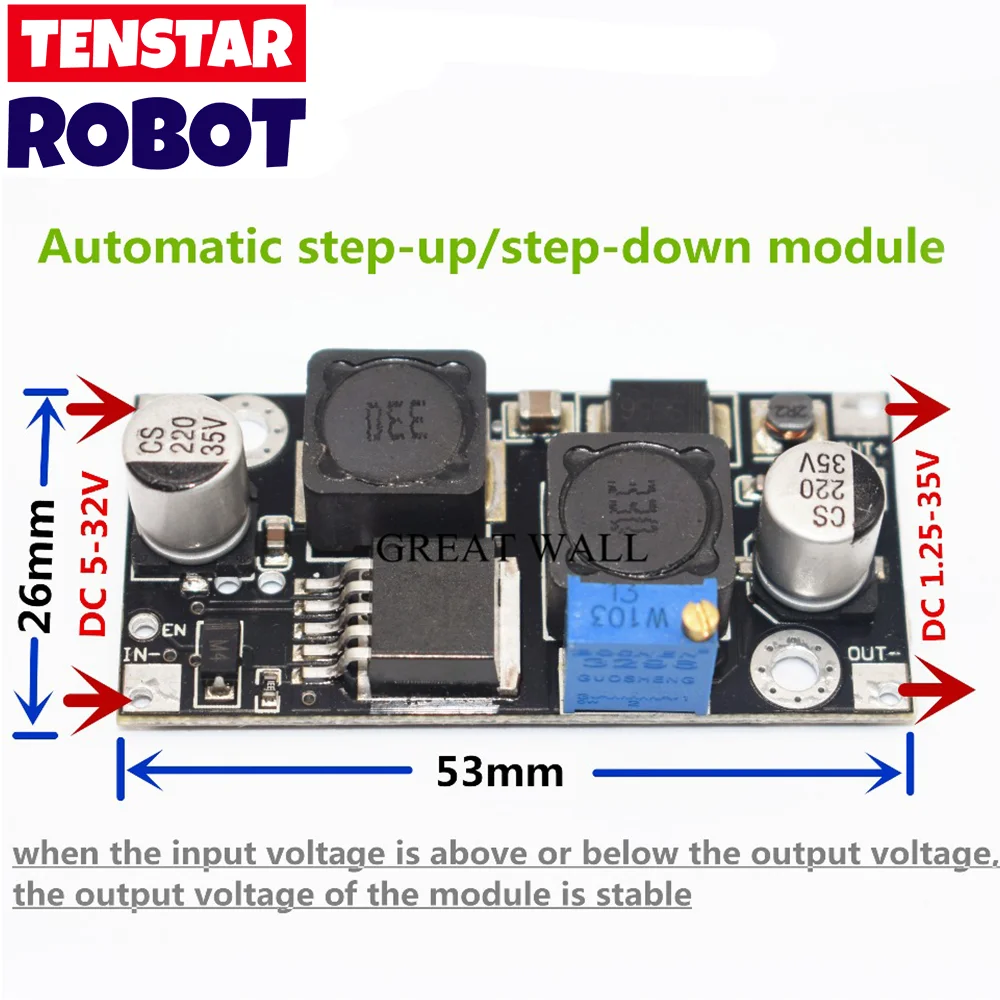
At the core of this module's functionality is the XL6019 switching regulator IC, an upgrade from the XL6009. This integrated circuit is responsible for the synchronous rectification and efficient energy transfer that enables both buck and boost operations. The XL6019's architecture allows for a wide input voltage range and provides robust output regulation. Its internal switching frequency is optimized for compact inductor sizes and high efficiency.The visible inductors, marked '330', are critical components in the DC-DC conversion process. These inductors store energy during one phase of the switching cycle and release it during another, smoothing the current flow. The physical size and visible winding quality of these inductors suggest a design capable of handling the advertised 20W power output without excessive saturation under typical loads. Proper inductance is crucial.
Capacitors, specifically the 220µF 35V SYK electrolytic capacitors, are strategically placed at both input and output stages. These components serve to filter ripple voltage and stabilize the power rails. The SYK branding indicates a common manufacturer in the electronics component market, suggesting standard quality. The voltage rating of 35V provides ample headroom for the specified input and output ranges, contributing to overall circuit reliability and longevity. These capacitors ensure clean power delivery.
Regulated Power Delivery: Performance and Adjustability
The module accepts a broad input voltage range of DC 5V to 32V. This wide tolerance makes it highly adaptable for various power sources, from standard 12V automotive systems to 24V industrial supplies, or even multi-cell battery packs. The ability to operate effectively across such a range minimizes the need for multiple specialized converters, streamlining project designs and reducing component inventory.Output voltage is adjustable from 1.3V to 35V, a significant feature that enhances its utility. A small blue multi-turn potentiometer is visible on the board, allowing for fine-tuning of the output voltage. This level of adjustability is invaluable for prototyping, testing, and powering diverse electronic loads that require precise voltage levels. The multi-turn design typically offers greater precision compared to single-turn potentiometers, making exact voltage setting easier. Small adjustments are possible.
With a maximum power output of 20W, this converter is suitable for a range of medium-power applications. This includes powering microcontrollers, driving LED strips, charging batteries, or providing regulated power to small motors and sensors. While 20W is respectable for its size, it's important to consider thermal management for continuous operation at higher loads. The absence of a dedicated heatsink implies that sustained operation near the 20W limit might require additional cooling, especially in enclosed environments. Efficiency is key here.
Build Quality and Connectivity: A Closer Look
The PCB (Printed Circuit Board) itself is a black, double-sided board with clear white silkscreen markings for input ('IN+') and output ('OUT+'). The 'TENSTAR ROBOT' branding is visible on both sides, indicating the module's origin. The soldering points appear clean and consistent across the board, suggesting automated manufacturing processes. Good solder joints are critical for long-term reliability and efficient current flow, minimizing resistance and heat generation. The board dimensions are approximately 53mm x 26mm, making it a compact solution for integration into tight spaces.Input and output connections are provided via through-hole pads, suitable for soldering wires directly or attaching pin headers. This offers flexibility in integration, allowing users to choose their preferred connection method. The robust nature of soldered connections, when properly executed, ensures excellent electrical contact and mechanical stability. Unlike screw terminals which can loosen over time, soldered connections provide a permanent and secure interface. Secure connections are vital.
Operational Considerations and Potential Applications
This module's automatic step-up/step-down capability is particularly beneficial in scenarios where the input voltage fluctuates around the desired output voltage. For instance, if a battery's voltage drops below the required output as it discharges, the module automatically switches to boost mode. Conversely, if the input voltage exceeds the output, it operates in buck mode. This seamless transition ensures a continuously stable output, preventing system resets or damage to sensitive components. Stable power is guaranteed.Consider a portable device powered by a variable voltage source, such as a solar panel or a battery pack that discharges over time. This converter can maintain a constant voltage for the device, regardless of the input fluctuations. It can also be used to create a stable 5V or 12V rail from a higher or lower voltage source in embedded systems. For example, powering a 5V microcontroller from a 12V lead-acid battery or boosting a 3.7V Li-ion cell to 12V for a small display. Its versatility is a major asset.
Compared to simpler linear regulators, which dissipate excess voltage as heat and can only step down, this switching converter offers significantly higher efficiency and the ability to step up voltage. Unlike fixed-output switching regulators, its adjustable output provides greater flexibility. This makes it a superior choice for applications demanding efficiency and adaptability, especially when battery life or thermal management is a concern. Efficiency is a key differentiator.
Ensuring Longevity and Safe Operation
While the module is designed for efficiency, continuous operation at its maximum 20W output, especially in high ambient temperatures or enclosed spaces, may lead to overheating. Monitoring the temperature of the main IC and inductors during initial setup and load testing is a prudent practice. If excessive heat is detected, consider adding a small heatsink to the XL6019 chip or improving airflow around the module. Proper thermal management extends component lifespan. Heat management is important.For applications requiring very low noise output, such as sensitive audio circuits or precision measurement equipment, additional output filtering may be beneficial. While the onboard capacitors provide good general-purpose filtering, specific applications might demand even cleaner power. The module's compact size and robust design make it an excellent choice for integrating into custom enclosures or existing electronic projects. It's a reliable building block.
Imagine completing a complex electronics project, confident that your critical components receive a perfectly stable voltage, regardless of the power source's whims. This module eliminates the frustration of fluctuating power, allowing your creations to perform reliably and consistently. It's the silent workhorse ensuring your designs function as intended, from the initial prototype to the final deployment. This stability empowers innovation.