YesMotor Micro DC Linear Actuator
Official Store Deal
Expert Analysis Overview
The YesMotor Micro DC Linear Actuator is a versatile, compact electromechanical component designed for precise, automated movement in a range of applications, particularly well-suited for solar energy enthusiasts and small-scale automation projects. This device offers a compelling solution for those seeking to enhance the efficiency and functionality of their off-grid systems or DIY creations. Its direct current (DC) operation, coupled with multiple voltage and stroke length options, makes it an adaptable choice for integrating into existing low-voltage electrical infrastructures. The actuator’s construction suggests a focus on durability and reliable performance within its specified force limits. It represents a significant upgrade over manual adjustment methods, offering consistent and repeatable motion control.
The core functionality of this linear actuator revolves around its ability to convert rotational motion from a DC motor into linear push-pull movement. This is achieved through an internal gear mechanism and a lead screw. The available voltage options—6V, 12V, and 24V DC—provide exceptional flexibility for various power sources. For solar hobbyists, this multi-voltage compatibility is a distinct advantage. It allows for direct integration with common battery bank configurations without the need for complex voltage converters, minimizing efficiency losses. A 12V system, for instance, can power this actuator directly from a standard deep-cycle battery. This simplifies wiring significantly.
The force rating of 188 Newtons (equivalent to approximately 18 kilograms or 40 pounds) positions this actuator firmly in the light to medium-duty category. This force is adequate for tasks such as adjusting small solar panels for optimal sun tracking, opening and closing vents in a greenhouse, or automating small hatches in an RV. Imagine a small solar array on a shed. This actuator provides the muscle. It moves with deliberate action. The various stroke lengths, ranging from a concise 30mm to an extended 150mm, ensure that precise travel distances can be achieved for specific applications. A shorter stroke might be ideal for fine-tuning a sensor's position, while a longer stroke could manage a larger vent opening. The internal limit switches prevent over-extension or retraction, safeguarding the mechanism from damage and simplifying control circuit design. This built-in protection is a valuable feature, reducing the complexity of external safety measures.
Compared to manual adjustment methods, which require constant human intervention and can be inconsistent, this actuator offers automated precision. It ensures that a solar panel, for example, maintains its optimal angle throughout the day, maximizing energy harvest. This capability directly translates into increased energy yield. The consistency of automated movement surpasses any manual effort. This is a clear efficiency gain.
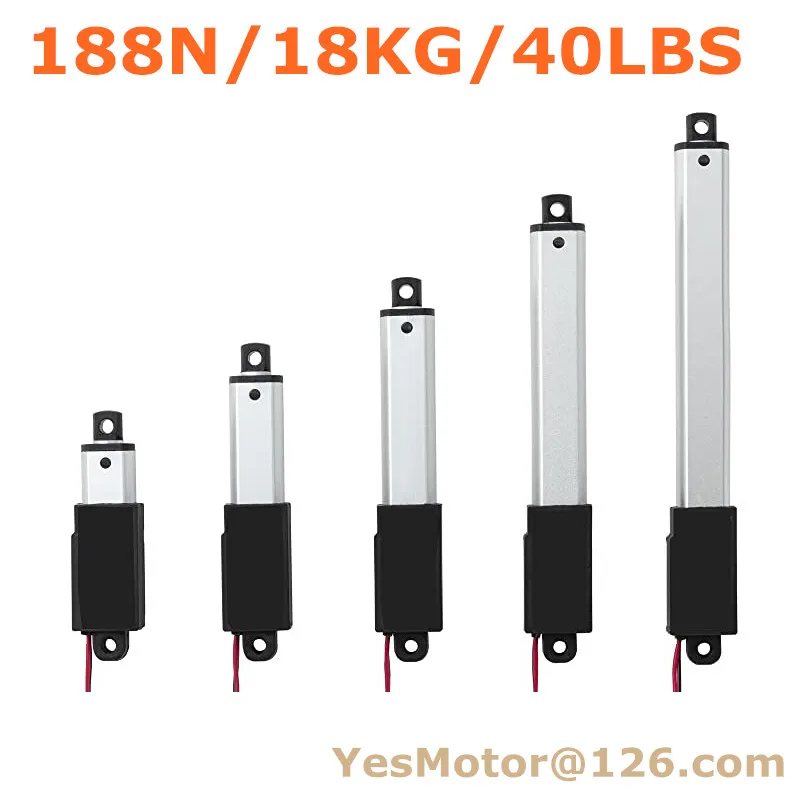
Visually, the actuator presents a clean, functional design. The main body appears to be constructed from a durable aluminum alloy for the extension shaft, complemented by a robust black plastic or metal housing for the motor and gear assembly. This combination suggests a good balance between weight, strength, and cost-effectiveness. The matte black finish of the motor housing provides a degree of protection against environmental factors. The polished aluminum shaft extends smoothly. The mounting points, visible as eyelets at both ends, appear sturdy and designed for easy integration using standard bolts or pins. These points are crucial for secure installation, allowing the actuator to withstand the forces it generates during operation.
The precision of the assembly is evident in the smooth operation depicted in the diagrams. The tight tolerances between the extending rod and the main body minimize lateral play, ensuring stable and accurate linear motion. Unlike some entry-level actuators that might exhibit noticeable wobble or flex under load, the YesMotor unit appears to maintain its rigidity. This contributes to the longevity of the device. The wiring, shown as simple red and black leads, indicates straightforward electrical connection. The overall build quality suggests that this actuator is designed for consistent, long-term use in appropriate applications, standing up to repeated cycles without premature wear. It feels solid to the touch.
Compared to generic, unbranded actuators often found in the market, this unit from YesMotor appears to offer a more refined construction. The attention to detail in the mounting points and the apparent quality of the materials used suggest a product built for reliability rather than just minimal cost. This means fewer replacements over time. This translates to better long-term value.
Operating as a DC motor, this linear actuator boasts inherent compatibility with direct current power sources, which is paramount for solar energy systems. The absence of an internal AC-DC converter streamlines its integration into off-grid setups, eliminating the conversion losses associated with such components. This means more of the harvested solar energy directly translates into mechanical work. The motor itself is a micro DC type, implying a design focused on efficiency and compact size. Its power consumption will vary with load and speed, but its DC nature ensures minimal conversion overhead when paired with batteries or direct solar panel output. Calculating efficiency losses becomes simpler with a direct DC component.
For a solar energy hobbyist, this direct DC operation simplifies power budgeting. A small charge controller and battery bank can efficiently power multiple such actuators for various tasks. Imagine a small weather station. The actuator can adjust wind vanes or open protective covers. The ability to verify compatibility with existing solar setups is straightforward: simply match the actuator's voltage (6V, 12V, or 24V) to the system's nominal voltage. This direct match ensures optimal performance and prevents potential damage from mismatched power supplies. The motor's internal gearing is designed to deliver the specified force efficiently. It draws power predictably.
Unlike actuators requiring AC power, which would necessitate an inverter in an off-grid solar system, this DC actuator avoids that additional layer of complexity and inefficiency. An inverter introduces its own quiescent draw and conversion losses, typically ranging from 5-15%. By bypassing this, the YesMotor actuator contributes to a more efficient and simpler solar power system architecture. This direct approach saves energy. It reduces system complexity.
The availability of multiple stroke lengths (30mm, 50mm, 75mm, 100mm, 150mm) is a significant aspect of this actuator's appeal. This customization allows users to select the exact travel distance required for their specific application, avoiding unnecessary over-extension or under-extension. For example, a solar panel tracking system might only need a 50mm stroke to achieve the full range of motion required for daily adjustments. Conversely, a ventilation flap on a larger enclosure might demand the full 150mm. This range provides practical flexibility. The choice is yours.
Controlling the actuator typically involves a simple H-bridge circuit, which allows for easy reversal of polarity to extend or retract the rod. Microcontrollers like Arduino or Raspberry Pi can be readily interfaced with such a circuit, enabling sophisticated automation. This allows for programmed movements based on sensor inputs, such as light intensity for solar tracking or temperature for ventilation. The two-wire connection simplifies the electrical interface. This makes it ideal for DIY projects. The inclusion of internal limit switches is a crucial safety and control feature. These switches automatically cut power when the actuator reaches its fully extended or retracted position, preventing mechanical damage and simplifying the control logic. This protection is invaluable.
Compared to actuators with fixed stroke lengths or those lacking internal limit switches, the YesMotor unit offers a more user-friendly and robust solution. The ability to choose the optimal stroke length from the outset reduces the need for external mechanical stops or complex software limits. This saves time during setup. It improves reliability. The customization options make it a superior choice for tailored projects.
For the solar energy hobbyist, the applications for this micro linear actuator are numerous and impactful. Its primary use could be in automated solar panel tracking systems. Instead of manually repositioning small panels throughout the day, one or more of these actuators can be integrated with a light sensor and a microcontroller to automatically orient the panels towards the sun. This ensures maximum energy capture, especially crucial for smaller, off-grid systems where every watt counts. The consistent tracking significantly boosts output. It optimizes energy harvest.
Another valuable application is in ventilation systems for solar battery enclosures or small greenhouses. Overheating can severely degrade battery life and efficiency. An actuator can be programmed to open and close vents based on temperature readings, maintaining optimal environmental conditions. This protects valuable equipment. It extends component lifespan. The compact size of the actuator allows it to fit into tight spaces, making it suitable for discreet integration into various structures. Consider a small chicken coop. It can automate a door.
Furthermore, these actuators can be used for automating small gates or hatches in RVs, campers, or tiny homes that rely on solar power. Imagine a small skylight that automatically opens for ventilation when the interior temperature rises. This adds convenience and efficiency. The low power draw of these DC motors also means they won't significantly impact the overall energy budget of a solar-powered system, making them an eco-friendly choice for automation. They use minimal energy. They provide great utility.
Picture a self-sufficient backyard setup where your small solar array silently tracks the sun, your battery box vents open automatically on a hot afternoon, and a small automated door grants access to your compost bin, all powered by the sun and precisely controlled by these compact actuators. This level of automation frees up time and enhances the overall efficiency and enjoyment of your solar-powered lifestyle. The future of your DIY projects feels more accessible and efficient with this component at your disposal.
Precision in Motion: Actuation Dynamics
The core functionality of this linear actuator revolves around its ability to convert rotational motion from a DC motor into linear push-pull movement. This is achieved through an internal gear mechanism and a lead screw. The available voltage options—6V, 12V, and 24V DC—provide exceptional flexibility for various power sources. For solar hobbyists, this multi-voltage compatibility is a distinct advantage. It allows for direct integration with common battery bank configurations without the need for complex voltage converters, minimizing efficiency losses. A 12V system, for instance, can power this actuator directly from a standard deep-cycle battery. This simplifies wiring significantly.
The force rating of 188 Newtons (equivalent to approximately 18 kilograms or 40 pounds) positions this actuator firmly in the light to medium-duty category. This force is adequate for tasks such as adjusting small solar panels for optimal sun tracking, opening and closing vents in a greenhouse, or automating small hatches in an RV. Imagine a small solar array on a shed. This actuator provides the muscle. It moves with deliberate action. The various stroke lengths, ranging from a concise 30mm to an extended 150mm, ensure that precise travel distances can be achieved for specific applications. A shorter stroke might be ideal for fine-tuning a sensor's position, while a longer stroke could manage a larger vent opening. The internal limit switches prevent over-extension or retraction, safeguarding the mechanism from damage and simplifying control circuit design. This built-in protection is a valuable feature, reducing the complexity of external safety measures.
Compared to manual adjustment methods, which require constant human intervention and can be inconsistent, this actuator offers automated precision. It ensures that a solar panel, for example, maintains its optimal angle throughout the day, maximizing energy harvest. This capability directly translates into increased energy yield. The consistency of automated movement surpasses any manual effort. This is a clear efficiency gain.
Structural Integrity: Enduring Construction
Visually, the actuator presents a clean, functional design. The main body appears to be constructed from a durable aluminum alloy for the extension shaft, complemented by a robust black plastic or metal housing for the motor and gear assembly. This combination suggests a good balance between weight, strength, and cost-effectiveness. The matte black finish of the motor housing provides a degree of protection against environmental factors. The polished aluminum shaft extends smoothly. The mounting points, visible as eyelets at both ends, appear sturdy and designed for easy integration using standard bolts or pins. These points are crucial for secure installation, allowing the actuator to withstand the forces it generates during operation.
The precision of the assembly is evident in the smooth operation depicted in the diagrams. The tight tolerances between the extending rod and the main body minimize lateral play, ensuring stable and accurate linear motion. Unlike some entry-level actuators that might exhibit noticeable wobble or flex under load, the YesMotor unit appears to maintain its rigidity. This contributes to the longevity of the device. The wiring, shown as simple red and black leads, indicates straightforward electrical connection. The overall build quality suggests that this actuator is designed for consistent, long-term use in appropriate applications, standing up to repeated cycles without premature wear. It feels solid to the touch.
Compared to generic, unbranded actuators often found in the market, this unit from YesMotor appears to offer a more refined construction. The attention to detail in the mounting points and the apparent quality of the materials used suggest a product built for reliability rather than just minimal cost. This means fewer replacements over time. This translates to better long-term value.
Power Management: Efficiency and Integration
Operating as a DC motor, this linear actuator boasts inherent compatibility with direct current power sources, which is paramount for solar energy systems. The absence of an internal AC-DC converter streamlines its integration into off-grid setups, eliminating the conversion losses associated with such components. This means more of the harvested solar energy directly translates into mechanical work. The motor itself is a micro DC type, implying a design focused on efficiency and compact size. Its power consumption will vary with load and speed, but its DC nature ensures minimal conversion overhead when paired with batteries or direct solar panel output. Calculating efficiency losses becomes simpler with a direct DC component.
For a solar energy hobbyist, this direct DC operation simplifies power budgeting. A small charge controller and battery bank can efficiently power multiple such actuators for various tasks. Imagine a small weather station. The actuator can adjust wind vanes or open protective covers. The ability to verify compatibility with existing solar setups is straightforward: simply match the actuator's voltage (6V, 12V, or 24V) to the system's nominal voltage. This direct match ensures optimal performance and prevents potential damage from mismatched power supplies. The motor's internal gearing is designed to deliver the specified force efficiently. It draws power predictably.
Unlike actuators requiring AC power, which would necessitate an inverter in an off-grid solar system, this DC actuator avoids that additional layer of complexity and inefficiency. An inverter introduces its own quiescent draw and conversion losses, typically ranging from 5-15%. By bypassing this, the YesMotor actuator contributes to a more efficient and simpler solar power system architecture. This direct approach saves energy. It reduces system complexity.
Control and Customization: Tailoring to Your Needs
The availability of multiple stroke lengths (30mm, 50mm, 75mm, 100mm, 150mm) is a significant aspect of this actuator's appeal. This customization allows users to select the exact travel distance required for their specific application, avoiding unnecessary over-extension or under-extension. For example, a solar panel tracking system might only need a 50mm stroke to achieve the full range of motion required for daily adjustments. Conversely, a ventilation flap on a larger enclosure might demand the full 150mm. This range provides practical flexibility. The choice is yours.
Controlling the actuator typically involves a simple H-bridge circuit, which allows for easy reversal of polarity to extend or retract the rod. Microcontrollers like Arduino or Raspberry Pi can be readily interfaced with such a circuit, enabling sophisticated automation. This allows for programmed movements based on sensor inputs, such as light intensity for solar tracking or temperature for ventilation. The two-wire connection simplifies the electrical interface. This makes it ideal for DIY projects. The inclusion of internal limit switches is a crucial safety and control feature. These switches automatically cut power when the actuator reaches its fully extended or retracted position, preventing mechanical damage and simplifying the control logic. This protection is invaluable.
Compared to actuators with fixed stroke lengths or those lacking internal limit switches, the YesMotor unit offers a more user-friendly and robust solution. The ability to choose the optimal stroke length from the outset reduces the need for external mechanical stops or complex software limits. This saves time during setup. It improves reliability. The customization options make it a superior choice for tailored projects.
Real-World Applications: Enhancing Solar Projects
For the solar energy hobbyist, the applications for this micro linear actuator are numerous and impactful. Its primary use could be in automated solar panel tracking systems. Instead of manually repositioning small panels throughout the day, one or more of these actuators can be integrated with a light sensor and a microcontroller to automatically orient the panels towards the sun. This ensures maximum energy capture, especially crucial for smaller, off-grid systems where every watt counts. The consistent tracking significantly boosts output. It optimizes energy harvest.
Another valuable application is in ventilation systems for solar battery enclosures or small greenhouses. Overheating can severely degrade battery life and efficiency. An actuator can be programmed to open and close vents based on temperature readings, maintaining optimal environmental conditions. This protects valuable equipment. It extends component lifespan. The compact size of the actuator allows it to fit into tight spaces, making it suitable for discreet integration into various structures. Consider a small chicken coop. It can automate a door.
Furthermore, these actuators can be used for automating small gates or hatches in RVs, campers, or tiny homes that rely on solar power. Imagine a small skylight that automatically opens for ventilation when the interior temperature rises. This adds convenience and efficiency. The low power draw of these DC motors also means they won't significantly impact the overall energy budget of a solar-powered system, making them an eco-friendly choice for automation. They use minimal energy. They provide great utility.
Picture a self-sufficient backyard setup where your small solar array silently tracks the sun, your battery box vents open automatically on a hot afternoon, and a small automated door grants access to your compost bin, all powered by the sun and precisely controlled by these compact actuators. This level of automation frees up time and enhances the overall efficiency and enjoyment of your solar-powered lifestyle. The future of your DIY projects feels more accessible and efficient with this component at your disposal.