Y&H MPPT Solar Charge Controller with LCD and Dual USB
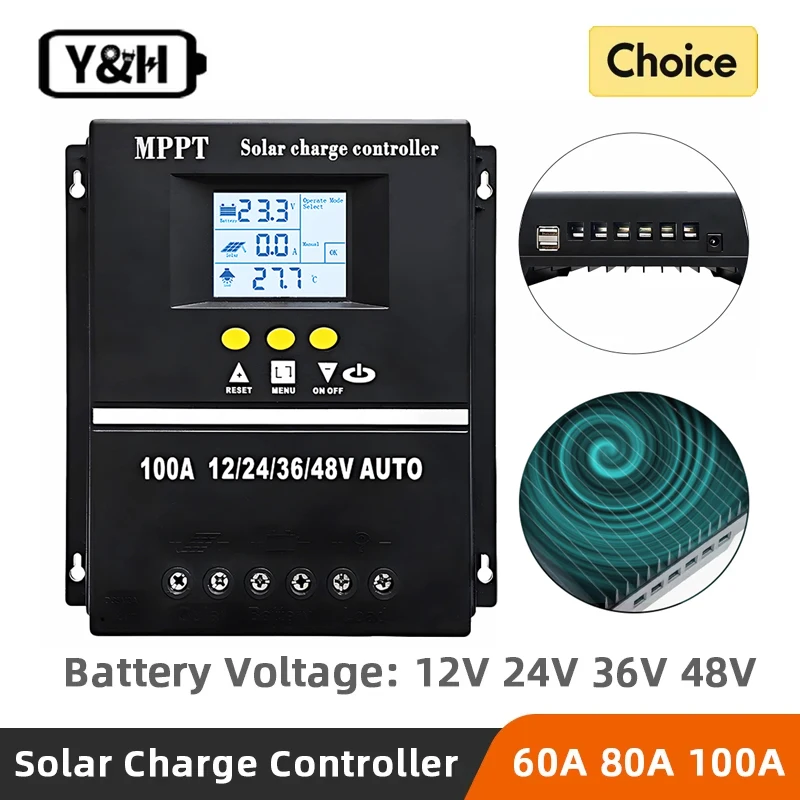
Official Store Deal
Expert Analysis Overview
Precision Power Management for Off-Grid Systems
The Y&H MPPT Solar Charge Controller is a critical component for optimizing photovoltaic energy harvesting, specifically engineered for users establishing or upgrading off-grid power systems. This device, available in 60A, 80A, and 100A configurations, is designed to efficiently manage power flow from solar panels to various battery chemistries, including lead-acid and lithium types. Its core function is to maximize power extraction from solar arrays, ensuring stable and effective battery charging across a wide range of system voltages.
Advanced MPPT Technology
The Maximum Power Point Tracking (MPPT) algorithm is the cornerstone of this controller's performance. It continuously adjusts the operating point of the solar array to extract the maximum available power, regardless of environmental conditions like temperature or irradiance. This is crucial for system efficiency.
Visible specifications indicate a 98% tracking efficiency and 99% conversion efficiency. These figures suggest that the controller is highly effective at minimizing energy losses during the power conversion process. Such high efficiency directly translates to more usable power delivered to the battery bank, optimizing the return on investment for solar panel installations.
Compared to older Pulse Width Modulation (PWM) controllers, MPPT technology offers a significant advantage, especially in colder climates or when panel voltage substantially exceeds battery voltage. PWM controllers simply chop the panel voltage to match the battery, wasting potential power. This MPPT unit, conversely, actively transforms higher voltage, lower current panel output into lower voltage, higher current battery charging, making every watt count.
Robust Voltage Compatibility and Battery Management
This controller offers broad compatibility, supporting 12V, 24V, 36V, and 48V battery systems with automatic voltage detection. This adaptability simplifies system design and allows for future expansion or modification without requiring a new charge controller. It's a flexible solution.
The unit is explicitly designed for use with SLD GEL, Flooded, and Lithium batteries. This multi-chemistry support is a significant benefit, as different battery types have distinct charging requirements. The controller incorporates a four-stage charging algorithm: Bulk, Boost, Float, and Equalization. This comprehensive approach ensures batteries are charged optimally, preventing overcharging and extending their service life. Proper charging is vital.
Many generic controllers often lack specific profiles for lithium batteries, which can lead to premature degradation or safety issues. The Y&H controller's explicit support for lithium chemistries, alongside traditional lead-acid types, positions it as a more versatile and safer option for modern energy storage solutions. This broad compatibility reduces the risk of battery damage.
Intuitive User Interface and Operational Modes
A prominent LCD display provides real-time operational data, including battery work status, solar panel operating status, load output status, and mode control information. This visual feedback is essential for monitoring system health and performance. Users can quickly assess critical parameters.
The controller offers several load working modes: Manual Mode (24H), Solar Light Control Mode (Sunset on, Sunrise off), and Solar Light Time Control. These modes provide flexibility for managing connected DC loads, allowing users to automate lighting or other devices based on daylight conditions or specific time schedules. Automation enhances convenience.
Unlike basic charge controllers that offer minimal feedback, this unit's detailed display and multiple load control options empower users with greater control and insight into their solar power system. The ability to configure load behavior directly from the controller simplifies system management, eliminating the need for external timers or relays for basic automation tasks.
Connectivity and Safety Features
The inclusion of dual USB output ports is a practical addition, allowing for direct charging of small electronic devices like smartphones or tablets. This feature can be particularly useful in off-grid cabins or remote installations where AC power might not be readily available. Direct charging is convenient.
From an electrical safety perspective, the visible screw terminals for solar input, battery, and load output appear robust. Proper wire termination is paramount for preventing resistive losses and potential fire hazards. The unit's design, with what appears to be a heat sink on the side, suggests attention to thermal management, which is critical for high-amperage devices. Effective heat dissipation prolongs component life.
Many budget controllers often cut corners on terminal quality or thermal design, leading to unreliable connections and overheating under load. The Y&H controller's apparent build quality, as indicated by the visible components and design elements, suggests a more reliable and safer operation compared to entry-level alternatives. Always verify wire gauges.
Performance Metrics and System Sizing
The product images highlight impressive efficiency figures: 98% tracking efficiency and 99% conversion efficiency. These metrics are crucial for maximizing the energy yield from a solar array. Higher efficiency means more power is converted into usable electricity for charging batteries and powering loads. Every percentage point matters.
For system sizing, the controller supports various maximum PV input power levels depending on the battery voltage and amperage rating. For instance, a 60A controller operating on a 48V system can handle up to 2880W of PV input power. This capacity allows for substantial solar array configurations, suitable for medium to large off-grid applications. Proper sizing prevents overload.
Understanding these power ratings is essential for electricians and system designers. Undersizing the charge controller can lead to power clipping, where the controller cannot process all the power generated by the solar panels, effectively wasting energy. Conversely, oversizing provides headroom for future expansion. This controller offers a good range for various applications.
Installation and Maintenance Considerations
Installation involves connecting the solar panels, battery bank, and DC loads to the clearly labeled terminals. Adhering to proper wiring practices, including using appropriate wire gauges and ensuring secure connections, is non-negotiable for safety and performance. Always consult local electrical codes.
The wall-mountable design facilitates a neat and secure installation. Regular inspection of connections for tightness and signs of corrosion is recommended as part of routine maintenance. The LCD display aids in quick diagnostic checks, allowing users to identify potential issues before they escalate. Proactive maintenance extends system longevity.
Compared to units requiring complex programming interfaces, the Y&H controller's intuitive display and button controls simplify initial setup and ongoing adjustments. This user-friendly approach reduces the learning curve for new users while still offering advanced functionality. Simplicity is key for adoption.
The Long-Term Value Proposition
Investing in a high-efficiency MPPT charge controller like the Y&H model offers significant long-term value. The superior power harvesting capabilities mean that a smaller solar array can potentially achieve the same charging performance as a larger array paired with a less efficient controller. This translates to cost savings on solar panels. Efficiency saves money.
The robust battery management features, including multi-stage charging and multi-chemistry support, contribute to extending battery lifespan. Batteries represent a significant investment in any off-grid system, and proper charging is critical to maximizing their operational years. This controller protects that investment.
Consider the cumulative savings over the lifespan of a solar power system. The initial cost of a quality MPPT controller is quickly offset by increased energy yield and reduced battery replacement frequency. This unit provides a reliable foundation for sustainable off-grid power, ensuring consistent performance and peace of mind for years to come.
Imagine a self-sufficient power system operating with peak efficiency, where every ray of sunlight is meticulously converted into usable energy. Picture the convenience of monitoring your power flow with a glance, knowing your batteries are optimally charged and your essential devices are powered reliably. Envision the freedom from grid dependency, supported by a charge controller engineered for consistent, high-performance energy management, providing a dependable backbone for your independent power needs.